Showing posts with label british tv. Show all posts

Wednesday, 11 November 2020

Mock The Week

I’ve just done a quick check, and I don’t think we’ve done a panel show before.  Unless you count University Challenge as a panel show, and you shouldn’t, because it’s not one.  It’s actually a quiz.  It differs from panel shows because people are actually trying to give the right answers to difficult questions.  Though panel shows are also quizzes of sorts, it’s more important to give a hilarious answer instead of a correct one.  And the questions are easier.

The reason I’ve not talked about one here before, though, is because I don’t really watch them.  Like chat shows, they seem to be a bit of a waste of time.  Chat shows are just people plugging their new book with rehearsed anecdotes while a former comedian swoons over them – I can get this sort of content from podcasts without having to use my eyeballs.  In my millennial office life (and by office, I mean working from home) nobody ever makes an appointment to view a panel show.  Lots of them are broadcast on Friday nights when we’re all at after-work drinks (not me), and now we’re not allowed to do that anymore, we’re too deep in season two of The Boys (no thanks) or the end of Schitt’s Creek (already completed it) to tune in.  In short, panel shows aren’t the kind of boxsets you can show off to your friends with.

When I still lived at home, Have I Got News For You was a firm family favourite.  Little did we know we were choosing our future PM based on who was the most discombobulated panellist (well, I didn’t vote for him, but it was f***ing one of yas – dezguztan!).  My parents still relish how the show’s humour makes a farce of British politics, but for me the subject matter is already too much of a farce to be funny anymore.  I once spent a whole train journey to Cornwall for work (shout out Eden Project) watching Never Mind The Buzzcocks on my phone and laughing so loudly that fellow passengers worried for my sanity.  But will we ever get Simon Amstell back?  I may save this for a future edition, as is my plan with Celebrity Juice, so we’ll try and focus on the show in hand.

The reason I’m picking Mock The Week is that I’ve come to admit begrudgingly it’s actually rather good.  Of an evening, around 10pm, as I disconnect the telly from Netflix or Amazon Prime or Sky Boxsets, I’m hit with a brief glimpse into live terrestrial telly.  The channel is never set to BBC1 or ITV, as my life is too worth living ever to sit through either station’s ten o’clock news – I am not going to bed angry.  Invariably, it’s BBC2, which means, on a certain night of the week I have thus far not ascertained, Mock The Week is in full swing.  Whether it’s a repeat, or a more recent edition with fun-ruining plastic dividers and social distancing, I will typically lose between ten and twenty minutes of delicious sleep because I’ve become distracted by the hilarity on screen.  But it’s worth it.

The idea is to laugh at things that have happened in the last seven days.  That’s where the name comes from.  Mocking the week.  Got it?  Good.  And we all know we could do with a laugh these days.  Given my fractional viewing, I’m not too sure of the rest of the format.  Dara Ó Briain ably chairs proceedings, a characterful man who combines erudition with, my personal favourite, plenty of silliness.  He once called me a c**t at a live show in response to my answer to his question regarding what job I do.  So I consider him a close personal friend.

The two teams of three that make up the rest of the panel are a revolving retinue of comedians, all taking part willingly in the weekly mockery.  More recent episodes have seen a great big shift upwards in the diversity of backgrounds here and if this doesn’t excite you then please stop reading now.  I’m up for banning white men from all TV and politics for the next five years (especially me) and seeing how we get on.  What’s the worst that can happen?  Sadly, this would cost me some of my favourites: Ed Gamble and his dry delivery, James Acaster and his perpetual face of confusion (let’s all agree to watch his Netflix specials please) and Tom Allen, taking a break from slagging off cakes but in a charming way on Bake Off: Extra Slice.

Sometimes our panellists sit around, sometimes there’s a microphone on a stand that they have to dash towards from little raised platforms and it’s fun wondering if they’ll bump into each other.  Sometimes you wonder how people can be so quick-witted, sometimes you wonder if they’ve had time to prepare their best lines.  Either way, there are plenty of chuckles to go round for everyone and, of course, nobody cares who actually wins.  I couldn’t even tell you if scores are kept – that’s just how little research I do for these posts.  And so, Mock The Week, let us salute you as a pandemic hero – you’re making me want to watch you in spite of myself.

Monday, 21 September 2020

W1A

This week, nobody has been asking me the following question: what other hidden gems in the world of comedy have you uncovered since you wrote so passionately about Crashing?  Nevertheless, I do need to tell you that I have gone and done it again.  I’ve come across a show whose existence I was completely oblivious to and now I’m going to harp on about it like I invented it myself.  It was probably huge at the time and is therefore already beloved by millions, but this is my blog and I can do whatever I like.  Something else people never ask me is how I decide which shows to feature in my self-indulging prose.  Well, there is no method to this madness.  I do have a longlist of shows I ought to get around to and this week’s programme was in fact on there – something I didn’t even realise until I had finished the third and (hopefully not) final season.  Anyway, preamble aside, we’re doing W1A this week.

Now, regular readers will be aware of my increasing despair when it comes to how awful we British our proving ourselves to be.  The dangerous yearning to return to a post-war peak from 75 years ago threatens everyone’s present-day opportunities.  Nevertheless, alongside the sinister jingoistic gymnastics, there are British traits that, conversely, feel as comforting and familiar as saying sorry to a stranger who’s bumped into you.  One of these is always suspecting we will make a mess of things.  Our trains can’t run in the snow, our trains can’t run in the heat, our breweries have hosted poorly organised piss-ups.  Back when we won the 2012 Olympics, everyone rolled their eyes in anticipation of ensuing shambles (when it was actually a recent national peak, inequality riots aside, and I’m not just talking about me dancing in the closing ceremony…).  So little faith did London’s wonderful liberal elite have in the organising committee than an irreverent sitcom was conceived: Twenty Twelve played on our suspicions surrounding how petty office bureaucrats would arrange and execute so much sport.  Sadly, I never saw this show and can’t find it anywhere, but W1A is its successor, following on with the adventures of Ian Fletcher (that lovely Hugh Bonneville off that lovely Downton Abbey) as he takes up a new post at the BBC.

Aha, you say, another institution we can deride for being a bunch of silly sausages.  How dare they make pensioners pay for their licenses when they of course deserve everything for free?  How dare there allow two women to dance together on Strictly?  How dare they pay female staff less than men?  (Guess which of these three is my actual opinion).  But, this is a BBC production, brilliantly sending up itself and our perceptions of the pencil-pushers who make it tick.  Fletcher serves as our guide in this institutionalised institution, stumbling through Old and New Broadcasting House trying to make sense of how things are done as the new Head of Values while slowly coming to accept that everyone is either incompetent at what they do, or they don’t do anything at all.  It’s at this point I must stress that the whole thing is laugh-out-loud funny.  I giggled my socks off in every single episode, so let’s count down which comedy creations scored the most LOLs on my chuckle-o-meter:

One: David Wilkes, played by Rufus Jones

As a development exec responsible for evolving potential show formats into ratings winners, Wilkes channels a new level of incompetency.  In any meeting, he expertly absolves himself of blame for every action and inaction of his.  He’s there, behind the fridge door, ready to steal your idea and take all the credit.  He interrupts discussions to tell everyone he can’t believe it and prefixes the name of anyone they are talking about with the adjective lovely: “Lovely Izzy, lovely Lucy.”  He’s frequently told to shut up and this generates in me the purest of joy.

Two: Siobhan Sharp, played by Jessica Hynes (seen in The Royle Family)

Another overspill from Twenty Twelve, Sharp is the PR guru who is incapable of listening to anyone but herself.  She is soundbites, mixed metaphors and statement jewellery, the very definition of having nothing original or useful to say.  Her response to every crisis is to blow things up on Twitter.  Her voice is supremely smug and she’ll announce that she’s “good with that” despite nobody requiring her approval.  I get the sense that whoever created her had some axe to grind after spending one too many meetings with members of the PR industry.  I can’t think why.

Three: Will Humphries, played by Hugh Skinner (seen in Fleabag)

“Yeah, no, hi, ok cool.”  Like everyone else, Will rarely says what he means, but he doesn’t know what he means anyway so it doesn’t matter.  He’s the awkward intern who’s overstayed his internship, but Skinner’s facial expressions show the perfect perplexity as Will screws up the simplest of tasks.

Four: Anna Rampton, played by Sarah Parish

As Head of Output, Rampton’s inability to move her top lip marks her out as a serious woman in business.  By repeating “yes, exactly, yes” she falsely portrays an air of decisive action while never doing anything.  Her catchphrase wears out slightly in later series, but she is at her funniest early on refusing every requested refreshment that is brought to her: “No, I don’t want that.”

Five: Simon Harwood, played by Jason Watkins

Harwood is that colleague we all sadly have.  The saboteur who wanted your role.  Non-committal, but always prepare to play his hand as a self-claimed confidante of the Director General (with whom he might enjoy the odd morning muffin), Harwood’s passive-aggression can be seen from space.  He’s constantly telling people he has no idea how things work (because they should) and that they will know how they want to play things (because he’s sure as hell not helping), before emitting one of his frequent exclamations of “brilliant” no matter what’s been decided.

I could go on.  There’s the for-once palatable David Tennant narrating, inserting the odd word to render all action ridiculous (particularly the Ministry for Culture, Media and, also, Sport).  You’ve got Tracy Pritchard beginning every criticism with “I’m not being funny but…”  Ben and/or Jerry bring a surreal element to the incredible pacing of every Damage Limitation meeting.  Layer upon layer of farce is dolloped out in rich scoops, crescendoing into ill-fated launches.  But it’s almost too close to home.  Some of the meetings feel like they were taken directly out of my life.  The curious inability of each and every character to communicate clearly makes wondrous use of two of the English language’s most abused words: yes and no.  Never seen alone or with certainty, W1A is strewn with oodles of “yes no” and lashings of “no yes” and then further fleshed out with generous portions of “yes no yes” and “no yes no.”  Playing out in a corner of London where I’ve worked for the last ten years, I look for myself in the background of scenes were Fletchers cycles into the office on his terrible Brompton (which bikes’ super-naffness is played for miles as laughs).  I’ve even been in the offices of Siobhan Sharp’s Fun Media on many occasions.

Get on the sofa and consume this immediately.  And then tell me if I was right or wrong about its brilliance.  Fair play to the Beeb for being such a good sport, lampooning itself for comedy (though never mentioning its news coverage’s right-wing leanings).  It’s not perfect – some exasperation at increasing wokeness has dated slightly.  Characters start to repeat their catchphrases too much and the freshness of the surprise wears off.  There’s an inevitable love triangle involving Ian Fletcher that doesn’t ring true, while the relationship between Izzy and Will remains effortlessly more charming.  We might not be able to organise a Brexit (so let’s stay) or a pandemic, but we sure can organise a silly sitcom about people who can’t organise things.

Tuesday, 10 December 2019

Gogglebox


It’s time to acknowledge something that’s been painfully clear in all of these posts: I’m pretty sure I’m addicted to TV.  Things came to a head in these last few weeks of I’m A Celebrity.  Until the Sky man comes next weekend (so that I have ITV2 HD in time for Love Island – always set and achieve your life goals), I’m in a household without any decent way of recording off my massive OLED telly.  Unable to stomach a nightly hour-long show complete with adverts (especially at Christmas, the most odious time of the year) I decided to watch the show catching up a day behind on ITV Hub.  However, this VoD service has the picture quality of peering through a steamed shower panel, the ads are all still there but at higher frequency and it loses your programme coming out of each break with a cheeky Whoops! message that infuriates more than it sympathises.  Realising it would only be a matter of time before my remote was smashed through my LG 55” screen, I reluctantly switched back to live viewing.  Suddenly, we were back in HD, and I could tell which one was Ant and which one was Dec again.  The dreaded ad breaks became three-minute chunks during which I would find other things to do, banal things like wash up, clean the kitchen, Whatsapp pals or stare into space – each preferable to watching supermarkets argue about who can provide the most magical Christmas.  The bigger drawback, though, was that I became a slave to the appointment to view.


Every evening was a countdown to 9pm, lest I miss the opening link.  Before the I’m A Celeb final, the nightly show was running longer till 10.30, cutting thirty minutes into my sacred bedtime and making the 5.30am alarm the next morning for Crossfit all the more devastating.  It was hell.  I’m relieved it’s over, despite loving the show.  My point is, keeping up with my favourites and devouring new boxsets in order to keep this blog interesting is starting to dominate my evening life.  I’m ending up watching hours each night, normally too exhausted from the early morning and full day of work to do anything productive (first-world problem – it warrants no sympathy).  Once my bum hits the sofa, that’s it.  I’m supposed to be furnishing a new flat, but now that the TV den part of the living room is up and running, I’ve a bad feeling we’re going to be stalled here for some time before there’s any further progress.  I have become a couch potato.  I have become my father.


It’s only fitting, then, that this week I should take a look at another set of people who while away their time on this fascinating planet sedentary on DFS furniture staring at a telly screen (though my sofa is from Heal’s everybody).  So, let’s do Gogglebox.  But, before we go any further, I should confess that this is a programme I don’t watch.  Don’t worry, though, that’s never stopped me throwing in my two pennies’ worth before (see posts on The Apprentice and Keeping Up With The Kardashians).  I’ve channel-surfed on enough Friday evenings to catch sufficient chunks of it to have the measure of the format and its cast.  Please read on while I oscillate wildly between tearing it asunder and extolling its charm.


And I do have some bones to pick with Gogglebox.  For the unaware, it’s a TV programme about people watching TV programmes.  It’s a real-life The Royle Family.  Up and down Britain, we mutually view selected televisual highlights with a cast of actual non-famous normos.  That’s right – we watch people watch telly.  Despite all of the above making it clear I’m wasting my life away, this format is the very definition to me of wasted time, and it’s for this reason I never make any effort to watch it.  Additionally, it shows you all the must-see moments of the week just gone which I rightly suspect would have the effect of making me want to watch even more TV.  This would benefit no-one.  But what I didn’t realise about the filming process was that the cast of Gogglebox know what they’re going to watch – they have scheduled filming sessions.  The production team pick the shows, put them on and then sit down to shoot the reactions.  When I realised this, I was very disappointed.  I thought we had more of a Big Brother vibe: families sign up to a camera being in the living room, go about their viewing lives as normal, and then the best bits are picked up and edited together.  This, I always felt, would be a fairer reflection of what we really watch and how we really react.  It’s excessive and impractical, but that’s just where my imagination goes to first.


Linked to this first fallacy and the fact that the participants know they are being filmed we have the following consequence: their responses aren’t that natural.  It’s an artificial set up.  I therefore can’t escape the feeling they’re all showing off.  Don’t get me wrong, I love showing off.  I do it constantly and enjoy it in others if they are entertaining me.  But Gogglebox acts like it’s a sneak peek behind closed doors to a more humdrum evening, with interstitial shots of household façades leading to cosy living-room set-ups, allowing we privileged few to glimpse real truth from unaware subjects.  But no, it’s just regional accents trying to think of the funniest thing to say about that week’s news or the John Lewis advert.  And it’s at that point I stop caring.


Everyone talks about their favourite Goggleboxers, but I don’t really know who’s who beyond those that have appeared in other reality shows (looking at you, Celebrity Big Brother).  What I do love is the diversity.  We have all points of the UK compass covered here: a wide array of family structures, lifestyle choices, ethnic backgrounds, cultural values, political persuasions, incomes, faiths, genders, ages, sexualities etc – basically every flavour of Brit you can shove out of the way on a crowded train.  What unites them all is a need to redecorate their living rooms.  It’s a bit like Come Dine With Me when you see that someone’s kitchen is a bit natty in comparison to all the show kitchens you see on cookery shows.  That said, given how many of them have hundreds of dogs sprawled across their soft furnishings, rubbing their worms into the fabric and wafting their canine farts over the cushions, there’d be no point updating any of the interiors.  You can sometimes smell the dog breath through the screen.  But it doesn’t matter what I think: what’s touching is the genuine love and affection these family members and friends have for each other.  That, at least, is always reassuringly genuine, if sprinkled with dog hair.


So, who on earth do I think I am talking disparagingly about Gogglebox simply because the people on it watch TV and do showing off?  This whole blog is based around the exact same concept: I watch too much TV and then show off about it, desperately seeking attention for my musings, awaiting offers of global syndication and secretly beaming when friends compliment my writing in real life.  The difference, sadly for me, is that Gogglebox still has millions of viewers, whereas I’m only getting tens of thousands of reads here…

Sunday, 24 November 2019

Green Wing


This week, I’m returning to work after two weeks on holiday.  While being on vacation is moderately preferable to sitting in an office, I’m counting my blessings that I’m not going down some terrible coal mine or making thousands of flat whites as a barista.  Sitting and typing emails isn’t really that taxing, so I’ve no need to dread my return to corporate life.  But I’m sparing a thought for my friends that have trained in medicine.  I’ve heard many of their tales of junior doctor shifts, seen them uprooted across the country with each rotation and laughed and cried while reading Adam Kay’s This Is Going To Hurt.  Now the NHS is being smashed and grabbed over as befits the run-up to any British election.  On holiday in the US, my hotel TVs (in between impeachment proceedings) were filled with vile ads for various niche drugs and their side effects.  Which has all got me thinking about hospitals.  But, as we can’t take anything seriously here, we’re hitting up a fantastic comedy whose two seasons (starting back in 2004) have always made me smile: Green Wing.


I had planned to go through each of the main characters, but Wikipedia lists 13 of these, plus some key recurring roles, and I’m running out of time before Seven Worlds, One Planet.  So, instead, I’m going to pick out my favourites from the madcap population that staffs East Hampton Hospital.

Harriet Schulenberg

Played by Olivia Colman (who’s now sporting the crown in The, er, Crown) Harriet is a bastion of the HR department whose every day of attendance is a miracle in spite of her four kids and unhappy marriage, to say nothing of her actual performance when finally seated at her desk.  Colman perfectly captures the chaos that can ensue when lots of small, dirty children are involved: cardigans constantly slipping off, school projects being crafted while ferrying offspring around extra-curriculars.  I never cease to be impressed by the parents in my office who, after each day, raise little people in their homes while I just lie on the sofa, only to be kept up by these same precious mites when they have the sniffles or start vomiting.  Yet they often manage to come in the next day fully composed.  Harriet is so cleverly observed and amplified that she has a universal quality in reflecting the edge of madness where working parents exist.  It’s not all bad though: you can leave the office at any time just by saying you have to pick your kids up.  I often pop off, claiming to be fetching children from somewhere, and nobody is allowed to question me.  But, secretly, I don’t have any offspring.


Sue White

East Hampton’s staff liaison officer demonstrates demonic behaviour in every scene, whether alone in her office up to no good, or torturing the staff whose concerns she is meant to soothe.  This was another occasion when I fell in love with Michelle Gomez (last seen in Chilling Adventures Of Sabrina) who clearly enjoys the madcap glint in her eye she is able to maintain throughout.  Of note is her ability to prevent all protest at her treatment of others, relying on British politeness and surprise at ill-behaviour in a way that’s similar to my hero, Jill Tyrell, in Nighty Night.


Guy Secretan

Stephen Mangan now performs 99% of all TV advert voiceover work, but his performance of the supercilious anaesthesiologist, always second fiddle to the much cooler Mac, made him a household favourite.  Every workplace needs a gaffman, and Dr Guy Secretan’s belief in his own half-Swiss importance can outgaff the gaffiest of them.


Caroline Todd

The newcomer through whom we navigate the sketch-show-esque world of East Hampton, Caroline is our everyman at an asylum full of medical professionals.  While she’s as neurotic as the rest of us, her foibles pale in comparison to those around her.  You can’t help but love Tamsin Greig throughout, even when she is having a strong adverse reaction to Angela Hunter.  There’s a GIF of Caroline typing wildly that I still use in work presentations most weeks, so she’s a gift (a GIF-t – get it?) that keeps on giving.

Angela Hunter

Sarah Alexander again nearly flies under the radar here (a perennially underappreciated national treasure of comedy acting), but this character is always one of the most enjoyable.  Excessively cheery and seemingly perfect, her colleagues’ response to her is always reassuring, including Caroline Todd’s irrational dislike.


Joanna Clore

I could go through the whole of the HR department here, but my final mention is for its head, played by Pippa Haywood.  A woman of a certain age, she doesn’t care what others might make of her brusque attitude and major mood swings.  You can’t beat an angry senior woman at work.  Senior men rightly cower from them leaving everyone else the chance to get on with stuff.


There are too many more to mention.  Even the deliciously named Martin Dear hasn’t made my list (despite his name encapsulating everything about his character perfectly).  I’ll stop once to mention Alan Statham though.  I have to confess that he was my least favourite and I never looked forward to his scenes coming around.  He is just so snivelling and conniving that my skin crawls every time I even think of him.  But one out of 13 ain’t bad, especially as there’s a great deal else to love about this sketch show-cum-sitcom-cum-comedy drama-cum-hospital show.  And that’s a lot of cums in this genre-splicing format.  Green Wing will forever remain welcome in our homes – we just need a political party to pledge in their manifesto that they are committed to bringing it back (and not shafting the actual NHS).


Thursday, 7 November 2019

Misfits


I’ve never really bought superheroes.  People wang on about the latest addition to the interminable Marvel Character Universe and I seem to zone out immediately.  What we can bear to watch comes down to what we can buy as a reality in which a story can play out.  My own mother can’t abide anything supernatural as it’s simply not realistic enough.  As a result, she cheerfully refuses to engage with the entire wizarding world of Harry Potter.  Sometimes I can’t work out why I’ll buy the things I’ll buy and reject the others.  Zombies?  Count me in no matter what (The Walking Dead and Kingdom).  Vampires?  Excuse me while I reminisce about loving True Blood.  I even sat through every season of Lost, long after I’d lost all hope of ever working out what I was actually buying.  But, typically, I’ll reject anything to do with costumed heroes.  So why, then, am I covering Misfits this week?


Well the truth is that I am behind with my boxset consumption and haven’t polished off anything new in a while.  But my viewing experience’s loss is your blog-reading pleasure’s gain, as I know we all love to trawl the archives.  I’ve cast my mind back to a show that did in fact deal with the real-life consequences of developing superpowers: Misfits.  The premise was not only a great excuse for orange jumpsuits, but also a sure-fire way to ponder the age-old question of just how much great power comes with which sort of great responsibility.  The premise was thus: some pesky youths on community service get caught up in a mysterious storm.  Superhuman new abilities ensue, with our drama served up by two sources: our characters coming to terms with their new faculties and the same characters coming across other individuals who enhanced their natural gifts in the storm’s rage.


Whenever I think what power I would have if I were a superhero, I always arrive at the conclusion that I can’t be improved.  I’ve occasionally thought it would be nice to be a bit taller, but I don’t think Slightly Taller Man would be a welcome addition to the Avengers when they’re next doing some of their assembling.  But don’t worry, the kids in Misfits got a good helping of powers each.  My favourite, regardless of power, was Kelly played by Lauren Socha.  At one point she was all over TV and I can’t fathom why this hasn’t continued.  Her voice had a quality to me that was pure entertainment and I just wanted her to say every line.  I’d have taken Misfits as a one-woman show if I’m honest.  Nathan Stewart-Jarrett (Curtis) appeared in a few things afterward, based on the strong vest-wearing he did in the show.  He once came to a party I was forced to attend as part of a work campaign (Primal Scream were playing but I just wanted to go home as I had no idea who they were) and I saw him in our VIP area.  “Yeah,” I thought, “there’s that man off the telly.”  Robert Sheehan provided impish charm with a hearty overegging of every scene as the very annoying Nathan.  He later appeared in Fortitude, which remains my least read blog (so click on it), and showed quite a different side to himself (and his private parts).  On the whole, though, everyone did a fantastic job in their parts.  Well done.  But some of those jobs got so over the top that I didn’t stick with things all the way to 2013’s fifth series.  It was the arrival of Rudy, played by Joseph Gilgun, in season three that started to wear me out.  I don’t like it when actors’ enjoyment of their own performances visibly outweighs the believability of their own performance.  You don’t see me at my office desk having a great time.


What made things really work was the gritty British urban setting of the whole thing.  Concrete wasteland is somehow a very plausible place for some inclement weather to dish out superhuman abilities.  But the greatest element of its own realism came from Misfits’ use of irreverent humour.  Sure coping with time-rewinding power and telepathy was deep stuff, but it also led to some LOLs.  This is why traditional hero fare always loses me.  At some point, our protagonist dons some sort of skin-tight outfit and begins posturing about the place as if we can take them seriously now they’ve got a uniform and a generic moniker that indicates their power.  I always think of Bananaman.  And I always hated him for being patronising.  The Misfits’ powers were buyable - probably just manifestations of the things we have about ourselves that make us think we are different to everyone.  I’ll confess here to my own hero creation: Bubble Boy.  Don’t worry; I didn’t think of the name.  My niece came up with that.  As an adult, imagination play is incredibly embarrassing.  I can spend hours building LEGO or playing board games with my sister’s daughter, but anything involving pretending goes beyond my comfort zone.  I was obliged to spend half the summer in the garden with her enacting superhero battles.  She was something to do with a ladybird.  Each battle starts with your pose.  It can be holding aloft a weapon or assuming some sort of proactive position.  Bubble Boy, whose name isn’t actually linked to any of my own digestive problems, draws a bubble with his hands.  Because, yes, he has the awesome power of bubbles.  Be afraid.  Don’t worry, I don’t proceed to assault a ten-year-old girl, as we are normally too busy laughing at our own posing to unleash any real violence.  Which just goes to show we British can’t take anything seriously.  I mean, just look at Brexit.


But if you want silly camp costumes, then Strictly Come Dancing is on every year.  Otherwise, dig out the old Misfits boxset for a masterclass in good British telly.  Nobody stands on a rooftop in Lycra with their hands on their hips.  They scowl while wearing dirty jumpsuits, before making some sort of quip about the whole situation.  The next time you see some disaffected youths, don’t forget that they might just have some superpowers you just don’t know about.


Sunday, 13 October 2019

The Apprentice


For the landmark 117th post of Just One More Episode, I’ll be returning not only to the recently talked-about topic of programmes I don’t watch (like Naked Attraction) but also to the rarely covered theme of programmes I actively hate (Altered Carbon).  While this blog has mostly remained a safe space of positivity about all the different boxsets out there (with a healthy dose of my own self-obsession), this week we are turning our smarmy observations and cutting critiques to the absolute pile of dross that is The Apprentice.  A fifteenth series has slipped onto air this month to a collective shrug of indifference and I’m happy to say I feel no need whatsoever to catch a single episode.  Part of this is now down to the fact I’ve reached the stage of flat ownership where I can have friends round for dinner (especially ones that invite themselves), so I’m too busy serving up Viennetta as a feasible dessert option to tune into this BBC flagship production.  So, eighties ice cream products aside, let’s go through the reasons why The Apprentice should be stricken from the TV guide.  And just to recap quickly the premise for anyone who’s never grasped it, this show is, in short, competitive job interviewing.  Yes, really.


It’s reality TV but pretends not to be

During the first few series from 2005 onwards, this programme’s biggest crime (against my personal view of what’s wrong and what’s right) was to provide a route to reality TV for viewing snobs that claimed not to be able to tolerate the genre.  Big Brother!” they would cry, “I can’t be watching that bunch of wannabes desperate to be famous.  But have you seen The Apprentice?”  I would sneer at them, pointing out they should just own the pleasure they take in consuming trash TV.  If you never miss an episode of Keeping Up With The Kardashians or Love Island then you might as well own that behaviour.  Anyone who judges you for it isn’t important.  Yet The Apprentice legitimised our natural interest in watching ordinary people humiliate themselves by dressing itself up in the pinstripes of actual business.  A tenuous link to product development, sales, marketing and boardroom practices suddenly meant that it was highbrow to watch 20-year-olds from Essex slag each other off while desperately trying to stay on the telly as long as possible.  Frankly, unforgiveable dishonesty.


The stupid tasks

Each week’s episode is themed around an industry, whether confectionary, fashion, events or some combination of all three to make cold hard cash.  A common trope of reality TV is to get people to showcase a skill but with the added pressure of an unfeasibly short period of time in which to do so (Great British Bake Off’s timed technical challenges, or the matter of days allowed to master a Quickstep in Strictly Come Dancing).  But somehow, The Apprentice stretches this too far by making ill-matched groups of applicants think up, refine, manufacture, distribute, market and sell a product within mere moments.  If this wasn’t enough of a recipe for failure, you need to factor in that the all team members are working against each other, with their interests vested in making everyone but themselves look as incompetent as possible.  What ensues are montages of the contestants, dressed in their best banker-wear, running around London streets doing everything wrong before a classic bollocking in the boardroom.


Stupid Lord Sugar

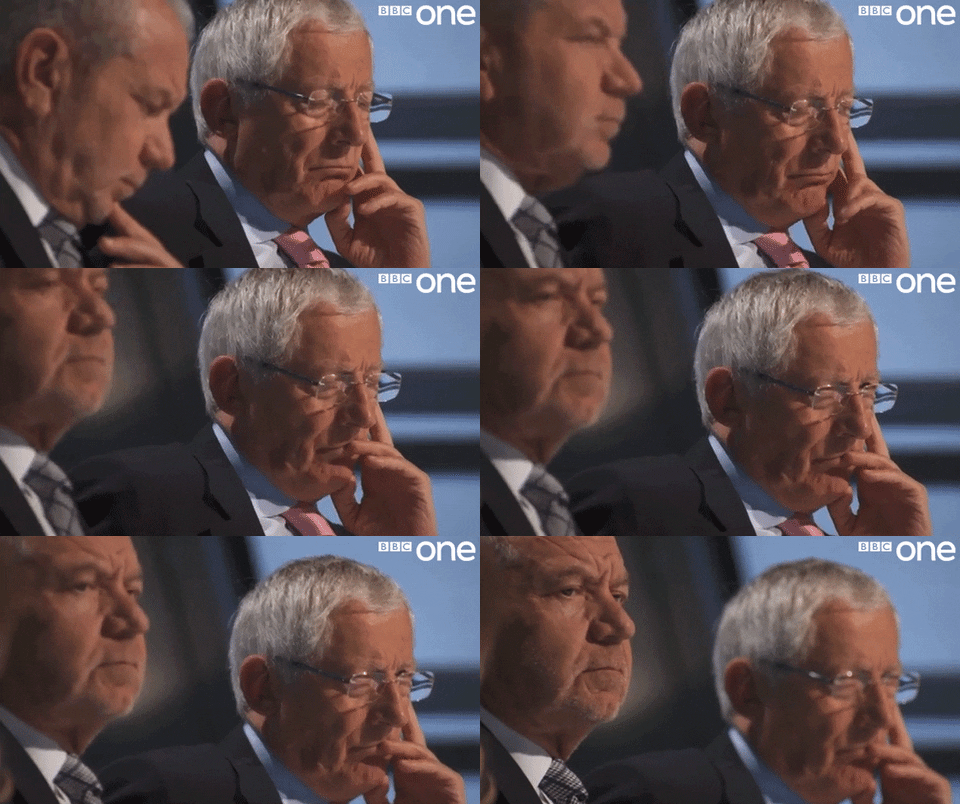
Enter (from a tiny door in the middle of the room, presumably coming from some sort of subterranean troll hole) Lord Sugar, the man whose apprentice these people are supposed to want to be.  Apparently he’s done well in big business, but he doesn’t strike me as someone dynamic enough to thrive in 2019’s brutal economy.  His furrowed brow thinly muffles the sounds of his mind whirring as he dodderily computes what’s said to him.  Fair enough, what’s being said is normally an accusatory argument between a handful of competitive business wannabes, but it all seems a bit much.  Relishing his own interruptions, our Alan then wheels out dad-gags that I swear have been written and fed to him by a team of eighties comedians.  Or sugar-jacked ten-year-olds.  If he announced “Well you’re a stupid poo poo head” to someone I don’t imagine a single eyebrow would rise in in surprise.  But that’s the thing about interviewing: best practice is to put the candidate at ease.  Instead, Sugar rules by fear and intimidation, pointing rudely and mistakenly firing people before he’s even employed them.  The apprentices might be inane, but I would feel more comfortable watching them judge him for his contributions to humanity.


The stupid contestants

This is a bit harsh as my only point of reference here has been the odd one that’s ended up on Celebrity Big Brother.  James Hill was actually a top lad, and I was even won over by Katie Hopkins in the house, watching her reason carefully with Katie Price in a way that betrayed a side to her which today’s unacceptable media persona has shat all over.  The rest come across as officewear-clad interns that talk a big game about their skills but end up set up for failure by each week’s task.  One thing I’ve learned in my working life is that nobody ever looks good blaming someone else, and yet these people sit in front of Sugar pointing fingers at poor old Jenny for not selling enough soap.  Maybe squabbling children is what’s missing from the world of professional behaviour, but it has me reaching for the remote.


Its crimes against humanity

Our UK version is based on an original US iteration that first gave a platform to Donald Trump.  This says it all.


Phone abuse

We’ll look back at The Apprentice UK’s most significant contribution to culture: holding the iPhone below your chin while talking on speaker.  This action became characteristic during the contestants’ various wild goose chases, coordinating errand teams sabotaging the overall effort on the sly.  Now it’s taken hold on the top deck of many of London’s buses, which is great if you want to be involved in other people’s banal chitter chatter.  Similarly, the tension of each episode’s climactic boardroom scene is supposedly elevated by a receptionist using the world’s oldest landline to tell the nervously waiting applicants as and when Sugar is summoning them to his shiny boardroom for some more showing off.  This all needs to stop.


In summary then, for those that might have missed the nuance, I really do take exception to this show.  It’s trash masquerading as premium, a theme that runs through the whole operation, from the contestants to Captain Sugar himself.  I don’t mind lots of showing off, but once someone’s screamed “look at me!” long enough to get your attention, they should have something interesting to tell you.  This is never the case in The Apprentice.  I don’t watch it, and I don’t like it.  Of course, loyal readers, you’re free to make your own decisions, just like Sugar is free of UK employment law in order to make his own hires.  But just be honest with yourself: you’re watching it because you like trash.

Sunday, 6 October 2019

Strictly Come Dancing


Dah da-dah dah dah dah daaaah, dah da-dah dah dah.  That music can only mean one thing: summer is well and truly over and we are now counting down the weeks till Christmas.  How do we know this?  By the return of Strictly Come Dancing season, of course.  Regular readers might think this primetime piece of the BBC1 Saturday and Sunday night schedule is a bit broad for the acerbic sideswipes of Just One More Episode.  But you can’t beat a bit of wholesome teatime family entertainment.  There’s enough terrible awful out there in the world that sometimes distracting yourself with concern about the quality of a faded soapstar’s Paso Doble can be just what the doctor ordered.


I was snootily dismissive of the show when it first appeared in 2004.  It seemed like a Daily Mail-esque attempt to bring back a long-gone former era by rebooting pensioners’ favourite Come Dancing, though the update came from the slapping on of the slightly lost adjective Strictly (presumably in an attempt to bring to mind the sexy intensity of Baz Luhrmann’s Strictly Ballroom).  Either way, the name doesn’t make any grammatical sense.  You can’t tell someone to carry out an action in a strict way: strictly wash your hands, strictly put your trousers back on etc.  But this is just the first quality of many that makes the show so magical: it is fully departed from reality.

The concept is simple: a handful of celebrities learn to ballroom dance by being partnered up with world champion professionals.  Each week, they present a dance before a panel of judges, whose scores are combined with a public vote to determine weekly eliminations until an overall winner is left to lift the Glitterball Trophy.  Whereas most celeb shows have come with a sense of shame and desperation (from Celebrity Big Brother to the early days of I’m A Celebrity Get Me Out Of Here), Strictly Come Dancing has always kept an aspirational quality simply because it looks so much fun and wins the heart of every participant.


And did someone say Sir Bruce Forsyth?  Probably not, but his presenting role for the show’s first ten years became part of its essential charm – you couldn’t help but enjoy his rambling links while at the same time slightly wishing they were over.  Sadly, Brucey’s last Tango was in 2017 (RIP), but the addition of Claudia Winkleman since 2014 has multiplied the joy the show brings, proving true the revolutionary theory that two women (she and Tess Daly) can present a primetime show without any need of an older gentleman.  Winkleman’s wizardry originates in her fringe, which she peers through while frequently rendering speechless the dancers around her with her quick(step) wit.  I love her.


But let’s be honest: everyone involved in this show must be wonderful.  Its production ambition is now so huge that I can only guess at the size of the various teams: wardrobe, hair, make-up, props, not to mention the band and singers who will literally take on anything, week in, week out.  I have particular affection for the judges.  Sadly, dear Len Goodman (seven!) is no longer pickling his walnuts having retired in 2016, but Shirley Ballas has proved a replacement to be reckoned with as Head Judge.  I always enjoyed Darcey Bussell, but am thrilled to see Motsi Mabuse storming onto the scene.  An older woman of colour in a role of authority on primetime TV shouldn’t need a comment in 2019, but it feels fitting to celebrate her appointment.  Meanwhile, whatever the significance to diversity, you’ve still got Bruno Tonioli’s elastic turns of expression being delivered with such energy he regularly slips off his chair, alongside Craig Revel Horwood’s deeply unimpressed face.  As each lifts their scoring paddle at the end of a dance, you realise numbers have never been so exciting.  Or glittery.


I often sit there wondering how I can possibly get on the show.  Normally, through work contacts, I can get tickets to my favourite telly, having bothered The X Factor live shows many a time over the years.  But as a BBC production, the doors are shuttered to my advertising dollars.  My only hope (and current career plan) therefore is to get a minor part in a soap opera.  My acting is hammy enough and I am open minded about onscreen nudity in case there are any late-night specials.  I’m not fussy about the story arc: a murder, or some other terrible crime perhaps.  It just needs to be enough to get me at the top of that staircase one Saturday evening, dressed in skin-tight trews, Cuban heels and a garish shirt barely buttoned to the naval, announced by Alan Dedicoat with some sort of creative play on my occupation (failed blogger and serial boxset consumer?), with an East European professional lady clasped at my side.  I reckon I could at least make it to Blackpool.


And that’s the glorious thing: how Strictly punctuates the road to the end of the year: movie week, Halloween, the first Argentine Tango, Blackpool, the final and into the Christmas special.  And the years have been punctuated by the professional dancers’ welcome place in the lists of what we call household names (went a bit Miranda there, didn’t I?).  You can hear the housewives frothing over their beloved Kevin Clifton, while Anton du Beke (the only one to make all 17 series) has mastered the withering comment after years of being saddled with an array of no hopers.  Janette Manrara is always the one to watch in the spectacular group performances while Karen Hauer and Aljaž Skorjanec compete for the world’s biggest smile.  They are all great and it’s easy to see how deeply they care about getting through to each next week.


The final element I’ll go on about is the celebrities themselves.  At some point in the future, everyone who’s ever been well known in the UK will have taken part, leading to my parents’ favourite question to ask about anyone famous: “What were they in last?”  The quality has been mixed, from the most appalling performances that make you wonder if that person can even clap in time to a beat, let alone perform a Foxtrot.  Then, there are the average ones, and both this and the former category can be fast-forwarded if you’re watching on catch up.  Sure, every minute of the show can be enjoyed, but once you compare the top scorers, there really is no competition.  So here is a rundown of a handful of the best dances ever (that I can currently remember):

Jay McGuiness and Aliona Vilani’s Jive, 2015

It was week three (movie week) and the pair’s Pulp Fiction-themed performance began softly but took us all by surprise as it escalated and escalated to breath-taking heights of cool fleet-footedness.  The audience’s cheers made it clear that they couldn’t believe it.  Nobody was expecting this from a chap off The Wanted and it became an absolute best in class.  The nods to the film were as perfect as the execution.

Danny Mac and Oti Mabuse’s Samba, 2016

Never an easy dance for the celebrity males, Mac embraced every element of the discipline, looking as comfortable in hold with Mabuse as he did shaking his hips liberally while out of it on the floor.

Alesha Dixon and Matthew Cutler’s Cha Cha Cha, 2007

Any of Dixon’s dances could be in here, but this one really played to her strengths.  Full of attack (a Darcey-ism) yet playful in nature, this dance elevated 2007 as a watershed year in the show when the celebrities really had to be exceptionally good to triumph, not just a bit good.

Caroline Flack and Pasha Kovalev’s Charleston, 2014

She of Love Island was a worthy Strictly winner, totally nailing this comedic routine with perfect form and smiling throughout while Pasha tossed her hither and thither.


Alexandra Burke and Gorka Márquez’s Jive, 2017

Elevating things again with perfect flicks throughout, Burke jives the bejesus out of Proud Mary and the crowd goes wild.

Aston Merrygold and Janette Manrara’s Cha Cha Cha, 2017         

Merrygold’s early exit from this series was one of history’s greatest miscarriages of justice and I still don’t know how it was allowed to happen.  In this dance, he still looks cool, despite being dressed as a blue troll, and proves beyond doubt why he and Janette should have gone on to the final.  Guaranteed smiles.

There are too many to mention, but let’s just take a moment to think about Lisa Riley’s Samba at Blackpool ending in the splits.  Yes.  I’m surprised more couples don’t forget their steps, though upsets can and do occur.  Perhaps the most distressing moment for anyone taking part is the Rumba, which surely needs to be cast out after so many years of stiff-hipped sportsmen making a mockery of it.  Nevertheless, Strictly remains some of the best fun you can have on TV.  And the ratings!  While X Factor fades from its peak, its BBC rival still easily draws ten million viewers.  No sob stories, no nastiness for the sake of it: just the pursuit of an artform that is potentially one of humankind’s greatest contributions to itself.  Maybe if life contained more dancing, there would be less Brexit.  The scores are in: TEN!