Showing posts with label tv show review. Show all posts

Wednesday, 11 November 2020

Mock The Week

I’ve just done a quick check, and I don’t think we’ve done a panel show before.  Unless you count University Challenge as a panel show, and you shouldn’t, because it’s not one.  It’s actually a quiz.  It differs from panel shows because people are actually trying to give the right answers to difficult questions.  Though panel shows are also quizzes of sorts, it’s more important to give a hilarious answer instead of a correct one.  And the questions are easier.

The reason I’ve not talked about one here before, though, is because I don’t really watch them.  Like chat shows, they seem to be a bit of a waste of time.  Chat shows are just people plugging their new book with rehearsed anecdotes while a former comedian swoons over them – I can get this sort of content from podcasts without having to use my eyeballs.  In my millennial office life (and by office, I mean working from home) nobody ever makes an appointment to view a panel show.  Lots of them are broadcast on Friday nights when we’re all at after-work drinks (not me), and now we’re not allowed to do that anymore, we’re too deep in season two of The Boys (no thanks) or the end of Schitt’s Creek (already completed it) to tune in.  In short, panel shows aren’t the kind of boxsets you can show off to your friends with.

When I still lived at home, Have I Got News For You was a firm family favourite.  Little did we know we were choosing our future PM based on who was the most discombobulated panellist (well, I didn’t vote for him, but it was f***ing one of yas – dezguztan!).  My parents still relish how the show’s humour makes a farce of British politics, but for me the subject matter is already too much of a farce to be funny anymore.  I once spent a whole train journey to Cornwall for work (shout out Eden Project) watching Never Mind The Buzzcocks on my phone and laughing so loudly that fellow passengers worried for my sanity.  But will we ever get Simon Amstell back?  I may save this for a future edition, as is my plan with Celebrity Juice, so we’ll try and focus on the show in hand.

The reason I’m picking Mock The Week is that I’ve come to admit begrudgingly it’s actually rather good.  Of an evening, around 10pm, as I disconnect the telly from Netflix or Amazon Prime or Sky Boxsets, I’m hit with a brief glimpse into live terrestrial telly.  The channel is never set to BBC1 or ITV, as my life is too worth living ever to sit through either station’s ten o’clock news – I am not going to bed angry.  Invariably, it’s BBC2, which means, on a certain night of the week I have thus far not ascertained, Mock The Week is in full swing.  Whether it’s a repeat, or a more recent edition with fun-ruining plastic dividers and social distancing, I will typically lose between ten and twenty minutes of delicious sleep because I’ve become distracted by the hilarity on screen.  But it’s worth it.

The idea is to laugh at things that have happened in the last seven days.  That’s where the name comes from.  Mocking the week.  Got it?  Good.  And we all know we could do with a laugh these days.  Given my fractional viewing, I’m not too sure of the rest of the format.  Dara Ó Briain ably chairs proceedings, a characterful man who combines erudition with, my personal favourite, plenty of silliness.  He once called me a c**t at a live show in response to my answer to his question regarding what job I do.  So I consider him a close personal friend.

The two teams of three that make up the rest of the panel are a revolving retinue of comedians, all taking part willingly in the weekly mockery.  More recent episodes have seen a great big shift upwards in the diversity of backgrounds here and if this doesn’t excite you then please stop reading now.  I’m up for banning white men from all TV and politics for the next five years (especially me) and seeing how we get on.  What’s the worst that can happen?  Sadly, this would cost me some of my favourites: Ed Gamble and his dry delivery, James Acaster and his perpetual face of confusion (let’s all agree to watch his Netflix specials please) and Tom Allen, taking a break from slagging off cakes but in a charming way on Bake Off: Extra Slice.

Sometimes our panellists sit around, sometimes there’s a microphone on a stand that they have to dash towards from little raised platforms and it’s fun wondering if they’ll bump into each other.  Sometimes you wonder how people can be so quick-witted, sometimes you wonder if they’ve had time to prepare their best lines.  Either way, there are plenty of chuckles to go round for everyone and, of course, nobody cares who actually wins.  I couldn’t even tell you if scores are kept – that’s just how little research I do for these posts.  And so, Mock The Week, let us salute you as a pandemic hero – you’re making me want to watch you in spite of myself.

Tuesday, 10 December 2019

Gogglebox


It’s time to acknowledge something that’s been painfully clear in all of these posts: I’m pretty sure I’m addicted to TV.  Things came to a head in these last few weeks of I’m A Celebrity.  Until the Sky man comes next weekend (so that I have ITV2 HD in time for Love Island – always set and achieve your life goals), I’m in a household without any decent way of recording off my massive OLED telly.  Unable to stomach a nightly hour-long show complete with adverts (especially at Christmas, the most odious time of the year) I decided to watch the show catching up a day behind on ITV Hub.  However, this VoD service has the picture quality of peering through a steamed shower panel, the ads are all still there but at higher frequency and it loses your programme coming out of each break with a cheeky Whoops! message that infuriates more than it sympathises.  Realising it would only be a matter of time before my remote was smashed through my LG 55” screen, I reluctantly switched back to live viewing.  Suddenly, we were back in HD, and I could tell which one was Ant and which one was Dec again.  The dreaded ad breaks became three-minute chunks during which I would find other things to do, banal things like wash up, clean the kitchen, Whatsapp pals or stare into space – each preferable to watching supermarkets argue about who can provide the most magical Christmas.  The bigger drawback, though, was that I became a slave to the appointment to view.


Every evening was a countdown to 9pm, lest I miss the opening link.  Before the I’m A Celeb final, the nightly show was running longer till 10.30, cutting thirty minutes into my sacred bedtime and making the 5.30am alarm the next morning for Crossfit all the more devastating.  It was hell.  I’m relieved it’s over, despite loving the show.  My point is, keeping up with my favourites and devouring new boxsets in order to keep this blog interesting is starting to dominate my evening life.  I’m ending up watching hours each night, normally too exhausted from the early morning and full day of work to do anything productive (first-world problem – it warrants no sympathy).  Once my bum hits the sofa, that’s it.  I’m supposed to be furnishing a new flat, but now that the TV den part of the living room is up and running, I’ve a bad feeling we’re going to be stalled here for some time before there’s any further progress.  I have become a couch potato.  I have become my father.


It’s only fitting, then, that this week I should take a look at another set of people who while away their time on this fascinating planet sedentary on DFS furniture staring at a telly screen (though my sofa is from Heal’s everybody).  So, let’s do Gogglebox.  But, before we go any further, I should confess that this is a programme I don’t watch.  Don’t worry, though, that’s never stopped me throwing in my two pennies’ worth before (see posts on The Apprentice and Keeping Up With The Kardashians).  I’ve channel-surfed on enough Friday evenings to catch sufficient chunks of it to have the measure of the format and its cast.  Please read on while I oscillate wildly between tearing it asunder and extolling its charm.


And I do have some bones to pick with Gogglebox.  For the unaware, it’s a TV programme about people watching TV programmes.  It’s a real-life The Royle Family.  Up and down Britain, we mutually view selected televisual highlights with a cast of actual non-famous normos.  That’s right – we watch people watch telly.  Despite all of the above making it clear I’m wasting my life away, this format is the very definition to me of wasted time, and it’s for this reason I never make any effort to watch it.  Additionally, it shows you all the must-see moments of the week just gone which I rightly suspect would have the effect of making me want to watch even more TV.  This would benefit no-one.  But what I didn’t realise about the filming process was that the cast of Gogglebox know what they’re going to watch – they have scheduled filming sessions.  The production team pick the shows, put them on and then sit down to shoot the reactions.  When I realised this, I was very disappointed.  I thought we had more of a Big Brother vibe: families sign up to a camera being in the living room, go about their viewing lives as normal, and then the best bits are picked up and edited together.  This, I always felt, would be a fairer reflection of what we really watch and how we really react.  It’s excessive and impractical, but that’s just where my imagination goes to first.


Linked to this first fallacy and the fact that the participants know they are being filmed we have the following consequence: their responses aren’t that natural.  It’s an artificial set up.  I therefore can’t escape the feeling they’re all showing off.  Don’t get me wrong, I love showing off.  I do it constantly and enjoy it in others if they are entertaining me.  But Gogglebox acts like it’s a sneak peek behind closed doors to a more humdrum evening, with interstitial shots of household façades leading to cosy living-room set-ups, allowing we privileged few to glimpse real truth from unaware subjects.  But no, it’s just regional accents trying to think of the funniest thing to say about that week’s news or the John Lewis advert.  And it’s at that point I stop caring.


Everyone talks about their favourite Goggleboxers, but I don’t really know who’s who beyond those that have appeared in other reality shows (looking at you, Celebrity Big Brother).  What I do love is the diversity.  We have all points of the UK compass covered here: a wide array of family structures, lifestyle choices, ethnic backgrounds, cultural values, political persuasions, incomes, faiths, genders, ages, sexualities etc – basically every flavour of Brit you can shove out of the way on a crowded train.  What unites them all is a need to redecorate their living rooms.  It’s a bit like Come Dine With Me when you see that someone’s kitchen is a bit natty in comparison to all the show kitchens you see on cookery shows.  That said, given how many of them have hundreds of dogs sprawled across their soft furnishings, rubbing their worms into the fabric and wafting their canine farts over the cushions, there’d be no point updating any of the interiors.  You can sometimes smell the dog breath through the screen.  But it doesn’t matter what I think: what’s touching is the genuine love and affection these family members and friends have for each other.  That, at least, is always reassuringly genuine, if sprinkled with dog hair.


So, who on earth do I think I am talking disparagingly about Gogglebox simply because the people on it watch TV and do showing off?  This whole blog is based around the exact same concept: I watch too much TV and then show off about it, desperately seeking attention for my musings, awaiting offers of global syndication and secretly beaming when friends compliment my writing in real life.  The difference, sadly for me, is that Gogglebox still has millions of viewers, whereas I’m only getting tens of thousands of reads here…

Sunday, 13 October 2019

The Apprentice


For the landmark 117th post of Just One More Episode, I’ll be returning not only to the recently talked-about topic of programmes I don’t watch (like Naked Attraction) but also to the rarely covered theme of programmes I actively hate (Altered Carbon).  While this blog has mostly remained a safe space of positivity about all the different boxsets out there (with a healthy dose of my own self-obsession), this week we are turning our smarmy observations and cutting critiques to the absolute pile of dross that is The Apprentice.  A fifteenth series has slipped onto air this month to a collective shrug of indifference and I’m happy to say I feel no need whatsoever to catch a single episode.  Part of this is now down to the fact I’ve reached the stage of flat ownership where I can have friends round for dinner (especially ones that invite themselves), so I’m too busy serving up Viennetta as a feasible dessert option to tune into this BBC flagship production.  So, eighties ice cream products aside, let’s go through the reasons why The Apprentice should be stricken from the TV guide.  And just to recap quickly the premise for anyone who’s never grasped it, this show is, in short, competitive job interviewing.  Yes, really.


It’s reality TV but pretends not to be

During the first few series from 2005 onwards, this programme’s biggest crime (against my personal view of what’s wrong and what’s right) was to provide a route to reality TV for viewing snobs that claimed not to be able to tolerate the genre.  Big Brother!” they would cry, “I can’t be watching that bunch of wannabes desperate to be famous.  But have you seen The Apprentice?”  I would sneer at them, pointing out they should just own the pleasure they take in consuming trash TV.  If you never miss an episode of Keeping Up With The Kardashians or Love Island then you might as well own that behaviour.  Anyone who judges you for it isn’t important.  Yet The Apprentice legitimised our natural interest in watching ordinary people humiliate themselves by dressing itself up in the pinstripes of actual business.  A tenuous link to product development, sales, marketing and boardroom practices suddenly meant that it was highbrow to watch 20-year-olds from Essex slag each other off while desperately trying to stay on the telly as long as possible.  Frankly, unforgiveable dishonesty.


The stupid tasks

Each week’s episode is themed around an industry, whether confectionary, fashion, events or some combination of all three to make cold hard cash.  A common trope of reality TV is to get people to showcase a skill but with the added pressure of an unfeasibly short period of time in which to do so (Great British Bake Off’s timed technical challenges, or the matter of days allowed to master a Quickstep in Strictly Come Dancing).  But somehow, The Apprentice stretches this too far by making ill-matched groups of applicants think up, refine, manufacture, distribute, market and sell a product within mere moments.  If this wasn’t enough of a recipe for failure, you need to factor in that the all team members are working against each other, with their interests vested in making everyone but themselves look as incompetent as possible.  What ensues are montages of the contestants, dressed in their best banker-wear, running around London streets doing everything wrong before a classic bollocking in the boardroom.


Stupid Lord Sugar

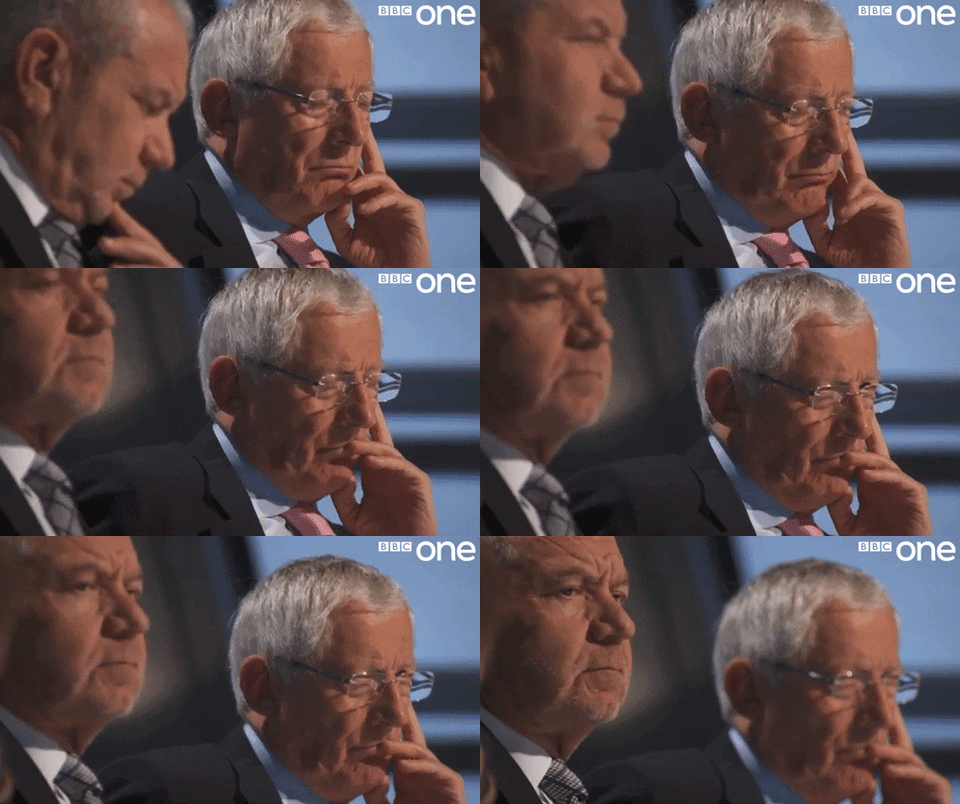
Enter (from a tiny door in the middle of the room, presumably coming from some sort of subterranean troll hole) Lord Sugar, the man whose apprentice these people are supposed to want to be.  Apparently he’s done well in big business, but he doesn’t strike me as someone dynamic enough to thrive in 2019’s brutal economy.  His furrowed brow thinly muffles the sounds of his mind whirring as he dodderily computes what’s said to him.  Fair enough, what’s being said is normally an accusatory argument between a handful of competitive business wannabes, but it all seems a bit much.  Relishing his own interruptions, our Alan then wheels out dad-gags that I swear have been written and fed to him by a team of eighties comedians.  Or sugar-jacked ten-year-olds.  If he announced “Well you’re a stupid poo poo head” to someone I don’t imagine a single eyebrow would rise in in surprise.  But that’s the thing about interviewing: best practice is to put the candidate at ease.  Instead, Sugar rules by fear and intimidation, pointing rudely and mistakenly firing people before he’s even employed them.  The apprentices might be inane, but I would feel more comfortable watching them judge him for his contributions to humanity.


The stupid contestants

This is a bit harsh as my only point of reference here has been the odd one that’s ended up on Celebrity Big Brother.  James Hill was actually a top lad, and I was even won over by Katie Hopkins in the house, watching her reason carefully with Katie Price in a way that betrayed a side to her which today’s unacceptable media persona has shat all over.  The rest come across as officewear-clad interns that talk a big game about their skills but end up set up for failure by each week’s task.  One thing I’ve learned in my working life is that nobody ever looks good blaming someone else, and yet these people sit in front of Sugar pointing fingers at poor old Jenny for not selling enough soap.  Maybe squabbling children is what’s missing from the world of professional behaviour, but it has me reaching for the remote.


Its crimes against humanity

Our UK version is based on an original US iteration that first gave a platform to Donald Trump.  This says it all.


Phone abuse

We’ll look back at The Apprentice UK’s most significant contribution to culture: holding the iPhone below your chin while talking on speaker.  This action became characteristic during the contestants’ various wild goose chases, coordinating errand teams sabotaging the overall effort on the sly.  Now it’s taken hold on the top deck of many of London’s buses, which is great if you want to be involved in other people’s banal chitter chatter.  Similarly, the tension of each episode’s climactic boardroom scene is supposedly elevated by a receptionist using the world’s oldest landline to tell the nervously waiting applicants as and when Sugar is summoning them to his shiny boardroom for some more showing off.  This all needs to stop.


In summary then, for those that might have missed the nuance, I really do take exception to this show.  It’s trash masquerading as premium, a theme that runs through the whole operation, from the contestants to Captain Sugar himself.  I don’t mind lots of showing off, but once someone’s screamed “look at me!” long enough to get your attention, they should have something interesting to tell you.  This is never the case in The Apprentice.  I don’t watch it, and I don’t like it.  Of course, loyal readers, you’re free to make your own decisions, just like Sugar is free of UK employment law in order to make his own hires.  But just be honest with yourself: you’re watching it because you like trash.

Saturday, 17 August 2019

Black Summer


I’m not sure why I’m doing this now, as Black Summer dropped on Netflix back in April and, as with all zombie content, I had to watch it there and then.  However, something about the title seems appropriate as we reach the back end of August.  No, it’s not a spin-off of Dear White People, whose third season has just launched, the viewing of which I am saving for when I’ve bought a big telly for my new flat.  My choice is more to do with the tempestuous weather that everyone has been moaning about.  Brits have evolved to be waterproof as it’s almost always raining here, so I’m not sure why one globally warmed day of 38 degrees would lead us to expect constant sunshine until the schools go back.


Summer 2019 is black due to the gathering storm clouds that seem to signal an afternoon shower each day as some part of new European rainy season.  From my office window I can spectate as workers clad optimistically in summer dresses and t-shirts alike sprint across pavements while a good old bucketing-down catches people unawares.  I know I shouldn’t delight in others’ suffering but getting caught in the rain (along with piña coladas) is something that truly affirms your humanity: the planet has literally wetted you.  Plus, I must get it from my father – he used to arrive early to pick me up from my Sixth Form job at Waitrose before I could drive, simply because my shift ended half an hour after closing time and he would derive endless entertainment from watching affluent potential shoppers stride towards the automatic doors, only to respond with outraged incredulity when they were denied entry to their favourite providore and therefore forced to forego a top-up shop consisting mostly of artisan cheese and fine wines.


Let’s make no bones about it: I don’t like summer.  In fact, a zombie apocalypse would probably improve my ability to withstand the aestival months.  I would like to blame London for this.  It’s the worst place in the world when hot, mostly as it was built in Victorian times for the damp climate mentioned above (though, over a hundred years later, they’re still building most of it).  The morning Tube, as unpleasant as it already is, takes on a new level of odorous odiousness: once you’ve spotted one sweat patch, you suddenly realise that everyone’s every crevice is proffering its own wet spot to any casually observing eye.  I may scoff into my novel, but I secretly know that the tickling in the small of my back is from my own sweat beads dashing down my spine to pool and fester in the dark dankness of my crack.  And there it stays for the whole working day and whatever else I am doing with my evening (watching boxsets).


Londoners do two things in the sun.  The first is to find a patch of grass, regardless of its proximity to the heavy traffic of a thoroughfare.  The second is to drink on it.  I don’t enjoy exhaust fumes, nor is it fun to look for somewhere to wee after your third cider, all while wishing you’d put more effort in at the gym as your body stretches before you like some squidgily marshmallow-like dough.  So, once the longest day has gone past, the chill in the air returns and the leaves start to fall, a certain joy fills me as I know we are approaching my favourite time of year.  For some reason, autumn carries with it the most nostalgia.  A breeze can suddenly evoke the exact moment in Year 10 when I realised that other people were stupid.  Factor in the bonus that each autumn brought another year of school: older, wiser, no cooler, but with a new pencil case.  The geek in me loved going back because I enjoyed all the writing and the learning and such.


Which is why some writing is happening now, as a hobby.  I started this blog about TV shows.  I should probably therefore spend a couple of passages actually tackling this week’s programme instead of sharing half-baked yet whimsically charming reflections on the passing of time.  Regular readers will know of my love for the zombie genre.  Fear The Walking Dead remains one of my most-read posts, while The Walking Dead and Korean treasure, Kingdom (킹덤), have of course been covered.  One show I’ve seen some of but not included here is Z Nation, another serial tackling the undead apocalypse.  Its crime?  Too many LOLs  I exist in perpetual fear of a zombie takeover, so I really struggle to see the funny side.  I don’t mind dark humour in the face of annihilation, but the viewer in me wants the genuine threat treated seriously.  The point is, Z Nation misses the mark slightly, but my scant research has revealed the Black Summer is its origin story.  Let’s not hold this against the show though.


Our action opens in an unnamed suburb, some weeks after breakout.  Enough confusion still exists about what is going on, and things are never really explained.  We only glimpse the unfolding of disorientating events through seemingly unrelated characters, all desperately trying to survive (with varying levels of success).  The characterisation has been accused of shallowness, but I’m going to describe it as subtle – you’re deliberately left conflicted about who is good and who is bad, bringing to life the fact that trusting others while the undead chase you can lead either to salvation or betrayal, but you’ll only find out when it’s too late.

The suburban streets in the sunshine take on a claustrophobic air, with peril around every repetitive corner, separated individuals hopelessly searching for loved ones.  Tension builds around rumours of sanctuary, yearning for reunion and the constant risk of zombies and bad people.  The eight episodes stumble forward, arrhythmically switching perspectives and pace, though we culminate in a series of gun battles which are equal parts thrilling climax and video game fodder.


For devotees of the genre, this is a worthwhile watch.  Its fresh-enough approach avoids the pitfalls of what we have seen before, but there’s a sense a bigger vision is lacking behind all the death and destruction.  I’d happily sit through a second series, but the internet is not forthcoming with details of any recommissioning.  I promise you genuine chills from Black Summer’s flesh-eating walkers, especially in the mix of the show’s concerning plausibility.  But I realise the most alarming image you may have from this week’s post is that of my sweaty crack.

Saturday, 4 August 2018

Footballers’ Wives


I have no idea why I’m doing a show from 2002, but it seems to have been a classic year for vintage TV.  In addition, the Desperate Housewives post whipped up a storm of reads, so I’ve decided that wives is a popular theme, and this show is about wives as well (clue’s in the title).  Then, I’m amplifying that with the power of nostalgia, after the Buffy The Vampire Slayer post drew more attention than I was prepared for: turns out we like to relive our memories of shows from when we were younger and less jaded, safely in the EU and certain of an economically prosperous future.


The next uninteresting detail I will talk you through at length is the orthography of the show’s name itself.  After some soul searching, I’ve decided to go with Footballers’ Wives, as you’ll see from the header on the post.  This is significant because at any one time I am devoting 20% of my life’s energy to grammatical pedantry.  Even at the age of 17, when this week’s programme was first broadcast, my teenage self was appalled at the lack of plural possessive apostrophe concluding the opening credits: Footballers Wives.  You’re only young once, so I’m glad I spent that time obsessing about punctuation.  Otherwise, how on earth are you supposed to know that the wives belong to the footballers?  It just looks like a strange, unconnected list.  But then, matters were made worse once I reminded myself how things really appeared: footballers wive$.  I won’t unpick why this is an abomination in my eyes (and if you don’t know why, then get out now please), but it does serve handily to illustrate the level of class on offer in this show.  In short, there was none.  Let’s crack on, then.

But first, it’s 2018, so let’s dispel the myth that wives are the property of their husbands (with or without the appropriate apostrophe to indicate this possession).  Yes, in this day and age, people can’t wait to rush up the aisle in order to spend thousands of pounds on flowers that nobody will remember and to secure a sofa buddy for future series of The Crown, but vows tend to be more about an equal partnership rather than referring to any duty of obedience.  But this was the beauty of Footballers’ Wives – the ladies wore the trousers.  Everything about the menfolk was incidental.  There were merely possessions to trade.  Even their footballing prowess was limited to a couple of lines in the script – almost no actual match footage ever appealed.  For someone with better things to do than sit through any sort of ballsport (such as watching reruns of dinnerladies) this only added to the programme’s appeal.


Let’s look at Tanya Turner, the ur-WAG.  Throughout the five series (yes, five!) she ended up in all manner of relationships, working through around half of the Earls Park FC first team, a proportion of the support staff and anyone else who just happened to be passing for that matter.  This wasn’t a search for love, though, but a quest to keep herself in acrylic nails and extraordinarily tacky outfit choices with no expense spared.  Once ex-captain Jason was dispatched, she fought for a place in new signing Conrad Gates’ bed (despite his straightened hair), dallied with sports agent/chairwoman Hazel Bailey and even found the time to get herself astride Frank Laslett, the overweight, over-age chairman of the club, specifically with the intention of shagging him to death.  Imagine talking about that storyline in the office the next day.  But the combination of cocaine, booze and vigorous love making did the job – our Tanya got what she wanted out of each chap (or chapette, in the case of Hazel) and then moved on to the next one.  Played with bags of aplomb by Zöe Lucker (whom I don’t seem to spot on TV these days, but ought to be a national treasure), Tanya was a popular creation, rooted for by an audience that was fully entertained by her outrageous behaviour.


In fact, the show suffered whenever she was absent.  IMDB tells me that Gillian Taylforth (Cathy from Eastenders, everyone) appeared in the most episodes, playing Jackie Pascoe, the overbearing pushy mother.  Yet, my most memorable character is Nurse Dunkley.  The name in itself is a comic moniker for someone you’re never going to take seriously.  But her arc was as sinister as they come: caring for Frank Laslett during his coma (obviously) she went from an apparently incidental background artist to front-of-camera abuser, pursuing a physical relationship with the unconscious man in her care, while whispering sweet nothings to him in her simpleton-sounding northern accent.  Her spectacles practically steaming up with lust is an image that still haunts me to this day.

But this was what we all tuned in for: far-fetched melodrama.  But you can watch that in most soap operas, so the attraction is better qualified as: far-fetched melodrama involving wealthy, mostly attractive people in glamorous settings.  Which is loads better.  Babies were swapped.  Boob implants caught fire.  Murders were attempted and completed.  Sex videos were leaked.  Joan Collins popped in.  Peter Stringfellow popped in.  This was the level of Footballers’ Wives.  As a result, it was wickedly fun.  I’m not ashamed to admit I also really enjoyed the foul language and frequent nudity – seeing someone being told to f*** off when their boobs are peaking over the duvet is oddly gratifying when you’re a teenager with punctuation-related anxiety.


Sadly, the show ended in 2006; it may well have been shagged to death itself to be honest.  I don’t even know if there’s any way to watch it these days, shy of trawling car boots for the old DVDs and then squinting at the appalling image quality with your HD-accustomed eyeballs, before realising things look appalling due to the noughties fashions the show so willingly embraced.  In fact, I don’t even recommend re-watching; times have changed, and the old show’s website still exists here, reminding you how crude the old internet was.  Have a click around and think of times past.  This is the trash that brought millions to ITV’s peak schedule.  At least now we have Love Island, eh?