Showing posts with label channel 4. Show all posts

Wednesday, 24 February 2021

Grand Designs

I think we can all agree there are moments in life when you realise the way you feel about things has changed.  Never has this been truer than during the year we’ve just had.  The thought of running around London attending various meetings, squeezing on Tubes and touching everything, then staying out all evening shedding cash on food and drink with pals sounds quite frankly like a dream come true.  A year ago, I would much rather have been ensconced in my flat, dressed in slacks and watching trash on the big telly.  But after twelve months of that, I feel like a social butterfly ready to obliterate my chrysalis and say yes to doing anything, as long as it is outside of my flat.  I’ve even got myself vaccinated (childhood asthma on my GP records saw me texted early and taking the jab when offered seemed like the most straightforward path – if you don’t agree, I am happy to arrange to spit in your mouth in order to share immunity… pretty sure that’s how it works) and, in fact, leaving the house for that was a great day out.

In other changes, I never thought I would feel I wanted to watch Grand Designs.  Any programming about property was a huge turn off, mostly because I spent eleven years saving in order to own one of my, er, own.  During that time, I was at the mercy of the rentals market, from the highs of making new lifelong besties out of flatmates, to the lows of being asked to leave after six months by a woman who once took herself to A&E due to constipation.  The prospect of privileged boomers spending untold cash on their own gratification held no appeal.  But then, I finally got my own flat, and then it became my prison.  Sure, it’s filled very tastefully with an interior scheme that is half John Lewis, half too many houseplants and sure, it’s in zone two among all the things (that are shut), but, as the upstairs neighbours stamp and shriek literally while I type this (and who can blame them as they are stuck in too), I’ve been wondering about finding my way to more space, to something further away from other (stamping and shrieking) people.  And this led me to Grand Designs.  Maybe the time has come for some inspiration about my next house.

Let me just confess that, unlike most of shows these endless posts cover, I haven’t actually seen all of Grand Designs.  There’s nothing to stop me watching all 210 episodes, but all my rambling here is based on three full episodes from the latest series and then an array of snatched snippets when I’ve happened to catch a few moments of the programme over the last 21 years.  But I do know the format, and it’s exactly that which makes it a show you don’t really want to dip in and out of: it’s all set up, tease and big reveal.

First, we meet our grand designers.  They are wealthy.  Not to look at though, and often half the fun is wondering how Jerome and Valentina earned hundreds of thousands of pounds trading rare fur gilets in semirural Hertfordshire.  Either way, they’ve decided to abandon the rat race (or to move into a caravan when one of them is pregnant) and design and build their own house.  And they want us, the viewer, to watch them do it.  It’s the insta humble brag, but make it self-unaware.  Casting judgment on our behalf is Kevin McCloud.  His job is to be a man that knows about buildings and his opinions on them.  Jerome and Valentina tell him about their dreams and he tilts and manoeuvres his head to demonstrate that he is listening, giving the impression he can only process certain sounds if his ears are at certain corresponding angles.  Yet this doesn’t diminish his undeniable charm.  Even when he proceeds to be rude.  He tells them their dreams sound unrealistic.  Then he asks them how much.  It’s a great moment if your pastime is watching people with old money squirm, or people with new money froth at the chance to flash their cash.

Then we get an 3D CGI illustration of the plans.  This is the bit I always want more of.  We never find out more about the exact reasons behind each room.  We focus on one thing instead: it’s all about the light, the heating, the carbon neutrality.  Everything else is rushed past: and then here’s where all the bedrooms and bathrooms are but they haven’t got any floors or windows and there’s no time to explain.  And with that, off we go.  Handy dates on screen remind us that the show takes years to film and we settle into the portion about how they did the foundations.  This shouldn’t be interesting, but we’re all willing things to go wrong and they inevitably do.  Often, to save money, Jerome will pour his own concrete, despite wearing his helmet backwards, and it’s enjoyable to watch the workmen roll their eyes at him, his entitlement and his inexperience.  There’ll be drama that you can’t actually see: if the foundations crack then everything will be ruined and it will cost fifty grand.

The family waiting to move in are shivering in the drizzle under a tarpaulin round the back, but Jerome is standing proud not giving a fig while his vision becomes a reality.  Valentina waits until she can pick out the curtains.  We check in over the months, with Kevin sometimes popping along to tell them off for removing period features (if they are renovating an old building) or expressing disbelief that a heating system powered by Jerome and Valentina’s own sense of smugness will ever function properly (it bloody will).  You’ll marvel at Kevin’s outerwear – his whole house must be filled with sensible jackets.  Lots more stuff can go wrong and the schadenfreude is deeply satisfying.  The latest series has the added tension of us counting down until lockdown hits them, knowing what’s in store while they naively plan their progress.

Suddenly, though, we swing the windows into place (careful!) and everything is finished.  The rainy shell is gone.  We are looking at the actual home.  It’s behind schedule, but we go from pointing and laughing at the grand designers’ misfortune to seething envy that they get to live somewhere so cool.  I would observe that we see the “finished” item too soon after completion.  I want to see it two years later when the French windows are covered in the children’s greasy fingerprints and someone’s chipped the plasterwork with the vacuum cleaner.  Kevin marvels at the ingenuity, rinsing the thesaurus to find just the right words to sum up the achievement, before a final stab in the shape of asking how much it all cost then after all that.  Through clenched teeth, we’re told about the casual one hundred grand over budget that was spent, wondering where on earth this money came from (and what it went on).  How do you secure a loan from a bank when it’s to fund Valentina’s underground crystal craft cave?  Was it worth it that Jerome hand-tickled a million metro tiles to create an impractical kitchen?

You’re left feeling inspired, though.  If money were no object, which bits would you take to fashion your own dream abode?  Kevin admits they’ve triumphed and we kick ourselves that we don’t and never will earn enough.  I normally like to think about what else they could have spent the money on.  Being Brits of a certain age, most of them should probably have prioritised some orthodontics.  But what if they had scaled back the ambition just a touch?  What if a few hundred pounds were freed up?  What if Jerome, instead of gratifying himself with gold-plated bathtubs, got the silver-plated ones instead and funded a family’s broadband bill so they could alleviate disruption to disadvantaged children’s educations?  After all this, that’s the other thing we might be starting to feel differently about.

Wednesday, 9 September 2020

Crashing

A lot of people have been struggling in lockdown due to the absence of sufficient new comedy/drama from Phoebe Waller-Bridge.  I think we could all do with another series of Fleabag but, as we know, in the long tradition of quality British sitcoms, we will never have as much of it as we want.  It's been proven many times that the UK cannot have nice things (EU membership, competent government, peace in Northern Ireland).  I know there was another series of Killing Eve that I don't think I will watch after falling slightly out of love with things in the second series, and I also don't think Waller-Bridge is involved.  There's literally no way of checking though.  But then, what should I stumble across on Netflix, but an old Channel 4 sitcom from 2016 called Crashing?  Well, I thought to myself, this has been recommended to me several times as a great example of some of our Phoebe's earlier work and so, this week, I'll be telling you all about how smashing these six episodes really are.

We will just pause for a moment to dwell on my seething jealousy of Phoebe's exceptional achievements.  Not content with having two outstanding shows to her name and securing a very well deserved spot in my list of national treasures (alongside Michaela Coel of Chewing Gum and I May Destroy You, and my beloved Julia Davis of Nighty Night and Sally4ever), Waller-Bridge also has Crashing.  I innocently embarked upon the first episode expecting to see a new comic writer honing her craft, trying a few things out, and scoring some gentle laughs in the guise of a rough diamond with limited experience.  How crushed was I to unearth the fact that Crashing is one of the funniest things I have seen in a very long time?  And it's not just playing for laughs; the humour is clever, built around relatable and likeable characters, and it propels the very neat plot forwards.  Either way, I laughed out loud so loudly at some of these jokes that I was worried about disturbing my neighbours.  They may already think I am a madman.

The theme of the show is property guardianship.  There's nothing terribly sexy about this and, to the best of my knowledge, it's not an area that has been mined for comedy gold before now.  That's because there's nothing that funny about young-ish people who cannot afford London rents opting to squat-with-permission in dilapidated vacant buildings.  In this case we have a big old hospital, with the various wards serving as individuals housing units, and shelves falling off walls at inopportune moments.  But the setup is really just a tool to bring together our gang of main characters; it's the Central Perk to Crashing's Friends, only with more electrical hazards.  Our entry into their world is through the eyes of Lulu, played by Waller-Bridge, who has come down to London with her ukulele under the seemingly innocent ruse of catching up with platonic best pal, Anthony.  The will-they-won't-they saga between the two of them forms our central narrative, much to the irritation of Anthony's fiancĂ©e, Kate.  But around this there swirls further relationship complications that link the rest of the residents together.  From Melody's obsession with painting Colin to the intense bromance between Sam and Fred, each episode draws you in to a charming romp up and down the hospital stairs while these people make a hilarious mess of their lives.

Even beyond the world of the hospital, Waller-Bridge creates a richly observed comedic universe.  You will giggle at the silliness of the restaurant where Anthony works, We Don't Give A Fork, themed as it is around the concept of insisting that its diners eat without cutlery.  Lulu's stint as a receptionist at Kate’s office, Something Events, had me in stitches, particularly when it comes to the office flirt (see Cardinal Burns for details).  Every few minutes we are treated to a devastating line that sums up the pointlessness of millennial life – in turn, I think it a crying shame but this script isn't more widely quoted in real life.  This is a show that deserves to be lauded in its own right, but given what comes after it, it's testament to Waller-Bridge’s talent that it was so quickly eclipsed.  Nevertheless, this is one of the cutest British comedies you can treat yourself to on Netflix while wondering if the government will ever let you out of your own house again.  I don't mind staying in if I get to watch stuff like this.  In fact, I might wait in until they agree to make a second series.

Wednesday, 1 January 2020

Hollyoaks


How the mighty have fallen.  This blog was going to be all about the high-brow boxsets I had uncovered.  Well, let’s be honest, that and a whole load of trash TV that I only watch ironically and as part of my job in media and just out of cultural curiosity and not because numbing my mind with garbage is the only way to cope with the traumatising experience of living in a country that’s repeatedly voting itself into oblivion.  Throughout, I’ve been scathing about the world of the soap opera.  Even though soaps give us a lot as a nation.  They provide the contestants for Strictly Come Dancing.  I think that’s it, actually.  I suppose they also reflect us as a nation and our slowly liberalising attitudes.  My nineties childhood teatimes featured witnessing a lesbian kiss in Brookside, swiftly followed by the discovery of a body under the patio (in Brookside, not at home in Surrey).  The British press railed at this travesty in a way not out of place in The Handmaid’s Tale, but, as we enter a new decade, nobody would bat an eyelid at this now.  People on TV (and in real life) are free to snog whomever they choose and, in this new apparently Tory4life Britain, we can hide whatever bodies we like under the patio.  So, with that in mind, let’s tear Hollyoaks apart.


While I don’t currently watch this soap, there was a period when I did.  Specifically, this was the early summer of 2007.  I was a finalist at Oxford, an institution that still asks me for money (I don’t have that much and they certainly aren’t top of the list for getting it), and every waking minute was spent preparing for our final exams, safe in the knowledge that roughly 100% of my final grade would be generated by the eight three-hour papers I would be sitting (in academic clothing known as subfusc).  Ever since I began the degree back in 2003, I’d noticed a guilt around our approach to studying: if you weren’t working, then you were aching with the bad conscience that you should be.  Pals at other academic institutions talk fondly now about memories of watching Neighbours twice a day and whiling away hours between a weekly lecture.  My average week involved 3,000 words of essay-writing (for which 40 hours of reading were expected – lol!) and translations in four different directions.  Therefore, as things inevitably ramped up under increasing pressure while finals approached, more and more time was spent studying and fewer and fewer moments remained for leisure.  However, this was and still is a recipe for burnout.


After a day buried in books, we would meet for dinner in hall, desperate for social contact and the support it brought.  Naturally, this was informal hall, rather than formal hall.  Informal hall involved a more canteen-like service, whereas for formal hall you had to don your gown over your normal clothes and be served a three-course meal that began with grace in Latin (which was sung by the choir on Sundays).  Just imagine Harry Potter and you’re pretty much there.  Both types of hall needed to be booked on a computer in the porters’ lodge (the main entrance to college) before lunchtime.  No, you couldn’t access this through the internet as that would be Oxonian heresy.  And yes, they really did need that many hours’ notice to broil an unidentifiable meat and mash some swede in time for that evening’s meal.  What a tangent!  The point is, after wolfing down this subsidised sustenance, we would still crave a further moment of unwinding.  Being 6.30, we would end up in front of someone’s TV.  And thus, Hollyoaks would end up in front of our eyes.


What began as ironic activity became something more important.  We began to look forward to our scheduled viewing, anticipating the storyline developments and speculating on the fallouts, anything to distract us from the 7pm drudge back to the library or our rooms for more fusty book-learning.  To this day, the first few notes of the Hollyoaks theme tune set my teeth on edge, but for that one summer, they were solace.  Our main problem, though, when it came to identifying with the characters in the production, was that they didn’t seem to be afflicted as we were with a constant need to be doing work.  They would walk about, talk to each other, do things, all without the omnipresent commentary of “Well, I really better be getting back to it.”  The reality didn’t match ours and their lack of work ethic didn’t compute.


But that didn’t stop us.  We were lost in the scripted tension that finally built up to John-Paul kissing his best friend Craig, all while Nancy and the other evergreen characters got smashed on half a sniff of Smirnoff Ice while “going out” at a venue that was, as with all local amenities, on the one street that they ever went along.  That was a terrible sentence, but it really brings to life the production quality of your average episode.  Let’s say my standards must have been lower, as, at no other time, have I been able to stomach multiple weeks of soap watching.  The plot developed at an agonisingly glacial pace, trapped within its own limited reality, chunked into daily cliff-hangers that got stretched so thinly you could see the next few weeks’ episodes through them.  It was still better than revising.


Exams completed, university a distant and overpriced recollection, I never returned to Hollyoaks.  To this day, it remains billed as the teen soap.  Yes, it’s still being made.  Occasionally I’ll catch a marketing trail on Channel 4 and be like: “Oh wow, this looks good,” but then I have to check myself and remember that this is one of those programmes whose marketing is better than the actual product.  Given the huge community of characters that make up the cast, unwieldy storytelling has to be avoided: only a handful of characters feature in any particular week.  It’s acting shift work.  And that’s always the complaint with soaps: the sheer quantity of entertainment they are required to produce harms its very quality.  Brookside may have long-since perished to cul-de-sac heaven, but Emmerdale seems to be on 43 times a week.  Either way, the 6.30pm broadcast was often well before home time once I became an office worker.  In fact, my favourite joke when on calls late in the day was to tell people planning to leave at 5.30 that it was good news they would be home in time for Hollyoaks.


So yeah, I’m not opposed to Hollyoaks being the 129th programme on Just One More Episode.  As this week’s post demonstrates, this is mostly about me anyway, and Hollyoaks was in my life for a brief period in a former decade, despite there being nearly 4,000 episodes to catch up on, not to mention late night specials with extra sex and a whole array of scantily clad calendars nobody asked for.  Its approach to issues, too, should be commended, serving a national purpose to the country’s youth (who still watch TV and not just inane YouTubers) when it comes to coming to terms with and coming of age in a political entity that hates them.  With cuts to public mental health funding, Hollyoaks will soon be the sole method through which our young people are cared for, so I better get used to the jangly guitar notes of its opening sequence.  It’s only a moment of discomfort when compared to a future lifetime of being locked out of Europe.

Tuesday, 10 December 2019

Gogglebox


It’s time to acknowledge something that’s been painfully clear in all of these posts: I’m pretty sure I’m addicted to TV.  Things came to a head in these last few weeks of I’m A Celebrity.  Until the Sky man comes next weekend (so that I have ITV2 HD in time for Love Island – always set and achieve your life goals), I’m in a household without any decent way of recording off my massive OLED telly.  Unable to stomach a nightly hour-long show complete with adverts (especially at Christmas, the most odious time of the year) I decided to watch the show catching up a day behind on ITV Hub.  However, this VoD service has the picture quality of peering through a steamed shower panel, the ads are all still there but at higher frequency and it loses your programme coming out of each break with a cheeky Whoops! message that infuriates more than it sympathises.  Realising it would only be a matter of time before my remote was smashed through my LG 55” screen, I reluctantly switched back to live viewing.  Suddenly, we were back in HD, and I could tell which one was Ant and which one was Dec again.  The dreaded ad breaks became three-minute chunks during which I would find other things to do, banal things like wash up, clean the kitchen, Whatsapp pals or stare into space – each preferable to watching supermarkets argue about who can provide the most magical Christmas.  The bigger drawback, though, was that I became a slave to the appointment to view.


Every evening was a countdown to 9pm, lest I miss the opening link.  Before the I’m A Celeb final, the nightly show was running longer till 10.30, cutting thirty minutes into my sacred bedtime and making the 5.30am alarm the next morning for Crossfit all the more devastating.  It was hell.  I’m relieved it’s over, despite loving the show.  My point is, keeping up with my favourites and devouring new boxsets in order to keep this blog interesting is starting to dominate my evening life.  I’m ending up watching hours each night, normally too exhausted from the early morning and full day of work to do anything productive (first-world problem – it warrants no sympathy).  Once my bum hits the sofa, that’s it.  I’m supposed to be furnishing a new flat, but now that the TV den part of the living room is up and running, I’ve a bad feeling we’re going to be stalled here for some time before there’s any further progress.  I have become a couch potato.  I have become my father.


It’s only fitting, then, that this week I should take a look at another set of people who while away their time on this fascinating planet sedentary on DFS furniture staring at a telly screen (though my sofa is from Heal’s everybody).  So, let’s do Gogglebox.  But, before we go any further, I should confess that this is a programme I don’t watch.  Don’t worry, though, that’s never stopped me throwing in my two pennies’ worth before (see posts on The Apprentice and Keeping Up With The Kardashians).  I’ve channel-surfed on enough Friday evenings to catch sufficient chunks of it to have the measure of the format and its cast.  Please read on while I oscillate wildly between tearing it asunder and extolling its charm.


And I do have some bones to pick with Gogglebox.  For the unaware, it’s a TV programme about people watching TV programmes.  It’s a real-life The Royle Family.  Up and down Britain, we mutually view selected televisual highlights with a cast of actual non-famous normos.  That’s right – we watch people watch telly.  Despite all of the above making it clear I’m wasting my life away, this format is the very definition to me of wasted time, and it’s for this reason I never make any effort to watch it.  Additionally, it shows you all the must-see moments of the week just gone which I rightly suspect would have the effect of making me want to watch even more TV.  This would benefit no-one.  But what I didn’t realise about the filming process was that the cast of Gogglebox know what they’re going to watch – they have scheduled filming sessions.  The production team pick the shows, put them on and then sit down to shoot the reactions.  When I realised this, I was very disappointed.  I thought we had more of a Big Brother vibe: families sign up to a camera being in the living room, go about their viewing lives as normal, and then the best bits are picked up and edited together.  This, I always felt, would be a fairer reflection of what we really watch and how we really react.  It’s excessive and impractical, but that’s just where my imagination goes to first.


Linked to this first fallacy and the fact that the participants know they are being filmed we have the following consequence: their responses aren’t that natural.  It’s an artificial set up.  I therefore can’t escape the feeling they’re all showing off.  Don’t get me wrong, I love showing off.  I do it constantly and enjoy it in others if they are entertaining me.  But Gogglebox acts like it’s a sneak peek behind closed doors to a more humdrum evening, with interstitial shots of household façades leading to cosy living-room set-ups, allowing we privileged few to glimpse real truth from unaware subjects.  But no, it’s just regional accents trying to think of the funniest thing to say about that week’s news or the John Lewis advert.  And it’s at that point I stop caring.


Everyone talks about their favourite Goggleboxers, but I don’t really know who’s who beyond those that have appeared in other reality shows (looking at you, Celebrity Big Brother).  What I do love is the diversity.  We have all points of the UK compass covered here: a wide array of family structures, lifestyle choices, ethnic backgrounds, cultural values, political persuasions, incomes, faiths, genders, ages, sexualities etc – basically every flavour of Brit you can shove out of the way on a crowded train.  What unites them all is a need to redecorate their living rooms.  It’s a bit like Come Dine With Me when you see that someone’s kitchen is a bit natty in comparison to all the show kitchens you see on cookery shows.  That said, given how many of them have hundreds of dogs sprawled across their soft furnishings, rubbing their worms into the fabric and wafting their canine farts over the cushions, there’d be no point updating any of the interiors.  You can sometimes smell the dog breath through the screen.  But it doesn’t matter what I think: what’s touching is the genuine love and affection these family members and friends have for each other.  That, at least, is always reassuringly genuine, if sprinkled with dog hair.


So, who on earth do I think I am talking disparagingly about Gogglebox simply because the people on it watch TV and do showing off?  This whole blog is based around the exact same concept: I watch too much TV and then show off about it, desperately seeking attention for my musings, awaiting offers of global syndication and secretly beaming when friends compliment my writing in real life.  The difference, sadly for me, is that Gogglebox still has millions of viewers, whereas I’m only getting tens of thousands of reads here…

Thursday, 7 November 2019

Misfits


I’ve never really bought superheroes.  People wang on about the latest addition to the interminable Marvel Character Universe and I seem to zone out immediately.  What we can bear to watch comes down to what we can buy as a reality in which a story can play out.  My own mother can’t abide anything supernatural as it’s simply not realistic enough.  As a result, she cheerfully refuses to engage with the entire wizarding world of Harry Potter.  Sometimes I can’t work out why I’ll buy the things I’ll buy and reject the others.  Zombies?  Count me in no matter what (The Walking Dead and Kingdom).  Vampires?  Excuse me while I reminisce about loving True Blood.  I even sat through every season of Lost, long after I’d lost all hope of ever working out what I was actually buying.  But, typically, I’ll reject anything to do with costumed heroes.  So why, then, am I covering Misfits this week?


Well the truth is that I am behind with my boxset consumption and haven’t polished off anything new in a while.  But my viewing experience’s loss is your blog-reading pleasure’s gain, as I know we all love to trawl the archives.  I’ve cast my mind back to a show that did in fact deal with the real-life consequences of developing superpowers: Misfits.  The premise was not only a great excuse for orange jumpsuits, but also a sure-fire way to ponder the age-old question of just how much great power comes with which sort of great responsibility.  The premise was thus: some pesky youths on community service get caught up in a mysterious storm.  Superhuman new abilities ensue, with our drama served up by two sources: our characters coming to terms with their new faculties and the same characters coming across other individuals who enhanced their natural gifts in the storm’s rage.


Whenever I think what power I would have if I were a superhero, I always arrive at the conclusion that I can’t be improved.  I’ve occasionally thought it would be nice to be a bit taller, but I don’t think Slightly Taller Man would be a welcome addition to the Avengers when they’re next doing some of their assembling.  But don’t worry, the kids in Misfits got a good helping of powers each.  My favourite, regardless of power, was Kelly played by Lauren Socha.  At one point she was all over TV and I can’t fathom why this hasn’t continued.  Her voice had a quality to me that was pure entertainment and I just wanted her to say every line.  I’d have taken Misfits as a one-woman show if I’m honest.  Nathan Stewart-Jarrett (Curtis) appeared in a few things afterward, based on the strong vest-wearing he did in the show.  He once came to a party I was forced to attend as part of a work campaign (Primal Scream were playing but I just wanted to go home as I had no idea who they were) and I saw him in our VIP area.  “Yeah,” I thought, “there’s that man off the telly.”  Robert Sheehan provided impish charm with a hearty overegging of every scene as the very annoying Nathan.  He later appeared in Fortitude, which remains my least read blog (so click on it), and showed quite a different side to himself (and his private parts).  On the whole, though, everyone did a fantastic job in their parts.  Well done.  But some of those jobs got so over the top that I didn’t stick with things all the way to 2013’s fifth series.  It was the arrival of Rudy, played by Joseph Gilgun, in season three that started to wear me out.  I don’t like it when actors’ enjoyment of their own performances visibly outweighs the believability of their own performance.  You don’t see me at my office desk having a great time.


What made things really work was the gritty British urban setting of the whole thing.  Concrete wasteland is somehow a very plausible place for some inclement weather to dish out superhuman abilities.  But the greatest element of its own realism came from Misfits’ use of irreverent humour.  Sure coping with time-rewinding power and telepathy was deep stuff, but it also led to some LOLs.  This is why traditional hero fare always loses me.  At some point, our protagonist dons some sort of skin-tight outfit and begins posturing about the place as if we can take them seriously now they’ve got a uniform and a generic moniker that indicates their power.  I always think of Bananaman.  And I always hated him for being patronising.  The Misfits’ powers were buyable - probably just manifestations of the things we have about ourselves that make us think we are different to everyone.  I’ll confess here to my own hero creation: Bubble Boy.  Don’t worry; I didn’t think of the name.  My niece came up with that.  As an adult, imagination play is incredibly embarrassing.  I can spend hours building LEGO or playing board games with my sister’s daughter, but anything involving pretending goes beyond my comfort zone.  I was obliged to spend half the summer in the garden with her enacting superhero battles.  She was something to do with a ladybird.  Each battle starts with your pose.  It can be holding aloft a weapon or assuming some sort of proactive position.  Bubble Boy, whose name isn’t actually linked to any of my own digestive problems, draws a bubble with his hands.  Because, yes, he has the awesome power of bubbles.  Be afraid.  Don’t worry, I don’t proceed to assault a ten-year-old girl, as we are normally too busy laughing at our own posing to unleash any real violence.  Which just goes to show we British can’t take anything seriously.  I mean, just look at Brexit.


But if you want silly camp costumes, then Strictly Come Dancing is on every year.  Otherwise, dig out the old Misfits boxset for a masterclass in good British telly.  Nobody stands on a rooftop in Lycra with their hands on their hips.  They scowl while wearing dirty jumpsuits, before making some sort of quip about the whole situation.  The next time you see some disaffected youths, don’t forget that they might just have some superpowers you just don’t know about.


Saturday, 19 October 2019

Toast Of London


Apropos of nothing, this week I shall be peeling back the skin of Toast Of London, taking a look at what lies beneath and maybe even sniffing it.  I say apropos of nothing, as I cannot link this week’s choice to anything happening in wider popular culture (plus the wankiness of the term suits the pretension of the programme in question).  Toast Of London’s three series came out between 2012 and 2015, yet my stumbling across them on Netflix in recent times and harnessing the gentle mirth and subversive lampooning of the luvvies that dominate British acting as my accompanying background viewing to Sunday evenings’ food prep marathon (step one: peel sweet potatoes, step two: accept the weekend is over) is particular only to me.  Yet that has never stopped me doing anything on this blog – in fact, regular readers will know it revolves more around me than it does around actually providing useful boxset recommendations.  That said, I have been craving more of Matt Berry since I made my way through The IT Crowd.  My need for his incredible voice was partly fulfilled by old episodes of The Adam Buxton Podcast (that’s right, I also voraciously consume content in podcast form – the eagle-eared among you may even have noticed a quotation from Russell Brand’s Under The Skin in this very introduction), but a vehicle of his own would surely hit the spot.


Fans of silliness will be well rewarded, though the brand of silliness is more conceptual than you might find in my other favourite silly sitcom, Miranda.  Toast is a London-based actor who isn’t that successful.  He gets enough degrading voiceover work to keep going, he has potentially been a household name during a previous decade’s heyday, but he still needs to badger his agent for work while she too badgers him to take up unsuitable jobs.  Like Andy Millman in Extras, he exhibits seething jealousy for any member of his acting cohort who is doing better than him.  The best thing about all of these minor actors is their surnames.  Toast in itself is enough to stop any top billing sounding too serious, conjuring up images of melting butter spread with crumb-covered knives.  Surpassing that English word for banal naffness is the name of Toast’s greatest rival, Ray “Bloody” Purchase.  Purchase is such a wet sock of a word and of a name.  Neither glamorous, nor familiar, it’s a simple monetary transaction for a good or service.  Starring Ray Purchase and Steven Toast isn’t what you want to hear about any blockbuster film.  Nor will you.  Purchase turns up on almost every job of Toast’s, outdoing him through chumminess with difficult prima donna directors or getting on better with smirkingly smug mugs of voiceover booth technicians.


Both take their craft seriously, but the comedy comes from showing how amateur and ham they really are.  Even Toast’s natural flair as a high winds actor (shouting in front of large fans) doesn’t bode well for future jobs, as whatever can go wrong does.  Helping to expose the evil of taking acting too seriously is a supporting cast with names as delicious as Toast’s and Purchase’s.  There’s Ken Suggestion, Duncan Clench, Cliff Bonanza, Jenny Spasm and Max Gland, not to mention a further raft of names who are only ever referred to such as Warren Organ and Sookie Houseboat.  Each belongs beneath a signed black-and-white headshot in a regional curry house.  Most beloved for me, though, is Toast’s agent, Jane Plough (pronounced Pluff).  Played by Doon Mackichan (whom I’ve always loved since Smack The Pony and I once smiled at on a train), Plough makes grandiose statements about never opening the attachments on emails (amen) and is often seen calling her client from completely unexplained sexual scenarios involving scantily clad young men and some dessert options.


Self-importance is easily made ridiculous, but we all end up on Team Toast, rooting for him to catch a break, despite him being a misogynist pig who only cares about himself.  He is aghast at current trends and longs for his younger years galivanting around Soho when he was a youthful upstart, rather than having to cope with the sniggers his voiceover recordings invariably draw.  Sending up how the British revere their stage and screen actors might seem like easy prey, but Toast Of London’s silliness has a caustic edge, an absurd narrative and a surrealist approach to almost every scene.  You’ll feel delicious every time you hear that immortal line: “Hello Steven, it’s Clem Fandango here.  Can you hear me?”  And so, apropos of nothing, let’s have another series please.

Sunday, 29 September 2019

The IT Crowd


People often ask me what do you do with yourself when you’re visiting Rome with pals but some of them have come over from China and therefore need afternoon naps to cope with the jetlag but you don’t sleep in the day because you wear contacts and are a machine?  The answer is simple: I watch The IT Crowd on the AirBnB’s Netflix account.  Part of my aversion to day-sleeping comes from a quality instilled in me by my mother that all time must be productive, otherwise I might have indulged in the slumber too.  In fact, given my penchant for early starts (5.30am on weekdays everybody) my body does shutdown if I am inactive for 45 minutes or more.  This makes afternoon meetings at work a huge no go, unless it’s me doing the talking, otherwise my plan just to shut one eye at a time so I’m only half giving into hibernation routinely results in nearly missed faceplants on company furniture.  Luckily I’m known for looking bored in all meetings, so this behaviour is part of a professional reputation I’ve spent over ten years building.  Secretly, I hear and remember all things (thank you, Asperger’s).


But yes, this well-loved sitcom (that ran 2006 to 2013) which I had never really seen before, despite getting halfway through the first season several times, proved to be one of the highlights of Rome.  Don’t worry – I had been before in 2005.  We did all the things, even spotting the then Pope (the former Nazi one, which reflects all my views on organised religion perfectly), not to mention me being stopped by elderly Austrian ladies while leaving a restaurant so they could tell me I looked like Hugh Grant’s younger brother.  Thanks.  This meant that my 2019 return was a chilled affair.  The non-Netflix highlights were my successful digestion of Roman gluten in several kilograms of pizza and pasta and a guided tour of the Forum by the talkative Giancarlo, whose palpable disappointment at his young charges actually being in their mid-thirties was exceeded only by his delight that one of my friends knew more than him about ancient Rome and ecclesiastical trivia.


Over a couple of afternoons, while it rained outside (mostly), I made my way through the four series and additional special of The IT Crowd, soothed under the apartment’s air conditioning, which made up for the major flaw which all AirBnBs subtly carry until you notice it on checking in: the third bedroom (mine) was actually a bed in a cupboard.  But let’s not dwell on the fact that I eventually commandeered the living room as my man pad and actually get into the telly bit of this week’s blog.  Back in 2006, every company’s IT department was endowed with majesty and mystery.  Nobody knew how their work computer functioned, yet a whole team existed to fix any bugs, viruses and digital runny noses that would occasion to happen (especially if you opened dodgy emails).  I’m pleased to report that, in 2019, things are exactly the same.  The Office perfectly captured the condescending IT geek whose one time to shine was while chastising the common worker for overheating their hard drive.  But the, er, crowd of The IT Crowd are a million times more lovable:

Roy

He of the ironic t-shirt and asking helpdesk callers if they’ve tried turning it off and then turning it on again (a joke that never gets unfunny, even in real life), Roy’s anger and impatience are a joy to behold.  This is because everything sounds delightful in Chris O’Dowd’s Irish accent.  Some of his best moments are in The Work Outing, when a toilet use misunderstanding is ensued by deeply offensive yet hilarious consequences, but I can’t get enough of him complaining about being kissed on the bottom by a male masseur in Something Happened.  Like me, O’Dowd is an actor who looks worse the younger he is.


Moss

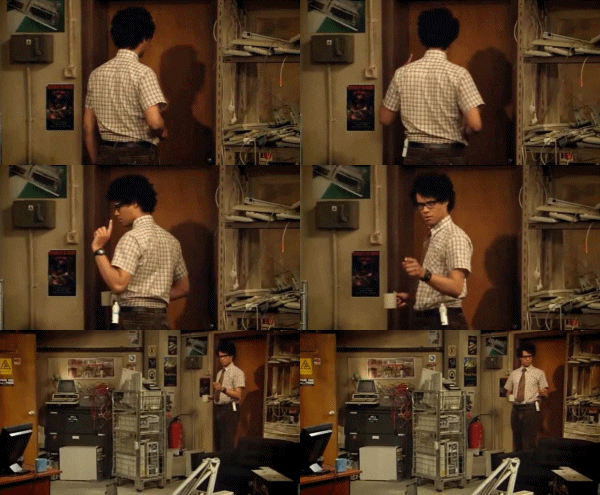
This character at first seems like a caricature, but ends up with inordinate mileage and depth.  I think I enjoy him most in The Final Countdown when the amazing Richard Ayoade gets to deliver the immortal line: “I came here to drink milk and kick ass. And I've just finished my milk.”  His every attempt to be normal only makes him more unusual, and that’s why he’s so special.


Jen

Played by Katherine Parkinson, who I would like on my screens more often please, Jen has one of my favourite voices in television, let alone comedy.  One of the key conceits is that Jen doesn’t know a thing about technology, despite being head of the IT Department.  But she can front anything, even without knowing what the I and the T stand for, or while thinking the internet is a black block given to her by Roy and Moss.  Her funniest moments are in Italian For Beginners when, in a delicious send-up of woman-on-woman workplace passive aggression (a situation that arises when women fight each other for dominance rather than taking on the chauvinist men-pigs holding them down) Jen pretends she can speak Italian and ends up translating for a visiting businessman by reeling off various Italian brands and sounding genuinely convincing.


Alongside our three heroes in the basement of Reynholm Industries, we are treated to occasional appearances from Richmond (Bake Off’s Noel Fielding) and almost constant appearances from series two onwards of Matt Berry as Douglas Reynholm himself.  I won’t extol the virtues of each here, as, if you don’t already recognise their genius, you can close this window and buy a tabloid newspaper (such is your level).


While some jokes have dated as attitudes have modernised and sensitivities adjusted, The IT Crowd, while guaranteeing an average of five LOLs in a decent episode, provides a lot of commentary on elements of our collective culture that are still relevant today: the impact of the internet, how we behave on social media, inequality, sexism, nepotism, unchecked privilege and turning computers off and turning them on again in order to make them work.  Let this be added to the guidebooks alongside the Trevi Fountain as one of the wonders of Rome, but please rest assured this can be watched in other places as well.


Sunday, 8 September 2019

Naked Attraction


In the last few days I’ve lost count of the number of times I’ve been asked if I watch Naked Attraction.  It’s a bold question for anyone to pose in an office, as it comes pre-packaged with an assumption that the asker is proudly declaring their love for nudity-based programming, displaying an unashamed love for looking at other people’s bits and pieces from the privacy and comfort of their own living room.  I can answer that question now: I don’t watch Naked Attraction.  But that doesn’t stop me going on about it here.  Besides, when I say I don’t watch it, this means I don’t make an appointment to view the onscreen wobbly bodies.  It means I don’t make a point of downloading missed episodes on a catch-up service.  But sure, I’ve flicked through the channels of a late evening and found myself transfixed by a good fifteen to twenty minutes of crotch-first dating, so we can all rest assured that I have definitely qualified myself to comment.


For those that don’t know, Naked Attraction is a dating show that gets right down to business.  Our singleton is presented with six potential partners, obscured from their view by coloured screens.  As you would have guessed from its title, there is nudity.  But while our chooser is fully clothed, those that are submitting themselves for selection or rejection have taken off their vest and pants beforehand and are awaiting judgment in the altogether.  Bit by literal bit, the screens reveal the bodies behind, but we start below the waist, only factoring the face into things at a final stage.  After each round, one contestant is cruelly purged, judged to have the wrong genitalia and the game goes on.  The action culminates in the chooser disrobing for the final decision, joining in all the bare-arsery, putting the cock (or pea) in peacocking with visible relish at the thought of finally making everyone else look at their junk.


Regular readers will know I love a boundary-pushing format, but I just can’t get the commissioning meeting for this one out of my head.  It’s one thing to greenlight a naked dating show – Britain could do with taking a more European approach to nudity (shrugging with disinterest rather than pointing and laughing), but the fact that this goes beyond unclothed coupling up and pivots on the first impressions people’s external sex organs make on each other must have made for an interesting PowerPoint presentation.  “So, the entrants look at each other naked and we see if sparks fly?” is what I presume the Channel 4 commissioner asked.  “Not quite,” must have come the response, “one contestant looks only at the other’s privates in order to determine if they are a suitable life partner.”


I suppose it gets any awkwardness out of the way that may come up later down the line.  Nobody wants to have wasted three evenings of their life in various Pizza Express branches before finally getting down to consensual rumpy pumpy, only to find that what lies beneath falls short of expectations.  Why not be upfront about what you want?  Judith from series five (yes, five) certainly has been, and this is what has got our prudish British tongues a-wagging.  Asked for her ideal man, she was candid in her prerequisite of eight to eleven inches.  And fair play to her – it’s not the Dark Ages so we’ve no right to sneer at an older church-going lady who likes to accommodate well-endowed chaps.  Finding out these details is the wonderful Anna Richardson, mastering the hosting art of not looking at the choosing contestants’ crotches in each final round, probably because so many eyefuls are forced upon her beforehand, eagerly examining each mons and foreskin with that week’s date-seeking hopeful.  I imagine she has ensured the clauses in her contract stipulating no obligation for her to join in with the naturism are clad in iron.


Why shouldn’t real bodies get more airtime on TV?  Naked Attraction has been applauded for its inclusiveness, with every shape, size and hue of human mixed in among the skin-showing.  Where it finds contestants willing to undergo such scrutiny is anyone’s guess.  It would be impossible to avoid any awkwardness, especially as the scrutinees can’t speak until later rounds, resulting in people trying to answer questions with eye-level hip shimmies until you can almost hear the pubic hair rustling.  My favourite delicate moment is when the chooser meets the rejected contenders.  It answers the question to which humankind has long pondered the answer: how do you hug someone when one of you is naked?  The solution: the crotch-back hug.  Participants lean in from a slightly more distant stance than they would normally, sticking their bottoms back a little more lest bare flaccid willy graze someone’s jeans.


The toe-curling is actually strongest once the clothes are back on and we witness the final pairing’s first date, reassuringly conducted in a well-lit public space in case anyone tries to slip their slip off again and parade around desperately seeking attention.  The matches rarely work out, despite both having the unhinged glint in their eye that they are perfectly willing to take part in a national television show whose main premise is the detailed scrutiny of their reproductive organs.  Watch it at your own peril and talk about it at work while running a similar risk that everyone thinks you’re a titspervert.  But let’s shed our inhibitions like candidates shed their underpants and knickers.  If they’re happy living free of shame that their scrotum is extra dangly or that their labia are unique, then you can be free of shame that you spend your evenings looking at them.