Showing posts with label british comedy. Show all posts

Wednesday, 11 November 2020

Mock The Week

I’ve just done a quick check, and I don’t think we’ve done a panel show before.  Unless you count University Challenge as a panel show, and you shouldn’t, because it’s not one.  It’s actually a quiz.  It differs from panel shows because people are actually trying to give the right answers to difficult questions.  Though panel shows are also quizzes of sorts, it’s more important to give a hilarious answer instead of a correct one.  And the questions are easier.

The reason I’ve not talked about one here before, though, is because I don’t really watch them.  Like chat shows, they seem to be a bit of a waste of time.  Chat shows are just people plugging their new book with rehearsed anecdotes while a former comedian swoons over them – I can get this sort of content from podcasts without having to use my eyeballs.  In my millennial office life (and by office, I mean working from home) nobody ever makes an appointment to view a panel show.  Lots of them are broadcast on Friday nights when we’re all at after-work drinks (not me), and now we’re not allowed to do that anymore, we’re too deep in season two of The Boys (no thanks) or the end of Schitt’s Creek (already completed it) to tune in.  In short, panel shows aren’t the kind of boxsets you can show off to your friends with.

When I still lived at home, Have I Got News For You was a firm family favourite.  Little did we know we were choosing our future PM based on who was the most discombobulated panellist (well, I didn’t vote for him, but it was f***ing one of yas – dezguztan!).  My parents still relish how the show’s humour makes a farce of British politics, but for me the subject matter is already too much of a farce to be funny anymore.  I once spent a whole train journey to Cornwall for work (shout out Eden Project) watching Never Mind The Buzzcocks on my phone and laughing so loudly that fellow passengers worried for my sanity.  But will we ever get Simon Amstell back?  I may save this for a future edition, as is my plan with Celebrity Juice, so we’ll try and focus on the show in hand.

The reason I’m picking Mock The Week is that I’ve come to admit begrudgingly it’s actually rather good.  Of an evening, around 10pm, as I disconnect the telly from Netflix or Amazon Prime or Sky Boxsets, I’m hit with a brief glimpse into live terrestrial telly.  The channel is never set to BBC1 or ITV, as my life is too worth living ever to sit through either station’s ten o’clock news – I am not going to bed angry.  Invariably, it’s BBC2, which means, on a certain night of the week I have thus far not ascertained, Mock The Week is in full swing.  Whether it’s a repeat, or a more recent edition with fun-ruining plastic dividers and social distancing, I will typically lose between ten and twenty minutes of delicious sleep because I’ve become distracted by the hilarity on screen.  But it’s worth it.

The idea is to laugh at things that have happened in the last seven days.  That’s where the name comes from.  Mocking the week.  Got it?  Good.  And we all know we could do with a laugh these days.  Given my fractional viewing, I’m not too sure of the rest of the format.  Dara Ó Briain ably chairs proceedings, a characterful man who combines erudition with, my personal favourite, plenty of silliness.  He once called me a c**t at a live show in response to my answer to his question regarding what job I do.  So I consider him a close personal friend.

The two teams of three that make up the rest of the panel are a revolving retinue of comedians, all taking part willingly in the weekly mockery.  More recent episodes have seen a great big shift upwards in the diversity of backgrounds here and if this doesn’t excite you then please stop reading now.  I’m up for banning white men from all TV and politics for the next five years (especially me) and seeing how we get on.  What’s the worst that can happen?  Sadly, this would cost me some of my favourites: Ed Gamble and his dry delivery, James Acaster and his perpetual face of confusion (let’s all agree to watch his Netflix specials please) and Tom Allen, taking a break from slagging off cakes but in a charming way on Bake Off: Extra Slice.

Sometimes our panellists sit around, sometimes there’s a microphone on a stand that they have to dash towards from little raised platforms and it’s fun wondering if they’ll bump into each other.  Sometimes you wonder how people can be so quick-witted, sometimes you wonder if they’ve had time to prepare their best lines.  Either way, there are plenty of chuckles to go round for everyone and, of course, nobody cares who actually wins.  I couldn’t even tell you if scores are kept – that’s just how little research I do for these posts.  And so, Mock The Week, let us salute you as a pandemic hero – you’re making me want to watch you in spite of myself.

Monday, 21 September 2020

W1A

This week, nobody has been asking me the following question: what other hidden gems in the world of comedy have you uncovered since you wrote so passionately about Crashing?  Nevertheless, I do need to tell you that I have gone and done it again.  I’ve come across a show whose existence I was completely oblivious to and now I’m going to harp on about it like I invented it myself.  It was probably huge at the time and is therefore already beloved by millions, but this is my blog and I can do whatever I like.  Something else people never ask me is how I decide which shows to feature in my self-indulging prose.  Well, there is no method to this madness.  I do have a longlist of shows I ought to get around to and this week’s programme was in fact on there – something I didn’t even realise until I had finished the third and (hopefully not) final season.  Anyway, preamble aside, we’re doing W1A this week.

Now, regular readers will be aware of my increasing despair when it comes to how awful we British our proving ourselves to be.  The dangerous yearning to return to a post-war peak from 75 years ago threatens everyone’s present-day opportunities.  Nevertheless, alongside the sinister jingoistic gymnastics, there are British traits that, conversely, feel as comforting and familiar as saying sorry to a stranger who’s bumped into you.  One of these is always suspecting we will make a mess of things.  Our trains can’t run in the snow, our trains can’t run in the heat, our breweries have hosted poorly organised piss-ups.  Back when we won the 2012 Olympics, everyone rolled their eyes in anticipation of ensuing shambles (when it was actually a recent national peak, inequality riots aside, and I’m not just talking about me dancing in the closing ceremony…).  So little faith did London’s wonderful liberal elite have in the organising committee than an irreverent sitcom was conceived: Twenty Twelve played on our suspicions surrounding how petty office bureaucrats would arrange and execute so much sport.  Sadly, I never saw this show and can’t find it anywhere, but W1A is its successor, following on with the adventures of Ian Fletcher (that lovely Hugh Bonneville off that lovely Downton Abbey) as he takes up a new post at the BBC.

Aha, you say, another institution we can deride for being a bunch of silly sausages.  How dare they make pensioners pay for their licenses when they of course deserve everything for free?  How dare there allow two women to dance together on Strictly?  How dare they pay female staff less than men?  (Guess which of these three is my actual opinion).  But, this is a BBC production, brilliantly sending up itself and our perceptions of the pencil-pushers who make it tick.  Fletcher serves as our guide in this institutionalised institution, stumbling through Old and New Broadcasting House trying to make sense of how things are done as the new Head of Values while slowly coming to accept that everyone is either incompetent at what they do, or they don’t do anything at all.  It’s at this point I must stress that the whole thing is laugh-out-loud funny.  I giggled my socks off in every single episode, so let’s count down which comedy creations scored the most LOLs on my chuckle-o-meter:

One: David Wilkes, played by Rufus Jones

As a development exec responsible for evolving potential show formats into ratings winners, Wilkes channels a new level of incompetency.  In any meeting, he expertly absolves himself of blame for every action and inaction of his.  He’s there, behind the fridge door, ready to steal your idea and take all the credit.  He interrupts discussions to tell everyone he can’t believe it and prefixes the name of anyone they are talking about with the adjective lovely: “Lovely Izzy, lovely Lucy.”  He’s frequently told to shut up and this generates in me the purest of joy.

Two: Siobhan Sharp, played by Jessica Hynes (seen in The Royle Family)

Another overspill from Twenty Twelve, Sharp is the PR guru who is incapable of listening to anyone but herself.  She is soundbites, mixed metaphors and statement jewellery, the very definition of having nothing original or useful to say.  Her response to every crisis is to blow things up on Twitter.  Her voice is supremely smug and she’ll announce that she’s “good with that” despite nobody requiring her approval.  I get the sense that whoever created her had some axe to grind after spending one too many meetings with members of the PR industry.  I can’t think why.

Three: Will Humphries, played by Hugh Skinner (seen in Fleabag)

“Yeah, no, hi, ok cool.”  Like everyone else, Will rarely says what he means, but he doesn’t know what he means anyway so it doesn’t matter.  He’s the awkward intern who’s overstayed his internship, but Skinner’s facial expressions show the perfect perplexity as Will screws up the simplest of tasks.

Four: Anna Rampton, played by Sarah Parish

As Head of Output, Rampton’s inability to move her top lip marks her out as a serious woman in business.  By repeating “yes, exactly, yes” she falsely portrays an air of decisive action while never doing anything.  Her catchphrase wears out slightly in later series, but she is at her funniest early on refusing every requested refreshment that is brought to her: “No, I don’t want that.”

Five: Simon Harwood, played by Jason Watkins

Harwood is that colleague we all sadly have.  The saboteur who wanted your role.  Non-committal, but always prepare to play his hand as a self-claimed confidante of the Director General (with whom he might enjoy the odd morning muffin), Harwood’s passive-aggression can be seen from space.  He’s constantly telling people he has no idea how things work (because they should) and that they will know how they want to play things (because he’s sure as hell not helping), before emitting one of his frequent exclamations of “brilliant” no matter what’s been decided.

I could go on.  There’s the for-once palatable David Tennant narrating, inserting the odd word to render all action ridiculous (particularly the Ministry for Culture, Media and, also, Sport).  You’ve got Tracy Pritchard beginning every criticism with “I’m not being funny but…”  Ben and/or Jerry bring a surreal element to the incredible pacing of every Damage Limitation meeting.  Layer upon layer of farce is dolloped out in rich scoops, crescendoing into ill-fated launches.  But it’s almost too close to home.  Some of the meetings feel like they were taken directly out of my life.  The curious inability of each and every character to communicate clearly makes wondrous use of two of the English language’s most abused words: yes and no.  Never seen alone or with certainty, W1A is strewn with oodles of “yes no” and lashings of “no yes” and then further fleshed out with generous portions of “yes no yes” and “no yes no.”  Playing out in a corner of London where I’ve worked for the last ten years, I look for myself in the background of scenes were Fletchers cycles into the office on his terrible Brompton (which bikes’ super-naffness is played for miles as laughs).  I’ve even been in the offices of Siobhan Sharp’s Fun Media on many occasions.

Get on the sofa and consume this immediately.  And then tell me if I was right or wrong about its brilliance.  Fair play to the Beeb for being such a good sport, lampooning itself for comedy (though never mentioning its news coverage’s right-wing leanings).  It’s not perfect – some exasperation at increasing wokeness has dated slightly.  Characters start to repeat their catchphrases too much and the freshness of the surprise wears off.  There’s an inevitable love triangle involving Ian Fletcher that doesn’t ring true, while the relationship between Izzy and Will remains effortlessly more charming.  We might not be able to organise a Brexit (so let’s stay) or a pandemic, but we sure can organise a silly sitcom about people who can’t organise things.

Wednesday, 9 September 2020

Crashing

A lot of people have been struggling in lockdown due to the absence of sufficient new comedy/drama from Phoebe Waller-Bridge.  I think we could all do with another series of Fleabag but, as we know, in the long tradition of quality British sitcoms, we will never have as much of it as we want.  It's been proven many times that the UK cannot have nice things (EU membership, competent government, peace in Northern Ireland).  I know there was another series of Killing Eve that I don't think I will watch after falling slightly out of love with things in the second series, and I also don't think Waller-Bridge is involved.  There's literally no way of checking though.  But then, what should I stumble across on Netflix, but an old Channel 4 sitcom from 2016 called Crashing?  Well, I thought to myself, this has been recommended to me several times as a great example of some of our Phoebe's earlier work and so, this week, I'll be telling you all about how smashing these six episodes really are.

We will just pause for a moment to dwell on my seething jealousy of Phoebe's exceptional achievements.  Not content with having two outstanding shows to her name and securing a very well deserved spot in my list of national treasures (alongside Michaela Coel of Chewing Gum and I May Destroy You, and my beloved Julia Davis of Nighty Night and Sally4ever), Waller-Bridge also has Crashing.  I innocently embarked upon the first episode expecting to see a new comic writer honing her craft, trying a few things out, and scoring some gentle laughs in the guise of a rough diamond with limited experience.  How crushed was I to unearth the fact that Crashing is one of the funniest things I have seen in a very long time?  And it's not just playing for laughs; the humour is clever, built around relatable and likeable characters, and it propels the very neat plot forwards.  Either way, I laughed out loud so loudly at some of these jokes that I was worried about disturbing my neighbours.  They may already think I am a madman.

The theme of the show is property guardianship.  There's nothing terribly sexy about this and, to the best of my knowledge, it's not an area that has been mined for comedy gold before now.  That's because there's nothing that funny about young-ish people who cannot afford London rents opting to squat-with-permission in dilapidated vacant buildings.  In this case we have a big old hospital, with the various wards serving as individuals housing units, and shelves falling off walls at inopportune moments.  But the setup is really just a tool to bring together our gang of main characters; it's the Central Perk to Crashing's Friends, only with more electrical hazards.  Our entry into their world is through the eyes of Lulu, played by Waller-Bridge, who has come down to London with her ukulele under the seemingly innocent ruse of catching up with platonic best pal, Anthony.  The will-they-won't-they saga between the two of them forms our central narrative, much to the irritation of Anthony's fiancée, Kate.  But around this there swirls further relationship complications that link the rest of the residents together.  From Melody's obsession with painting Colin to the intense bromance between Sam and Fred, each episode draws you in to a charming romp up and down the hospital stairs while these people make a hilarious mess of their lives.

Even beyond the world of the hospital, Waller-Bridge creates a richly observed comedic universe.  You will giggle at the silliness of the restaurant where Anthony works, We Don't Give A Fork, themed as it is around the concept of insisting that its diners eat without cutlery.  Lulu's stint as a receptionist at Kate’s office, Something Events, had me in stitches, particularly when it comes to the office flirt (see Cardinal Burns for details).  Every few minutes we are treated to a devastating line that sums up the pointlessness of millennial life – in turn, I think it a crying shame but this script isn't more widely quoted in real life.  This is a show that deserves to be lauded in its own right, but given what comes after it, it's testament to Waller-Bridge’s talent that it was so quickly eclipsed.  Nevertheless, this is one of the cutest British comedies you can treat yourself to on Netflix while wondering if the government will ever let you out of your own house again.  I don't mind staying in if I get to watch stuff like this.  In fact, I might wait in until they agree to make a second series.

Thursday, 27 August 2020

Travel Man: 48 Hours In…

While some parts of modern life are returning to a semblance of normality, particularly if you already avoided all human contact, one area of sunshine in our otherwise pointless existences has come back with an added layer of jeopardy.  What used to be called going on holiday, but is now defined as a hobby under the smugger term of “travelling”, is fraught with the risk of your foreign destination falling foul of arbitrary quarantine rules mid-sojourn.  It might have been officially safe to go there, but you could end up coming back from somewhere dangerous, required to submit to an honesty box-enforced personal lockdown of two weeks, just for burning your skin and eating full Englishes in Marbs.  Luckily, TV has many options when it comes to vicarious holiday-making.  I’ve already covered Cruising With Jane McDonald, much to the ambivalence of my loyal reader(s).  But this week I’m going to be telling you all about my recent obsession with Travel Man.

Everyone loves Richard Ayoade.  He was crucial to the charm of The IT Crowd and has gone on to make a living as a professional silly sausage, which schtick is only enabled by his conversely erudite true nature.  For those of us whose lifestyles are more than a little inspired by the teachings of Asperger, he’s a ruddy hero.  Like me, he’s guilty of the approach to travelling where, on the day you’re required to leave, you’d do anything to be able to stay at home instead.  Once away, you may well have a lovely time and forge treasurable memories, but you’re never gladder than the moment you cross the threshold back into your own abode again.  An entertaining choice, then, for a travelogue series.  Let’s run through, to borrow Ayoade’s own frequent references, the format points:

Travel Man always goes with a pal

Each episode focuses on a different predominantly European destination, to which Ayoade is accompanied by a predominantly comedic companion.  It’s a who’s who of British televisual light entertainers, though some Hollywood heavyweights do steam in, introduced to us with all their hyphenations: writers, actors and, ubiquitously, broadcasters.  But what really is a broadcaster?  Am I broadcasting now?  I don’t know.  The show has been opened with a madcap monologue where Ayoade soliloquises from multiple incongruous locations on the pitfalls of modern weekends away: what if it’s a bit rubbish?  The showbiz pal then sets us up for the second earful, demanding to know why they have been brought to Porto/Bergen/Athens etc.  Cue a street jive-inspired yet still deeply ironic beginner’s outburst to the place in question.  The guest tourists are often reduced to foils for Ayoade’s self-confessed glibness, with any showing off swiftly halted, but there is always enough chemistry for the viewer to yearn for an accompanying ticket.

Travel Man is on a budget, a massive one

Prices for sundries and excursions pop up in jaunty bubbles onscreen, with an overview of the cheapest possible trip to our destination given early on.  However, this is often run roughshod over in the very next scene when inordinate funds are spaffed on the most extravagant of hotels.  It’s wasted on Ayoade, who cares only to toss his retro luggage on the king size before dashing off.

Travel Man is tight on time

There’s a lot to be forced into 48 hours, ideally three activities either side of the break plus travel and extra filming time.  As such, Ayoade is constantly badgering his co-voyager to hurry up, resulting in a trail of unfinished drinks and food being left in their wake.  I always find this funniest when his celeb pal wants to chill in the hotel on arriving and Ayoade must insist upon them meeting him downstairs immediately in order to stick to their itinerary.  Relaxing this ain’t.

Travel Man can’t be arsed with the food or indeed any other affectation

Whether trying odd local dishes, or sitting through a 14-course Michelin-starred tasting menu, Ayoade is ever the everyman in only ever being able to assess things as “fine” or “OK” – he’ll often refuse additional bites if he deems one mouthful sufficient for analysing flavour.  Fuss and fancy are instant turn offs, often dismissed on the spot, much to the disappointment of obsequious wait staff and barkeeps.  I unknowingly channelled this approach on a media jolly to San Sebastián when I inadvertently told the maître d’ at Arzak that I didn’t like the monkfish.  Whoops.

Travel Man is nourished by facts

Our guest follows Richard on a schlepp to the city’s nearest highpoint, using a bird’s eye view to orientate themselves and discuss Ayoade’s vertigo.  Before, during and after, they are showered with openly Wikipedia-procured nuggets of varying relevance, often responding with their only viable reaction: bemusement.  On occasions, even hired tour guides seem to know less than our Richard.  It’s all deliciously awkward.  Of note is when UNESCO World Heritage Site status is pointed out, as we do realise at one point that nobody knows what this means.

Travel Man has other foibles

He makes outrageous sartorial choices.  He has a real passion for funiculars (and you will too).  He finds it outrageous when artisanal workshops do not conclude with appropriate certification.  He is vivid in his descriptions of tummy bugs.  He treats guides facetiously by asking them to stay in touch.  But most of all…

Travel Man gets travel sick

Across the nine series and counting, the producers push Ayoade into every mode of transport imaginable, from speedboats to helicopters, from camels to toboggans.  Each and every one triggers his motion sickness.  As a fellow sufferer, I identify with this more than I can convey here.  In fact, I have developed sympathy sickness which comes on whenever Ayoade looks queasy.  Which is often.

Nevertheless, this show is now a firm favourite of mine in light of its lightness and entertainment.  I feel as though I’ve been on a farewell grand tour of my beloved EU with a host of new pals.  Its irreverent tone really takes the gap yah out of someone else’s holidays, transcending the traditional tedium of online showing off by never taking anything that seriously.  Best of all, its brutal honesty really peaks at the very end when Ayoade is itching to get home and shut the doors.  Should they have come?  It doesn’t matter if you have speedy boarding.


Sunday, 15 December 2019

The League Of Gentlemen


The dark humour of this cult classic sitcom-cum-sketchshow used to scare me slightly.  Its first TV series appeared back in 1999 when I was still a rather sheltered Surrey schoolboy.  I was known for things like having the most housepoints in the year and being good at drawing.  Subversive comedy seemed unnecessary: how could you laugh when something was horrible?  This is probably why I harboured such a soft spot for Keeping Up Appearances.  Nevertheless, I was drawn to The League Of Gentlemen.  The characters were inordinately quotable, and many a playground conversation consequently descended into recitations of the episodes’ scripts.  I could therefore seek solace in recognising the key players from the village of Royston Vasey.  For example, Tubbs and Edward were vile, but also ridiculous.  Once they started talking about local shops for local people, there was safety in the catchphrase, allowing me to overlook the brief references to burning bodies on the moor, to the fact that nobody ever left Royston Vasey… alive.


But as each would-be customer of their Local Shop slowly arrived at the realisation that they had set foot in a terrible place, chills would shiver down my spine.  And that’s why I have chosen The League Of Gentlemen this week.  I am that unsuspecting stranger, hoping for the best (or at least not fearing the worst).  And England is that Local Shop.  I’ve finally seen its grotesque nature for what it is, and all too late in the day.  Trapped and doomed, I await my grisly fate.  But hey, that’s enough election chat for this post – I don’t want to make things too political at the expense of being silly!
For those that don’t know this classic contribution to our horrendous nation’s comedy canon, The League Of Gentlemen is a series of interlinked sketches set in a fictional northern settlement.  Everything about it is sinister, and only those that live there can in any way tolerate its ways.  These ways can sometimes get pretty fantastical, but its thanks to the performances and the writing of the actual gentlemen in this league that they are as believable as they are sickening and entertaining.  My tastes in adult life have caught up with their subversion, so let’s take a Top Trumps moment to go through these not-so-gentle men (in no particular order):


Best character:  Credit has to be given for Edward (of Tubbs and Edward fame).  While his sister-wife channels a Skeksis-like degree of naïve mischief (see post on The Dark Crystal), Edward’s more plausible stance as your recognisable local bigot is almost therefore the straight man to her easier laughs (counting to twelvty and touching her precious things).  His distrust of outsiders makes him the perfect parochial Tory.

Close second:  Bitterly lampooning the class-sensitive wives of middle earners, Judee Levinson’s spot-on believability is a triumph in its own right.  But contrasted with working-class cleaner, Iris Krell, then this lady-on-help passive-aggression reaches new levels of acid tongue.


Best character:  Everyone has ended up a third party to some awful couple’s petty arguments.  Pemberton plays Charlie Hull, husband of Stella, and together they turn any location into a theatre of war for the years of resentment their marriage has given them.  While anyone would prescribe a divorce, the Hulls can turn any environment into a tense hotbed of angry grudges.

Close second:  Running the Royston Vasey Jobcentre with as much efficacy as Little Britain’s Marjorie Dawes runs her Fat Fighters branch, Pauline Campbell-Jones has a terrifying universality to her.  Patronising yet clueless herself, we’ve all worked with a Pauline.  The lipstick alone makes me want to wash my face.


Best character:  Clad in Val Denton’s lank long hair, Gatiss’s mumsy mannerisms and ability to make far-fetched lines sound totally humdrum result in a subtly gruesome creation.  Along with husband Harvey, and creepy twin daughters Chloe and Radclyffe, the Dentons’ household is every unusual family visit you’ve ever been forced to endure.  From the toad fascination to Harvey’s masturbation obsession, and not forgetting the first Monday of every month (nude day – something we all suspect our neighbours of doing), we share their nephew Benjamin’s terror that he may never be able to leave.

Close second:  Hilary Briss, the local butcher famed for his special stuff, was probably the hardest character for my young mind to stomach.  Even the name causes me shudders now.  Briss.  Urgh.


Best character:  He doesn’t play any of them – he just writes with the others.  Well done him.  I wouldn’t be able to resist dressing up and getting on camera, but that’s just me.

I could go on for ages, reminiscing of my favourites, but we’ve got lives to lead.  You’ll have to resurrect your own memories of Papa Lazarou, Herr Lipp or Legz Akimbo (put yourself in a child), or maybe seek out this classic if you’ve never seen it before, but there’s one final sketch I have to fuss over, simply as it remains one of my most quoted pieces of comedy and yet still makes me laugh.  Enter stage right, Pamela Doove.  Another Shearsmith performance, this budding actress just needs to nail some diction challenges to hit the big time, as exemplified in this orange juice advert audition.  While the joke is obvious, even Jed Hunter’s small-time director is just one of the many subtler creations that enhance Royston Vasey’s realism.  Strangely prescient, then, that this British settlement should seem so normal and acceptable on the surface.  Scratch beneath and it is truly grotesque by its very nature.  Unlike Europe, we can never leave.

Sunday, 24 November 2019

Green Wing


This week, I’m returning to work after two weeks on holiday.  While being on vacation is moderately preferable to sitting in an office, I’m counting my blessings that I’m not going down some terrible coal mine or making thousands of flat whites as a barista.  Sitting and typing emails isn’t really that taxing, so I’ve no need to dread my return to corporate life.  But I’m sparing a thought for my friends that have trained in medicine.  I’ve heard many of their tales of junior doctor shifts, seen them uprooted across the country with each rotation and laughed and cried while reading Adam Kay’s This Is Going To Hurt.  Now the NHS is being smashed and grabbed over as befits the run-up to any British election.  On holiday in the US, my hotel TVs (in between impeachment proceedings) were filled with vile ads for various niche drugs and their side effects.  Which has all got me thinking about hospitals.  But, as we can’t take anything seriously here, we’re hitting up a fantastic comedy whose two seasons (starting back in 2004) have always made me smile: Green Wing.


I had planned to go through each of the main characters, but Wikipedia lists 13 of these, plus some key recurring roles, and I’m running out of time before Seven Worlds, One Planet.  So, instead, I’m going to pick out my favourites from the madcap population that staffs East Hampton Hospital.

Harriet Schulenberg

Played by Olivia Colman (who’s now sporting the crown in The, er, Crown) Harriet is a bastion of the HR department whose every day of attendance is a miracle in spite of her four kids and unhappy marriage, to say nothing of her actual performance when finally seated at her desk.  Colman perfectly captures the chaos that can ensue when lots of small, dirty children are involved: cardigans constantly slipping off, school projects being crafted while ferrying offspring around extra-curriculars.  I never cease to be impressed by the parents in my office who, after each day, raise little people in their homes while I just lie on the sofa, only to be kept up by these same precious mites when they have the sniffles or start vomiting.  Yet they often manage to come in the next day fully composed.  Harriet is so cleverly observed and amplified that she has a universal quality in reflecting the edge of madness where working parents exist.  It’s not all bad though: you can leave the office at any time just by saying you have to pick your kids up.  I often pop off, claiming to be fetching children from somewhere, and nobody is allowed to question me.  But, secretly, I don’t have any offspring.


Sue White

East Hampton’s staff liaison officer demonstrates demonic behaviour in every scene, whether alone in her office up to no good, or torturing the staff whose concerns she is meant to soothe.  This was another occasion when I fell in love with Michelle Gomez (last seen in Chilling Adventures Of Sabrina) who clearly enjoys the madcap glint in her eye she is able to maintain throughout.  Of note is her ability to prevent all protest at her treatment of others, relying on British politeness and surprise at ill-behaviour in a way that’s similar to my hero, Jill Tyrell, in Nighty Night.


Guy Secretan

Stephen Mangan now performs 99% of all TV advert voiceover work, but his performance of the supercilious anaesthesiologist, always second fiddle to the much cooler Mac, made him a household favourite.  Every workplace needs a gaffman, and Dr Guy Secretan’s belief in his own half-Swiss importance can outgaff the gaffiest of them.


Caroline Todd

The newcomer through whom we navigate the sketch-show-esque world of East Hampton, Caroline is our everyman at an asylum full of medical professionals.  While she’s as neurotic as the rest of us, her foibles pale in comparison to those around her.  You can’t help but love Tamsin Greig throughout, even when she is having a strong adverse reaction to Angela Hunter.  There’s a GIF of Caroline typing wildly that I still use in work presentations most weeks, so she’s a gift (a GIF-t – get it?) that keeps on giving.

Angela Hunter

Sarah Alexander again nearly flies under the radar here (a perennially underappreciated national treasure of comedy acting), but this character is always one of the most enjoyable.  Excessively cheery and seemingly perfect, her colleagues’ response to her is always reassuring, including Caroline Todd’s irrational dislike.


Joanna Clore

I could go through the whole of the HR department here, but my final mention is for its head, played by Pippa Haywood.  A woman of a certain age, she doesn’t care what others might make of her brusque attitude and major mood swings.  You can’t beat an angry senior woman at work.  Senior men rightly cower from them leaving everyone else the chance to get on with stuff.


There are too many more to mention.  Even the deliciously named Martin Dear hasn’t made my list (despite his name encapsulating everything about his character perfectly).  I’ll stop once to mention Alan Statham though.  I have to confess that he was my least favourite and I never looked forward to his scenes coming around.  He is just so snivelling and conniving that my skin crawls every time I even think of him.  But one out of 13 ain’t bad, especially as there’s a great deal else to love about this sketch show-cum-sitcom-cum-comedy drama-cum-hospital show.  And that’s a lot of cums in this genre-splicing format.  Green Wing will forever remain welcome in our homes – we just need a political party to pledge in their manifesto that they are committed to bringing it back (and not shafting the actual NHS).


Saturday, 19 October 2019

Toast Of London


Apropos of nothing, this week I shall be peeling back the skin of Toast Of London, taking a look at what lies beneath and maybe even sniffing it.  I say apropos of nothing, as I cannot link this week’s choice to anything happening in wider popular culture (plus the wankiness of the term suits the pretension of the programme in question).  Toast Of London’s three series came out between 2012 and 2015, yet my stumbling across them on Netflix in recent times and harnessing the gentle mirth and subversive lampooning of the luvvies that dominate British acting as my accompanying background viewing to Sunday evenings’ food prep marathon (step one: peel sweet potatoes, step two: accept the weekend is over) is particular only to me.  Yet that has never stopped me doing anything on this blog – in fact, regular readers will know it revolves more around me than it does around actually providing useful boxset recommendations.  That said, I have been craving more of Matt Berry since I made my way through The IT Crowd.  My need for his incredible voice was partly fulfilled by old episodes of The Adam Buxton Podcast (that’s right, I also voraciously consume content in podcast form – the eagle-eared among you may even have noticed a quotation from Russell Brand’s Under The Skin in this very introduction), but a vehicle of his own would surely hit the spot.


Fans of silliness will be well rewarded, though the brand of silliness is more conceptual than you might find in my other favourite silly sitcom, Miranda.  Toast is a London-based actor who isn’t that successful.  He gets enough degrading voiceover work to keep going, he has potentially been a household name during a previous decade’s heyday, but he still needs to badger his agent for work while she too badgers him to take up unsuitable jobs.  Like Andy Millman in Extras, he exhibits seething jealousy for any member of his acting cohort who is doing better than him.  The best thing about all of these minor actors is their surnames.  Toast in itself is enough to stop any top billing sounding too serious, conjuring up images of melting butter spread with crumb-covered knives.  Surpassing that English word for banal naffness is the name of Toast’s greatest rival, Ray “Bloody” Purchase.  Purchase is such a wet sock of a word and of a name.  Neither glamorous, nor familiar, it’s a simple monetary transaction for a good or service.  Starring Ray Purchase and Steven Toast isn’t what you want to hear about any blockbuster film.  Nor will you.  Purchase turns up on almost every job of Toast’s, outdoing him through chumminess with difficult prima donna directors or getting on better with smirkingly smug mugs of voiceover booth technicians.


Both take their craft seriously, but the comedy comes from showing how amateur and ham they really are.  Even Toast’s natural flair as a high winds actor (shouting in front of large fans) doesn’t bode well for future jobs, as whatever can go wrong does.  Helping to expose the evil of taking acting too seriously is a supporting cast with names as delicious as Toast’s and Purchase’s.  There’s Ken Suggestion, Duncan Clench, Cliff Bonanza, Jenny Spasm and Max Gland, not to mention a further raft of names who are only ever referred to such as Warren Organ and Sookie Houseboat.  Each belongs beneath a signed black-and-white headshot in a regional curry house.  Most beloved for me, though, is Toast’s agent, Jane Plough (pronounced Pluff).  Played by Doon Mackichan (whom I’ve always loved since Smack The Pony and I once smiled at on a train), Plough makes grandiose statements about never opening the attachments on emails (amen) and is often seen calling her client from completely unexplained sexual scenarios involving scantily clad young men and some dessert options.


Self-importance is easily made ridiculous, but we all end up on Team Toast, rooting for him to catch a break, despite him being a misogynist pig who only cares about himself.  He is aghast at current trends and longs for his younger years galivanting around Soho when he was a youthful upstart, rather than having to cope with the sniggers his voiceover recordings invariably draw.  Sending up how the British revere their stage and screen actors might seem like easy prey, but Toast Of London’s silliness has a caustic edge, an absurd narrative and a surrealist approach to almost every scene.  You’ll feel delicious every time you hear that immortal line: “Hello Steven, it’s Clem Fandango here.  Can you hear me?”  And so, apropos of nothing, let’s have another series please.

Sunday, 29 September 2019

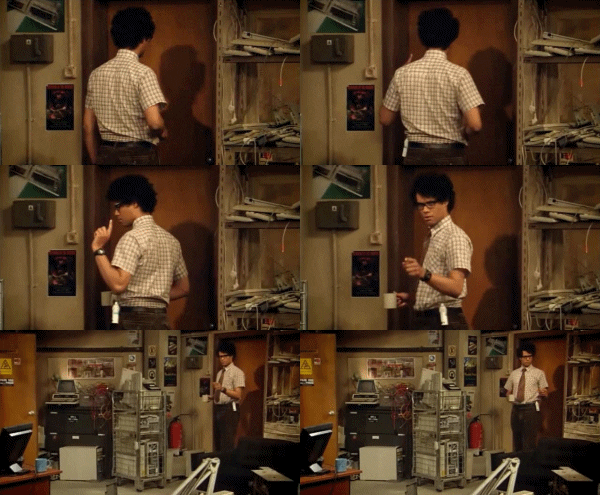
The IT Crowd


People often ask me what do you do with yourself when you’re visiting Rome with pals but some of them have come over from China and therefore need afternoon naps to cope with the jetlag but you don’t sleep in the day because you wear contacts and are a machine?  The answer is simple: I watch The IT Crowd on the AirBnB’s Netflix account.  Part of my aversion to day-sleeping comes from a quality instilled in me by my mother that all time must be productive, otherwise I might have indulged in the slumber too.  In fact, given my penchant for early starts (5.30am on weekdays everybody) my body does shutdown if I am inactive for 45 minutes or more.  This makes afternoon meetings at work a huge no go, unless it’s me doing the talking, otherwise my plan just to shut one eye at a time so I’m only half giving into hibernation routinely results in nearly missed faceplants on company furniture.  Luckily I’m known for looking bored in all meetings, so this behaviour is part of a professional reputation I’ve spent over ten years building.  Secretly, I hear and remember all things (thank you, Asperger’s).


But yes, this well-loved sitcom (that ran 2006 to 2013) which I had never really seen before, despite getting halfway through the first season several times, proved to be one of the highlights of Rome.  Don’t worry – I had been before in 2005.  We did all the things, even spotting the then Pope (the former Nazi one, which reflects all my views on organised religion perfectly), not to mention me being stopped by elderly Austrian ladies while leaving a restaurant so they could tell me I looked like Hugh Grant’s younger brother.  Thanks.  This meant that my 2019 return was a chilled affair.  The non-Netflix highlights were my successful digestion of Roman gluten in several kilograms of pizza and pasta and a guided tour of the Forum by the talkative Giancarlo, whose palpable disappointment at his young charges actually being in their mid-thirties was exceeded only by his delight that one of my friends knew more than him about ancient Rome and ecclesiastical trivia.


Over a couple of afternoons, while it rained outside (mostly), I made my way through the four series and additional special of The IT Crowd, soothed under the apartment’s air conditioning, which made up for the major flaw which all AirBnBs subtly carry until you notice it on checking in: the third bedroom (mine) was actually a bed in a cupboard.  But let’s not dwell on the fact that I eventually commandeered the living room as my man pad and actually get into the telly bit of this week’s blog.  Back in 2006, every company’s IT department was endowed with majesty and mystery.  Nobody knew how their work computer functioned, yet a whole team existed to fix any bugs, viruses and digital runny noses that would occasion to happen (especially if you opened dodgy emails).  I’m pleased to report that, in 2019, things are exactly the same.  The Office perfectly captured the condescending IT geek whose one time to shine was while chastising the common worker for overheating their hard drive.  But the, er, crowd of The IT Crowd are a million times more lovable:

Roy

He of the ironic t-shirt and asking helpdesk callers if they’ve tried turning it off and then turning it on again (a joke that never gets unfunny, even in real life), Roy’s anger and impatience are a joy to behold.  This is because everything sounds delightful in Chris O’Dowd’s Irish accent.  Some of his best moments are in The Work Outing, when a toilet use misunderstanding is ensued by deeply offensive yet hilarious consequences, but I can’t get enough of him complaining about being kissed on the bottom by a male masseur in Something Happened.  Like me, O’Dowd is an actor who looks worse the younger he is.


Moss

This character at first seems like a caricature, but ends up with inordinate mileage and depth.  I think I enjoy him most in The Final Countdown when the amazing Richard Ayoade gets to deliver the immortal line: “I came here to drink milk and kick ass. And I've just finished my milk.”  His every attempt to be normal only makes him more unusual, and that’s why he’s so special.


Jen

Played by Katherine Parkinson, who I would like on my screens more often please, Jen has one of my favourite voices in television, let alone comedy.  One of the key conceits is that Jen doesn’t know a thing about technology, despite being head of the IT Department.  But she can front anything, even without knowing what the I and the T stand for, or while thinking the internet is a black block given to her by Roy and Moss.  Her funniest moments are in Italian For Beginners when, in a delicious send-up of woman-on-woman workplace passive aggression (a situation that arises when women fight each other for dominance rather than taking on the chauvinist men-pigs holding them down) Jen pretends she can speak Italian and ends up translating for a visiting businessman by reeling off various Italian brands and sounding genuinely convincing.


Alongside our three heroes in the basement of Reynholm Industries, we are treated to occasional appearances from Richmond (Bake Off’s Noel Fielding) and almost constant appearances from series two onwards of Matt Berry as Douglas Reynholm himself.  I won’t extol the virtues of each here, as, if you don’t already recognise their genius, you can close this window and buy a tabloid newspaper (such is your level).


While some jokes have dated as attitudes have modernised and sensitivities adjusted, The IT Crowd, while guaranteeing an average of five LOLs in a decent episode, provides a lot of commentary on elements of our collective culture that are still relevant today: the impact of the internet, how we behave on social media, inequality, sexism, nepotism, unchecked privilege and turning computers off and turning them on again in order to make them work.  Let this be added to the guidebooks alongside the Trevi Fountain as one of the wonders of Rome, but please rest assured this can be watched in other places as well.