Showing posts with label bbc. Show all posts

Thursday, 22 April 2021

The Fast Show

As we reach the end of Just One More Episode (and, in fact, there are just four more episodes to go of this nonsense) I wanted to dedicate some time to rambling about a very influential show that people don’t seem to talk about anymore.  I’ve mentioned before my passion for sketch shows, both the terrifying highs of jokes that come off well and the dizzying lows set ups that never really pay off (see post on Little Britain), so it’s only right that I touch on The Fast Show before bowing out.  I was recently assailed by an irresistible urge to revisit some of my beloved sketches and managed to track down a handful of episodes downloadable from Sky Comedy.  Sadly, given that series one appeared in 1994, some of the footage looks like it was filmed on Vaseline (but don’t worry, guys, as the adverts that are inserted everywhere are crystal clear HD) but the humour still shines through and I found myself laughing my head off all over again, despite having seen all of it many times before.

These days, my attention span is so much shorter than it used to be, ruined by years of little whatsapps and incoming office work on multiple fronts (emails, calls, instant messages, someone standing next to your desk coughing lightly back in the days of actually working from anywhere but home), so it stands to reason that The Fast Show’s delivery of its very name’s promise (it’s quite fast) has helped to ensure that I’ve only grown fonder of it with age.  Most sketches are fairly rapid, some are even a few seconds and a single sentence.  Perfect if you’re itching to get the next one without delay.  This results in a vast population of characters and scenarios that I could never do justice to here, but my recent viewing has yielded two conclusions.  Firstly, the writers and actors love silliness as much as I do, as each sketch plays out in a parallel universe of messing about.  Secondly, their target is always anything that takes itself too seriously.  Sign me up.

Let’s take, for example, Jazz Club.  I remember only ever waiting patiently for this one to end when I was a child.  The punchlines were buried and subtle and, probably, it was too similar to real programmes at the time.  But it’s proven a revelation this time around.  John Thomson’s compere is unflinchingly earnest in his curation of various jazz musicians’ backstories, delighting in their hilarious-yet-subtle made-up names (hello, Toast Of London), before throwing with real enthusiasm to the stage where something terrible always unfolds, yet with every artist believing they are a heaven-sent gift to the music scene and the world in general, all conveyed through the medium of the rest of the cast messing about.  There’s an interpretative dance where you can just see Caroline Aherne (princess of The Royle Family) having the time of her life, channelling every pretentious performer she’s probably had the displeasure of coming across.  It’s at this point there’s a great moment of self-reference when the amazing Tom Bola and Jack Pot waddle into shot with their creepy dance.  I think about them all the time and have recently taken to whatsapping friends a video of me laughing along to this without any preceding explanation.

The two first appear in a sketch from Chanel 9, the brightly coloured pastiche of foreign telly, set in the scorching hot Republicca Democratia Militaria.  While it feels a bit Brexit-y and jingoistic these days, the sleaze of the presenters, the chaotic unfathomable action of the shows and the superbly coined and indecipherable language are all so well observed that you really do have the impression of having switched on the TV in a Spanish hotel room.  The linguist in me immediately starts decoding to find units of meaning, relishing in each Chris Waddle as much as every sminky pinky.  The awards show must have busted the budget, but it’s the lottery numbers that take me to my favourite farcical territory, with the multisyllabic word for five pushing the very boundaries of credibility, yet still erring on the side of plausibility.

Call me simple, but sometimes the repeatability is exactly what the fragile mind needs in comedy.  I’m going to channel my inner Simon Day with a “someone’s sitting there, mate” at the next opportunity.  I still maintain that every one of Jessie’s Diets and Fashion Tips is superbly written, and brought to life as an individual and unique performance by Mark Williams.  I didn’t even realise my habit of saying “no offence” in a South African accent after something offensive is generated by an Arabella Weir character.  Inevitably, I do need to question how well everything has aged, as it mostly, and shoot me if I am wrong, seems ok.  Upper class superciliousness and affectation seem to be The Fast Show’s target for its most extensive ruthlessness.  A few other lines have become a bit dud as our attitudes have improved, but I think the things we now deem sexist were in fact highlighting our imbalanced expectations from women, from “does my bum look big in this?” to the competent female employees who turn into simpering idiots at the first sight of a man.

I have to mention Paul Whitehouse, even if just to make it clear that my sister and I still whisper to each other “you ain’t seen me, right?” and Charlie Higson as Johnny Nice Painter, because we two siblings still re-enact the moments he finally utters the word black and asks mother why we must stick pins in our eyes.  Even all those years ago, some of the humour is eerily prescient, with Sir Geoffrey Norman MP a spot-on rendering of today’s chinless Tory, refusing to accept any assessment of reality by simply shouting nooooo.  I’d like to end outrageously by claiming The Fast Show invented humour as I now know and love it.  From the crude, such as the couple who have to pause briefly to explain that they’ve “just come” in inopportune circumstances, to the uncanny depiction of my childhood, as shown in the sketch which I now know is called The Hurried Poor, where a family constantly run about with too much luggage while the dad shouts “come on!”, the breadth of The Fast Show is as much a part of its charm as each sketch’s brevity.  I laughed then, and I laugh now.  Which was nice.

Thursday, 31 December 2020

Louis Theroux

As we all know, Christmas was originally established so that shops could sell more things.  This is back when there were shops, though.  Historical times when there was an economy and EU membership.  By calling their wares presents and saying everyone had to give something to all the people they knew, once-mighty shops vacuumed up our cash (also consigned to the past, thankfully, which will make switching to the euro easier when we re-join the EU) while we skipped home with unnecessary trinkets to wrap, hide under tree branches, and then distribute to relatives before a turkey dinner and some TV, or an argument.  This traditional meaning has of course been forgotten now, partly because things were better in the olden days (especially WWII), but also because there’s a new meaning in town: the birth of baby Jesus.  Even though his mum was a virgin, this infant founded a religion that millions follow to this very day.  Some of my favourite followers are the members of the Westboro Baptist Church.  What this waffle means to say is that I always think of them at Christmas (even though they dismiss the festival as being too paganistic).  So, while holed up at my parents’, a tier 4 refugee airlifted out of London lest I miss any of the above rejoicing, I cracked out my laptop, logged onto the BBC iPlayer, and reminded myself of the documentaries Louis Theroux had made about them.

For those slow on the uptake, let me just confirm that Louis Theroux is the boxset we’ll be discussing in this week’s blog.  And those quick on the uptake will be pointing out to me that he is in fact a man rather than a boxset.  While his programmes over the years have taken such monikers as Altered States or When Louis Met, the editors and I (actually just me) have decided to treat his whole oeuvre as one boxset here.  The fact is: it’s my blog and I can make up whatever rules I want.  But, more importantly, this really is the best way to tackle a career coming up for thirty years of quality output.

We’ll start with his Weird Weekends, first broadcast when I was a wee lad of twelve and already watching things I shouldn’t have been.  Young Louis himself is a bit of a gangly smirker, embedding himself in fringe communities focused on either extreme views or extreme ways of life or some combination of both.  What unites all he comes across is their unshakeable conviction that they have found the ultimate life hack.  Whether a career making money in porn, or navigating marriage up-spicing with swinging parties, his subjects wax lyrical about the benefits of their lifestyle choices.  What helps matters is that most of his weird weekenders are Americans (from that wild land that, to British people, is where telly comes from) all too eager to show off their certainty.  Unto them, however, Louis casts no judgment.  While the whites of his eyes might betray some consternation, his questioning simply offers a length of rope by which they all ultimately unravel themselves.  Instead of jumping in once they have finished speaking, Louis pauses.  His garrulous new pals can’t help but fill the gap, eventually talking themselves almost out of their own flag-waving beliefs.  It’s glorious content you can find on Netflix and, even though it looks like it was filmed on tracing paper when compared to their modern gloss, it’s still utterly compelling.

We then move into When Louis Met territory, a small number of episodes that get under the skin of a variety of prominent Brits who can only really be described as naff.  Some are treasures like Paul Daniels and Debbie McGee or Chris Eubank, and others pose more sinister figures, like Anne Widdecombe and Max Clifford.  Most notorious of all is telly paedo Jimmy Savile and you can’t help but imagine a kiddie porn dungeon behind every unopened door in his home.  For me, though, a highlight is the haranguing of the Hamiltons, as Christine’s self-care wine servings offer great lubrication to the antics that abound.

Both the above have occasionally been reviewed as exploitative and, as a viewer, you can’t help but recoil at others embarrassing themselves.  That said, participation is clearly voluntary, and we must each earn our fifteen minutes of fame as best we can.  Look at me: writing the 180th entry in an unpopular blog.

Between 2003 and the present day, Louis sporadically treats us to one of his BBC Two specials.  More global in subject matter (though still always best in the USA), broader themes are investigated, but still in characteristically extreme circumstances.  Law and (dis)order figure heavily, with the mind-blowing double on the Miami Mega Jail haunting my memory.  Linked to this are explorations of addictive behaviour.  The City Addicted To Crystal Meth remains truly shocking, with Theroux’s calm presence drawing out gasp-inducing frankness from addicts.  His same style in Talking To Anorexia similarly sees him hide his own discomfort in order to provide fragile girls with a platform through which to process their irreconcilable behaviour.  Tragedy looms large and Theroux will return to subjects to track their progress only to find that things haven’t turned out as planned, Twilight Of The Porn Stars being a particular example.

I would also commend our man’s bravery.  In America’s Most Dangerous Pets, he unearths a pre-Tiger King Joe Exotic and remains calm in the face of some harrowing animal encounters.  But 2007’s visit to The Most Hated Family In America stands out as the best example of Theroux’s willingness to stick his head in the lion’s mouth.  We’re back the Westboro Baptist Church of my introduction, a bible-inspired hate group who achieved notoriety by picketing the funerals of dead soldiers with offensive (and poorly illustrated) signs blaming all of America’s problems on sodomy.  Louis is hosted by the charismatic Shirley Phelps-Roper, daughter of the church’s founder and committed member, happy to shout down his ludicrous questions about whether she has to be so nasty to everyone.  With Theroux, we stand by while she runs her household of eleven kids with maternal tenderness, making sure they are clear about who will burn in eternal hellfire (everybody else) and who won’t (them and them alone).

In 2011, Louis returns to the Phelps in America’s Most Hated Family In Crisis, quizzing them about departed members who have come to reject the group’s ministry but also noticing that their infamy has attracted new converts.  This brings me to the highlight of this year’s festive period for me: uncovering a third documentary in this series.  Surviving America’s Most Hated Family interviews, among others, Shirley’s own estranged daughter, Megan Phelps-Roper.  In earlier documentaries, she embodies the unwavering conviction that characterises Theroux’s subjects.  To see such a sensible young lady calmly spout vitriol offers an insight into human potential that scripted drama often fails to approximate.  But, as she details in her book that I happened to be reading at the same time, Unfollow, she began to uncover inconsistencies in the doctrine the church promoted.  The arguments on Twitter that had so thrilled her started to persuade her.  Now, here she is, talking to Louis Theroux and the whole world about treating fellow humans with compassion and kindness, rather than shouting at them while they bury their dead, holding aloft illustrations of stickmen penetrating each other.

Conversely, Louis of later years does start to take exception to his subjects’ beliefs, almost speeding up the process whereby they formally unravelled themselves independently and prodding them more impatiently to agree that, yes, they’re being a bit silly and should probably stop it.  A father in his fifties, should we worry that Theroux is becoming the more conservative older gent so many of us are sadly destined to turn into?  Probably not, as he does concede where convinced, and he ultimately comes from a place of compassion and understanding.  There appears a genuine worry for the wellbeing of those involved.  In my eyes, he can do no wrong.  I’ve devoured his compelling podcast series, Grounded, and am fairly certain we will one day be the best of pals.  And with that, he enters into the folklore of Just One More Episode, alongside 179 of my most important boxsets.

Tuesday, 1 December 2020

Industry

Thank goodness for this boxset.  I don’t know when the BBC and HBO got together for this co-funder, nor when they filmed it as there are plenty of scenes involving people coming within fewer than two metres of each other, and I don’t even really know when it was on or who told me about it (a manager said I might like it and, as if unregistered at the time, I suddenly obeyed this recommendation at an unconnected juncture a few weeks later).  There’s no way of knowing any of these things, least of all me checking for myself, but it doesn’t matter.  The important thing is that I came across a new show that gripped me and wouldn’t let me go until I had consumed every last drop.  And now I’m telling yous lot about it: Industry.  This is a big deal: I’m putting it up there with Succession and Watchmen, even though a number of friends I’ve insisted watch it aren’t quite convinced.

Firstly, it’s set in the world of work.  And not just any old job.  We’re talking finance.  This means we get to look inside offices that are full of people.  As we end a year spent mostly working alone in underpants, seeing desks and business attire and strained professional relationships has taken on an almost pornographic quality.  We’ll come back to the porn side later, as there’s plenty of stimulation in the swish City of London office of Pierpoint already.  Some of these people have six screens (including a Bloomberg one, known affectionately as a Bloomie) and I couldn’t even count the phones: there are headsets and then funny retro ones on coils hanging directly from the desk with little switches on the back.  It’s all a feast for the eyes and this is before we even get onto the drama.

Pierpoint is a swanky fictional (sure) investment bank, long the preserve of privileged white men and a hotbed of questionable financial ethics and even more questionable employee behaviour.  Our intro into this world is a new intake of grads, hungry to earn those big money dollars straight out the gates of university.  But first, they must survive the upcoming reduction in force (RIF) day to secure permanent contracts – pow, we have tension right from the start.  Our grads’ chances are subject to numerous unfair factors, from the desk they end up on, to their line manager’s temperament, their clients’ intentions, their own backgrounds and whether they fit in with the vision of itself Pierpoint is trying to create.  It’s not life or death (well…) but nobody is safe.

You might find yourself struggling with the lack of likeability all the characters display.  Our main focus, Harper Stern, has proven challenging for many.  She’s unpredictable, makes seemingly bad choices that result in self-sabotage and can be unnecessarily unpleasant to those around her.  But she’s blazing a trail, has ambition and won’t let her past overcome her.  There’s doubt about her college credentials from the off (as stuttered by a creepy HR man) and she’s a woman of colour in a world not known for embracing diversity beyond tokenism.  In fact, fellow grad Gus Sackey (not that she is fond of him) seems endlessly amused by how little Pierpoint knows what to do with him.  More than once, his eyebrow is askance at the drones around him.

Back to Harper, though, as we invariably always must go, and her story arc sees her caught in office tension between her desk lead, Eric Tao, and her line manager, Daria.  Should she align herself with the rogue trader who is a law unto himself or the conscientious rising star, carefully plotting an ascendance that will coincide with a redressing of Pierpoint’s gender balance and subsequent treatment of women?  Over on the FX desk, meanwhile, we’ve got Yasmin, whose approach to ingratiating herself with the menfolk is to go on constant coffee/salad/smoothie runs at the expense of proving her investment chops.  From an inordinately wealthy background herself, she instead flexes female strength via humiliating and escalating power play with Robert.  Despite his cocksure manner, he too suffers from the other Pierpointers’ snobbery when it comes to his more working-class background.  His dark suit is ridiculed, but he soon finds a way in with the oldest-school Clement Cowan.

In time, the dysfunctionality of the grads only serves to emphasise the more deeply ingrained dysfunctionality of their superiors, eventually sucking everyone into a vortex of sexy skulduggery.  Claims that the drama is far-fetched don’t wash with me – if it’s someone’s real job to spend their days trading money that’s so derivative it doesn’t exist via impenetrable jargon and their nights indulging in excessive alcohol and drug consumption to entertain evil clients, then surely it’s easy enough to buy the storylines of Industry.  Having spent my first working year in financial headhunting, it confirms the whole banking sector as a glorious near miss for me.

Now, we wanted to circle back to porn, didn’t we?  Hold tight, everyone, because Industry is incredibly graphic.  If sexual misconduct is going down, then we really do see it all.  We see more or less all of our young leads too.  This adds that Game Of Thrones jeopardy of being surprised by a boob or willy at any point, lending grittiness to a London that is already smeared with dirt as it is.  Sure, we often end up seeing about twelve more thrusts that we needed to in order to establish what’s afoot, and, if like me, you get distracted whenever a line is snorted by wondering if it’s CGI or if the actor really did woof some talcum powder, but it’s all part of the fun.  Who said work had to be boring?  You just have to work in the right industry.

Saturday, 21 November 2020

The Fall

Yes, I’ve fallen.  Into The Fall.  There was a sudden urge in me for something gritty and British.  Something grittish.  On Netflix’s autoplay function, the clip of this show answered my specifications perfectly: dashboard-shot footage of an approach to a crime scene, greyness everywhere, probably some drizzle, Gillian Anderson looking a bit grumpy.  Right, I thought, this is going to be the perfect blend of Line Of Duty and Happy Valley – everyone says it’s supposed to be very good.

The grip came very early on and I was soon anxious to get through as much of the three series as quickly as I could.  But what were we dealing with?  First of all, there was a location that was pretty new for me.  The Fall plays out in Northern Ireland and, more specifically, Belfast.  Now, I appreciate that even me saying that this programme fulfilled my need for something British can be interpreted as political – the whole place has been hotly contested as either Irish or part of the UK since way before my conception in the mid-eighties.  The Troubles were rarely out of the news in my childhood, and we even revisited them at A-Level when someone thought we should look at the cold cold poetry of Seamus Heaney, but there’s been a peace process for ages now.  Some would say for too long, so it’s a good job people voted for Brexit and we can all hurry back in time at the earliest opportunity.  It’s not like the year has already been a bit of a state.  Nevertheless, as the murders played out, I found myself deciding I really ought to visit Belfast at some point.

Aye, murder.  Here we are again, fuelling another British obsession: the details of how young women are murdered.  They’re not prostitutes this time, but successful career brunettes, targeted carefully by our killer, haunted and taunted until dispatched by slow strangulation.  This part of the story, dominating the first series, is taut with tension, from police not believing claims of home invasion, to the sleight of hand used to home in on the next victim.  The Northern Irish police force are refusing to acknowledge that a string of murders could be linked, flying in our Gillian as London-based Stella Gibson to investigate how previous operations have failed to yield results.

Anderson is enjoying something of a renaissance as a very British actor, even though she’s proper American.  Her X Files days still plague my nightmares (not her, but that ghost going down the stairs in the opening credits), but she’s given us pure joy in Sex Education and is currently on Thatcher duties in the latest lavish season of The Crown (the Diana years).  The Netflix blurb described her character as an ice queen, but there’s more to Gibson than perfect hair and some nice flowy blouses.  She stands up to the men around her.  She owns her sexuality.  She’s focused on her career.  We know she’s sensitive because, you know, she has a dream journal and that, but she’s a captivating hero and we urge her to succeed.  She even sleeps at work and, by season three, this seems to be taking its toll, as her voice establishes a distracting rasp.

Uncomfortably, she finds herself drawn to the killer as much as he to her.  The obsession tests the bounds not just of her professionalism, but also affects his murderous ambitions.  I don’t want to spoil who our main suspect is, so I’ll just now start to talk about Jamie Dornan as part of a completely unrelated matter.  He remains inscrutable throughout.  While his torso is for spurious reasons shown in varying states of undress at any excuse, working out why he is the way he is remains a mystery, its illumination only really beginning as we build to the final series’ climax.  As Paul Spector, he’s a loving dad (to his daughter at least) but a neglectful husband.  He alternates between leading on and spurning poor wee Katie Benedetto.  He stands up to yet is cowed by the likes of James Tyler.  It’s fitting that we never know whether we can believe him, even when he gives a firm yes in police interviews (never a yeah).

But, once the chase of Gibson’s cat to his mouse is more or less over, things slow down and settle a bit, such that the lack of momentum drove me to distraction.  In this lull, I started and finished The Staircase before forcing myself to return to the story.  I’m glad I did but, looking back at the sum of its parts, there are elements to its sprawlingly ambitious web of narratives that I wish we’d returned to or gained more closure on.  Corruption in the police force from series one fades away.  Supporting officers in the investigation get a bit of interesting characterisation before relegation to the background.  Our focus grows tighter and more claustrophobic culminating quite literally in Spector-on-Gibson action.

Join me, then, in taking a fall into The Fall.  If your second lockdown isn’t harrowing enough, this will surely contain enough gruesome themes to keep you in the house.  Just make sure you pop out if you find your bra laid out on the bed.

Monday, 21 September 2020

W1A

This week, nobody has been asking me the following question: what other hidden gems in the world of comedy have you uncovered since you wrote so passionately about Crashing?  Nevertheless, I do need to tell you that I have gone and done it again.  I’ve come across a show whose existence I was completely oblivious to and now I’m going to harp on about it like I invented it myself.  It was probably huge at the time and is therefore already beloved by millions, but this is my blog and I can do whatever I like.  Something else people never ask me is how I decide which shows to feature in my self-indulging prose.  Well, there is no method to this madness.  I do have a longlist of shows I ought to get around to and this week’s programme was in fact on there – something I didn’t even realise until I had finished the third and (hopefully not) final season.  Anyway, preamble aside, we’re doing W1A this week.

Now, regular readers will be aware of my increasing despair when it comes to how awful we British our proving ourselves to be.  The dangerous yearning to return to a post-war peak from 75 years ago threatens everyone’s present-day opportunities.  Nevertheless, alongside the sinister jingoistic gymnastics, there are British traits that, conversely, feel as comforting and familiar as saying sorry to a stranger who’s bumped into you.  One of these is always suspecting we will make a mess of things.  Our trains can’t run in the snow, our trains can’t run in the heat, our breweries have hosted poorly organised piss-ups.  Back when we won the 2012 Olympics, everyone rolled their eyes in anticipation of ensuing shambles (when it was actually a recent national peak, inequality riots aside, and I’m not just talking about me dancing in the closing ceremony…).  So little faith did London’s wonderful liberal elite have in the organising committee than an irreverent sitcom was conceived: Twenty Twelve played on our suspicions surrounding how petty office bureaucrats would arrange and execute so much sport.  Sadly, I never saw this show and can’t find it anywhere, but W1A is its successor, following on with the adventures of Ian Fletcher (that lovely Hugh Bonneville off that lovely Downton Abbey) as he takes up a new post at the BBC.

Aha, you say, another institution we can deride for being a bunch of silly sausages.  How dare they make pensioners pay for their licenses when they of course deserve everything for free?  How dare there allow two women to dance together on Strictly?  How dare they pay female staff less than men?  (Guess which of these three is my actual opinion).  But, this is a BBC production, brilliantly sending up itself and our perceptions of the pencil-pushers who make it tick.  Fletcher serves as our guide in this institutionalised institution, stumbling through Old and New Broadcasting House trying to make sense of how things are done as the new Head of Values while slowly coming to accept that everyone is either incompetent at what they do, or they don’t do anything at all.  It’s at this point I must stress that the whole thing is laugh-out-loud funny.  I giggled my socks off in every single episode, so let’s count down which comedy creations scored the most LOLs on my chuckle-o-meter:

One: David Wilkes, played by Rufus Jones

As a development exec responsible for evolving potential show formats into ratings winners, Wilkes channels a new level of incompetency.  In any meeting, he expertly absolves himself of blame for every action and inaction of his.  He’s there, behind the fridge door, ready to steal your idea and take all the credit.  He interrupts discussions to tell everyone he can’t believe it and prefixes the name of anyone they are talking about with the adjective lovely: “Lovely Izzy, lovely Lucy.”  He’s frequently told to shut up and this generates in me the purest of joy.

Two: Siobhan Sharp, played by Jessica Hynes (seen in The Royle Family)

Another overspill from Twenty Twelve, Sharp is the PR guru who is incapable of listening to anyone but herself.  She is soundbites, mixed metaphors and statement jewellery, the very definition of having nothing original or useful to say.  Her response to every crisis is to blow things up on Twitter.  Her voice is supremely smug and she’ll announce that she’s “good with that” despite nobody requiring her approval.  I get the sense that whoever created her had some axe to grind after spending one too many meetings with members of the PR industry.  I can’t think why.

Three: Will Humphries, played by Hugh Skinner (seen in Fleabag)

“Yeah, no, hi, ok cool.”  Like everyone else, Will rarely says what he means, but he doesn’t know what he means anyway so it doesn’t matter.  He’s the awkward intern who’s overstayed his internship, but Skinner’s facial expressions show the perfect perplexity as Will screws up the simplest of tasks.

Four: Anna Rampton, played by Sarah Parish

As Head of Output, Rampton’s inability to move her top lip marks her out as a serious woman in business.  By repeating “yes, exactly, yes” she falsely portrays an air of decisive action while never doing anything.  Her catchphrase wears out slightly in later series, but she is at her funniest early on refusing every requested refreshment that is brought to her: “No, I don’t want that.”

Five: Simon Harwood, played by Jason Watkins

Harwood is that colleague we all sadly have.  The saboteur who wanted your role.  Non-committal, but always prepare to play his hand as a self-claimed confidante of the Director General (with whom he might enjoy the odd morning muffin), Harwood’s passive-aggression can be seen from space.  He’s constantly telling people he has no idea how things work (because they should) and that they will know how they want to play things (because he’s sure as hell not helping), before emitting one of his frequent exclamations of “brilliant” no matter what’s been decided.

I could go on.  There’s the for-once palatable David Tennant narrating, inserting the odd word to render all action ridiculous (particularly the Ministry for Culture, Media and, also, Sport).  You’ve got Tracy Pritchard beginning every criticism with “I’m not being funny but…”  Ben and/or Jerry bring a surreal element to the incredible pacing of every Damage Limitation meeting.  Layer upon layer of farce is dolloped out in rich scoops, crescendoing into ill-fated launches.  But it’s almost too close to home.  Some of the meetings feel like they were taken directly out of my life.  The curious inability of each and every character to communicate clearly makes wondrous use of two of the English language’s most abused words: yes and no.  Never seen alone or with certainty, W1A is strewn with oodles of “yes no” and lashings of “no yes” and then further fleshed out with generous portions of “yes no yes” and “no yes no.”  Playing out in a corner of London where I’ve worked for the last ten years, I look for myself in the background of scenes were Fletchers cycles into the office on his terrible Brompton (which bikes’ super-naffness is played for miles as laughs).  I’ve even been in the offices of Siobhan Sharp’s Fun Media on many occasions.

Get on the sofa and consume this immediately.  And then tell me if I was right or wrong about its brilliance.  Fair play to the Beeb for being such a good sport, lampooning itself for comedy (though never mentioning its news coverage’s right-wing leanings).  It’s not perfect – some exasperation at increasing wokeness has dated slightly.  Characters start to repeat their catchphrases too much and the freshness of the surprise wears off.  There’s an inevitable love triangle involving Ian Fletcher that doesn’t ring true, while the relationship between Izzy and Will remains effortlessly more charming.  We might not be able to organise a Brexit (so let’s stay) or a pandemic, but we sure can organise a silly sitcom about people who can’t organise things.

Sunday, 15 December 2019

The League Of Gentlemen


The dark humour of this cult classic sitcom-cum-sketchshow used to scare me slightly.  Its first TV series appeared back in 1999 when I was still a rather sheltered Surrey schoolboy.  I was known for things like having the most housepoints in the year and being good at drawing.  Subversive comedy seemed unnecessary: how could you laugh when something was horrible?  This is probably why I harboured such a soft spot for Keeping Up Appearances.  Nevertheless, I was drawn to The League Of Gentlemen.  The characters were inordinately quotable, and many a playground conversation consequently descended into recitations of the episodes’ scripts.  I could therefore seek solace in recognising the key players from the village of Royston Vasey.  For example, Tubbs and Edward were vile, but also ridiculous.  Once they started talking about local shops for local people, there was safety in the catchphrase, allowing me to overlook the brief references to burning bodies on the moor, to the fact that nobody ever left Royston Vasey… alive.


But as each would-be customer of their Local Shop slowly arrived at the realisation that they had set foot in a terrible place, chills would shiver down my spine.  And that’s why I have chosen The League Of Gentlemen this week.  I am that unsuspecting stranger, hoping for the best (or at least not fearing the worst).  And England is that Local Shop.  I’ve finally seen its grotesque nature for what it is, and all too late in the day.  Trapped and doomed, I await my grisly fate.  But hey, that’s enough election chat for this post – I don’t want to make things too political at the expense of being silly!
For those that don’t know this classic contribution to our horrendous nation’s comedy canon, The League Of Gentlemen is a series of interlinked sketches set in a fictional northern settlement.  Everything about it is sinister, and only those that live there can in any way tolerate its ways.  These ways can sometimes get pretty fantastical, but its thanks to the performances and the writing of the actual gentlemen in this league that they are as believable as they are sickening and entertaining.  My tastes in adult life have caught up with their subversion, so let’s take a Top Trumps moment to go through these not-so-gentle men (in no particular order):


Best character:  Credit has to be given for Edward (of Tubbs and Edward fame).  While his sister-wife channels a Skeksis-like degree of naïve mischief (see post on The Dark Crystal), Edward’s more plausible stance as your recognisable local bigot is almost therefore the straight man to her easier laughs (counting to twelvty and touching her precious things).  His distrust of outsiders makes him the perfect parochial Tory.

Close second:  Bitterly lampooning the class-sensitive wives of middle earners, Judee Levinson’s spot-on believability is a triumph in its own right.  But contrasted with working-class cleaner, Iris Krell, then this lady-on-help passive-aggression reaches new levels of acid tongue.


Best character:  Everyone has ended up a third party to some awful couple’s petty arguments.  Pemberton plays Charlie Hull, husband of Stella, and together they turn any location into a theatre of war for the years of resentment their marriage has given them.  While anyone would prescribe a divorce, the Hulls can turn any environment into a tense hotbed of angry grudges.

Close second:  Running the Royston Vasey Jobcentre with as much efficacy as Little Britain’s Marjorie Dawes runs her Fat Fighters branch, Pauline Campbell-Jones has a terrifying universality to her.  Patronising yet clueless herself, we’ve all worked with a Pauline.  The lipstick alone makes me want to wash my face.


Best character:  Clad in Val Denton’s lank long hair, Gatiss’s mumsy mannerisms and ability to make far-fetched lines sound totally humdrum result in a subtly gruesome creation.  Along with husband Harvey, and creepy twin daughters Chloe and Radclyffe, the Dentons’ household is every unusual family visit you’ve ever been forced to endure.  From the toad fascination to Harvey’s masturbation obsession, and not forgetting the first Monday of every month (nude day – something we all suspect our neighbours of doing), we share their nephew Benjamin’s terror that he may never be able to leave.

Close second:  Hilary Briss, the local butcher famed for his special stuff, was probably the hardest character for my young mind to stomach.  Even the name causes me shudders now.  Briss.  Urgh.


Best character:  He doesn’t play any of them – he just writes with the others.  Well done him.  I wouldn’t be able to resist dressing up and getting on camera, but that’s just me.

I could go on for ages, reminiscing of my favourites, but we’ve got lives to lead.  You’ll have to resurrect your own memories of Papa Lazarou, Herr Lipp or Legz Akimbo (put yourself in a child), or maybe seek out this classic if you’ve never seen it before, but there’s one final sketch I have to fuss over, simply as it remains one of my most quoted pieces of comedy and yet still makes me laugh.  Enter stage right, Pamela Doove.  Another Shearsmith performance, this budding actress just needs to nail some diction challenges to hit the big time, as exemplified in this orange juice advert audition.  While the joke is obvious, even Jed Hunter’s small-time director is just one of the many subtler creations that enhance Royston Vasey’s realism.  Strangely prescient, then, that this British settlement should seem so normal and acceptable on the surface.  Scratch beneath and it is truly grotesque by its very nature.  Unlike Europe, we can never leave.

Tuesday, 19 November 2019

Seven Worlds, One Planet


Attenborough is back, and the BBC’s decision to schedule him in that Sunday evening slot makes drawing viewers as easy as shooting fish in a barrel.  However, shooting fish in a barrel is unethical and, probably, environmentally unsound, which means I am already making bad choices with metaphors and it’s only the second sentence of this week’s post.  If I’m A Celebrity Get Me Out Of Here can get with the times and acknowledge that insects shouldn’t be eaten alive for our entertainment, especially when the people eating them haven’t had proper telly careers for ages, then I can at least show our planet the respect that Seven Worlds, One Planet is very clear it deserves.  And by very clear, I mean smacking you in the face with it over and over throughout a single hour of television.  We’re at the height, here, of what TV can achieve.  Combining wildlife photography that easily stuns even the most soporific post-roast Sunday-evening eyeball into wholeheartedly acknowledging that everything ever on Earth is a miracle with undeniable demonstration of humans’ denigration of those miracles for our own gain, surely this programme will deliver the watershed moment where mankind stops it and tidies up?  (It being environmental naughtiness).


We all know something needs to happen, but our every subsequent action betrays a compromise of that truth.  I’m currently crawling through Connecticut on a train to Boston.  To reach the US, I generated a load of carbon emissions, but I’ll need to cross the Atlantic again by air to get back, so I already know I’ll be adding some more emissions.  I’m sorry.  Today’s been light on the old single-use plastics, yet I do have a bundle of garbage (American for rubbish) to throw in the trashcan (American for bin) when I reach my destination.  I’m sorry.  I stayed with a pal in New York whose building centrally regulates the heat for all apartments (American for flat).  The heating was therefore on too high and couldn’t be adjusted, but, no worries, the air conditioning kicked in to cool things down, burning energy at both ends in order to find the most energy-inefficient way to achieve room temp comfort.  We’re sorry.  So, can we rely on Sir David Attenborough to save the planet from climate change and plastic pollution?  The fact is, we shouldn’t have to.


Nevertheless, each episode of Seven Worlds, One Planet focuses on a different continent, detailing its unique and fragile ecological systems, so let’s review the story so far.

Antarctica

Penguins, seals and whales, with a backdrop of dramatically melting ice.  The guilt is woven in throughout, setting the tone for some uncomfortable viewing, but pulling no punches with the message that action is needed now.  We have facts and figures on population numbers that have dwindled or resurged at the hands of human activity, but there is retribution from Mother Nature when we see how seasick the production crew get as they sail to reach South Georgia.


Asia

Finally, a continent I have actually been to, though I am now of course racked with guilt at my carbon footprint following separate trips to China, Japan and South Korea.  This episode features the harrowing footage previously discussed on this blog from Netflix’s Our Planet: walruses falling to their deaths from Siberian cliffs.  Their plight is no less shocking this time around, though hopefully the BBC’s broader audience should draw greater attention to the living collateral damage my trips to the Far East have caused.  You’ll also weep for the orang-utan, both because this close cousin’s habitat is being destroyed so Iceland can make ads about it (I think) and because you’ll never pronounce the name of this animal correctly as it changes every few years.


South America

Never been here either, but we of course take time for the decades-old narrative about the disappearing rainforests.  This is chat that’s been in the media for such a long time that it’s become as easy to ignore as that rough-sleeper you walk past every morning on the way to work.  If, like me, the total number of hectares of virgin forest you have cleared personally in your lifetime is zero and you think that exculpates you, then you’re missing the point, you big silly.  But what do we do with the powerlessness we feel about the change we want to see?  This episode also delivers real novelty with animal behaviour never filmed before: pumas hunting guanacos.  I didn’t even know what guanacos were when the episode began, and now I am obsessed with them.


I’ll be catching up on Australasia once home, plus big player Africa is still to drop in the series.  I might confess early to expecting to be underwhelmed by Europe (the continent, not the political union we all want to stay in forever) as I’m not sure we can stretch foxes and squirrels out for an hour, but they might have found wilder cast members away from English suburbia.  Either way, this is the type of landmark content that makes me eager to pay my license fee (even if the BBC News app uses biased language to favour right-wing politics).  We can’t let down dear old David by carrying on as we have been doing.  I’m switching to Bulb, voting Green, shopping more at Co-op and haven’t put my heating on so far this year (mostly as I can’t work the new-fangled thermostat in my fancy newbuild) but these are drops in the plastic-filled ocean while New York is still giving out single-use plastic bags and I, ever the Millennial, jet about on fossil-fuelled aeroplanes.  Someone needs to stop me.  Someone needs to stop us.  Over to you, David.  We’ll do whatever you say.

Sunday, 13 October 2019

The Apprentice


For the landmark 117th post of Just One More Episode, I’ll be returning not only to the recently talked-about topic of programmes I don’t watch (like Naked Attraction) but also to the rarely covered theme of programmes I actively hate (Altered Carbon).  While this blog has mostly remained a safe space of positivity about all the different boxsets out there (with a healthy dose of my own self-obsession), this week we are turning our smarmy observations and cutting critiques to the absolute pile of dross that is The Apprentice.  A fifteenth series has slipped onto air this month to a collective shrug of indifference and I’m happy to say I feel no need whatsoever to catch a single episode.  Part of this is now down to the fact I’ve reached the stage of flat ownership where I can have friends round for dinner (especially ones that invite themselves), so I’m too busy serving up Viennetta as a feasible dessert option to tune into this BBC flagship production.  So, eighties ice cream products aside, let’s go through the reasons why The Apprentice should be stricken from the TV guide.  And just to recap quickly the premise for anyone who’s never grasped it, this show is, in short, competitive job interviewing.  Yes, really.


It’s reality TV but pretends not to be

During the first few series from 2005 onwards, this programme’s biggest crime (against my personal view of what’s wrong and what’s right) was to provide a route to reality TV for viewing snobs that claimed not to be able to tolerate the genre.  Big Brother!” they would cry, “I can’t be watching that bunch of wannabes desperate to be famous.  But have you seen The Apprentice?”  I would sneer at them, pointing out they should just own the pleasure they take in consuming trash TV.  If you never miss an episode of Keeping Up With The Kardashians or Love Island then you might as well own that behaviour.  Anyone who judges you for it isn’t important.  Yet The Apprentice legitimised our natural interest in watching ordinary people humiliate themselves by dressing itself up in the pinstripes of actual business.  A tenuous link to product development, sales, marketing and boardroom practices suddenly meant that it was highbrow to watch 20-year-olds from Essex slag each other off while desperately trying to stay on the telly as long as possible.  Frankly, unforgiveable dishonesty.


The stupid tasks

Each week’s episode is themed around an industry, whether confectionary, fashion, events or some combination of all three to make cold hard cash.  A common trope of reality TV is to get people to showcase a skill but with the added pressure of an unfeasibly short period of time in which to do so (Great British Bake Off’s timed technical challenges, or the matter of days allowed to master a Quickstep in Strictly Come Dancing).  But somehow, The Apprentice stretches this too far by making ill-matched groups of applicants think up, refine, manufacture, distribute, market and sell a product within mere moments.  If this wasn’t enough of a recipe for failure, you need to factor in that the all team members are working against each other, with their interests vested in making everyone but themselves look as incompetent as possible.  What ensues are montages of the contestants, dressed in their best banker-wear, running around London streets doing everything wrong before a classic bollocking in the boardroom.


Stupid Lord Sugar

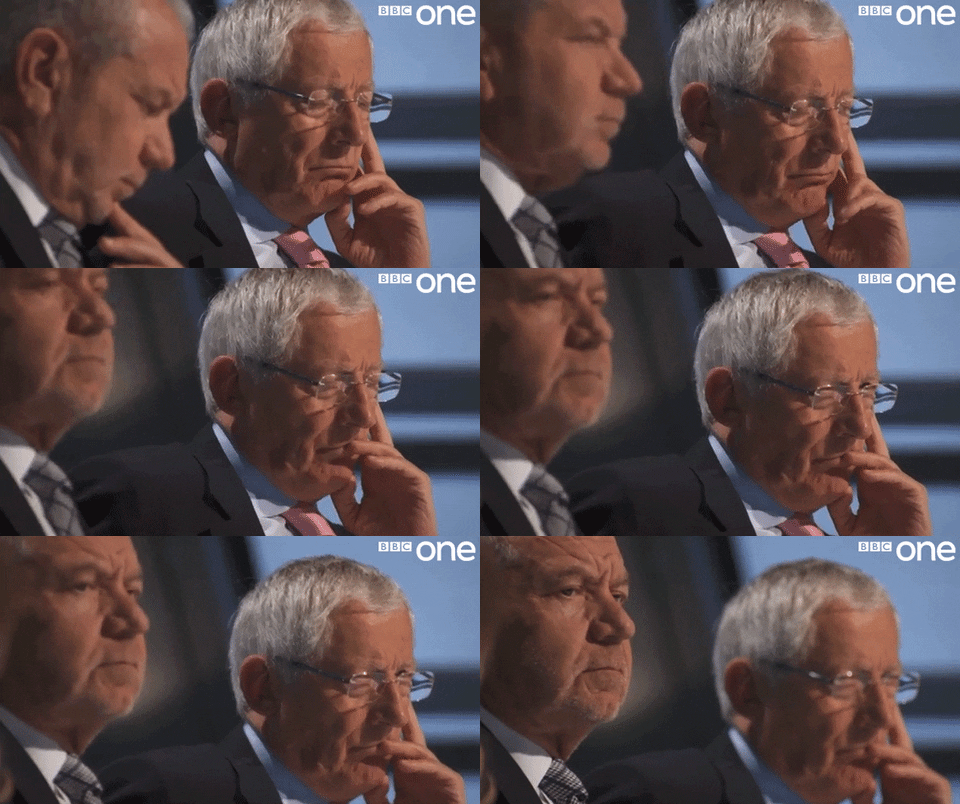
Enter (from a tiny door in the middle of the room, presumably coming from some sort of subterranean troll hole) Lord Sugar, the man whose apprentice these people are supposed to want to be.  Apparently he’s done well in big business, but he doesn’t strike me as someone dynamic enough to thrive in 2019’s brutal economy.  His furrowed brow thinly muffles the sounds of his mind whirring as he dodderily computes what’s said to him.  Fair enough, what’s being said is normally an accusatory argument between a handful of competitive business wannabes, but it all seems a bit much.  Relishing his own interruptions, our Alan then wheels out dad-gags that I swear have been written and fed to him by a team of eighties comedians.  Or sugar-jacked ten-year-olds.  If he announced “Well you’re a stupid poo poo head” to someone I don’t imagine a single eyebrow would rise in in surprise.  But that’s the thing about interviewing: best practice is to put the candidate at ease.  Instead, Sugar rules by fear and intimidation, pointing rudely and mistakenly firing people before he’s even employed them.  The apprentices might be inane, but I would feel more comfortable watching them judge him for his contributions to humanity.


The stupid contestants

This is a bit harsh as my only point of reference here has been the odd one that’s ended up on Celebrity Big Brother.  James Hill was actually a top lad, and I was even won over by Katie Hopkins in the house, watching her reason carefully with Katie Price in a way that betrayed a side to her which today’s unacceptable media persona has shat all over.  The rest come across as officewear-clad interns that talk a big game about their skills but end up set up for failure by each week’s task.  One thing I’ve learned in my working life is that nobody ever looks good blaming someone else, and yet these people sit in front of Sugar pointing fingers at poor old Jenny for not selling enough soap.  Maybe squabbling children is what’s missing from the world of professional behaviour, but it has me reaching for the remote.


Its crimes against humanity

Our UK version is based on an original US iteration that first gave a platform to Donald Trump.  This says it all.


Phone abuse

We’ll look back at The Apprentice UK’s most significant contribution to culture: holding the iPhone below your chin while talking on speaker.  This action became characteristic during the contestants’ various wild goose chases, coordinating errand teams sabotaging the overall effort on the sly.  Now it’s taken hold on the top deck of many of London’s buses, which is great if you want to be involved in other people’s banal chitter chatter.  Similarly, the tension of each episode’s climactic boardroom scene is supposedly elevated by a receptionist using the world’s oldest landline to tell the nervously waiting applicants as and when Sugar is summoning them to his shiny boardroom for some more showing off.  This all needs to stop.


In summary then, for those that might have missed the nuance, I really do take exception to this show.  It’s trash masquerading as premium, a theme that runs through the whole operation, from the contestants to Captain Sugar himself.  I don’t mind lots of showing off, but once someone’s screamed “look at me!” long enough to get your attention, they should have something interesting to tell you.  This is never the case in The Apprentice.  I don’t watch it, and I don’t like it.  Of course, loyal readers, you’re free to make your own decisions, just like Sugar is free of UK employment law in order to make his own hires.  But just be honest with yourself: you’re watching it because you like trash.