Wednesday, 4 November 2020

Atlanta

It was good while it lasted, but now we’re staying in again apparently.  I’m sure that will help.  Naturally, while rushing around seeing friends in the run up to everything closing again, talk turned, as it often does, to boxsets that could help pass the time while we wait for unelected government advisors to test their eyesight.  To anyone that will listen, I’ve been recommending Atlanta.  The show had long been on my list of things I must get round to, but it didn’t seem to be anywhere until its recent appearance on the BBC’s iPlayer.  Maybe it slipped on while they were busy making VTs about how this year’s series of Strictly is keeping to social distancing guidelines even though nobody cares anymore and just wants to watch some dancing.  Where I failed in my explanation though was in bringing to life the joys of Atlanta and why this is such a seminal show (it’s at number 124 currently on the IMDB list of top-rated shows, just behind Line Of Duty, which, when you think of how many TV programmes there are out in there in the world, is very good going).

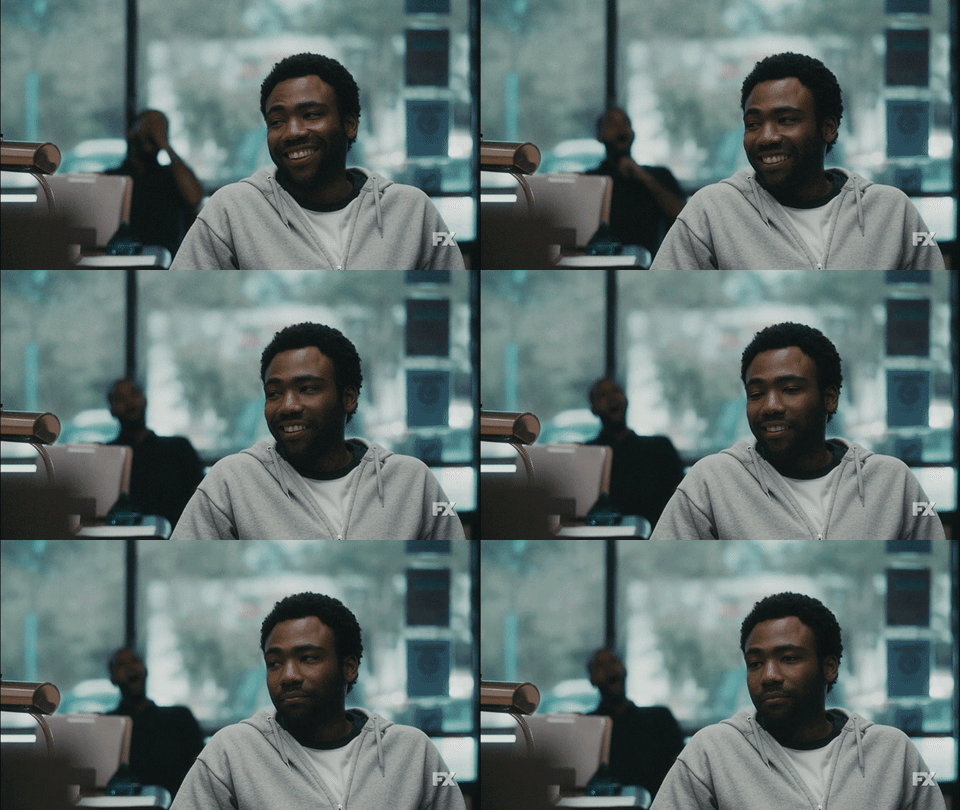
I’ll just wheel out some clichés here about why Atlanta defies categorisation.  It breaks the mould.  It’s one of a kind.  It’s truly unique.  Ok, there we go.  Now let’s talk about Donald Glover.  Our Donnie G is the creative force behind the whole show.  This is what made me realise that I needed Atlanta in my life.  Ever since I finished all his episodes of Community (Troy and Abed in the morning) there’s been a Troy Barnes-shaped chasm in my soul.  But gone are the bright smiles and innocent confusion of that character.  Instead we have scowling, unkempt facial hair and almost everything going wrong.  In Atlanta, Glover plays Earn, our leading man who isn’t really leading anyone anywhere (and is remarkably generous about stepping back to let the other characters shine).  We learn that he’s had educational potential, but it’s not amounted to much, with him struggling to hold down jobs, find places to live, care for his daughter and girlfriend.  We see his mum barring him entry to the house.  Throughout all of this, though, we root for Earn, a well-meaning everyman who’s often tested by but mostly tolerates the nonsense and weirdness of those around him.  And they are:

Van

Initially a background figure under the heading of baby momma, it’s thanks to Zazie Beetz’s magnetism that we’re grateful to see Vanessa step forward into focus as the two seasons progress.  She’s always surprising, whether whipping out richtig gut German in Helen at a crazy Bavarian festival (making it clear that we white folk are whack), dealing with her wasted friends at a supposed Drake party in Champagne Papi or struggling with an imbalanced and outdated friendship in Value.  These female-led instalments have lower ratings than the others, but this is just one of life’s great injustices.  Van steals my heart each time she rolls her eyes at others’ Instagram behaviour, so may we ever get to see more of her.

Paper Boi

This is actually Alfred, Earn’s cousin and smalltime-going-on-bigtime rapper.  When he can’t get off the sofa due to laziness, we really believe it, but Brian Tyree Henry comes into his own when required to cold-hard stare at anyone spouting nonsense.  In Barbershop, his frustration while trying to get a fade is so palpable it led me to sack off trying to pin down a barber to cut my hair before lockdown.  His must-see moment, though, is in B.A.N. when he’s forced to answer for his views on a late-night panel show, ambushed at every turn by virtue-signalling wokeness while the awkwardness is interspersed with fake adverts for African Americans on this pastiche of a popular channel.  Spoof ads have always had a special place in my amusement chambers and this episode delivers multiple belly laughs as a result.

Darius

Mostly found in Alfred’s kitchen, Darius is never doing what you expect him to.  LaKeith Stanfield is perfect at all times, never more so than when dealing with Teddy Perkins in a Michael Jackson-alike episode.

The rest of Atlanta is populated by all manner of grotesques, offering acerbic commentary on how race in the US interplays with wealth, work, education, family life, music, social media and just about everything you can think of.  We have humour in the deadpan observations, but also heartbreak in how easy it is to recognise these inequalities as very very real.  Atlanta’s strength comes from making everything somehow universal so that you’re forced to identify with the action as it unfolds.  But it doesn’t care what you’re expecting, calling to mind an I May Destroy You approach of drawing focus to whatever is more interesting, not what necessarily seems best placed to come next.  As such, each episode creates a work of its own, setting its own mix of characters, locations and times.  The throwback to Earn and Alfred’s schooldays seems at first leftfield, but artfully grounds what follows.

The soundtrack doesn’t stint on bangers and there’s even joy to behold in the opening credits.  Atlanta appears somewhere on screen in its unmistakable font, but you need to keep your eyes peeled to spot it among the madness.  I found myself tingling each time with excitement at the prospect of finding it, but maybe I need to get out more.  But I can’t because I’m now government-mandated to stay in.  The pandemic doesn’t stop there: it’s delayed production on the third series, automatically giving any return of Atlanta the epithet long-awaited.  And I shall wait as long as it takes.


Sunday, 25 October 2020

Motherland

I’ve been doing some parenting recently.  Well, I held a friend’s baby for about half an hour while she had a crème brûlée (the mum, not the three-month-old).  Despite not having procreated, I was fairly confident I could keep the young lad content with my impressive jiggling skills, honed over a decade ago when I was a quaternary caregiver to my niece.  A couple of times however, I could sense his bottom lip quiver, his copious cheeky cheeks redden and his little face screw up in unhappiness, prompting me to adopt a new position to distract him from any number of distress sources: hunger, overheating, a soiled gusset, boredom with the view.  When the moment came, I was fairly satisfied to be handing him back over, even if the girls had commented that his 6.5kg of weight had leant my biceps an alluring bulge.  If I factor up the duration of that brief stint of (quite literally) baby sitting to a week, I have to multiply its difficulty by 336, and if we go all the way to the eighteenth birthday at which point I assume you turf your progeny out into the street and cut them off from the family fortune, that’s a total of 314,496 units of parenting.  In short: child-rearing is hard.  And as the owner of a phallus, I’ve got the easy end of the stick, as it were.  Motherhood is hardest of all.  Here, then, is the hilarious truth that forms the comedic backbone to BBC sitcom, Motherland, whose achievements we will be celebrating today.

Too millennial ever to be aware of what’s scheduled on the actual TV, I was only vaguely conscious of Motherland’s two series when they first went out, catching glimpses whenever the real telly came when switching from Netflix to Amazon Prime.  I knew one of its creators was Sharon Horgan, who had co-created Catastrophe, and again, following my nose in working out why people on podcasts like a thing, I finally plumped to dive in after spotting Motherland’s first series appear on Netflix, before eventually tracking down the second on iPlayer.  I was craving the wit and cynicism of British humour after having so many glossy American boxsets in recent rotation: Power, Watchmen and, er, Love Island USA.  The situation is suburban London and the comedy is balancing childcare, a career, a relationship, and, worst of all, other mums, so let’s meet the mothers of this land:

Julia

The master of the fake smile, Julia covers up each episode’s mounting shower of disasters with a suitably correlating uptick in false cheerfulness, effectively using effusive exclamations to paper over cracks in her best-laid plans until she ultimately breaks down in ranting and raving.  We cross our fingers and toes that she will catch a break, but she’s ever thwarted by each element of what should be her support structure: her husband would help but he has to play golf with the lads, her mother would help but she’s entitled to enjoy her retirement, the other mums would help but they’re busy forming a sort of mummy Mean Girls (mean mums?) at the local café, consigning Julia to the table by the toilets.  A career in PR only makes matters worse, as it does most things, but it’s the people Julia meets at that lavatory-adjacent table who finally offer help.

Liz

The queen of laid-back parenting, Liz has had to develop more extreme coping strategies as a single mum.  Her seemingly thick skin places her well to encourage Julia to be less anxious, though Liz does herself later struggle with pushchair extraction when her youngest finally abandons her for nursery.  Life’s too short not to cut corners, and that time saved is better spent having a cheeky drink anyway.

Kevin

Yes, it’s a man, but Kevin is perhaps the mumsiest of all.  Contrasting with Liz’s workaround and make-do methods, Kevin is not happy unless he is out-parenting left, right and centre.  Desperate for the approval of the other mums, he volunteers for every PTA gig going, yet fails to find the acceptance he yearns for.  Mostly seen in a cagoule, his highlights are his throwaway lines about never-seen wife Gill as it’s clear to everyone but him that his approach to parenting makes her skin crawl.  Yes, Kevin is cloying, but his heart’s in the right place, and his very inclusion provides a spirited commentary on gender roles for those that are looking to find one.  Otherwise he’s a silly sausage in a bicycle helmet.

Amanda (not Mandy)

With her expensively coiffured blonde hair and yoga-taught frame, Amanda is the alpha-mummy whose every utterance either allows her to show off (less of the humble, more of the brag) or serves as a backhander to put down the other mums around her.  For some reason, I love her.

Anne

My favourite mum.  She begins as one of many flunkies to Amanda’s act as chief mum, but soon accumulates enough scene-stealing lines to guarantee belly laughs so loud that you can only hope you’re giving your neighbours a taste of their own medicine for all those lockdown reggaeton parties you’ve endured.  She’s a cautious parent, convinced all adults are out to molest or poison her offspring, which makes trick or treating challenging.  Her wardrobe malfunction at a swimming pool party and her poor management of her own IBS during a weekend away in half term both endear her further to me.

The second series also sees the introduction of Meg, a hard-partying, hard-working mum who hasn’t got time for any of your nonsense, unless it involves being abusive on night buses.  I can’t work out what they’ve been trying to do with her beyond address a lack of diversity but it’s great to have her along.  Let’s say she is wonderfully complex.

On the other hand, the kids rarely merit any significant characterisation and this is, again, because they don’t really matter.  The humour is brittle and acidic when it comes to deploring the role of modern working mums, running households, keeping everyone happy, sacrificing their interests and yet still being expected to knock up a harvest festival costume at a moment’s notice.  They’ve been told they can have it all, but yet somehow it feels like having nothing.  The swimming pool party episode illustrates this perfectly when Julia, hair done and posh outfit selected for a career-important work do, is strong-armed into in-pool supervision that leaves her showing up later at her function as drowned as a rat.  We laugh because it’s true, but as I recovered from each chortle, I had to check my childless male privilege lest I feel hopeless about a status quo whose imbalance looms large in daily lives.  Motherland’s comedy comes from its universal truth, but I’m sure we could find something else to laugh about if gender inequality no longer existed.

Sunday, 18 October 2020

Catastrophe

It’s easy to feel like your life is a mess.  Maybe you’re not where you thought you would be by this age.  Maybe your social channels lead you to believe that your lifestyle is not as enviable as your friends’.  Maybe it seems like everyone you know is desperately repopulating the earth with constant progeny whose names you’ll never really be arsed to learn while you’re channelling your energies into writing an unpopular blog about your views on recent TV shows you have been watching.  Well, have I got the show for you!  This week, we are doing Catastrophe.  I had somehow completely missed this show’s existence, yet became conscious of the appearances of creators Sharon Horgan and Rob Delaney as separate guests on a number of different podcasts whose back catalogues I am working through while sitting on buses wondering how far I can let my nose peak out of my facemask before someone scowls at me.

But there it was one evening on my unnavigable Amazon Prime EPG, drawing me in during one spare half hour before bedtime.  The comedy-drama’s origins arise in a business travel fling conducted between Delaney’s Rob Norris, our American in London, and Horgan’s Sharon Morris, our Irish fortysomething single lady at home in the capital.  Norris returns to the States, but Morris has conceived a baby and it’s this mini Norris-Morris that forces Sharon and Rob to upheave their whole lives while they work out what to do next.  Can a brief affair last for four hilarious and poignant series while Sharon and Rob repeatedly end up almost self-sabotaging their own happiness?  Well, yes.

Despite originating on opposite sides of the Atlantic, Rob and Sharon’s shared sense of humour unites them into a lasting bond which neither of their respective misdemeanours ever successfully ruptures, though you repeatedly worry each time that this will surely be the end.  Trading affectionate insults while scraping back the fanciful façade in which so many marriages shroud themselves for palatable public consumption, we’re shown a truthful relationship awash with painfully raw honesty, yet still dogged with sufficient dishonesty to engender tension.  We never shy away from the blood, sweat and tears required to keep things going.  At first, I found the bickering difficult, unused as I was to such harsh storytelling.  I couldn’t hook myself into a likeability anchor with any of the main characters.  But as time progresses and the Catastrophisers grow more familiar, a familiarity develops, and you become equally invested in their happiness.  And with this comes even greater laughs – by the end of the fourth season I was disturbing my neighbours with my chortles.  Well, I imagined I was, but one was probably screaming into his headset while playing computer games and the folk upstairs were having another lockdown party with reggaeton dancing.

Most importantly, nothing is overly dramatised.  Rob’s own struggle with alcoholism in particular, while blowing up rather climactically, progresses there with a believability that makes it all the more horrific.  In short, everyone is struggling, including Rob and Sharon’s own family and friends.  ExtrasAshley Jensen is worth her weight in gold as Fran, Sharon’s old friend who’s on call with a passive-aggressive comment at every juncture, until her own life starts to fall apart thanks to husband Chris or precocious actor son Jeffrey.  Sharon’s brother persists in being a hot mess throughout proceedings while Rob’s own friends and colleagues veer from one crisis to the next.  It’s probably only occasional babysitter Anna (played by Misfits’ goddess Lauren Socha) who has her life most on track, simply because she’s too laid back to care.  Or too young.

Storylines scatter and scarper, but, throughout, the kids are refreshingly ignored.  Rob and Sharon’s growing brood rarely come to centre stage, unless the plot requires them to bite someone or to have a name that’s difficult to pronounce.  This is about how hard it is to be an adult, a parent, a person.  The kids have it easy and are therefore not of interest.  Catastrophe’s episodes thus became essential comfort, four sets of six charming half hours to enjoy in the bath or at the end of a long day trapped inside.  The wit zips along with intelligence, anything generic is jettisoned and we’re left with a perfect balance of pure enjoyment and tempering miserable realism.  Any show that fails to acknowledge life is disastrous will ring hollow after Catastrophe, so you might as well view it yourself in order to distract from the terrible mess you have made of things.

Tuesday, 13 October 2020

Power

In and amongst the various quality boxsets (Watchmen) and trash series (Love Island USA) I might have on the go at any one time, there’s always a background show that I’m getting through at a more leisurely pace.  For the last one hundred years, this has been Power.  I forget when I finally relented to Netflix’s constant algorithmic suggestion that this was a show I might enjoy, but somehow I’ve got through its six series of at least ten (sometimes fifteen) one-hour episode.  Let’s be clear: I’m here to say I’m a fan of Power.  But, crikey, it’s been some tough going.  How easily and how often I’ve been distracted by shinier (Euphoria), cleverer (I May Destroy You) programming.

Firstly, let’s categorise the show.  It belongs in a group that I have previously christened: a whole lot of f*cking.  Alongside Elite and, let’s be honest, Game Of Thrones, Power viewing comes with the risk of sudden sexually explicit antics filling your screen.  Episode one barely throws out a few establishing shots before our sexy leads are not just cavorting in their marital bed, but properly having a right old go at some serious slap and tickle (I definitely heard scrotal slapping).  You don’t need to use your imagination, because nothing is left to it, but you might want to ensure your 55” telly screen isn’t overlooked by neighbours with young children and you haven’t yet sorted out curtains for your floor-to-ceiling French windows.

So, who are these people whose close-up intercourse is essential to the plot development?  Power is all about James “Jamie” St. Patrick, an NYC kid from the wrong side of the tracks who, after amassing a fortune from large-scale drug dealing, is trying to turn himself into a legitimate businessman.  Played by the exquisitely goateed Omari Hardwick, this is a character we root for no matter what terrible things he does, clothed or otherwise.  And if he happens to interpret legitimate business as opening up seedy nightclubs that are dogged by violent crime, then so be it.  What we rarely see Jamie doing is going to the gym, despite the fact he is stacked beyond all belief.  There’s some intense jogging in early seasons and he does visit a prison weights room later on (albeit briefly and bloodily), but I find it hard to believe he’s not constantly repping out some big lifts and counting his macros, in between trimming his beard, dealing drugs, shooting people, surveying his night club from a raised walkway or being an absolute sod to his long-suffering wife, Tasha, (Naturi Naughton).

Tasha St. Patrick is the heart of the show, often called upon to channel her inner boss to protect her family (with mixed success) or to ward off threats.  She and Jamie are often found in their swanky penthouse where the lift opens straight into the lounge, and it’s here they’re often visited by our third lead and Jamie’s childhood BFF, Tommy Egan.  I vowed I would never troll anyone on this blog, but Joseph Sikora is the hammiest actor I have ever seen.  It takes a real scenery-chewer to know one, so we can accept this is coming from a place of being a ham on stage myself, but you eventually develop a charmed affection for his idiosyncrasies – he is simply another layer of camp in the outrageous proceedings that almost never seem to end.

As we’ve noted before (Narcos, Narcos:Mexico) a career in drugs can be a touch stressful – I don’t think they even get to work from home during lockdown.  Drama dogs Tommy and Jamie at every step, with each season introducing a new array of dastardly dealers looking to steal their patches, take their connects and generally indulge in anti-competitive business practices.  Instead of litigation, recourse is taken rather to ultra-violence, with the body count exceeded only by the nudity count.  Whenever a fresh character is introduced, you’re hard pushed to guess whether they’ll die before they get naked or get naked before they die, or do both at the same time by dying naked.  As a homebody, the worst part about their chosen industry is the constant galivanting about town.  The endless texts and calls between the characters predominantly showcase them demanding to meet each other in person all over New York.  Once you factor in a journey time of more than 45 minutes each way then suddenly the millions of pounds earned from selling cocaine to yuppies don’t seem worth it at all, and that’s before the FBI start tailing you.

Despite being sexy and sleek, a certain bleakness with Power can take things out of you.  Sure it’s a banging soundtrack that accompanies the, er, banging, but everyone behaves like angry children and it can only really go round in circles as they cross, double-cross, triple-cross and shoot at each other.  It’s made me want to go back to New York, but I’m not currently allowed in case I bring the sniffles with me there or take it back with me afterwards.  For fans of 50 Cent, you’ve got 50 Cent, so I suppose that’s something, as he really does play an absolute shit.  Most galling for me was, being very close to the end, I inadvertently caught an advert for the spin-off series which spoiled the ending of Power completely, so all the hours of viewing became slightly redundant, resulting only in these few hundred words of poorly structured prose.  I’m about to search for GIFs to pepper in here and I’m a touch afraid about what I’ll see but, assuming you’re not pulling together an indulgent blog on your viewing experience, you can’t go wrong with a bit of Power’s sexy gangster mayhem.  And with Lockdown Two ruining lives near you soon, you’ll have plenty of time to get through it all.

Wednesday, 7 October 2020

Love Island USA

In a roller coaster year of dizzying highs and terrifying lows, I’m going to point the finger at ITV2 for being both the cause of and the solution to a large number of these peaks and troughs.  As we all know, the calendar year is built around Love Island.  Normally those wonderful weeks of coupling up each night with an hour of guaranteed good telly (apart from the oddly unengaging Saturday night highlights/unseen shows) synchronise with our British summers of torrential downpours and sticky sticky heatwaves (both of which give everyone a first-hand experience of our climate crisis future), but 2020 got off to a great start with an absolute glut of Majorcan madness thanks to the inaugural series of winter Love Island.

But then, as we all know, pandemic pandemonium took hold and nobody knew how to make a show about cracking on if contestants had to remain two metres apart, not to mention the indecipherable lottery that foreign travel had become.  With a shrug, the whole series was cancelled and my life was ruined.  Then, it was divulged there would be no further winter edition in 2021, meaning it was over a year till the next UK series.  I can cope with supermarket queues and remote working under the threat of redundancy, but this was a major gut punch.  Naturally, I blamed Boris.  Naturally, he blamed immigration.  Surely Love Island 2020 could go ahead if everyone claimed they were testing their eyesight?

ITV redeemed themselves by screening Love Island Australia and, even though it was an old series, it was the vape to the cigarette of my Love Island addiction.  But then someone had the bright idea of taking Love Island USA and giving it to us in real time, allowing a glorious watch-along with our American brethren – it turns out our special relationship extends beyond a catastrophic covid response and being led by privileged petulant blonde fatties.  Of course, I stopped for half a second to wonder how on earth the States were going to run a reality dating show which involves the liberal exchanging of bodily fluids (orally, mostly) in the midst of a world health emergency.

Apparently, the islanders quarantined before entering the villa, ensuring a negative test for the virus.  More importantly, while a luxury island was out of the question, the perfect solution was found in a Las Vegas rooftop.  Offering hot weather and the constant background hum of downtown traffic (interspersed with sirens), the producers had struck gold.  In fact, so much of Love Island’s much-needed escapism comes from its almost complete refusal to engage with the outside world.  There were some initial comments about lockdown, but our couples soon became the truly insular islanders we would expect.  Sure, we’re all sick of corona, but the absence of a single mention of Black Lives Matter among a group of diverse young people seems like a missed opportunity.  Even Justine opening up about her family’s time in a Kenyan refugee camp barely warranted more than a few seconds of screen time when I could happily have watched a one-hour special on the subject.

But, if to Love-Island is to act as if the outside world doesn’t matter, then this series of Love Island USA is serving up pure escapism with our perception of reality deliberately removed.  The pandemic doesn’t matter.  The centuries of racial oppression don’t matter.  The climate crisis doesn’t matter.  All that matters is finding a boyfriend or a girlfriend, as being single is the greatest travesty of all.  But, whereas 2019’s season of Love Island USA made the competition to couple up all too obvious, taking the more American approach to reality TV (ruthless game-planning), this new version has realised that a lot of the format’s charm lies in sticking closely to the silliness of the UK original.  At last, we have an irreverent voiceover, mocking every single thing our island young folk get up to.  A glamorous host wonders in on the odd occasion with bad news.  People shout out “got a text!”  The ridiculous challenges have been shipped over and acted out blow by blow (literally), while Casa Amor was a resounding triumph, descending quickly into explosive orgiastic debauchery and creating great telly.  I shall hand it to the Americans – they are TV naturals.  Unlike the Brits, they take themselves a touch more seriously and are better at articulating their emotions, and they will never shy away from a cheesy Hollywood moment with no sense of irony, but the senses of humour are there, alongside the budding friendships you want to join in with.  Of particular note this season is the island girls’ predilection for slipping suddenly into outrageous British accents to ask each other: “Are you alriiiight?”  This contrasts delightfully with their otherwise as-apple-pie American accents and is a healthy reminder of how stupid British people must sound abroad.  And at home.

Of course, the teeth are whiter, but the bikinis and trunks are no tighter.  Some bits are different, some are the same, but it’s enough to tide me over in my lockdown (will we, won’t we) viewing.  Sometimes it’s nice not to hear the T word (Trump) or to see human beings experience social contact without a curtain-twitching neighbour tutting.  And if you’re looking for pure joy, I recommend Cely from this year’s cohort.  Her constant ray of positivity starts every morning when she jumps out of bed with glee while her co-islander squint and groan, before she goes on to tackle every challenge and tribulation with laughter and good humour.  As the final approaches it will be interesting to see what American viewers make of her relationship with Johnny and whether they rate it over the slower and steadier Justine and Caleb.  All I know is I’ll be sorry again when it’s all over, but maybe there’s another international version of Love Island I can distract myself with.


Monday, 28 September 2020

Watchmen

Right, you can stop the pandemic now.  I’m not playing anymore.  Granted, I’ve only got prosecco problems when it comes to coping with covvers (the mask makes my beard itch, I want to go to the theatre, I could lose my job etc), but as a lifestyle trend it would be really great if we could move on to something new.  Such is the extent of my fatigue that I actively avoid almost all news, as it’s mostly just white male Etonians blustering about the perils of young people and other such evils.  But, my clicks were recently baited by reports of the Emmy Awards.  Sure, there was no ceremony, but this was a normal annual thing that was almost happening.  I’ve harped on here about incredible pieces of TV that have kept me glued to my sofa and, of course, there were those top shows among the nominees – you know, your Euphorias and your Successions.  However, among the winning boxsets I was proud of completing, there was one that had passed me by: Watchmen.

I got the first episode cued up, but it wasn’t until a Friday evening when I was taken by the mood to delve into the story.  We all know I’ve no time for superheroes.  I’ve even been underwhelmed by attempts to subvert the genre (The Boys).  Nevertheless, I had thoroughly enjoyed the film version of Watchmen when it came out in 2009.  Oddly plausible, artfully stylised and with a story I can no longer really recall (which wasn’t helped by a second viewing that I mostly slept through), the film gave me an underlying confidence that I wouldn’t be subjecting myself to mindless Marvel’s punching by numbers.  This would be something better.  And how right was I?  And the Emmys?  And also all the people that watched it when it came out last year and told me then that it was worth a watch?  My whole subsequent weekend was consumed by a need to finish the nine episodes, desperate as I was to solve the mounting mysteries and witness the conclusion of the very complicated plot (unlike the last episode of Dark that I am too scared to watch).

We’ll run through now how watching Watchmen checks off a lot of my boxes when it comes to a good, er, boxset.  First up, we’ve got the alternative reality, last seen blowing my mind in the third series of The Handmaid’s Tale.  In Watchmen, the Vietnam War has gone a bit differently, cars no longer use petrol, interdimensional squids are an ongoing hazard and, in Tulsa, the police are required to wear masks.  If you’re finding this disorientating, then I’ve come some way to approximating the experience of watching the first episode.  Initially, Watchmen doesn’t care if you’re clued up on what’s happening or not.  Somehow, I was thrilled by my own stupidity and electrified by the need to keep up.  Filling the gaps became a desperate urge, mostly because these important elements of context were only ever alluded to in passing, thus making the later expositions all the more plausible.  I was completely sold.

One alternate the Watchmen reality keeps the same is racial tension.  A prominent catalyst to the show’s events is the Tulsa race massacre, something which, to my shame, I had never heard of.  If Watchmen’s only achievement in this world is to make more people aware of the 1921 destruction of a prosperous Black neighbourhood by white supremacists, then for that alone I would doff my hat to it.  Throughout the present-day narrative, the threat of racists remains and looms large.  It’s given an all-the-more-terrifying edge by the way these thugs mask their beliefs with respectability, making us blind to their blind hatred, while they are deaf to reason.  I won’t reduce racial tension to a plot device – Watchmen unapologetically puts America’s issues with race front and centre – but it brings to life a good-versus-evil jeopardy that means so much more than generic white man hero battling generic supervillain.  And on that note, Watchmen revels in its championing of actors that are normally side-lined.  Reams and reams of glorious dialogue proceed without a white man in sight.

My final point to stress is Watchmen’s deft stretching of narrative tension so that each episode thwarts as much as it solves, carefully creating the coming crescendo which forms the mini-series’ climax.  Once enough intrigue is set up, the revelations come thick and fast.  Regina King is our (badass) anchor as we navigate each blow to the psyche, and don’t worry if you at first think that Yahya Abdul-Mateen II doesn’t have enough to do (see The Get Down and Black Mirror for evidence of his range), but around this central couple assembles an array of characters you can’t help but feel desperate to know more about.  I craved more of Jean Smart’s Agent Blake while Hong Chau’s Lady Trieu maintained the perfect level of moral ambiguity until just the right moment.  I won’t spoil things by saying one or two minutes of the finale got just a touch too Marvel-y for me as everything else was a sublime televisual experience.

If we end up confined to our homes again, then Watchmen is the closest you can get to the visceral real-life experiences we have been lacking in 2020.  Maybe we do need heroes after all, but Watchmen’s heroes aren’t preening about in Spandex demanding attention for selective philanthropy.  Instead, they’re driven by their own hatred of systems and belief structures that hold humankind back.  They’re compelled to act against what is wrong, no matter the cost, and this is quite rightly what Watchmen presents as heroism.  Anyway, we seem to have strayed into some very uncharacteristically earnest territory for Just One More Episode, especially when we’re all here for passive aggression and sarcasm.  But what can I say?  Here is a boxset that transcends all the blue willy comments it’s left itself open to.  If only all storytelling could be this good, and this important.

Monday, 21 September 2020

W1A

This week, nobody has been asking me the following question: what other hidden gems in the world of comedy have you uncovered since you wrote so passionately about Crashing?  Nevertheless, I do need to tell you that I have gone and done it again.  I’ve come across a show whose existence I was completely oblivious to and now I’m going to harp on about it like I invented it myself.  It was probably huge at the time and is therefore already beloved by millions, but this is my blog and I can do whatever I like.  Something else people never ask me is how I decide which shows to feature in my self-indulging prose.  Well, there is no method to this madness.  I do have a longlist of shows I ought to get around to and this week’s programme was in fact on there – something I didn’t even realise until I had finished the third and (hopefully not) final season.  Anyway, preamble aside, we’re doing W1A this week.

Now, regular readers will be aware of my increasing despair when it comes to how awful we British our proving ourselves to be.  The dangerous yearning to return to a post-war peak from 75 years ago threatens everyone’s present-day opportunities.  Nevertheless, alongside the sinister jingoistic gymnastics, there are British traits that, conversely, feel as comforting and familiar as saying sorry to a stranger who’s bumped into you.  One of these is always suspecting we will make a mess of things.  Our trains can’t run in the snow, our trains can’t run in the heat, our breweries have hosted poorly organised piss-ups.  Back when we won the 2012 Olympics, everyone rolled their eyes in anticipation of ensuing shambles (when it was actually a recent national peak, inequality riots aside, and I’m not just talking about me dancing in the closing ceremony…).  So little faith did London’s wonderful liberal elite have in the organising committee than an irreverent sitcom was conceived: Twenty Twelve played on our suspicions surrounding how petty office bureaucrats would arrange and execute so much sport.  Sadly, I never saw this show and can’t find it anywhere, but W1A is its successor, following on with the adventures of Ian Fletcher (that lovely Hugh Bonneville off that lovely Downton Abbey) as he takes up a new post at the BBC.

Aha, you say, another institution we can deride for being a bunch of silly sausages.  How dare they make pensioners pay for their licenses when they of course deserve everything for free?  How dare there allow two women to dance together on Strictly?  How dare they pay female staff less than men?  (Guess which of these three is my actual opinion).  But, this is a BBC production, brilliantly sending up itself and our perceptions of the pencil-pushers who make it tick.  Fletcher serves as our guide in this institutionalised institution, stumbling through Old and New Broadcasting House trying to make sense of how things are done as the new Head of Values while slowly coming to accept that everyone is either incompetent at what they do, or they don’t do anything at all.  It’s at this point I must stress that the whole thing is laugh-out-loud funny.  I giggled my socks off in every single episode, so let’s count down which comedy creations scored the most LOLs on my chuckle-o-meter:

One: David Wilkes, played by Rufus Jones

As a development exec responsible for evolving potential show formats into ratings winners, Wilkes channels a new level of incompetency.  In any meeting, he expertly absolves himself of blame for every action and inaction of his.  He’s there, behind the fridge door, ready to steal your idea and take all the credit.  He interrupts discussions to tell everyone he can’t believe it and prefixes the name of anyone they are talking about with the adjective lovely: “Lovely Izzy, lovely Lucy.”  He’s frequently told to shut up and this generates in me the purest of joy.

Two: Siobhan Sharp, played by Jessica Hynes (seen in The Royle Family)

Another overspill from Twenty Twelve, Sharp is the PR guru who is incapable of listening to anyone but herself.  She is soundbites, mixed metaphors and statement jewellery, the very definition of having nothing original or useful to say.  Her response to every crisis is to blow things up on Twitter.  Her voice is supremely smug and she’ll announce that she’s “good with that” despite nobody requiring her approval.  I get the sense that whoever created her had some axe to grind after spending one too many meetings with members of the PR industry.  I can’t think why.

Three: Will Humphries, played by Hugh Skinner (seen in Fleabag)

“Yeah, no, hi, ok cool.”  Like everyone else, Will rarely says what he means, but he doesn’t know what he means anyway so it doesn’t matter.  He’s the awkward intern who’s overstayed his internship, but Skinner’s facial expressions show the perfect perplexity as Will screws up the simplest of tasks.

Four: Anna Rampton, played by Sarah Parish

As Head of Output, Rampton’s inability to move her top lip marks her out as a serious woman in business.  By repeating “yes, exactly, yes” she falsely portrays an air of decisive action while never doing anything.  Her catchphrase wears out slightly in later series, but she is at her funniest early on refusing every requested refreshment that is brought to her: “No, I don’t want that.”

Five: Simon Harwood, played by Jason Watkins

Harwood is that colleague we all sadly have.  The saboteur who wanted your role.  Non-committal, but always prepare to play his hand as a self-claimed confidante of the Director General (with whom he might enjoy the odd morning muffin), Harwood’s passive-aggression can be seen from space.  He’s constantly telling people he has no idea how things work (because they should) and that they will know how they want to play things (because he’s sure as hell not helping), before emitting one of his frequent exclamations of “brilliant” no matter what’s been decided.

I could go on.  There’s the for-once palatable David Tennant narrating, inserting the odd word to render all action ridiculous (particularly the Ministry for Culture, Media and, also, Sport).  You’ve got Tracy Pritchard beginning every criticism with “I’m not being funny but…”  Ben and/or Jerry bring a surreal element to the incredible pacing of every Damage Limitation meeting.  Layer upon layer of farce is dolloped out in rich scoops, crescendoing into ill-fated launches.  But it’s almost too close to home.  Some of the meetings feel like they were taken directly out of my life.  The curious inability of each and every character to communicate clearly makes wondrous use of two of the English language’s most abused words: yes and no.  Never seen alone or with certainty, W1A is strewn with oodles of “yes no” and lashings of “no yes” and then further fleshed out with generous portions of “yes no yes” and “no yes no.”  Playing out in a corner of London where I’ve worked for the last ten years, I look for myself in the background of scenes were Fletchers cycles into the office on his terrible Brompton (which bikes’ super-naffness is played for miles as laughs).  I’ve even been in the offices of Siobhan Sharp’s Fun Media on many occasions.

Get on the sofa and consume this immediately.  And then tell me if I was right or wrong about its brilliance.  Fair play to the Beeb for being such a good sport, lampooning itself for comedy (though never mentioning its news coverage’s right-wing leanings).  It’s not perfect – some exasperation at increasing wokeness has dated slightly.  Characters start to repeat their catchphrases too much and the freshness of the surprise wears off.  There’s an inevitable love triangle involving Ian Fletcher that doesn’t ring true, while the relationship between Izzy and Will remains effortlessly more charming.  We might not be able to organise a Brexit (so let’s stay) or a pandemic, but we sure can organise a silly sitcom about people who can’t organise things.