Showing posts with label dating show. Show all posts

Wednesday, 7 October 2020

Love Island USA

In a roller coaster year of dizzying highs and terrifying lows, I’m going to point the finger at ITV2 for being both the cause of and the solution to a large number of these peaks and troughs.  As we all know, the calendar year is built around Love Island.  Normally those wonderful weeks of coupling up each night with an hour of guaranteed good telly (apart from the oddly unengaging Saturday night highlights/unseen shows) synchronise with our British summers of torrential downpours and sticky sticky heatwaves (both of which give everyone a first-hand experience of our climate crisis future), but 2020 got off to a great start with an absolute glut of Majorcan madness thanks to the inaugural series of winter Love Island.

But then, as we all know, pandemic pandemonium took hold and nobody knew how to make a show about cracking on if contestants had to remain two metres apart, not to mention the indecipherable lottery that foreign travel had become.  With a shrug, the whole series was cancelled and my life was ruined.  Then, it was divulged there would be no further winter edition in 2021, meaning it was over a year till the next UK series.  I can cope with supermarket queues and remote working under the threat of redundancy, but this was a major gut punch.  Naturally, I blamed Boris.  Naturally, he blamed immigration.  Surely Love Island 2020 could go ahead if everyone claimed they were testing their eyesight?

ITV redeemed themselves by screening Love Island Australia and, even though it was an old series, it was the vape to the cigarette of my Love Island addiction.  But then someone had the bright idea of taking Love Island USA and giving it to us in real time, allowing a glorious watch-along with our American brethren – it turns out our special relationship extends beyond a catastrophic covid response and being led by privileged petulant blonde fatties.  Of course, I stopped for half a second to wonder how on earth the States were going to run a reality dating show which involves the liberal exchanging of bodily fluids (orally, mostly) in the midst of a world health emergency.

Apparently, the islanders quarantined before entering the villa, ensuring a negative test for the virus.  More importantly, while a luxury island was out of the question, the perfect solution was found in a Las Vegas rooftop.  Offering hot weather and the constant background hum of downtown traffic (interspersed with sirens), the producers had struck gold.  In fact, so much of Love Island’s much-needed escapism comes from its almost complete refusal to engage with the outside world.  There were some initial comments about lockdown, but our couples soon became the truly insular islanders we would expect.  Sure, we’re all sick of corona, but the absence of a single mention of Black Lives Matter among a group of diverse young people seems like a missed opportunity.  Even Justine opening up about her family’s time in a Kenyan refugee camp barely warranted more than a few seconds of screen time when I could happily have watched a one-hour special on the subject.

But, if to Love-Island is to act as if the outside world doesn’t matter, then this series of Love Island USA is serving up pure escapism with our perception of reality deliberately removed.  The pandemic doesn’t matter.  The centuries of racial oppression don’t matter.  The climate crisis doesn’t matter.  All that matters is finding a boyfriend or a girlfriend, as being single is the greatest travesty of all.  But, whereas 2019’s season of Love Island USA made the competition to couple up all too obvious, taking the more American approach to reality TV (ruthless game-planning), this new version has realised that a lot of the format’s charm lies in sticking closely to the silliness of the UK original.  At last, we have an irreverent voiceover, mocking every single thing our island young folk get up to.  A glamorous host wonders in on the odd occasion with bad news.  People shout out “got a text!”  The ridiculous challenges have been shipped over and acted out blow by blow (literally), while Casa Amor was a resounding triumph, descending quickly into explosive orgiastic debauchery and creating great telly.  I shall hand it to the Americans – they are TV naturals.  Unlike the Brits, they take themselves a touch more seriously and are better at articulating their emotions, and they will never shy away from a cheesy Hollywood moment with no sense of irony, but the senses of humour are there, alongside the budding friendships you want to join in with.  Of particular note this season is the island girls’ predilection for slipping suddenly into outrageous British accents to ask each other: “Are you alriiiight?”  This contrasts delightfully with their otherwise as-apple-pie American accents and is a healthy reminder of how stupid British people must sound abroad.  And at home.

Of course, the teeth are whiter, but the bikinis and trunks are no tighter.  Some bits are different, some are the same, but it’s enough to tide me over in my lockdown (will we, won’t we) viewing.  Sometimes it’s nice not to hear the T word (Trump) or to see human beings experience social contact without a curtain-twitching neighbour tutting.  And if you’re looking for pure joy, I recommend Cely from this year’s cohort.  Her constant ray of positivity starts every morning when she jumps out of bed with glee while her co-islander squint and groan, before she goes on to tackle every challenge and tribulation with laughter and good humour.  As the final approaches it will be interesting to see what American viewers make of her relationship with Johnny and whether they rate it over the slower and steadier Justine and Caleb.  All I know is I’ll be sorry again when it’s all over, but maybe there’s another international version of Love Island I can distract myself with.


Wednesday, 8 July 2020

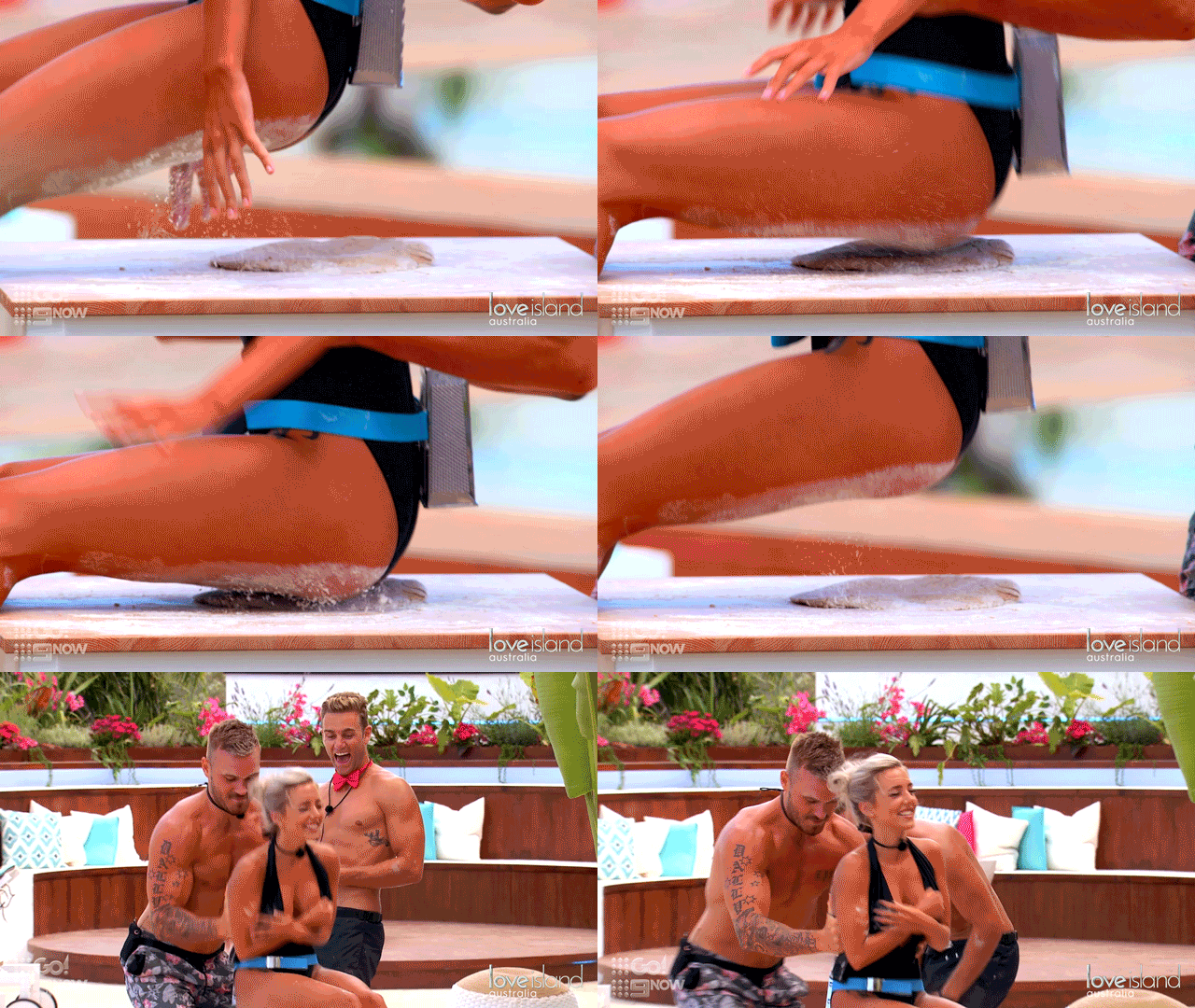
Love Island Australia


To what extent is showing a 2018 season of Love Island Australia an adequate replacement for a new series of summer Love Island in the UK?


While this is a question I could ask ITV, it’s actually the essay question I have set myself for this week’s blog entry.  No, sadly I’ve not completed an impressive foreign boxset that I’m going to tell you all about this week (though a third and final series of Dark has dropped).  So we’re turning to what is fast becoming my favourite lockdown viewing.  Let’s be honest, this pandemic has a lot to answer for.  We’re not allowed to have strangers invade our personal space on public transport.  We can’t spend all day in an office wondering what the dog is doing while we’re not home.  We can no longer speculate whether our elected (no, really) government could cope with a national crisis (they can’t).  These are all things we can live with (or without).  But when ITV pointed out that a socially-distanced version of our favourite reality dating show might not fulfil our expectations (you can’t watch a couple under a twitching duvet via night vision if they have to be two metres apart), all while having no clue whether foreign travel would be in any way possible, it felt like the final straw.  This pandemic might just be a bad thing.


However, in a stroke of genius, they decided to whack on another nation’s first series, probably reasoning it was close enough.  The good news about Australia is that we’re super familiar with it.  It doesn’t suffer from the gloss of the US’s TV output (the scripted dramas, I mean, not the dross of their political news).  Generations of Brits grew up on Ozzie soaps – every weekday dinner of mine after primary school in the early 90s was accompanied by Home & Away and Neighbours.  We swap our populations back and forth, nowhere more so than in the media industry (where I work (from home)).  Australiana is pretty easy to get used to.  In addition, the Australian version has all the familiarity of also being filmed in Majorca.  Not in the same villa, mind, but near enough.  I’m struck by the imagined statistic that 80% of this Balearic island’s GDP comes from various nations filming their versions of Love Island on it.  These two points made Love Island Australia a much more obvious choice than the US version, whose departures from key format points and inclusion of actual Americans means it loses all the charm of the original.


Alongside the classic setting, we also have the characteristically irreverent voiceover, though the Celt of choice here is an Irishman instead of a Scot.  The stray cats that visit the villa provide most of the ammo for his humour but I think we can all agree there is nothing funnier than a cat.  Just look at the reason for the internet’s invention: cat videos.  We also have a glamorous hostess entering the villa with bad news for the couples at random junctures.  Sadly, we lost the UK’s OG presenter earlier this year after our vile tabloids hounded Caroline Flack to her death yet faced no consequences, with Laura Whitmore taking over from her dear friend.  In the Australian version, former popstar Sophie Monk proves a feisty equivalent, and her antipodean vowels are so wonderful that I can’t help but suspect she may be a new character from Kath & Kim.  There are still texts with hashtags in them.  In summary, it’s similar enough then…


So, in order to answer the question (and if I learnt anything from GCSE it’s that’s you must make sure you answer the question) we need to look at the contestants.  This was perhaps my greatest stumbling block when it came to convincing myself that I had been provided with a worthy replacement.  They didn’t do much to grab me in the first episode, though the girls’ reluctance to step forth for anyone at all was amusing.  There was a major lack of diversity.  But then, with any season, it takes a few days to marinade and, before long, I began to look forward to catching up on the previous night’s shenanigans with all my new pals after a videocall-heavy day at the laptop.


Somehow, then, this can become an adequate replacement.  But there are certain rules that I must impart when it comes to being able to enjoy it as much as a brand new series of our own.  The first is that you mustn’t look ahead online to find out what the future held in store for these young Australians who are so full of hope in 2018.  To do so would deflate any of the tension that makes the show so compelling.  The second is that you need to attune to a different vibe on the behaviour.  So far, the Australian girls have proven much quicker to attack one another, never hiding their mutual dislike (split along hair colour lines) which, while a contrast to the British besties that emerge, is actually palatable as a more honest approach to the villa’s interpersonal relationships.  The boys seem to be predominantly from the socio-economic group that Australians describe as bogan, but on the whole are a slightly gruffer and less flamboyant equivalent of our own tattooed chaps.


I’ll conclude my essay with the answer to my own question.  Love Island Australia is quite an adequate replacement, offering charm and entertainment in its own way.  To illustrate, we’ll touch on my favourites of each gender.  From the boys, it’s Josh who, while one of the slenderer and under-tattoeed specimens, wins out consistently on personality simply because he speaks with the authority of someone who knows that confidence is the same as, if not better than, intelligence.  When the boys ask him for wisdom, he’s happy to fabricate his responses with the hilarious consequence that they almost always believe him.  From the girls, it’s Millie.  Shrugging off any nonsense from those of her own gender when it comes to disagreements, she’s practical and resilient, and would much rather be writhing around in the pool on an inflated flamingo than getting into arguments.  Wouldn’t we all.