Saturday, 21 November 2020

The Fall

Yes, I’ve fallen.  Into The Fall.  There was a sudden urge in me for something gritty and British.  Something grittish.  On Netflix’s autoplay function, the clip of this show answered my specifications perfectly: dashboard-shot footage of an approach to a crime scene, greyness everywhere, probably some drizzle, Gillian Anderson looking a bit grumpy.  Right, I thought, this is going to be the perfect blend of Line Of Duty and Happy Valley – everyone says it’s supposed to be very good.

The grip came very early on and I was soon anxious to get through as much of the three series as quickly as I could.  But what were we dealing with?  First of all, there was a location that was pretty new for me.  The Fall plays out in Northern Ireland and, more specifically, Belfast.  Now, I appreciate that even me saying that this programme fulfilled my need for something British can be interpreted as political – the whole place has been hotly contested as either Irish or part of the UK since way before my conception in the mid-eighties.  The Troubles were rarely out of the news in my childhood, and we even revisited them at A-Level when someone thought we should look at the cold cold poetry of Seamus Heaney, but there’s been a peace process for ages now.  Some would say for too long, so it’s a good job people voted for Brexit and we can all hurry back in time at the earliest opportunity.  It’s not like the year has already been a bit of a state.  Nevertheless, as the murders played out, I found myself deciding I really ought to visit Belfast at some point.

Aye, murder.  Here we are again, fuelling another British obsession: the details of how young women are murdered.  They’re not prostitutes this time, but successful career brunettes, targeted carefully by our killer, haunted and taunted until dispatched by slow strangulation.  This part of the story, dominating the first series, is taut with tension, from police not believing claims of home invasion, to the sleight of hand used to home in on the next victim.  The Northern Irish police force are refusing to acknowledge that a string of murders could be linked, flying in our Gillian as London-based Stella Gibson to investigate how previous operations have failed to yield results.

Anderson is enjoying something of a renaissance as a very British actor, even though she’s proper American.  Her X Files days still plague my nightmares (not her, but that ghost going down the stairs in the opening credits), but she’s given us pure joy in Sex Education and is currently on Thatcher duties in the latest lavish season of The Crown (the Diana years).  The Netflix blurb described her character as an ice queen, but there’s more to Gibson than perfect hair and some nice flowy blouses.  She stands up to the men around her.  She owns her sexuality.  She’s focused on her career.  We know she’s sensitive because, you know, she has a dream journal and that, but she’s a captivating hero and we urge her to succeed.  She even sleeps at work and, by season three, this seems to be taking its toll, as her voice establishes a distracting rasp.

Uncomfortably, she finds herself drawn to the killer as much as he to her.  The obsession tests the bounds not just of her professionalism, but also affects his murderous ambitions.  I don’t want to spoil who our main suspect is, so I’ll just now start to talk about Jamie Dornan as part of a completely unrelated matter.  He remains inscrutable throughout.  While his torso is for spurious reasons shown in varying states of undress at any excuse, working out why he is the way he is remains a mystery, its illumination only really beginning as we build to the final series’ climax.  As Paul Spector, he’s a loving dad (to his daughter at least) but a neglectful husband.  He alternates between leading on and spurning poor wee Katie Benedetto.  He stands up to yet is cowed by the likes of James Tyler.  It’s fitting that we never know whether we can believe him, even when he gives a firm yes in police interviews (never a yeah).

But, once the chase of Gibson’s cat to his mouse is more or less over, things slow down and settle a bit, such that the lack of momentum drove me to distraction.  In this lull, I started and finished The Staircase before forcing myself to return to the story.  I’m glad I did but, looking back at the sum of its parts, there are elements to its sprawlingly ambitious web of narratives that I wish we’d returned to or gained more closure on.  Corruption in the police force from series one fades away.  Supporting officers in the investigation get a bit of interesting characterisation before relegation to the background.  Our focus grows tighter and more claustrophobic culminating quite literally in Spector-on-Gibson action.

Join me, then, in taking a fall into The Fall.  If your second lockdown isn’t harrowing enough, this will surely contain enough gruesome themes to keep you in the house.  Just make sure you pop out if you find your bra laid out on the bed.

Thursday, 19 November 2020

The Staircase

Deep in a second lockdown, the last thing you need while trying to account for lost income and no gyms (thanks, Bozza) is a tense and paranoia-inducing documentary about murder, guilt, loss and the flaws in any justice system.  I know this now.  But I didn’t when I decided the time had finally come for me to consume Netflix’s well-known thirteen-part series: The Staircase.  Previously, it had proven easy enough to ignore in the algorithm, particularly with such distractions as the second series of The End Of The F***ing World, a Wales-based attempt at I’m A Celebrity (works quite well, actually) and, thank goodness, despite its dilution by social distancing, Strictly Come Dancing.  Don’t even ask me about season four of The Crown – that will just have to wait (plus it’s not like my enjoyment is at risk from spoilers).  But no, podcast after podcast had conspired to reference The Staircase in heated discussion, bringing out my worst fear: boxset omission.  Here I am carefully curating all my viewing so I can chime in with any conversation, and yet I had missed what sounded like a bit of a classic.  Not that I can interrupt people while podcasting.  I’ve tried that before and they can’t actually hear you so there’s no point.

Potentially a poor man’s Making A Murderer, The Staircase looks like it’s going to offer you the same sort of did-he-didn’t-he, blow-by-blow account of an American crime as examined through the American justice system.  Indeed, both shows err on the side of the subject’s pleas of innocence, highlighting how courthouses are vulnerable to corruption, bias and unfairness, but while the Steven Amery case focuses on a low-income family whose only wealth is in the form of dilapidated cars, the clan at the centre of our story, by the look of their North Carolina mansion, seem to be drenched in riches.

But, they do have an awkwardly poky staircase, and it’s this part of the interior that forms the point of dispute driving the whole series’ narrative.  At the bottom of it, the body of Kathleen Peterson is found in 2001, covered in blood.  Is her tragic death an accidental fall, or the result of murder by her husband, Michael Peterson?  Either way, it’s his frantic calls to 911 that open our story.  It’s a chilling beginning and one seemingly designed to arouse suspicion immediately.  As the trial proceeds and we learn more about the Petersons’ happy family home, containing well turned-out children from previous marriages as well as some adopted daughters, we can only look on as the state brings a case against Michael and appears willing to play every trick to clinch a conviction.  We’re going back twenty years, so attitudes towards sexuality highlight an excess of narrow-mindedness.  Juror response research even yields free admissions that experts with Chinese accents aren’t easy to trust.  The odds stack up against Michael who, out on bail, potters about his large home drinking cans of Diet Coke while his legal team strategise.  He brings to mind an early-season Caitlyn Jenner in Keeping Up With The Kardashians, bemused by the goings on of the young people in the home but ultimately happy in some jogging bottoms.

It’s hard to discuss much more about the case without spoiling the plot.  I was hoping for references to an owl theory that had played out centrally in the podcast discussions that had driven me to the programme, but, unless I blacked out at very specific moments, I totally missed this.  Instead, over the course of many years, we watch a middle-aged man grow very old and suffer, eliciting natural sympathy no matter the verdict.  This is contrasted with the burning hatred that Kathleen’s surviving sisters have for him, which grows only stronger with time, giving some indication of the impetus behind his prosecution.  There’s uneasy viewing throughout, from graphic depictions of Kathleen after her fall to deeply skin-crawling testimonies in the courtroom.

As we progress, you develop a sense of melancholy from all the waste.  All the time, money, energy and emotion that goes into something like this, only for it never truly to be over, highlights the human damage and hopelessness such a case leaves in its wake.  Nothing can bring Kathleen back and nothing can make clear what really happened.  Our perspective is only ever really that of the accused, so sympathies naturally develop there, but nobody really wins.

The episodes each pivot around a singular development in the case, but we could potentially have zipped through some of them a bit more quickly to tighten up the documentary’s intensity.  The shaky footage from the early 2000s is hardly going to stress out your HD telly, but this is more of an unputdownable story than a visual feast by any stretch of the imagination.  In addition, the camerawork improves as the episodes shift focus nearer to the present day, particularly in the three final editions added by Netflix.  You’ll come away feeling uneasy, knowing what a blow poke is and questioning who gets to decide guilt and innocence, but at least you’ll be about thirteen hours closer to the end of a lockdown.

Wednesday, 11 November 2020

Mock The Week

I’ve just done a quick check, and I don’t think we’ve done a panel show before.  Unless you count University Challenge as a panel show, and you shouldn’t, because it’s not one.  It’s actually a quiz.  It differs from panel shows because people are actually trying to give the right answers to difficult questions.  Though panel shows are also quizzes of sorts, it’s more important to give a hilarious answer instead of a correct one.  And the questions are easier.

The reason I’ve not talked about one here before, though, is because I don’t really watch them.  Like chat shows, they seem to be a bit of a waste of time.  Chat shows are just people plugging their new book with rehearsed anecdotes while a former comedian swoons over them – I can get this sort of content from podcasts without having to use my eyeballs.  In my millennial office life (and by office, I mean working from home) nobody ever makes an appointment to view a panel show.  Lots of them are broadcast on Friday nights when we’re all at after-work drinks (not me), and now we’re not allowed to do that anymore, we’re too deep in season two of The Boys (no thanks) or the end of Schitt’s Creek (already completed it) to tune in.  In short, panel shows aren’t the kind of boxsets you can show off to your friends with.

When I still lived at home, Have I Got News For You was a firm family favourite.  Little did we know we were choosing our future PM based on who was the most discombobulated panellist (well, I didn’t vote for him, but it was f***ing one of yas – dezguztan!).  My parents still relish how the show’s humour makes a farce of British politics, but for me the subject matter is already too much of a farce to be funny anymore.  I once spent a whole train journey to Cornwall for work (shout out Eden Project) watching Never Mind The Buzzcocks on my phone and laughing so loudly that fellow passengers worried for my sanity.  But will we ever get Simon Amstell back?  I may save this for a future edition, as is my plan with Celebrity Juice, so we’ll try and focus on the show in hand.

The reason I’m picking Mock The Week is that I’ve come to admit begrudgingly it’s actually rather good.  Of an evening, around 10pm, as I disconnect the telly from Netflix or Amazon Prime or Sky Boxsets, I’m hit with a brief glimpse into live terrestrial telly.  The channel is never set to BBC1 or ITV, as my life is too worth living ever to sit through either station’s ten o’clock news – I am not going to bed angry.  Invariably, it’s BBC2, which means, on a certain night of the week I have thus far not ascertained, Mock The Week is in full swing.  Whether it’s a repeat, or a more recent edition with fun-ruining plastic dividers and social distancing, I will typically lose between ten and twenty minutes of delicious sleep because I’ve become distracted by the hilarity on screen.  But it’s worth it.

The idea is to laugh at things that have happened in the last seven days.  That’s where the name comes from.  Mocking the week.  Got it?  Good.  And we all know we could do with a laugh these days.  Given my fractional viewing, I’m not too sure of the rest of the format.  Dara Ó Briain ably chairs proceedings, a characterful man who combines erudition with, my personal favourite, plenty of silliness.  He once called me a c**t at a live show in response to my answer to his question regarding what job I do.  So I consider him a close personal friend.

The two teams of three that make up the rest of the panel are a revolving retinue of comedians, all taking part willingly in the weekly mockery.  More recent episodes have seen a great big shift upwards in the diversity of backgrounds here and if this doesn’t excite you then please stop reading now.  I’m up for banning white men from all TV and politics for the next five years (especially me) and seeing how we get on.  What’s the worst that can happen?  Sadly, this would cost me some of my favourites: Ed Gamble and his dry delivery, James Acaster and his perpetual face of confusion (let’s all agree to watch his Netflix specials please) and Tom Allen, taking a break from slagging off cakes but in a charming way on Bake Off: Extra Slice.

Sometimes our panellists sit around, sometimes there’s a microphone on a stand that they have to dash towards from little raised platforms and it’s fun wondering if they’ll bump into each other.  Sometimes you wonder how people can be so quick-witted, sometimes you wonder if they’ve had time to prepare their best lines.  Either way, there are plenty of chuckles to go round for everyone and, of course, nobody cares who actually wins.  I couldn’t even tell you if scores are kept – that’s just how little research I do for these posts.  And so, Mock The Week, let us salute you as a pandemic hero – you’re making me want to watch you in spite of myself.

Wednesday, 4 November 2020

Atlanta

It was good while it lasted, but now we’re staying in again apparently.  I’m sure that will help.  Naturally, while rushing around seeing friends in the run up to everything closing again, talk turned, as it often does, to boxsets that could help pass the time while we wait for unelected government advisors to test their eyesight.  To anyone that will listen, I’ve been recommending Atlanta.  The show had long been on my list of things I must get round to, but it didn’t seem to be anywhere until its recent appearance on the BBC’s iPlayer.  Maybe it slipped on while they were busy making VTs about how this year’s series of Strictly is keeping to social distancing guidelines even though nobody cares anymore and just wants to watch some dancing.  Where I failed in my explanation though was in bringing to life the joys of Atlanta and why this is such a seminal show (it’s at number 124 currently on the IMDB list of top-rated shows, just behind Line Of Duty, which, when you think of how many TV programmes there are out in there in the world, is very good going).

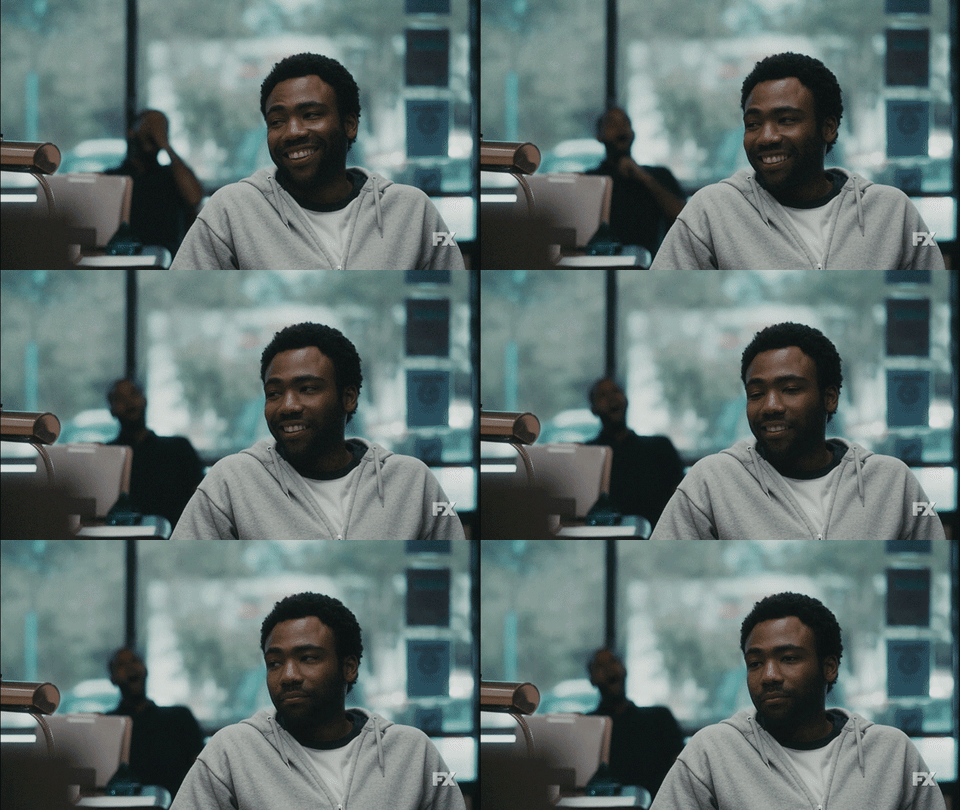
I’ll just wheel out some clichés here about why Atlanta defies categorisation.  It breaks the mould.  It’s one of a kind.  It’s truly unique.  Ok, there we go.  Now let’s talk about Donald Glover.  Our Donnie G is the creative force behind the whole show.  This is what made me realise that I needed Atlanta in my life.  Ever since I finished all his episodes of Community (Troy and Abed in the morning) there’s been a Troy Barnes-shaped chasm in my soul.  But gone are the bright smiles and innocent confusion of that character.  Instead we have scowling, unkempt facial hair and almost everything going wrong.  In Atlanta, Glover plays Earn, our leading man who isn’t really leading anyone anywhere (and is remarkably generous about stepping back to let the other characters shine).  We learn that he’s had educational potential, but it’s not amounted to much, with him struggling to hold down jobs, find places to live, care for his daughter and girlfriend.  We see his mum barring him entry to the house.  Throughout all of this, though, we root for Earn, a well-meaning everyman who’s often tested by but mostly tolerates the nonsense and weirdness of those around him.  And they are:

Van

Initially a background figure under the heading of baby momma, it’s thanks to Zazie Beetz’s magnetism that we’re grateful to see Vanessa step forward into focus as the two seasons progress.  She’s always surprising, whether whipping out richtig gut German in Helen at a crazy Bavarian festival (making it clear that we white folk are whack), dealing with her wasted friends at a supposed Drake party in Champagne Papi or struggling with an imbalanced and outdated friendship in Value.  These female-led instalments have lower ratings than the others, but this is just one of life’s great injustices.  Van steals my heart each time she rolls her eyes at others’ Instagram behaviour, so may we ever get to see more of her.

Paper Boi

This is actually Alfred, Earn’s cousin and smalltime-going-on-bigtime rapper.  When he can’t get off the sofa due to laziness, we really believe it, but Brian Tyree Henry comes into his own when required to cold-hard stare at anyone spouting nonsense.  In Barbershop, his frustration while trying to get a fade is so palpable it led me to sack off trying to pin down a barber to cut my hair before lockdown.  His must-see moment, though, is in B.A.N. when he’s forced to answer for his views on a late-night panel show, ambushed at every turn by virtue-signalling wokeness while the awkwardness is interspersed with fake adverts for African Americans on this pastiche of a popular channel.  Spoof ads have always had a special place in my amusement chambers and this episode delivers multiple belly laughs as a result.

Darius

Mostly found in Alfred’s kitchen, Darius is never doing what you expect him to.  LaKeith Stanfield is perfect at all times, never more so than when dealing with Teddy Perkins in a Michael Jackson-alike episode.

The rest of Atlanta is populated by all manner of grotesques, offering acerbic commentary on how race in the US interplays with wealth, work, education, family life, music, social media and just about everything you can think of.  We have humour in the deadpan observations, but also heartbreak in how easy it is to recognise these inequalities as very very real.  Atlanta’s strength comes from making everything somehow universal so that you’re forced to identify with the action as it unfolds.  But it doesn’t care what you’re expecting, calling to mind an I May Destroy You approach of drawing focus to whatever is more interesting, not what necessarily seems best placed to come next.  As such, each episode creates a work of its own, setting its own mix of characters, locations and times.  The throwback to Earn and Alfred’s schooldays seems at first leftfield, but artfully grounds what follows.

The soundtrack doesn’t stint on bangers and there’s even joy to behold in the opening credits.  Atlanta appears somewhere on screen in its unmistakable font, but you need to keep your eyes peeled to spot it among the madness.  I found myself tingling each time with excitement at the prospect of finding it, but maybe I need to get out more.  But I can’t because I’m now government-mandated to stay in.  The pandemic doesn’t stop there: it’s delayed production on the third series, automatically giving any return of Atlanta the epithet long-awaited.  And I shall wait as long as it takes.


Sunday, 25 October 2020

Motherland

I’ve been doing some parenting recently.  Well, I held a friend’s baby for about half an hour while she had a crème brûlée (the mum, not the three-month-old).  Despite not having procreated, I was fairly confident I could keep the young lad content with my impressive jiggling skills, honed over a decade ago when I was a quaternary caregiver to my niece.  A couple of times however, I could sense his bottom lip quiver, his copious cheeky cheeks redden and his little face screw up in unhappiness, prompting me to adopt a new position to distract him from any number of distress sources: hunger, overheating, a soiled gusset, boredom with the view.  When the moment came, I was fairly satisfied to be handing him back over, even if the girls had commented that his 6.5kg of weight had leant my biceps an alluring bulge.  If I factor up the duration of that brief stint of (quite literally) baby sitting to a week, I have to multiply its difficulty by 336, and if we go all the way to the eighteenth birthday at which point I assume you turf your progeny out into the street and cut them off from the family fortune, that’s a total of 314,496 units of parenting.  In short: child-rearing is hard.  And as the owner of a phallus, I’ve got the easy end of the stick, as it were.  Motherhood is hardest of all.  Here, then, is the hilarious truth that forms the comedic backbone to BBC sitcom, Motherland, whose achievements we will be celebrating today.

Too millennial ever to be aware of what’s scheduled on the actual TV, I was only vaguely conscious of Motherland’s two series when they first went out, catching glimpses whenever the real telly came when switching from Netflix to Amazon Prime.  I knew one of its creators was Sharon Horgan, who had co-created Catastrophe, and again, following my nose in working out why people on podcasts like a thing, I finally plumped to dive in after spotting Motherland’s first series appear on Netflix, before eventually tracking down the second on iPlayer.  I was craving the wit and cynicism of British humour after having so many glossy American boxsets in recent rotation: Power, Watchmen and, er, Love Island USA.  The situation is suburban London and the comedy is balancing childcare, a career, a relationship, and, worst of all, other mums, so let’s meet the mothers of this land:

Julia

The master of the fake smile, Julia covers up each episode’s mounting shower of disasters with a suitably correlating uptick in false cheerfulness, effectively using effusive exclamations to paper over cracks in her best-laid plans until she ultimately breaks down in ranting and raving.  We cross our fingers and toes that she will catch a break, but she’s ever thwarted by each element of what should be her support structure: her husband would help but he has to play golf with the lads, her mother would help but she’s entitled to enjoy her retirement, the other mums would help but they’re busy forming a sort of mummy Mean Girls (mean mums?) at the local café, consigning Julia to the table by the toilets.  A career in PR only makes matters worse, as it does most things, but it’s the people Julia meets at that lavatory-adjacent table who finally offer help.

Liz

The queen of laid-back parenting, Liz has had to develop more extreme coping strategies as a single mum.  Her seemingly thick skin places her well to encourage Julia to be less anxious, though Liz does herself later struggle with pushchair extraction when her youngest finally abandons her for nursery.  Life’s too short not to cut corners, and that time saved is better spent having a cheeky drink anyway.

Kevin

Yes, it’s a man, but Kevin is perhaps the mumsiest of all.  Contrasting with Liz’s workaround and make-do methods, Kevin is not happy unless he is out-parenting left, right and centre.  Desperate for the approval of the other mums, he volunteers for every PTA gig going, yet fails to find the acceptance he yearns for.  Mostly seen in a cagoule, his highlights are his throwaway lines about never-seen wife Gill as it’s clear to everyone but him that his approach to parenting makes her skin crawl.  Yes, Kevin is cloying, but his heart’s in the right place, and his very inclusion provides a spirited commentary on gender roles for those that are looking to find one.  Otherwise he’s a silly sausage in a bicycle helmet.

Amanda (not Mandy)

With her expensively coiffured blonde hair and yoga-taught frame, Amanda is the alpha-mummy whose every utterance either allows her to show off (less of the humble, more of the brag) or serves as a backhander to put down the other mums around her.  For some reason, I love her.

Anne

My favourite mum.  She begins as one of many flunkies to Amanda’s act as chief mum, but soon accumulates enough scene-stealing lines to guarantee belly laughs so loud that you can only hope you’re giving your neighbours a taste of their own medicine for all those lockdown reggaeton parties you’ve endured.  She’s a cautious parent, convinced all adults are out to molest or poison her offspring, which makes trick or treating challenging.  Her wardrobe malfunction at a swimming pool party and her poor management of her own IBS during a weekend away in half term both endear her further to me.

The second series also sees the introduction of Meg, a hard-partying, hard-working mum who hasn’t got time for any of your nonsense, unless it involves being abusive on night buses.  I can’t work out what they’ve been trying to do with her beyond address a lack of diversity but it’s great to have her along.  Let’s say she is wonderfully complex.

On the other hand, the kids rarely merit any significant characterisation and this is, again, because they don’t really matter.  The humour is brittle and acidic when it comes to deploring the role of modern working mums, running households, keeping everyone happy, sacrificing their interests and yet still being expected to knock up a harvest festival costume at a moment’s notice.  They’ve been told they can have it all, but yet somehow it feels like having nothing.  The swimming pool party episode illustrates this perfectly when Julia, hair done and posh outfit selected for a career-important work do, is strong-armed into in-pool supervision that leaves her showing up later at her function as drowned as a rat.  We laugh because it’s true, but as I recovered from each chortle, I had to check my childless male privilege lest I feel hopeless about a status quo whose imbalance looms large in daily lives.  Motherland’s comedy comes from its universal truth, but I’m sure we could find something else to laugh about if gender inequality no longer existed.

Sunday, 18 October 2020

Catastrophe

It’s easy to feel like your life is a mess.  Maybe you’re not where you thought you would be by this age.  Maybe your social channels lead you to believe that your lifestyle is not as enviable as your friends’.  Maybe it seems like everyone you know is desperately repopulating the earth with constant progeny whose names you’ll never really be arsed to learn while you’re channelling your energies into writing an unpopular blog about your views on recent TV shows you have been watching.  Well, have I got the show for you!  This week, we are doing Catastrophe.  I had somehow completely missed this show’s existence, yet became conscious of the appearances of creators Sharon Horgan and Rob Delaney as separate guests on a number of different podcasts whose back catalogues I am working through while sitting on buses wondering how far I can let my nose peak out of my facemask before someone scowls at me.

But there it was one evening on my unnavigable Amazon Prime EPG, drawing me in during one spare half hour before bedtime.  The comedy-drama’s origins arise in a business travel fling conducted between Delaney’s Rob Norris, our American in London, and Horgan’s Sharon Morris, our Irish fortysomething single lady at home in the capital.  Norris returns to the States, but Morris has conceived a baby and it’s this mini Norris-Morris that forces Sharon and Rob to upheave their whole lives while they work out what to do next.  Can a brief affair last for four hilarious and poignant series while Sharon and Rob repeatedly end up almost self-sabotaging their own happiness?  Well, yes.

Despite originating on opposite sides of the Atlantic, Rob and Sharon’s shared sense of humour unites them into a lasting bond which neither of their respective misdemeanours ever successfully ruptures, though you repeatedly worry each time that this will surely be the end.  Trading affectionate insults while scraping back the fanciful façade in which so many marriages shroud themselves for palatable public consumption, we’re shown a truthful relationship awash with painfully raw honesty, yet still dogged with sufficient dishonesty to engender tension.  We never shy away from the blood, sweat and tears required to keep things going.  At first, I found the bickering difficult, unused as I was to such harsh storytelling.  I couldn’t hook myself into a likeability anchor with any of the main characters.  But as time progresses and the Catastrophisers grow more familiar, a familiarity develops, and you become equally invested in their happiness.  And with this comes even greater laughs – by the end of the fourth season I was disturbing my neighbours with my chortles.  Well, I imagined I was, but one was probably screaming into his headset while playing computer games and the folk upstairs were having another lockdown party with reggaeton dancing.

Most importantly, nothing is overly dramatised.  Rob’s own struggle with alcoholism in particular, while blowing up rather climactically, progresses there with a believability that makes it all the more horrific.  In short, everyone is struggling, including Rob and Sharon’s own family and friends.  Extras’ Ashley Jensen is worth her weight in gold as Fran, Sharon’s old friend who’s on call with a passive-aggressive comment at every juncture, until her own life starts to fall apart thanks to husband Chris or precocious actor son Jeffrey.  Sharon’s brother persists in being a hot mess throughout proceedings while Rob’s own friends and colleagues veer from one crisis to the next.  It’s probably only occasional babysitter Anna (played by Misfits’ goddess Lauren Socha) who has her life most on track, simply because she’s too laid back to care.  Or too young.

Storylines scatter and scarper, but, throughout, the kids are refreshingly ignored.  Rob and Sharon’s growing brood rarely come to centre stage, unless the plot requires them to bite someone or to have a name that’s difficult to pronounce.  This is about how hard it is to be an adult, a parent, a person.  The kids have it easy and are therefore not of interest.  Catastrophe’s episodes thus became essential comfort, four sets of six charming half hours to enjoy in the bath or at the end of a long day trapped inside.  The wit zips along with intelligence, anything generic is jettisoned and we’re left with a perfect balance of pure enjoyment and tempering miserable realism.  Any show that fails to acknowledge life is disastrous will ring hollow after Catastrophe, so you might as well view it yourself in order to distract from the terrible mess you have made of things.

Tuesday, 13 October 2020

Power

In and amongst the various quality boxsets (Watchmen) and trash series (Love Island USA) I might have on the go at any one time, there’s always a background show that I’m getting through at a more leisurely pace.  For the last one hundred years, this has been Power.  I forget when I finally relented to Netflix’s constant algorithmic suggestion that this was a show I might enjoy, but somehow I’ve got through its six series of at least ten (sometimes fifteen) one-hour episode.  Let’s be clear: I’m here to say I’m a fan of Power.  But, crikey, it’s been some tough going.  How easily and how often I’ve been distracted by shinier (Euphoria), cleverer (I May Destroy You) programming.

Firstly, let’s categorise the show.  It belongs in a group that I have previously christened: a whole lot of f*cking.  Alongside Elite and, let’s be honest, Game Of Thrones, Power viewing comes with the risk of sudden sexually explicit antics filling your screen.  Episode one barely throws out a few establishing shots before our sexy leads are not just cavorting in their marital bed, but properly having a right old go at some serious slap and tickle (I definitely heard scrotal slapping).  You don’t need to use your imagination, because nothing is left to it, but you might want to ensure your 55” telly screen isn’t overlooked by neighbours with young children and you haven’t yet sorted out curtains for your floor-to-ceiling French windows.

So, who are these people whose close-up intercourse is essential to the plot development?  Power is all about James “Jamie” St. Patrick, an NYC kid from the wrong side of the tracks who, after amassing a fortune from large-scale drug dealing, is trying to turn himself into a legitimate businessman.  Played by the exquisitely goateed Omari Hardwick, this is a character we root for no matter what terrible things he does, clothed or otherwise.  And if he happens to interpret legitimate business as opening up seedy nightclubs that are dogged by violent crime, then so be it.  What we rarely see Jamie doing is going to the gym, despite the fact he is stacked beyond all belief.  There’s some intense jogging in early seasons and he does visit a prison weights room later on (albeit briefly and bloodily), but I find it hard to believe he’s not constantly repping out some big lifts and counting his macros, in between trimming his beard, dealing drugs, shooting people, surveying his night club from a raised walkway or being an absolute sod to his long-suffering wife, Tasha, (Naturi Naughton).

Tasha St. Patrick is the heart of the show, often called upon to channel her inner boss to protect her family (with mixed success) or to ward off threats.  She and Jamie are often found in their swanky penthouse where the lift opens straight into the lounge, and it’s here they’re often visited by our third lead and Jamie’s childhood BFF, Tommy Egan.  I vowed I would never troll anyone on this blog, but Joseph Sikora is the hammiest actor I have ever seen.  It takes a real scenery-chewer to know one, so we can accept this is coming from a place of being a ham on stage myself, but you eventually develop a charmed affection for his idiosyncrasies – he is simply another layer of camp in the outrageous proceedings that almost never seem to end.

As we’ve noted before (Narcos, Narcos:Mexico) a career in drugs can be a touch stressful – I don’t think they even get to work from home during lockdown.  Drama dogs Tommy and Jamie at every step, with each season introducing a new array of dastardly dealers looking to steal their patches, take their connects and generally indulge in anti-competitive business practices.  Instead of litigation, recourse is taken rather to ultra-violence, with the body count exceeded only by the nudity count.  Whenever a fresh character is introduced, you’re hard pushed to guess whether they’ll die before they get naked or get naked before they die, or do both at the same time by dying naked.  As a homebody, the worst part about their chosen industry is the constant galivanting about town.  The endless texts and calls between the characters predominantly showcase them demanding to meet each other in person all over New York.  Once you factor in a journey time of more than 45 minutes each way then suddenly the millions of pounds earned from selling cocaine to yuppies don’t seem worth it at all, and that’s before the FBI start tailing you.

Despite being sexy and sleek, a certain bleakness with Power can take things out of you.  Sure it’s a banging soundtrack that accompanies the, er, banging, but everyone behaves like angry children and it can only really go round in circles as they cross, double-cross, triple-cross and shoot at each other.  It’s made me want to go back to New York, but I’m not currently allowed in case I bring the sniffles with me there or take it back with me afterwards.  For fans of 50 Cent, you’ve got 50 Cent, so I suppose that’s something, as he really does play an absolute shit.  Most galling for me was, being very close to the end, I inadvertently caught an advert for the spin-off series which spoiled the ending of Power completely, so all the hours of viewing became slightly redundant, resulting only in these few hundred words of poorly structured prose.  I’m about to search for GIFs to pepper in here and I’m a touch afraid about what I’ll see but, assuming you’re not pulling together an indulgent blog on your viewing experience, you can’t go wrong with a bit of Power’s sexy gangster mayhem.  And with Lockdown Two ruining lives near you soon, you’ll have plenty of time to get through it all.