Showing posts with label fx. Show all posts

Wednesday, 31 March 2021

Fargo

“Whatcha got there, Margie?” seems like a strange choice for the most memorable line from the 1996 film, Fargo.  A lot of crime goes on in that story, all against the backdrop of the snowy Minnesota landscape, but it’s the charming local accents and the banal interest in what people are having for their meals that has stayed with me to this day.  That said, I only saw the film during my university years in the early 2000s, during a period in which I felt the best way to round out my terrible personality was to make sure I had seen all those classic films people talk about.  Back in the days of DVDs, Fargo was easily procured from a now-defunct online rental company, viewed on a laptop intended for academic support, and sat through with an attention span that now seems alien as these were also the days that predated smartphones and their irresistible whispers of distraction when you are trying to concentrate on absolutely anything at all.

Fast forward to 2014 and, a mere 18 years after the film’s release, a TV spin off emerges.  I’ve chosen the word spin off, as it really cheapens the programme, making it clear where the quality lies in this originator-progeny relationship.  Pah, I thought to myself, I shan’t ever be watching that.  But join me, if you will, in 2021.  More advanced in age, with greater maturity and self-assurance than my student self from decades before, I was no longer pursuing self-betterment through lists of must-see movies.  Oh no, I was looking at the IMDb list of top-rated television programmes.  And this is called growth.  There, at 38 (rankings may change over time) and with a score of 8.9/10, was the previously ignored Fargo TV series.  Well, this omission needed rectifying.  What kind of wildly successful TV blog would this be if, while having sat through the vast majority of top scorers (don’t worry, they’re all covered here, guys, from Rick & Morty to Our Planet) I allowed this oversight to continue?  And lo, thanks to Netflix, three quarters of my neglect has been rectified.

From my vantage point of having seen three of Fargo’s four seasons, I shall now offload all my thoughts and opinions for you to read.  Unfortunately the fourth series emerged while I was otherwise preoccupied and I haven’t been able to track it down on a platform, so we’ll just pretend we don’t care (though I truly do as it looks like a ripping period production with casting that finally offsets Fargo’s overwhelming whiteness).  But what I can say is that those first three outings of this boxset are cracking viewing to put in front of your face – how wrong I was about not expecting much from the TV version of a film.  What’s more, the stellar cast just goes to show how far TV has come in taking on cinema as the home of the big acting name or indeed of the quality production.

Each episode of Fargo is exquisitely crafted.  From the first frame, care and attention has been taken over every detail, as if all of it is a pilot that wants you to like it.  It’s how telly should be.  This is made all the more impressive by the fact that so much of it is shot in temperatures below freezing, as I can only imagine cameramen wanting to get out of the cold and therefore not really caring a toss.  I also like to think of everyone slipping over in the ice during the outtakes.  Not because I wish them ill, but because I am the sort of person that slips in ice, so I might as well assume it’s a universal quality.  One curious feature of our storytelling is that every instalment is preceded by a statement that the events are based on a true story, but that names have been changed to protect identities.  There’s no way of checking this as I simply cannot be bothered to type it into the internet, so again, we can just sit with it, wondering if we believe it, wondering if it matters, before moving on.

It’s pertinent, though, as the plots in Fargo are delightfully far-fetched.  To me, this is proof of veracity.  Honestly, you couldn’t make this stuff up.  Right?  Each series tracks over its ten episodes a wholly different storyline.  This means you’ll need to jettison an old cast and get to know a new one.  Gradually, hints of how these worlds and timelines connect are revealed, with series two’s seventies setting engendering an aftermath that plays back into the first series, which in turn has repercussions on the third.  May I one day know how this comes to bear on the fourth.

Playing out over the real towns of Minnesota and the Dakotas, our cast is often split into three camps.  We have heroes, often nice folk with above-average yet underappreciated ability in their jobs, normally law enforcement, who have to put up with the nonsense that swirls around them.  These are our Margies, carrying a torch of affection over from our original film.  Then we have our malcontents.  Their morals are often dubious, yet we can’t resist rooting for them.  They’ve faced hardship and come out stronger, but their drive and effort often lead to their own downfalls.  And then we have some great straight-up baddies, doling out evil willy nilly, creating the murderous rampages and bloodstains in the snow that are required to propel much of the plot forward.

I’d venture to describe Fargo as gently soothing, even though it’s awash in ultraviolence.  Somehow, the gruesome gore is easy to forgive, maybe because it’s framed in a higher art form.  We have a top-notch ratio of intrigue resolution to new curiosity establishment in each episode, as well as exemplary season finale crescendoing that resulted in my own patented viewing strategy: episodes nine and ten of each series had to be back-to-backed simply because I would get so excited (what a sad little life, Jane).  I typically only ever watch one instalment of a drama at a time so it doesn’t become wallpaper, but don’t worry if you have an alternative approach – it just means I am better than you.

So come all and feast upon this ensemble masterpiece.  You’ll revel at whatshisface off that film once and whoshername that used to be in thingy.  Not everyone masters the accent as successfully as others, and all the “oh yah”s and “ok then”s are a crucial part of our charm requirements, but each player has a great time with their character.  There’s bold storytelling as far as the eye can see, and dusting everything else in snow covers a variety of other flaws that I simply didn’t notice.  So take a trip via your screen of choice to this slice of the USA and treat yourself to some of the nicest murder stories ever known.

Wednesday, 4 November 2020

Atlanta

It was good while it lasted, but now we’re staying in again apparently.  I’m sure that will help.  Naturally, while rushing around seeing friends in the run up to everything closing again, talk turned, as it often does, to boxsets that could help pass the time while we wait for unelected government advisors to test their eyesight.  To anyone that will listen, I’ve been recommending Atlanta.  The show had long been on my list of things I must get round to, but it didn’t seem to be anywhere until its recent appearance on the BBC’s iPlayer.  Maybe it slipped on while they were busy making VTs about how this year’s series of Strictly is keeping to social distancing guidelines even though nobody cares anymore and just wants to watch some dancing.  Where I failed in my explanation though was in bringing to life the joys of Atlanta and why this is such a seminal show (it’s at number 124 currently on the IMDB list of top-rated shows, just behind Line Of Duty, which, when you think of how many TV programmes there are out in there in the world, is very good going).

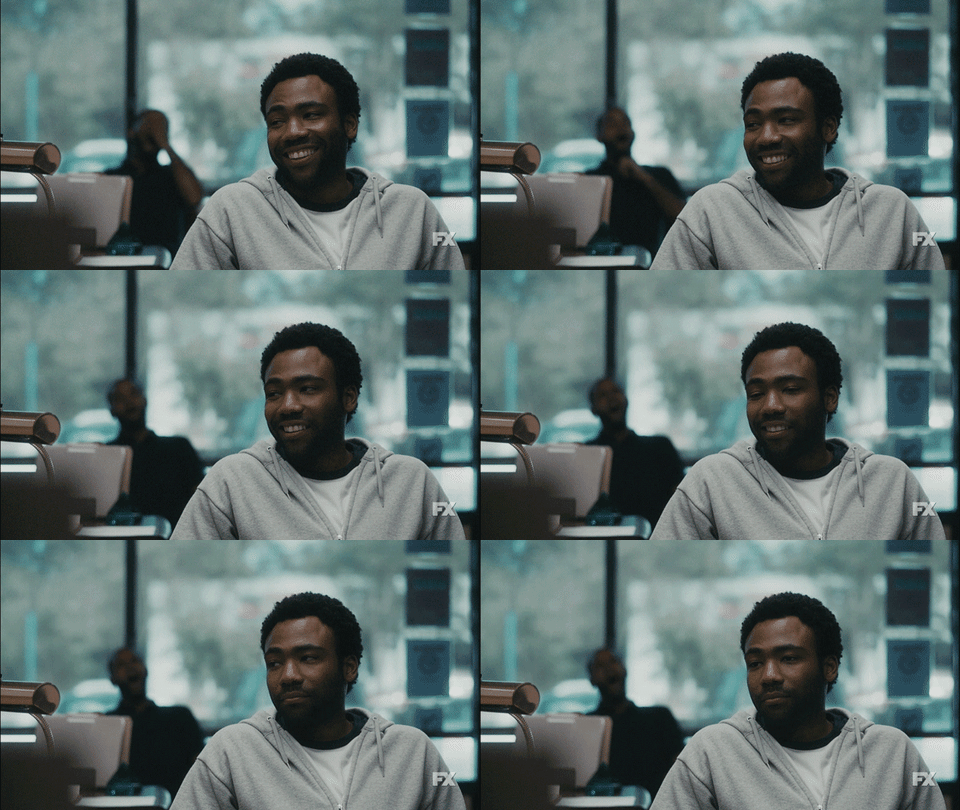
I’ll just wheel out some clichés here about why Atlanta defies categorisation.  It breaks the mould.  It’s one of a kind.  It’s truly unique.  Ok, there we go.  Now let’s talk about Donald Glover.  Our Donnie G is the creative force behind the whole show.  This is what made me realise that I needed Atlanta in my life.  Ever since I finished all his episodes of Community (Troy and Abed in the morning) there’s been a Troy Barnes-shaped chasm in my soul.  But gone are the bright smiles and innocent confusion of that character.  Instead we have scowling, unkempt facial hair and almost everything going wrong.  In Atlanta, Glover plays Earn, our leading man who isn’t really leading anyone anywhere (and is remarkably generous about stepping back to let the other characters shine).  We learn that he’s had educational potential, but it’s not amounted to much, with him struggling to hold down jobs, find places to live, care for his daughter and girlfriend.  We see his mum barring him entry to the house.  Throughout all of this, though, we root for Earn, a well-meaning everyman who’s often tested by but mostly tolerates the nonsense and weirdness of those around him.  And they are:

Van

Initially a background figure under the heading of baby momma, it’s thanks to Zazie Beetz’s magnetism that we’re grateful to see Vanessa step forward into focus as the two seasons progress.  She’s always surprising, whether whipping out richtig gut German in Helen at a crazy Bavarian festival (making it clear that we white folk are whack), dealing with her wasted friends at a supposed Drake party in Champagne Papi or struggling with an imbalanced and outdated friendship in Value.  These female-led instalments have lower ratings than the others, but this is just one of life’s great injustices.  Van steals my heart each time she rolls her eyes at others’ Instagram behaviour, so may we ever get to see more of her.

Paper Boi

This is actually Alfred, Earn’s cousin and smalltime-going-on-bigtime rapper.  When he can’t get off the sofa due to laziness, we really believe it, but Brian Tyree Henry comes into his own when required to cold-hard stare at anyone spouting nonsense.  In Barbershop, his frustration while trying to get a fade is so palpable it led me to sack off trying to pin down a barber to cut my hair before lockdown.  His must-see moment, though, is in B.A.N. when he’s forced to answer for his views on a late-night panel show, ambushed at every turn by virtue-signalling wokeness while the awkwardness is interspersed with fake adverts for African Americans on this pastiche of a popular channel.  Spoof ads have always had a special place in my amusement chambers and this episode delivers multiple belly laughs as a result.

Darius

Mostly found in Alfred’s kitchen, Darius is never doing what you expect him to.  LaKeith Stanfield is perfect at all times, never more so than when dealing with Teddy Perkins in a Michael Jackson-alike episode.

The rest of Atlanta is populated by all manner of grotesques, offering acerbic commentary on how race in the US interplays with wealth, work, education, family life, music, social media and just about everything you can think of.  We have humour in the deadpan observations, but also heartbreak in how easy it is to recognise these inequalities as very very real.  Atlanta’s strength comes from making everything somehow universal so that you’re forced to identify with the action as it unfolds.  But it doesn’t care what you’re expecting, calling to mind an I May Destroy You approach of drawing focus to whatever is more interesting, not what necessarily seems best placed to come next.  As such, each episode creates a work of its own, setting its own mix of characters, locations and times.  The throwback to Earn and Alfred’s schooldays seems at first leftfield, but artfully grounds what follows.

The soundtrack doesn’t stint on bangers and there’s even joy to behold in the opening credits.  Atlanta appears somewhere on screen in its unmistakable font, but you need to keep your eyes peeled to spot it among the madness.  I found myself tingling each time with excitement at the prospect of finding it, but maybe I need to get out more.  But I can’t because I’m now government-mandated to stay in.  The pandemic doesn’t stop there: it’s delayed production on the third series, automatically giving any return of Atlanta the epithet long-awaited.  And I shall wait as long as it takes.


Saturday, 8 December 2018

Archer


“Have you seen Archer?” a friend asked.  I hadn’t.  I had no idea what they were talking about.  It was my worst fear come true: someone trying to engage in conversation about a piece of content pivotal to modern culture and there’s me, oblivious and unable to take part.  “You’d love Archer,” they went on.  Things had escalated.  Now this thing I had never heard of was actually being recommended to me!  I gave the only response possible at the time: nodding silently while my mouth slowly opened and closed.  But I don’t think I got away with it, as the same friend then insisted on showing me the programme while I was visiting him in Beijing.  (This was the same dear friend who first recommended the Unbreakable Kimmy Schmidt to me, so he has a strong track record).

Let’s relive my first thoughts during that initial viewing, as this will help to bring the show to life for readers.

“So, it’s some sort of spy agency?”

Yes, it is.


“Wow, this is a work of art.”

Firstly, it’s adult animation.  This doesn’t mean it’s a cartoon of explicit jiggery and pokery for lonely men to watch with boxes of tissues.  It means it’s something for grown-ups that just happens to be produced from moving illustrations, like BoJack Horseman or Rick & Morty.  But everything in Archer is drawn to look like artwork by Roy Lichtenstein.  The characters are pneumatic in their attractiveness (though this still isn’t aimed at the hand-over-fist crowd).  The backgrounds too add to the overall high quality, while sixties lines and styling give everything a slight Mad Men feel.  I feasted my eyes.

“Isn’t that Bob from Bob’s Burgers?”

Following the overload in the eyeballs, my ears attuned to the aural assault.  Lead character, Stirling Archer, is voiced by H. Jon Benjamin, who plays Bob in Bob’s Burgers.  While Archer isn’t exactly supposed to be a successful spy, it’s hard to forget the images of a bumbling family man who flips burgers when Archer is seducing beautiful ladies or rolling about on covert missions.

“Why is everyone shouting?”

The characters pursue all dialogue at a certain heightened pitch.  It’s the tone you use in a conversation where each exchange elevates the previous sentence’s sarcasm, irony or sardonic tone.  It has nowhere to go but shouting, which means that everything can feel a bit ranty, jokes (though funny) don’t stand out and we end up with one level to the whole thing.


“But yes, this is quite funny.”

Once you overcome the scream at which lines are delivered, you can appreciate the humour that laces everything.  Jokes reoccur and harken back to former statements, layering on themselves over and over till you can’t help but chuckle or groan.

“Oh, so it really is only these characters then.”

We more or less stick to the world of ISIS, the spy agency where Archer works.  Fun fact: it’s run by his mother, Malory (voiced, well, shouted by Jessica Walter from Arrested Development), so his relationship with her is the source of about 60% of the humour because it’s funny and silly to work for your mum as a spy.  Around eight characters feature in practically every episode, no matter what, which starts to feel close and closed off across the nine seasons.  Yes, nine.  Occasional relief comes from guest roles, for which some sort of Hollywood comedy actor is always found, like a bit of an inside joke, so you can have a great time trying to place the voice before giving in, checking IMDB and seeing that it was Janice off Friends.


In short, this is a good man-show.  I don’t want to be gendering things as we move into 2019, but the humour can be schoolboy, Archer lives consequence-free and I’m fairly certain the female characters only serve as garnish in order to bait or foil (all while shouting of course).  Nevertheless, nine series is good going, so let’s go through how things have been padded out and what my bodily responses were for each one:

Series one

Still getting to grips with the style, characters and tone, we have an episodic approach with each instalment more or less resolving itself.  There’s an airship, among other retro elements, with most conflict coming from a rival agency (and between Archer and Malory).


Series two

More office management japes creep in, but the episodes climax in Archer searching for the true identity of his father.  We get into our stride here a bit more.

Series three

Things get joyfully further and further fetched, with more action in the animation (versus perennial standing around posturing) and more diverse settings.  Robots appear, as does a mission to space.  Enjoyment peaks.

Series four

Just more classic Archer, with a hilarious Bob’s Burgers crossover.

Series five

This is Archer: Vice.  We depart from the old office and the whole staff end up in South America trying to offload cocaine.  Comedy comes from Pam doing most of the cocaine most of the time.


Series six

Back to nearly normal with more global travel.  Some of the characters’ backgrounds are fleshed out.

Series seven

Archers goes all Hollywood.  I didn’t really get what was going on.

Series eight

This whole series is a dream.  No, really, it’s called Archer: Dreamland and takes place in Archer’s mind during a coma.  It’s a shame he can’t dream up some new main characters.

Series nine

Completely clapped out, the whole thing moves to 1938.  I lost the plot.  I didn’t have a mental health episode, I simply was unable to find any narrative to follow.


After the quick intro in Beijing, I’ve limped my way through this show, possibly repeating series three, or, in fact, missing out whole chunks of episodes altogether.  Because of its constant tone, I find myself easily distracted, even though each instalment is short.  As such, in an effort to make it finally to the last episode (which wasn’t helped by series nine dropping when I was knee deep in series six) it has become a background show I put on whenever I am doing something else.  Many a work email has been bashed out on the old laptop while Archer and Lana scream at Figgis, or while Pam runs around naked eating snacks and taking drugs.  Maybe a close-knit colleague collective of inept spies can only go so far, yet Archer still feels unique in both the worlds of comedy and animation.  Within its overwhelming volume, there are hilarious gems.  So, if you live life terrified of being caught out by someone asking if you’ve seen Archer (and it’s only happened to me twice more and both times I could respond confidently with a big fat yes) try a couple of episodes.  If you hate it, then stop it and do something else.  And if you like it, then enjoy; you’re welcome.