Showing posts with label racism. Show all posts

Wednesday, 23 December 2020

Brooklyn Nine-Nine

I’ve found another sitcom workplace where I think I’d really fit in.  This time, it’s within the NYPD.  Let’s be clear: I’d be no good at solving crimes.  I would also be unwilling to undertake any duties that put me at risk in any way whatsoever.  Similarly, I couldn’t work in New York as it’s either too hot or too cold (and UK citizens currently can’t go there).  But, Brooklyn Nine-Nine has now joined the ranks of charming comedy shows where I tune in to feel like one of the gang.  I’ve imagined myself really fitting in with the personalities of Parks & Recreation.  I’ve considered where my place would be among the Scranton bods of The Office US (as well as knowing full well which one’s me in The Office…).  Now I can spend time wondering how my own sense of humour would enrich the pleasant chuckling that the activities of this very special police squad create.

Naturally, I am intentionally late to this party.  Having seen countless ads on e4 for the UK broadcast of this programme, I put it in the same category as Hollyoaks: TV shows whose existence I can ignore.  This decision was compounded by my televisual aversion to the emergency services.  However, I was frequently asked if I had seen Brooklyn Nine-Nine, with most people prompted by my own excessive office-based consumption of yoghurt – a trait I share with Sergeant Terry Jeffords (Terry Crews).  Well, with lockdown coming up to its one-year anniversary, we’ve all got through more TV than we ever thought possible.  I’m not sure what happens when you complete Netflix, but let’s start a rumour that you get a telegram from the Queen (The Crown’s Olivia Colman of course).  So, to offset some of the heavier drama boxsets I was wading through (The Fall, The Staircase etc), Brooklyn Nine-Nine seemed like a welcome addition to my rotations.

At first, I’ll admit to seeing nothing special.  It was about crime, but not in a serious way.  Nobody died, jeopardy was only there to serve as plot device against which comedy could play out, the characters were loud and excessive in their behaviour.  Before I got to know them inside out, the humour struck me as obvious and I began to come to terms with the fact this might well be a true background show: something that plays in the background while I cook under the extractor fan, unable really to hear or see it.  Sure, a couple of episodes would get a bit of focus during my weekly bath, but Brooklyn’s fictional 99th precinct hadn’t yet earned a special place in my heart.  I did however unearth my favourite character early on: Gina Linetti (Chelsea Peretti).  There’s something about a woman who won’t let anything or anyone stop her doing exactly as she pleases that just makes for wonderful entertainment.  Her rudeness to all her colleagues is a constant source of inspiration.

Over time, though, I learned that all our main players have such strong characterisation that the humour’s beauty clearly comes from knowing them well.  Disturbingly, perhaps, there was also a bit of me in all of them.  My lifelong geek side means I see Amy Santiago as a kindred spirit.  My emotionless intellectual snobbery turns Captain Raymond Holt into a hero.  Charles Boyle is all of my insecurities wrapped up in one tiny little man.  I won’t go through them all, but they’re so much more than background artists designed to offer perspective on our central figure: Jake Peralta, played by Andy Samberg.  He is the only one I am not, but he still makes me laugh with his childishness: a great face for silliness.  As series progress, the vibe becomes less about Peralta’s tension with fish-out-of-water new boss Holt, and more about the unit’s ability to support each other through good and bad times.

If that doesn’t sound hilarious, Brooklyn Nine-Nine is also taking on a number of social issues in a matter-of-fact way.  Racism, homophobia and sexism all come under the microscope.  We tread a narrow tightrope between signalling worthiness and, in fact, reflecting the world around us.  A stereotype or stock character is a very rare occurrence throughout the show’s universe.  And it is this, coupled with the cast’s irresistibility, that saw Brooklyn Nine-Nine succeed in commanding my attention.  Somehow, it’s elevated itself well above a background show.  Each instalment of its six series on Netflix (and a seventh out there that aired this year) deserves your full attention.

Wednesday, 4 November 2020

Atlanta

It was good while it lasted, but now we’re staying in again apparently.  I’m sure that will help.  Naturally, while rushing around seeing friends in the run up to everything closing again, talk turned, as it often does, to boxsets that could help pass the time while we wait for unelected government advisors to test their eyesight.  To anyone that will listen, I’ve been recommending Atlanta.  The show had long been on my list of things I must get round to, but it didn’t seem to be anywhere until its recent appearance on the BBC’s iPlayer.  Maybe it slipped on while they were busy making VTs about how this year’s series of Strictly is keeping to social distancing guidelines even though nobody cares anymore and just wants to watch some dancing.  Where I failed in my explanation though was in bringing to life the joys of Atlanta and why this is such a seminal show (it’s at number 124 currently on the IMDB list of top-rated shows, just behind Line Of Duty, which, when you think of how many TV programmes there are out in there in the world, is very good going).

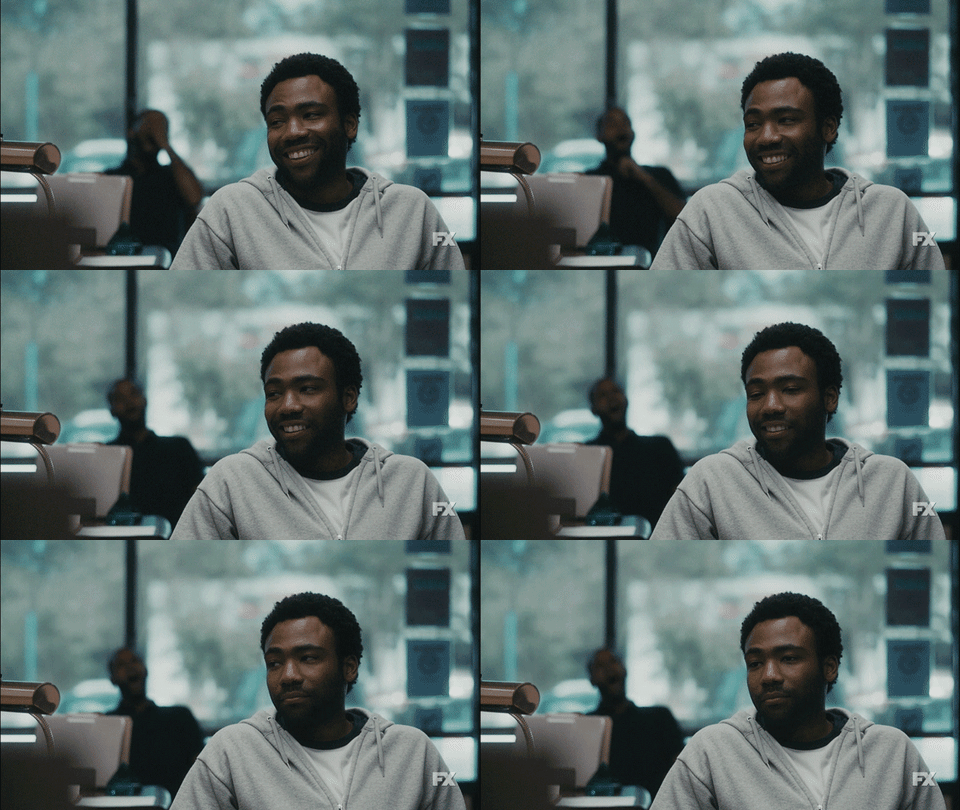
I’ll just wheel out some clichés here about why Atlanta defies categorisation.  It breaks the mould.  It’s one of a kind.  It’s truly unique.  Ok, there we go.  Now let’s talk about Donald Glover.  Our Donnie G is the creative force behind the whole show.  This is what made me realise that I needed Atlanta in my life.  Ever since I finished all his episodes of Community (Troy and Abed in the morning) there’s been a Troy Barnes-shaped chasm in my soul.  But gone are the bright smiles and innocent confusion of that character.  Instead we have scowling, unkempt facial hair and almost everything going wrong.  In Atlanta, Glover plays Earn, our leading man who isn’t really leading anyone anywhere (and is remarkably generous about stepping back to let the other characters shine).  We learn that he’s had educational potential, but it’s not amounted to much, with him struggling to hold down jobs, find places to live, care for his daughter and girlfriend.  We see his mum barring him entry to the house.  Throughout all of this, though, we root for Earn, a well-meaning everyman who’s often tested by but mostly tolerates the nonsense and weirdness of those around him.  And they are:

Van

Initially a background figure under the heading of baby momma, it’s thanks to Zazie Beetz’s magnetism that we’re grateful to see Vanessa step forward into focus as the two seasons progress.  She’s always surprising, whether whipping out richtig gut German in Helen at a crazy Bavarian festival (making it clear that we white folk are whack), dealing with her wasted friends at a supposed Drake party in Champagne Papi or struggling with an imbalanced and outdated friendship in Value.  These female-led instalments have lower ratings than the others, but this is just one of life’s great injustices.  Van steals my heart each time she rolls her eyes at others’ Instagram behaviour, so may we ever get to see more of her.

Paper Boi

This is actually Alfred, Earn’s cousin and smalltime-going-on-bigtime rapper.  When he can’t get off the sofa due to laziness, we really believe it, but Brian Tyree Henry comes into his own when required to cold-hard stare at anyone spouting nonsense.  In Barbershop, his frustration while trying to get a fade is so palpable it led me to sack off trying to pin down a barber to cut my hair before lockdown.  His must-see moment, though, is in B.A.N. when he’s forced to answer for his views on a late-night panel show, ambushed at every turn by virtue-signalling wokeness while the awkwardness is interspersed with fake adverts for African Americans on this pastiche of a popular channel.  Spoof ads have always had a special place in my amusement chambers and this episode delivers multiple belly laughs as a result.

Darius

Mostly found in Alfred’s kitchen, Darius is never doing what you expect him to.  LaKeith Stanfield is perfect at all times, never more so than when dealing with Teddy Perkins in a Michael Jackson-alike episode.

The rest of Atlanta is populated by all manner of grotesques, offering acerbic commentary on how race in the US interplays with wealth, work, education, family life, music, social media and just about everything you can think of.  We have humour in the deadpan observations, but also heartbreak in how easy it is to recognise these inequalities as very very real.  Atlanta’s strength comes from making everything somehow universal so that you’re forced to identify with the action as it unfolds.  But it doesn’t care what you’re expecting, calling to mind an I May Destroy You approach of drawing focus to whatever is more interesting, not what necessarily seems best placed to come next.  As such, each episode creates a work of its own, setting its own mix of characters, locations and times.  The throwback to Earn and Alfred’s schooldays seems at first leftfield, but artfully grounds what follows.

The soundtrack doesn’t stint on bangers and there’s even joy to behold in the opening credits.  Atlanta appears somewhere on screen in its unmistakable font, but you need to keep your eyes peeled to spot it among the madness.  I found myself tingling each time with excitement at the prospect of finding it, but maybe I need to get out more.  But I can’t because I’m now government-mandated to stay in.  The pandemic doesn’t stop there: it’s delayed production on the third series, automatically giving any return of Atlanta the epithet long-awaited.  And I shall wait as long as it takes.


Monday, 28 September 2020

Watchmen

Right, you can stop the pandemic now.  I’m not playing anymore.  Granted, I’ve only got prosecco problems when it comes to coping with covvers (the mask makes my beard itch, I want to go to the theatre, I could lose my job etc), but as a lifestyle trend it would be really great if we could move on to something new.  Such is the extent of my fatigue that I actively avoid almost all news, as it’s mostly just white male Etonians blustering about the perils of young people and other such evils.  But, my clicks were recently baited by reports of the Emmy Awards.  Sure, there was no ceremony, but this was a normal annual thing that was almost happening.  I’ve harped on here about incredible pieces of TV that have kept me glued to my sofa and, of course, there were those top shows among the nominees – you know, your Euphorias and your Successions.  However, among the winning boxsets I was proud of completing, there was one that had passed me by: Watchmen.

I got the first episode cued up, but it wasn’t until a Friday evening when I was taken by the mood to delve into the story.  We all know I’ve no time for superheroes.  I’ve even been underwhelmed by attempts to subvert the genre (The Boys).  Nevertheless, I had thoroughly enjoyed the film version of Watchmen when it came out in 2009.  Oddly plausible, artfully stylised and with a story I can no longer really recall (which wasn’t helped by a second viewing that I mostly slept through), the film gave me an underlying confidence that I wouldn’t be subjecting myself to mindless Marvel’s punching by numbers.  This would be something better.  And how right was I?  And the Emmys?  And also all the people that watched it when it came out last year and told me then that it was worth a watch?  My whole subsequent weekend was consumed by a need to finish the nine episodes, desperate as I was to solve the mounting mysteries and witness the conclusion of the very complicated plot (unlike the last episode of Dark that I am too scared to watch).

We’ll run through now how watching Watchmen checks off a lot of my boxes when it comes to a good, er, boxset.  First up, we’ve got the alternative reality, last seen blowing my mind in the third series of The Handmaid’s Tale.  In Watchmen, the Vietnam War has gone a bit differently, cars no longer use petrol, interdimensional squids are an ongoing hazard and, in Tulsa, the police are required to wear masks.  If you’re finding this disorientating, then I’ve come some way to approximating the experience of watching the first episode.  Initially, Watchmen doesn’t care if you’re clued up on what’s happening or not.  Somehow, I was thrilled by my own stupidity and electrified by the need to keep up.  Filling the gaps became a desperate urge, mostly because these important elements of context were only ever alluded to in passing, thus making the later expositions all the more plausible.  I was completely sold.

One alternate the Watchmen reality keeps the same is racial tension.  A prominent catalyst to the show’s events is the Tulsa race massacre, something which, to my shame, I had never heard of.  If Watchmen’s only achievement in this world is to make more people aware of the 1921 destruction of a prosperous Black neighbourhood by white supremacists, then for that alone I would doff my hat to it.  Throughout the present-day narrative, the threat of racists remains and looms large.  It’s given an all-the-more-terrifying edge by the way these thugs mask their beliefs with respectability, making us blind to their blind hatred, while they are deaf to reason.  I won’t reduce racial tension to a plot device – Watchmen unapologetically puts America’s issues with race front and centre – but it brings to life a good-versus-evil jeopardy that means so much more than generic white man hero battling generic supervillain.  And on that note, Watchmen revels in its championing of actors that are normally side-lined.  Reams and reams of glorious dialogue proceed without a white man in sight.

My final point to stress is Watchmen’s deft stretching of narrative tension so that each episode thwarts as much as it solves, carefully creating the coming crescendo which forms the mini-series’ climax.  Once enough intrigue is set up, the revelations come thick and fast.  Regina King is our (badass) anchor as we navigate each blow to the psyche, and don’t worry if you at first think that Yahya Abdul-Mateen II doesn’t have enough to do (see The Get Down and Black Mirror for evidence of his range), but around this central couple assembles an array of characters you can’t help but feel desperate to know more about.  I craved more of Jean Smart’s Agent Blake while Hong Chau’s Lady Trieu maintained the perfect level of moral ambiguity until just the right moment.  I won’t spoil things by saying one or two minutes of the finale got just a touch too Marvel-y for me as everything else was a sublime televisual experience.

If we end up confined to our homes again, then Watchmen is the closest you can get to the visceral real-life experiences we have been lacking in 2020.  Maybe we do need heroes after all, but Watchmen’s heroes aren’t preening about in Spandex demanding attention for selective philanthropy.  Instead, they’re driven by their own hatred of systems and belief structures that hold humankind back.  They’re compelled to act against what is wrong, no matter the cost, and this is quite rightly what Watchmen presents as heroism.  Anyway, we seem to have strayed into some very uncharacteristically earnest territory for Just One More Episode, especially when we’re all here for passive aggression and sarcasm.  But what can I say?  Here is a boxset that transcends all the blue willy comments it’s left itself open to.  If only all storytelling could be this good, and this important.

Saturday, 5 January 2019

Orange Is The New Black


Right, what’s the Netflixiest show you can possibly think of?  Chances are, whether or not you have the streaming service in your home, nagging away at you until it chains you hopelessly to the sofa, that Orange Is The New Black is near the top of that list.  Sure, there’s House Of Cards, and you’ve got Stranger Things.  You might even love the often-overlooked The Get Down (I do).  But Netflix’s most watched original series is that one with orange jumpsuits about some women in a prison or something along those lines.  I can hardly become some sort of boxset streaming guru, then, if I haven’t watched this one.  So, a few months back, I took myself down to Litchfield Penitentiary and freely surrendered my viewing liberty to the minimum-security women’s prison there.  I’m now out the other side, six series down, with a seventh and final season due in 2019.  I’ve never been in a real prison, but I loved every minute of this one.


I’ve wanged on before about certain things that make human drama that extra bit tenser – I’m calling these my trigger themes.  You know, things like having a zombie apocalypse as a backdrop as in The Walking Dead, which means your favourite characters can die at any minute.  Or setting things in a dystopian future, like the Gilead of The Handmaid’s Tale.  All along, I’d forgotten that prison was one of the best trigger themes ever given to a drama series.  You’ve got the artificial and unnatural environment of cells and wings, an entrenched division of characters into prisoners, guards and those left behind, and the heightened stakes that come when prisoners dream of their freedom.  Orange Is The New Black has all of this and a load more stuff you won’t be expecting.  I was hooked in from episode one and happily threw the key away until I had watched every instalment.


Everything is packaged up for your middle-class sensitivities, as we enter the world of the prison through the eyes Piper Chapman, an educated New Yorker with a wealthy background who is self-surrendering on drugs charges trawled up from a misspent youth.  She wrinkles her nose at the showers, accidentally insults the food to the main chef and expects the guards to be reasonable when it comes to listening to her many complaints.  Piper is a good in to the prison world, but in later series she ends up being one of the least interesting things about it.  Once her fiancé, best friend and parents fall away, the show no longer needs its blonde, white leading lady.  Litchfield is divided racially into prison families: Hispanic, black and white, with a splinter group shooting off the whites for the methheads, who you can identify from their bad teeth.  While racial tension shouldn’t be boiled down to a plot device for our own entertainment, Orange Is The New Black simply reflects a prison predisposition for inmates to categorise themselves in this way, like the segregation discussion in Dear White People.


What’s surprising is the limited interaction between these groups.  Some of the cast go for series only having scenes with their own prison families.  While the main white family (finally) embraces Piper under the matriarchal protection of fiery Red, you’ll want to hang out in the black family for bigger belly laughs, or in the Latina family for the wittiest bilingual dialogue.  I found myself getting excited every time a scene began for the Latina characters, especially if my favourite Litchfielder of all was there: Mendoza.  Played by Selenis Leyva (who, like all the cast, is unrecognisable in her IMDB headshot), Gloria Mendoza is capable of a wonderful combination of bad-assery, smart-mouthery, mother-hennery and unadulterated sass that my main feedback would have been to make the whole damn thing about her (and maybe Aleida).  She could push Piper down the stairs just by glaring at her (fingers crossed for season seven).  Next time you’re doing housework, imagine her shouting at you and see if you don’t get the job done in half the time.


Let’s run through how six series’ worth of content can be extracted from just one place and yet remain darkly comic and deeply dramatic (the show, that is, not what I’ve written about it; though, maybe…):

Season one

This is our Philosopher’s Stone to Litchfield’s underfunded and corrupt Hogwarts.  Piper walks stubbornly and headfirst into all sorts of unnecessary drama.  Keep an eye out for, basically, everyone, as even that incidental crazy hairy lady in the cubicle becomes a pivotal character over time.  Back on planet Piper, though, where we are forced to go, she realises the ex-lover who got her in the drugs trouble in the first place, Alex, is locked in with her.  Cue LOLs as Piper insists she is engaged to a man (Jason Biggs in various sweaters).  A dramatic arc around naughty guard Mendez supplying drugs to addicts and supplying his tool to other inmates in broom cupboards culminates in a sort-of Christmas special with surprising singing...  In all of this, you find charm and humour, but you’re first exposed to the harsh reality of the show’s treatment of its characters – they are never more than a hair’s breadth from a life of disaster.


Season two

Thinking you’ve got used to things, the first episode disorientates you horribly, as we follow a bewildered Piper around what seems like the whole federal prison system – truly grim.  Back at Litchfield, a new villain, the slimy Vee, is back behind bars, stirring up old tensions and manipulating the black family to grim effect.  We pootle through a lot of the other surrounding characters, but the finale serves up perfect justice.

Season three

Throughout this series, Litchfield is threatened with closure until a private firm buys up the operation.  Conditions deteriorate before and after and the inmates’ growing frustration is palpable.  Piper (oh god, it’s all about her) grows into a role as a bit of a hardass, taking advantage of the prison knicker-sewing industry to set up a little enterprise for herself, despite good friend Nicky Nichols (the wild Natasha Lyonne) getting carted off to max unjustly.


Season four

MCC, the new private owners of Litchfield, double inmate numbers, with bunkbeds being the only infrastructure adjustment.  This brings in a host of new characters, all while we’re still uncovering those that have been there the whole time, such as the Dominican faction and the older ladies.  Litchfield also gets its first celebrity inmate, but, overall, the new guards are too inexperienced and feckless to ensure prisoner safety.  All hell breaks loose.

Season five

This whole series revolves around a riot that bursts out in response to the guard brutality that will cost you one of your favourite characters.  While some prisoners run amok, others stay out of trouble.  Highlights include the emergence of coffee shop culture in the midst of chaos, and the unveiling of the library memorial.  Throughout, you’ll wish the cast dearest to you would behave, as you fear their future punishment and resent how they dehumanise themselves with their behaviour.  Worse still, the riot negotiations constantly dangle a satisfactory conclusion that remains frustratingly out of reach.


Season six

The action moves to maximum security and a whole host of characters never seem to return.  You really miss them, but D and C block are bursting with feisty new ladies (and guards) to help with the loss.  Every riot action, it seems, comes with its consequence, but injustice seems to be the overall response.  A kickball game promises to see a lifelong grudge between two sisters (Carol and Barb) erupt into bloodshed, but it’s the way the prisoners are forced to betray each other that will cause the most pain.

There, you’re all prepared for the journey.  A lot of folk have abandoned Orange Is The New Black midway through a series for its slower pace, but, on reflection, each season does seem to set up, ramp down, and then crescendo perfectly in its thirteen-episode arc.  It’s ruthless with removing characters, but each addition is worth their weight in orange jumpsuit.  Like Lost, each character’s pre-prison life is fleshed out with flashbacks, with one dominating each episode.  My only frustration here is that some of the best ladies never got theirs.  Methhead Angie, like many, comes from the periphery to the fore over the show’s run, but we never find out how she got such bad teeth and why she is constantly a vile mix of naivety, foolishness and sinister selfishness.  Gina, often called the squirrel lady, is another inmate whose crimes I’d love to have seen unpacked.  And finally, Maritza, a Latina whose lines are almost as good as Mendoza’s, is just crying out for more explanation.  Luckily, her story finally does get fleshed out, but I was worried for a long time that it wouldn’t.


Either way, for me, the star of the show becomes Taystee.  At first, she seems like a side-serving of comic relief, but her warmth and conflict is a magnetic force on viewers.  It’s in the riot that she really comes into her own, bringing Caputo onside in a way that proves he is a good man (beer can or not).  While Piper ultimately skips through her Litchfield journey relatively unscathed (minus some teeth chipping, a shit tattoo and some involuntary burning), Taystee is set up to shoulder an ultimate injustice that would be all the more alarming if it didn’t feel so realistic.  I said I loved every minute of Orange Is The New Black, but that can’t be true.  Taystee’s story is not one you can enjoy, but it’s one that everyone needs to see.


Monday, 29 October 2018

Dear White People


Sometimes you come across something on Netflix that seems perfectly aimed at you.  This is how I felt when I was first served Dear White People via their unfathomable algorithm (probably based on the fact I had watched Friends From College and The Get Down).  Surely, this was a show for me, as I am definitely a white people.  But, you know what?  I’ve got a careful line to tread here using the snarky and irreverent tone that regular readers of this blog are used to.  I’m still going to be flippant when taking apart its style and pace, but its head-on tackling of racial sensitivity will not be coming in for that sort of treatment.  Firstly, because that would be whack, and secondly, because this part of the show is absolutely banging.  From a cynical perspective, we can view this purely as a plot device and state that the black/white friction throughout each episode generates gripping drama.  But as a human (from one of the least diverse villages in one of the least diverse counties of England) it prompts constant questions and internal discussions, ladling surprises on disappointments on confusion on outrage in an endless cycle of much-needed re-evaluation.  Sometimes, we all need to be challenged.


Welcome to the fictional Ivy League college of Winchester.  Here, the USA’s brightest (and wealthiest) young minds pursue further education among the leafy quads and historic traditions.  One of these traditions is that a particular hall of residence’s residing residents are African-Americans, leaving the campus segregated.  Each episode focuses on an individual student’s experience of this situation.  Not only are they navigating their own transition into adulthood by way of the pretend adult world of university life, but most of our characters are also coping with being minorities in a historically white-dominated environment.  Romantic relationships, friendships and academic stress, along with a lot of extra-curriculars, are par for the course, but, for our black and dual heritage characters, they must also cope with the prejudice, fetishisation, enthusiasm and guilt of their fellow students of all skin tones (but with heavy emphasis on liberal white students getting it totally wrong – white readers will cringe hard each time they recognise themselves).


Don’t worry, though, almost everyone is beautiful, and each episode is tantalisingly shot as if this is fodder for a boutique cinema showing European arthouse flicks.  But it’s not; it’s really good telly.  Even the colour palette of the lighting, the wardrobe and the interiors carries a stylised theme, with warm autumnal hues circling the storylines.  You will, however, stop and wonder how so much garishly patterned wallpaper needs to adorn the walls of Winchester’s dorms.  This crafting calls to mind shows like Girls, and the thirty-minute run time drives the likeness further.  In fact, it hoodwinked me into quite a run of allowing myself just one more episode (as each was only an extra half hour before I got off the sofa) and I got through the current two seasons in two days.


So how does each episode unfold?  Well, there’s a clever formula.  An omniscient narrator sardonically eases us into each instalment before revealing who’ll be our focus.  There’s Samantha, the host of Winchester student radio’s eponymous phone-in, Dear White People, in whom it’s easy to recognise the idealistic student activist.  Far more interesting is her best friend, Joelle, who combines a wicked sense of humour with being top of the class in everything.  On the boys’ side, there’s Troy, the dean’s son struggling under the weight of expectation, but still finding time to do all the sit ups so you’ll feel like a blob each time his clothes come off (which is all the time).  There’s also Reggie, whose unrequited love for Samantha is matched only by the unrequited-ness of Joelle’s love for him, but I was forced to question the latter because he makes some really dodgy choices with his sweaters, and then let’s not forget Lionel, the unassuming, aspiring journalist coming to terms with his sexuality.  At first, the cast seems like a standard run-through of generic college tropes, but their depth and originality is uncovered as we journey through the racist-infested water with them.  They all also have a fair bit of sex, as all students do, so be prepared to look like a perv if your viewing is ever interrupted.

At each episode’s conclusion, the focus character makes eye contact directly through the camera with you, the viewer.  It took me a while to notice this and then it became all I thought about.  Is it a knowing glance to acknowledge the overall artificiality of the whole production or is it in the spirit of being caught red-handed as a voyeur feasting on other people’s (racial) dramas from a (safe, judgment-free) distance?  Either way, the soundtrack cranks back up with an epic song selection that leaves you sitting there letting it all sink in.  Until Netflix’s autoplay kicks in and you’re back in to find out what happens next.


And I genuinely wanted to know.  The thing about young people, whatever their skin colour, is that they are idealists.  Their passions burn brighter than those of people who’ve been chained to office desks for the last eleven years (hiya!), so I defy anyone not to connect with all the dear different people of Dear White People.  Series one deals with the fallout of a black-face Halloween party, before building to an altercation with a white, gun-happy college security guard and climaxing with a sham town hall meeting to iron out racial tensions on campus.  The second series doesn’t feel as tightly packed: the characters cope with the rise of anonymous alt-right social media accounts and prepare for controversial public figures to descend on Winchester.  Throughout both, our intelligent and articulate heroes broadcast their responses in the student paper or on the student radio station.  If anything, this was the least credible part.  Based on my university experience, nobody listened to student radio, and we only looked in the newspaper to see whose pictures had appeared in the Fit College section.  But series two offers some explanations, showing that the radio is broadcast over speakers into the quads.  It also shows for the first time that these students actually go to class.


We don’t have dorm segregation in the UK, but Dear White People should be essential viewing everywhere.  I laughed out loud, I did myself mischief through excessive cringing and I cared deeply about the human drama.  I was entertained, but not in a way that was intended to distract me from realising that discussion about race, and specifically the experience of black people in America at the hands (and patronising comments) of white people, is not something to shy away from.  IMDB claims a third series is coming and I can’t wait.  Not because I’m taking pains to sound woke in my writing here, but because Dear White People is Netflix at its best.  More please.