Showing posts with label atlanta. Show all posts

Wednesday, 4 November 2020

Atlanta

It was good while it lasted, but now we’re staying in again apparently.  I’m sure that will help.  Naturally, while rushing around seeing friends in the run up to everything closing again, talk turned, as it often does, to boxsets that could help pass the time while we wait for unelected government advisors to test their eyesight.  To anyone that will listen, I’ve been recommending Atlanta.  The show had long been on my list of things I must get round to, but it didn’t seem to be anywhere until its recent appearance on the BBC’s iPlayer.  Maybe it slipped on while they were busy making VTs about how this year’s series of Strictly is keeping to social distancing guidelines even though nobody cares anymore and just wants to watch some dancing.  Where I failed in my explanation though was in bringing to life the joys of Atlanta and why this is such a seminal show (it’s at number 124 currently on the IMDB list of top-rated shows, just behind Line Of Duty, which, when you think of how many TV programmes there are out in there in the world, is very good going).

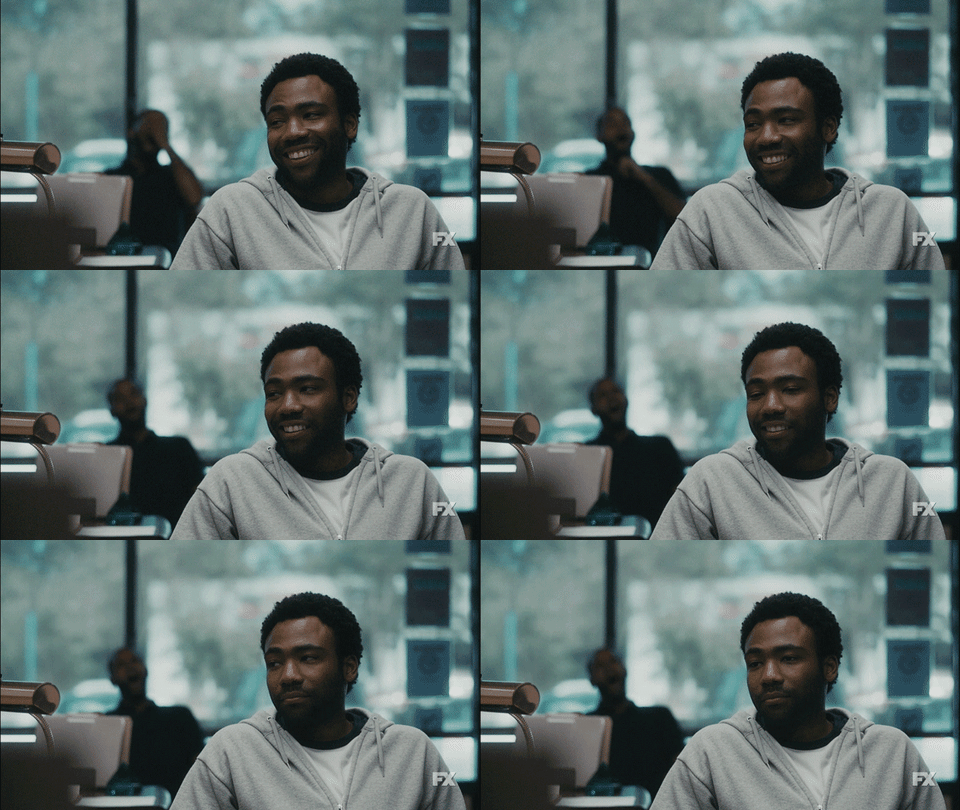
I’ll just wheel out some clichés here about why Atlanta defies categorisation.  It breaks the mould.  It’s one of a kind.  It’s truly unique.  Ok, there we go.  Now let’s talk about Donald Glover.  Our Donnie G is the creative force behind the whole show.  This is what made me realise that I needed Atlanta in my life.  Ever since I finished all his episodes of Community (Troy and Abed in the morning) there’s been a Troy Barnes-shaped chasm in my soul.  But gone are the bright smiles and innocent confusion of that character.  Instead we have scowling, unkempt facial hair and almost everything going wrong.  In Atlanta, Glover plays Earn, our leading man who isn’t really leading anyone anywhere (and is remarkably generous about stepping back to let the other characters shine).  We learn that he’s had educational potential, but it’s not amounted to much, with him struggling to hold down jobs, find places to live, care for his daughter and girlfriend.  We see his mum barring him entry to the house.  Throughout all of this, though, we root for Earn, a well-meaning everyman who’s often tested by but mostly tolerates the nonsense and weirdness of those around him.  And they are:

Van

Initially a background figure under the heading of baby momma, it’s thanks to Zazie Beetz’s magnetism that we’re grateful to see Vanessa step forward into focus as the two seasons progress.  She’s always surprising, whether whipping out richtig gut German in Helen at a crazy Bavarian festival (making it clear that we white folk are whack), dealing with her wasted friends at a supposed Drake party in Champagne Papi or struggling with an imbalanced and outdated friendship in Value.  These female-led instalments have lower ratings than the others, but this is just one of life’s great injustices.  Van steals my heart each time she rolls her eyes at others’ Instagram behaviour, so may we ever get to see more of her.

Paper Boi

This is actually Alfred, Earn’s cousin and smalltime-going-on-bigtime rapper.  When he can’t get off the sofa due to laziness, we really believe it, but Brian Tyree Henry comes into his own when required to cold-hard stare at anyone spouting nonsense.  In Barbershop, his frustration while trying to get a fade is so palpable it led me to sack off trying to pin down a barber to cut my hair before lockdown.  His must-see moment, though, is in B.A.N. when he’s forced to answer for his views on a late-night panel show, ambushed at every turn by virtue-signalling wokeness while the awkwardness is interspersed with fake adverts for African Americans on this pastiche of a popular channel.  Spoof ads have always had a special place in my amusement chambers and this episode delivers multiple belly laughs as a result.

Darius

Mostly found in Alfred’s kitchen, Darius is never doing what you expect him to.  LaKeith Stanfield is perfect at all times, never more so than when dealing with Teddy Perkins in a Michael Jackson-alike episode.

The rest of Atlanta is populated by all manner of grotesques, offering acerbic commentary on how race in the US interplays with wealth, work, education, family life, music, social media and just about everything you can think of.  We have humour in the deadpan observations, but also heartbreak in how easy it is to recognise these inequalities as very very real.  Atlanta’s strength comes from making everything somehow universal so that you’re forced to identify with the action as it unfolds.  But it doesn’t care what you’re expecting, calling to mind an I May Destroy You approach of drawing focus to whatever is more interesting, not what necessarily seems best placed to come next.  As such, each episode creates a work of its own, setting its own mix of characters, locations and times.  The throwback to Earn and Alfred’s schooldays seems at first leftfield, but artfully grounds what follows.

The soundtrack doesn’t stint on bangers and there’s even joy to behold in the opening credits.  Atlanta appears somewhere on screen in its unmistakable font, but you need to keep your eyes peeled to spot it among the madness.  I found myself tingling each time with excitement at the prospect of finding it, but maybe I need to get out more.  But I can’t because I’m now government-mandated to stay in.  The pandemic doesn’t stop there: it’s delayed production on the third series, automatically giving any return of Atlanta the epithet long-awaited.  And I shall wait as long as it takes.


Wednesday, 4 December 2019

Mindhunter


Everyone was telling me to watch Mindhunter.  So I watched it and now we’re going to hear all about what I thought of it.  Only it wasn’t as simple as that.  The people in the office that were going on about it were easily ignored.  I’m well known for not really being a listener, so this was within character.  It was, in fact, a chance encounter with the Netflix trailer for season two that really sold me into the show.  I’ve talked before about how navigating the overwhelming choice on Netflix can be daunting, leading to a paralysed state where no real commitment can be made, and you end up spending your whole evening browsing.  Before you know it, you’ve got to get in the bed and set the alarm so you don’t forget to go back to your office for typing emails into a computer the next morning.


But if you hover a show for too long on Netflix, the trailer autoplays.  The alarming eruption of voices has often led me to suspect I am undergoing a home invasion, but I am now used to this and have finally agreed with London Metropolitan Police that we will leave each other alone.  In the case of the Mindhunter trailer, suspenseful music immediately filled my sparsely decorated new build living room.  The screen of my massive telly conveyed a past decade of American life.  All of this was soaked through with a quickly gripping sense of mystery: the story was clearly of a serial killer in late seventies, early eighties Atlanta targeting African-American children while the institutionally racist law enforcement, er, institutions ignored calls for them to investigate.  I’m not normally one for grisly crime investigations, but the added tension of strained race relations promised more intense drama (see post on Dear White People) so this, coupled with some clearly very high production values, saw me dive in.


But what started as a dive turned into a slow, uncomfortable, duty-bound crawl as Mindhunter shifted awkwardly under my expectations of what it would actually be.  Let’s get this out of the way first: the Atlanta murders are only really about 40% of the second series, and to get to that I had to get through the first series, where they are 0% of the content.  Don’t get me wrong; I’m not saying I can now only enjoy things that are to do with the Atlanta child murders, but I want to acknowledge that Netflix’s trailer mis-sold the show.  Nevertheless, I put my thumb-distracting smartphone in a different room and committed to the first few episodes.  But I couldn’t work out where things were going.  We had some FBI people forming an unlikely partnership, going around training local police, but then kind of starting to interview serial killers (before the term had been coined) in prisons and then sort of, you know, getting into running a whole study to understand more about the behaviour of violent criminals.  Mindhunter gets into a great stride, but it takes its time getting there.  This was competing in my TV-viewing time with masterpieces like Seven Worlds, One Planet and I’m A Celebrity (also obviously a masterpiece), so I found it harder and harder to prioritise such heavy-going fare.


After a bit of a gap, though, I found myself on lengthy plane and train journeys during my America trip and, with nothing else to do, was able to focus on subsequent episodes downloaded to my phone, finally hooking myself in to get totally mindhunted.  And that’s the first thing about Mindhunter: its terrible name.  The cast don’t actually go out hunting for minds.  A more apt title would be Crimesolver or Violentoffenderinterviewer, but both of those sound much naffer than Mindhunter.  But where there was a lack of effort in thinking up a title, there is an excess of doing a good job when it comes to most other elements of the production.  The period setting is executed masterfully – parts of it are slightly akin to a latter-day suburban Mad Men, and, like that show, the attitudes of the time are held true, rather than filtering history’s bigotry through a more palatable lens to make modern audiences feel good (I’m looking at you, Downton Abbey).  People smoke constantly, there is little to no airport security, and seatbelts look distinctly optional – ah, the good old days.


Let’s meet, then, the chap who I think is the actual Mindhunter: Holden Ford.  He’s played by Jonathan Groff and he speaks with the same pitch of voice at all times, which makes his lines hypnotic, but brings to life Ford’s untapped genius as he begins to realise the scope of what his work can achieve: if they learn to profile killers, they can solve murders before further victims fall.  The grumpy cop to his wide-eyed cop is Bill Tench and what unites them is they both have really bad shirts.  Our pair are joined by Dr Wendy Carr who seems to perform the role of some sort of line manager stroke unenthusiastic office-bound cheerleader, sending her chaps out to record interviews she can listen to.  All three are drawing on their experiences at a certain school of acting in their performances: the “I just smelled a fart” approach.  Indeed, each actor’s talent shines through as they create their characters, but the distasteful and serious nature of their conversations and relationships make it look like someone has just keffed in their airspace the whole time.  This extends to almost all the supporting cast, with the exception of the serial killers they meet in various jails.  There are some real household names that I won’t spoil, but you can tell each performer is having a smashing time in the role.


As we progress into series two, a lot starts to go on.  Story strands spread outwards like planets in an ever-expanding universe.  While everything that unfolds about the Atlanta child murders is compelling, we’re also getting deep into Tench’s own problems with his adopted son and very curly-haired wife (with in-marriage dialogue that perfectly captures how things can get so much worse when you only say the wrong thing to each other).  In addition, Carr’s relationship goes under the microscope in order to allow us a better understanding of her mode of operation (which is refreshingly unusual).  Mindhunter treats its viewers intelligently, allowing real focus on each area rather than jumping about like a dance video.  The whole pace can tend to luxuriate in its own quality, as if demanding we drink in the awesome settings, the American nostalgia and the faces of cast members who look like they’re trying to work out who just did that terrible fart.


Season two has left me wanting more and a new TV-viewing approach has evolved to keep up with historical references.  It’s called the Google-along and it’s something you might already have found yourself doing with The Crown.  Each time something comes up that you’ve never heard of, call upon your search engine of choice to cover the gaps in your historical context.  But don’t forget to look at the TV screen too, otherwise you’ll miss this unusual show as it defies your categorisations and expectations.  Focus on the mindhunting.