Showing posts with label sitcom. Show all posts

Wednesday, 3 March 2021

The Simpsons (Seasons One To Five)

For those that know me in real life, you’ll have noticed a significant and glaring omission from these posts over the last 188 entries.  There’s a certain animated sitcom that influences my speech every day, that I have spent whole ski trips reciting (“Stupid, sexy Flanders”), whose songs I have butchered to the irritation of other passengers on trains in Germany (“Oh please won’t you see my vest?”) and that probably represents to me the first time I saw the status of masterpiece achieved in TV: The Simpsons.  It’s now been running almost as long as I have, but we’re going to go back to the very start and giving its early years the respect they deserve.  Therefore, its voluminous canon will be split into chunks and we shall begin with the first five seasons.  The classics, if you will.  It’s a well-documented and popular opinion held these days that America’s favourite yellow family is far past its peak.  Now that I have plumped for access to Disney+ (see crucial explanatory post on my life admin decisions here: The Mandalorian), I’ve decided to go back and see for myself.  But let’s be generous – at no point will I be denying the ongoing cultural impact of one family from 742 Evergreen Terrace.  In fact, they may even be victims of their own success.

For a long time I had no real idea what this Simpsonite phenomenon was.  In the UK, the show originally only went out on Sky One (which my parents wouldn’t pay for), and, in the days before the internet, my single route to any further information was an on-pack promotion with Shreddies.  This cereal occasionally appeared in the line-up for breakfast in my early 90s childhood.  My dad, who worked nights, would be asleep upstairs while my mum would quietly prepare my sister and me for school.  A selection of cereal boxes would be laid out on the table in the breakfast room (yes, I know) the night before, so we could serve ourselves on waking up, munching along in time to Mr Motivator on GMTV.  These days, Shreddies would cause me severe digestive discomfort, but in my youth I seemed happy to risk a code brown in order to keep hunger locked up till lunch.  In place of toys, the promotional packs contained Simpsons trivia cards.  I devoured these, desperate to know more about this collection of people who were, to me, at the time, little more than a spiky haired boy, a bald man, a lady with a blue head bush, and an indeterminate number of star-headed woman, all with bulging eyes and yellow skin.  One question then posed still lives with me: who is Bart Simpson’s hero?  I remember you had to slide out a little piece of paper to confirm the multiple-choice answer: Krusty the Clown.  I was torn.  Thrilled to have learned something about these intriguing characters, Krusty sounded like a weird name for a clown.  I also hated, and still hate, clowns.  I was left broadly concerned and very much unsatiated when it came to the world of these yellow cartoon strangers.  What was all the fuss about?

In a rare use of the license fee not to promote Tory politics, the BBC finally acquired the license to broadcast old Simpsons series in the later nineties.  It was the dawning of a new age for my sister and me.  This was years before culture was simulcast on both sides of the Atlantic.  Primitive dwellers of Blighty had to wait months and sometimes years to access Hollywood films.  Thus, only seven years after its American debut, The Simpsons came to British terrestrial telly in 1996.  Life would never be the same again.  In an act of severe trolling, its initial slot was something like 5.25pm on a Saturday afternoon (though it may have been Sunday).  This was before catch-up services and during an epoch throughout which my dad didn’t know how to set the timer on the VCR (which actually extends into present day as he has never learned), so the appointment to view was without compromise.  The show was paired with the TV spin-off of Clueless, so, for the best part of an hour, we would bathe in the contrasting genres of glamorous, sunshine-drenched, high school-based light entertainment that we didn’t understand, and a riot of colourful animation that we simply had to have in our lives.

Viewed in the present day, the episodes of that first season are charmingly rough around the edges.  The drawings threaten to melt at any moment.  Characters take on almost liquid form, and there is a very loose approach to ethnicity, with some racial identities taking a while to settle (and even adjusting in the same episode).  But this is part of the fun, and, either way, the tight tight storytelling distracts from any sketchy sketching to a significant degree.  Each instalment is a masterclass in screenwriting, combining biting satire with comforting heart, acidic wit with sweetness, genuine emotion with slapstick silliness.  The balance of contrasts is remarkable and something that, as modern detractors would argue, hasn’t stayed with the show through subsequent series.  At one point, Homer attempts suicide.  Lisa has depression.  But these aren’t played for laughs – they are taken on to reflect modern life.  Homer, in particular, is a different man.  Sure, he likes is food and is often outsmarted, but he is much more short-tempered, snapping often at Bart, and even at one point the driving force for his family to improve.

As I re-watched, I became fixated on the evolution of our paterfamilias.  Season one Homer has depth, but by season three he is almost fully dumb, and as season five settles in he is stupid beyond all reason.  Reflecting now, this strikes me as the main feature whose loss affects the quality of The Simpsons.  We go from masterpiece to (only!) still better than most things.  A tough judgment for something so lasting and popular but it’s my blog and there’s nobody to stop me venting my bugbears.  Homer shouldn’t matter so much as I’ve always preferred the rest of the family.  Storylines focusing on the children hold more fascination, with Bart channelling my impulse to do anything for the laughs, and Lisa a kindred spirit to my intellectual snobbery.  Often, the best line is simply Maggie’s dummy-sucking.  Marge, in fact, feels more relevant than ever as a manifestation of the invisible mental burden carried by female members of most modern hetero households.  As we progress, a whole town population of Springfielders is generated around the family and a perk of sitting through some episodes for what must be the twentieth time is tracking their first appearances and subsequent developments.

By season two, The Simpsons has perfected (from a high base) the art of the 22-minute story, carrying this right through to most of season five, which is what made me separate this quintuplet off for its own post.  A blessing and a curse comes in the form of the fact that each episode must end with the world unchanged.  The characters don’t age (imagine being eight since 1989).  All plot must be wrapped up and resolved.  When played for laughs, such as with the ongoing joke that Mr Burns can never remember who Homer is (“one of the carbon blobs from Sector 7G”) despite significant intertwining of their lives, this feels appropriately self-conscious.  But as time goes on, the increasing extremity of what happens in each episode gradually chips away at the family’s everyman status.  By the time Homer has gone to space, I start to feel a certain amount of turning off.  While an incredibly witty episode that puts Lisa’s morals front and centre, Whacking Day’s plot hinges on snake activity that is so unrealistic that the suspension of disbelief barely clings on (even though everyone is yellow and only has three fingers).

But who am I to nit-pick?  The show remains enormously comforting.  Even after its UK repetition ad-nauseum in the 6pm weekday slot on BBC2 and then Channel 4, I somehow stumbled across real gems in season four that I had potentially only seen once.  Season five in places represents a pinnacle in perfect sitcomery.  From my more advanced years, I can appreciate the wealth of references, both high- and lowbrow, that pepper proceedings: Edgar Allan Poe, The Grinch, Hitchcock and more.  From season two, there exists a wildcard Treehouse Of Horrors episode that serves to let the writers really shake things out.  As a cartoon, ultraviolence has fewer repercussions, and I always laugh whenever there’s an unnecessary explosion.
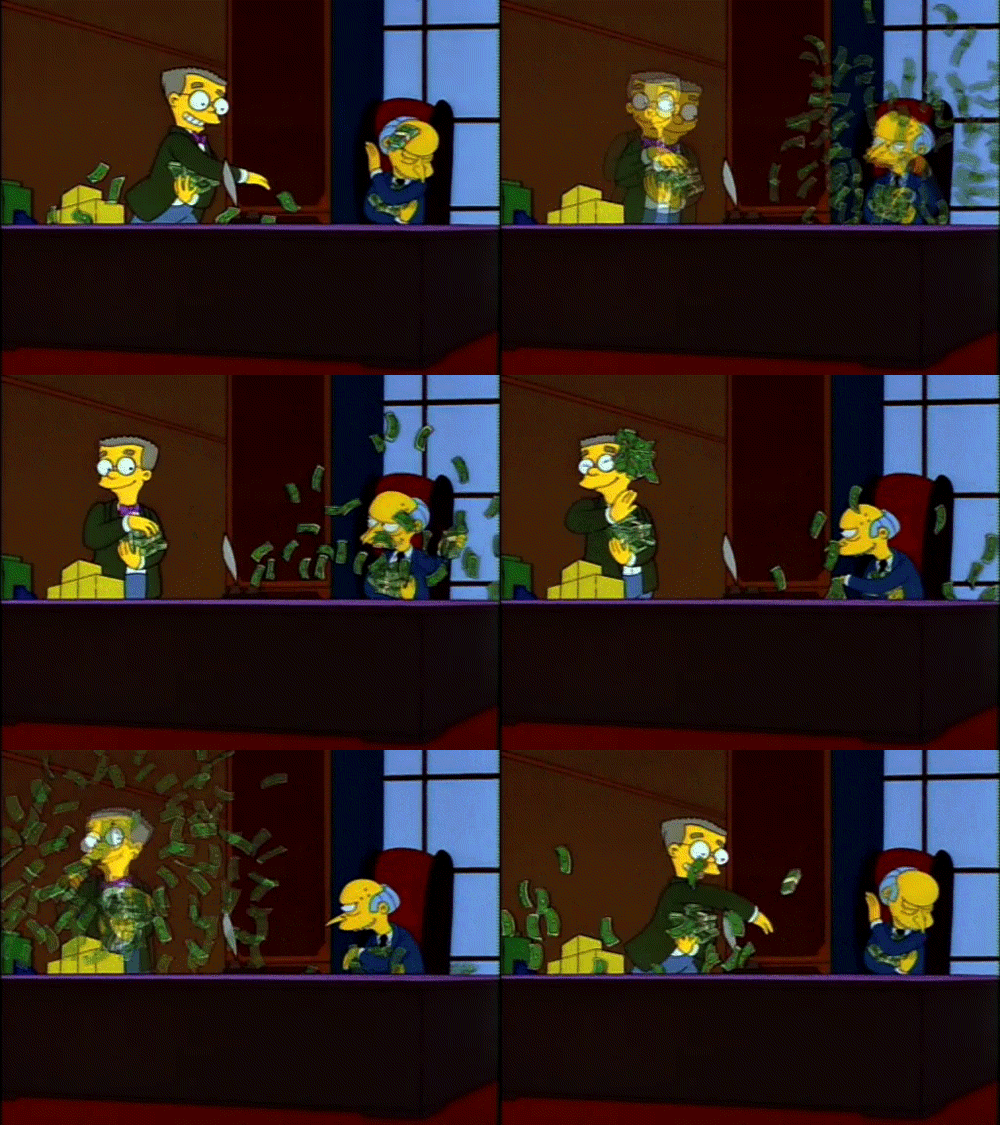
The Simpsons’ first seasons set an impossibly high standard.  They spawned a whole new world of animation for adults, begetting an array of entertainment that could often go further with offensive humour and push the boundaries of taste (South Park, American Dad!).  As such, The Simpsons in later years began to look safe and pedestrian.  Like Facebook, it risked acquiring a role as something embarrassing only your parents go on.  But, going back to its classics has been the perfect background comfort while pottering around my flat in lockdown 523, gaining a new and meaningful appreciation of its importance.  To imagine a world where it never existed is to imagine a duller, sadder way of thinking and being.  The inequalities it parodies are still with us so we can conclude that vintage Simpsons is as evergreen as the terrace where the eponymous family still live, all these decades later.

Tuesday, 16 February 2021

30 Rock

For the creators of amazing telly, it must be dispiriting to have their programme described as a background show.  Yet the concept is well worn, particularly when we are stuck at home all the time.  For me, the background show is ideally shorter than half an hour in length and, typically, a comedy.  It might seem like a fall from grace for something like Friends, going from must-see TV premiers in primetime to something we can put on for a bit of chatter to drown out our thoughts while our attention is half-taken by chopping up vegetables or watering the houseplants.  But, it’s either a new way of appreciating an old favourite, as my journey reacquainting myself with South Park proved in its unfolding, or a perfectly apt way of discovering a new show, as I did with Brooklyn Nine-Nine.  It’s even more impressive if a background show can make you laugh out loud, and this week’s subject, 30 Rock, certainly did that to me.

Interestingly, to nobody but me, 30 Rock straddled both of these categories.  I remember watching the first series in some former stage of my life, enjoying the fast pace of the gags on gags, the perpetual irrelevance and the abundance of very very silliness (hello to you, Miranda).  Nobody knows why, despite the best efforts of scholars, but I never got any further.  Cue 2020/1 and I’m working from home every day, trying to make lunch breaks a thing by popping on an episode of my current background show while treating myself to one of life’s few remaining comforts: food.  There, among all the Sky boxsets, was dear old 30 Rock.  Surely I could get through all seven seasons simply because I have nothing else to do, unless you count staring in the mirror and weeping.  I’m here to report that, yes, I really did achieve my goal of watching all of it.

Scant research, by me, has revealed that the concept of 30 Rock is loosely based around the writers’ room of famous American cultural thing Saturday Night Live.  We don’t get that in the UK.  Our live thing on Saturday night is Strictly Come Dancing and that doesn’t have a writers’ room because, like a lot of British telly, there aren’t actually enough writers to go round that every show can fill its own room with them.  I suppose it depends on the room, though, as we could just be talking about the downstairs cloak.  In short, SNL (for short) is a parody sketch show of that week’s events featuring a celebrity guest host and a retinue of regular cast.  Within 30 Rock, our version of this is The Girlie Show but, as each series unfolds, we see hardly any of it.  Half the joke is that it’s bad and unfunny, cobbled together at the last minute despite the ineptitude of its writers and producers, while the rest of the humour comes from the lives of the characters trying to make it happen in the first place.

Our hero is Liz Lemon, played by creator Tina Fey.  I’m doing things arse-backwards here as I’ve already banged on about my Tina love in a previous post on her later creation Unbreakable Kimmy Schmidt.  Both shows have a lot in common, but one key difference is that Fey hardly appears in the latter.  Lemon, however, is our window into the TV sketch show production world, the only (relatively) normal and capable NBC employee trying to wrestle everyone else along to something approaching acceptable behaviour.  You’ll come to love her as much as you’ll love seeing her abused by co-workers, friends and family, often via flashbacks to her dweeby childhood and teenage years.  She’s all of us in later decades when we can’t be bothered to go out at night anymore (something I regret terribly now we’re not allowed to go out at all).

The pilot sets up her main foil, network executive Jack Donaghy.  Alec Baldwin has the time of his life as this right-wing conservative, sending up a variety of attitudes with charming affection and building over the series with Liz Lemon an almost perfectly symbiotic relationship.  Lemon, too, is thwarted by her cast.  Donaghy forces upon her Tracy Jordan, played by Tracy Morgan.  She must effectively parent this manchild and his entourage while keeping happy her best friend, Jenna Maroney, TGS’s original star whose nose is well and truly put out of joint by the arrival of Jordan.  At all times, Jane Krakowski’s performance is my favourite thing, as Maroney’s fame-hungry desperation, delusional attitude to ageing and uncompromising need for attention mark her out as a true kindred spirit, although I can’t sing and she can’t stop blurting out tunes at the slightest provocation.  The wider cast sets up constant jokes at the expense of various strata of American society, and then this is fleshed out to great effect by a steady stream of guest stars, from Mad Men’s Jon Hamm to Bojack Horseman’s Will Arnett.  I’m reserving special mentions for Rachel Dratch in various scene-stealing roles and for the character of Leo Spaceman, the world’s worst and therefore funniest medical professional.

And that’s the main conclusion to leave you with – this stuff is funny.  Some elements haven’t aged too well from 30 Rock’s 2006 beginnings, but we’ve had many intervening years to improve our society and so any reaction to bad taste simply shows you how far we’ve come.  The characters are strong, ridiculous and don’t even come close to running out of mileage.  The action is relentless and there’s never more than ten seconds without some sort of gag.  With even just half an eye on it while you move your mouse around on your laptop so it looks like you’re actively working from home, it can still guarantee you laughs.  So this still remains amazing telly, no matter what attention you’re paying it.

Wednesday, 23 December 2020

Brooklyn Nine-Nine

I’ve found another sitcom workplace where I think I’d really fit in.  This time, it’s within the NYPD.  Let’s be clear: I’d be no good at solving crimes.  I would also be unwilling to undertake any duties that put me at risk in any way whatsoever.  Similarly, I couldn’t work in New York as it’s either too hot or too cold (and UK citizens currently can’t go there).  But, Brooklyn Nine-Nine has now joined the ranks of charming comedy shows where I tune in to feel like one of the gang.  I’ve imagined myself really fitting in with the personalities of Parks & Recreation.  I’ve considered where my place would be among the Scranton bods of The Office US (as well as knowing full well which one’s me in The Office…).  Now I can spend time wondering how my own sense of humour would enrich the pleasant chuckling that the activities of this very special police squad create.

Naturally, I am intentionally late to this party.  Having seen countless ads on e4 for the UK broadcast of this programme, I put it in the same category as Hollyoaks: TV shows whose existence I can ignore.  This decision was compounded by my televisual aversion to the emergency services.  However, I was frequently asked if I had seen Brooklyn Nine-Nine, with most people prompted by my own excessive office-based consumption of yoghurt – a trait I share with Sergeant Terry Jeffords (Terry Crews).  Well, with lockdown coming up to its one-year anniversary, we’ve all got through more TV than we ever thought possible.  I’m not sure what happens when you complete Netflix, but let’s start a rumour that you get a telegram from the Queen (The Crown’s Olivia Colman of course).  So, to offset some of the heavier drama boxsets I was wading through (The Fall, The Staircase etc), Brooklyn Nine-Nine seemed like a welcome addition to my rotations.

At first, I’ll admit to seeing nothing special.  It was about crime, but not in a serious way.  Nobody died, jeopardy was only there to serve as plot device against which comedy could play out, the characters were loud and excessive in their behaviour.  Before I got to know them inside out, the humour struck me as obvious and I began to come to terms with the fact this might well be a true background show: something that plays in the background while I cook under the extractor fan, unable really to hear or see it.  Sure, a couple of episodes would get a bit of focus during my weekly bath, but Brooklyn’s fictional 99th precinct hadn’t yet earned a special place in my heart.  I did however unearth my favourite character early on: Gina Linetti (Chelsea Peretti).  There’s something about a woman who won’t let anything or anyone stop her doing exactly as she pleases that just makes for wonderful entertainment.  Her rudeness to all her colleagues is a constant source of inspiration.

Over time, though, I learned that all our main players have such strong characterisation that the humour’s beauty clearly comes from knowing them well.  Disturbingly, perhaps, there was also a bit of me in all of them.  My lifelong geek side means I see Amy Santiago as a kindred spirit.  My emotionless intellectual snobbery turns Captain Raymond Holt into a hero.  Charles Boyle is all of my insecurities wrapped up in one tiny little man.  I won’t go through them all, but they’re so much more than background artists designed to offer perspective on our central figure: Jake Peralta, played by Andy Samberg.  He is the only one I am not, but he still makes me laugh with his childishness: a great face for silliness.  As series progress, the vibe becomes less about Peralta’s tension with fish-out-of-water new boss Holt, and more about the unit’s ability to support each other through good and bad times.

If that doesn’t sound hilarious, Brooklyn Nine-Nine is also taking on a number of social issues in a matter-of-fact way.  Racism, homophobia and sexism all come under the microscope.  We tread a narrow tightrope between signalling worthiness and, in fact, reflecting the world around us.  A stereotype or stock character is a very rare occurrence throughout the show’s universe.  And it is this, coupled with the cast’s irresistibility, that saw Brooklyn Nine-Nine succeed in commanding my attention.  Somehow, it’s elevated itself well above a background show.  Each instalment of its six series on Netflix (and a seventh out there that aired this year) deserves your full attention.

Sunday, 25 October 2020

Motherland

I’ve been doing some parenting recently.  Well, I held a friend’s baby for about half an hour while she had a crème brûlée (the mum, not the three-month-old).  Despite not having procreated, I was fairly confident I could keep the young lad content with my impressive jiggling skills, honed over a decade ago when I was a quaternary caregiver to my niece.  A couple of times however, I could sense his bottom lip quiver, his copious cheeky cheeks redden and his little face screw up in unhappiness, prompting me to adopt a new position to distract him from any number of distress sources: hunger, overheating, a soiled gusset, boredom with the view.  When the moment came, I was fairly satisfied to be handing him back over, even if the girls had commented that his 6.5kg of weight had leant my biceps an alluring bulge.  If I factor up the duration of that brief stint of (quite literally) baby sitting to a week, I have to multiply its difficulty by 336, and if we go all the way to the eighteenth birthday at which point I assume you turf your progeny out into the street and cut them off from the family fortune, that’s a total of 314,496 units of parenting.  In short: child-rearing is hard.  And as the owner of a phallus, I’ve got the easy end of the stick, as it were.  Motherhood is hardest of all.  Here, then, is the hilarious truth that forms the comedic backbone to BBC sitcom, Motherland, whose achievements we will be celebrating today.

Too millennial ever to be aware of what’s scheduled on the actual TV, I was only vaguely conscious of Motherland’s two series when they first went out, catching glimpses whenever the real telly came when switching from Netflix to Amazon Prime.  I knew one of its creators was Sharon Horgan, who had co-created Catastrophe, and again, following my nose in working out why people on podcasts like a thing, I finally plumped to dive in after spotting Motherland’s first series appear on Netflix, before eventually tracking down the second on iPlayer.  I was craving the wit and cynicism of British humour after having so many glossy American boxsets in recent rotation: Power, Watchmen and, er, Love Island USA.  The situation is suburban London and the comedy is balancing childcare, a career, a relationship, and, worst of all, other mums, so let’s meet the mothers of this land:

Julia

The master of the fake smile, Julia covers up each episode’s mounting shower of disasters with a suitably correlating uptick in false cheerfulness, effectively using effusive exclamations to paper over cracks in her best-laid plans until she ultimately breaks down in ranting and raving.  We cross our fingers and toes that she will catch a break, but she’s ever thwarted by each element of what should be her support structure: her husband would help but he has to play golf with the lads, her mother would help but she’s entitled to enjoy her retirement, the other mums would help but they’re busy forming a sort of mummy Mean Girls (mean mums?) at the local café, consigning Julia to the table by the toilets.  A career in PR only makes matters worse, as it does most things, but it’s the people Julia meets at that lavatory-adjacent table who finally offer help.

Liz

The queen of laid-back parenting, Liz has had to develop more extreme coping strategies as a single mum.  Her seemingly thick skin places her well to encourage Julia to be less anxious, though Liz does herself later struggle with pushchair extraction when her youngest finally abandons her for nursery.  Life’s too short not to cut corners, and that time saved is better spent having a cheeky drink anyway.

Kevin

Yes, it’s a man, but Kevin is perhaps the mumsiest of all.  Contrasting with Liz’s workaround and make-do methods, Kevin is not happy unless he is out-parenting left, right and centre.  Desperate for the approval of the other mums, he volunteers for every PTA gig going, yet fails to find the acceptance he yearns for.  Mostly seen in a cagoule, his highlights are his throwaway lines about never-seen wife Gill as it’s clear to everyone but him that his approach to parenting makes her skin crawl.  Yes, Kevin is cloying, but his heart’s in the right place, and his very inclusion provides a spirited commentary on gender roles for those that are looking to find one.  Otherwise he’s a silly sausage in a bicycle helmet.

Amanda (not Mandy)

With her expensively coiffured blonde hair and yoga-taught frame, Amanda is the alpha-mummy whose every utterance either allows her to show off (less of the humble, more of the brag) or serves as a backhander to put down the other mums around her.  For some reason, I love her.

Anne

My favourite mum.  She begins as one of many flunkies to Amanda’s act as chief mum, but soon accumulates enough scene-stealing lines to guarantee belly laughs so loud that you can only hope you’re giving your neighbours a taste of their own medicine for all those lockdown reggaeton parties you’ve endured.  She’s a cautious parent, convinced all adults are out to molest or poison her offspring, which makes trick or treating challenging.  Her wardrobe malfunction at a swimming pool party and her poor management of her own IBS during a weekend away in half term both endear her further to me.

The second series also sees the introduction of Meg, a hard-partying, hard-working mum who hasn’t got time for any of your nonsense, unless it involves being abusive on night buses.  I can’t work out what they’ve been trying to do with her beyond address a lack of diversity but it’s great to have her along.  Let’s say she is wonderfully complex.

On the other hand, the kids rarely merit any significant characterisation and this is, again, because they don’t really matter.  The humour is brittle and acidic when it comes to deploring the role of modern working mums, running households, keeping everyone happy, sacrificing their interests and yet still being expected to knock up a harvest festival costume at a moment’s notice.  They’ve been told they can have it all, but yet somehow it feels like having nothing.  The swimming pool party episode illustrates this perfectly when Julia, hair done and posh outfit selected for a career-important work do, is strong-armed into in-pool supervision that leaves her showing up later at her function as drowned as a rat.  We laugh because it’s true, but as I recovered from each chortle, I had to check my childless male privilege lest I feel hopeless about a status quo whose imbalance looms large in daily lives.  Motherland’s comedy comes from its universal truth, but I’m sure we could find something else to laugh about if gender inequality no longer existed.

Monday, 21 September 2020

W1A

This week, nobody has been asking me the following question: what other hidden gems in the world of comedy have you uncovered since you wrote so passionately about Crashing?  Nevertheless, I do need to tell you that I have gone and done it again.  I’ve come across a show whose existence I was completely oblivious to and now I’m going to harp on about it like I invented it myself.  It was probably huge at the time and is therefore already beloved by millions, but this is my blog and I can do whatever I like.  Something else people never ask me is how I decide which shows to feature in my self-indulging prose.  Well, there is no method to this madness.  I do have a longlist of shows I ought to get around to and this week’s programme was in fact on there – something I didn’t even realise until I had finished the third and (hopefully not) final season.  Anyway, preamble aside, we’re doing W1A this week.

Now, regular readers will be aware of my increasing despair when it comes to how awful we British our proving ourselves to be.  The dangerous yearning to return to a post-war peak from 75 years ago threatens everyone’s present-day opportunities.  Nevertheless, alongside the sinister jingoistic gymnastics, there are British traits that, conversely, feel as comforting and familiar as saying sorry to a stranger who’s bumped into you.  One of these is always suspecting we will make a mess of things.  Our trains can’t run in the snow, our trains can’t run in the heat, our breweries have hosted poorly organised piss-ups.  Back when we won the 2012 Olympics, everyone rolled their eyes in anticipation of ensuing shambles (when it was actually a recent national peak, inequality riots aside, and I’m not just talking about me dancing in the closing ceremony…).  So little faith did London’s wonderful liberal elite have in the organising committee than an irreverent sitcom was conceived: Twenty Twelve played on our suspicions surrounding how petty office bureaucrats would arrange and execute so much sport.  Sadly, I never saw this show and can’t find it anywhere, but W1A is its successor, following on with the adventures of Ian Fletcher (that lovely Hugh Bonneville off that lovely Downton Abbey) as he takes up a new post at the BBC.

Aha, you say, another institution we can deride for being a bunch of silly sausages.  How dare they make pensioners pay for their licenses when they of course deserve everything for free?  How dare there allow two women to dance together on Strictly?  How dare they pay female staff less than men?  (Guess which of these three is my actual opinion).  But, this is a BBC production, brilliantly sending up itself and our perceptions of the pencil-pushers who make it tick.  Fletcher serves as our guide in this institutionalised institution, stumbling through Old and New Broadcasting House trying to make sense of how things are done as the new Head of Values while slowly coming to accept that everyone is either incompetent at what they do, or they don’t do anything at all.  It’s at this point I must stress that the whole thing is laugh-out-loud funny.  I giggled my socks off in every single episode, so let’s count down which comedy creations scored the most LOLs on my chuckle-o-meter:

One: David Wilkes, played by Rufus Jones

As a development exec responsible for evolving potential show formats into ratings winners, Wilkes channels a new level of incompetency.  In any meeting, he expertly absolves himself of blame for every action and inaction of his.  He’s there, behind the fridge door, ready to steal your idea and take all the credit.  He interrupts discussions to tell everyone he can’t believe it and prefixes the name of anyone they are talking about with the adjective lovely: “Lovely Izzy, lovely Lucy.”  He’s frequently told to shut up and this generates in me the purest of joy.

Two: Siobhan Sharp, played by Jessica Hynes (seen in The Royle Family)

Another overspill from Twenty Twelve, Sharp is the PR guru who is incapable of listening to anyone but herself.  She is soundbites, mixed metaphors and statement jewellery, the very definition of having nothing original or useful to say.  Her response to every crisis is to blow things up on Twitter.  Her voice is supremely smug and she’ll announce that she’s “good with that” despite nobody requiring her approval.  I get the sense that whoever created her had some axe to grind after spending one too many meetings with members of the PR industry.  I can’t think why.

Three: Will Humphries, played by Hugh Skinner (seen in Fleabag)

“Yeah, no, hi, ok cool.”  Like everyone else, Will rarely says what he means, but he doesn’t know what he means anyway so it doesn’t matter.  He’s the awkward intern who’s overstayed his internship, but Skinner’s facial expressions show the perfect perplexity as Will screws up the simplest of tasks.

Four: Anna Rampton, played by Sarah Parish

As Head of Output, Rampton’s inability to move her top lip marks her out as a serious woman in business.  By repeating “yes, exactly, yes” she falsely portrays an air of decisive action while never doing anything.  Her catchphrase wears out slightly in later series, but she is at her funniest early on refusing every requested refreshment that is brought to her: “No, I don’t want that.”

Five: Simon Harwood, played by Jason Watkins

Harwood is that colleague we all sadly have.  The saboteur who wanted your role.  Non-committal, but always prepare to play his hand as a self-claimed confidante of the Director General (with whom he might enjoy the odd morning muffin), Harwood’s passive-aggression can be seen from space.  He’s constantly telling people he has no idea how things work (because they should) and that they will know how they want to play things (because he’s sure as hell not helping), before emitting one of his frequent exclamations of “brilliant” no matter what’s been decided.

I could go on.  There’s the for-once palatable David Tennant narrating, inserting the odd word to render all action ridiculous (particularly the Ministry for Culture, Media and, also, Sport).  You’ve got Tracy Pritchard beginning every criticism with “I’m not being funny but…”  Ben and/or Jerry bring a surreal element to the incredible pacing of every Damage Limitation meeting.  Layer upon layer of farce is dolloped out in rich scoops, crescendoing into ill-fated launches.  But it’s almost too close to home.  Some of the meetings feel like they were taken directly out of my life.  The curious inability of each and every character to communicate clearly makes wondrous use of two of the English language’s most abused words: yes and no.  Never seen alone or with certainty, W1A is strewn with oodles of “yes no” and lashings of “no yes” and then further fleshed out with generous portions of “yes no yes” and “no yes no.”  Playing out in a corner of London where I’ve worked for the last ten years, I look for myself in the background of scenes were Fletchers cycles into the office on his terrible Brompton (which bikes’ super-naffness is played for miles as laughs).  I’ve even been in the offices of Siobhan Sharp’s Fun Media on many occasions.

Get on the sofa and consume this immediately.  And then tell me if I was right or wrong about its brilliance.  Fair play to the Beeb for being such a good sport, lampooning itself for comedy (though never mentioning its news coverage’s right-wing leanings).  It’s not perfect – some exasperation at increasing wokeness has dated slightly.  Characters start to repeat their catchphrases too much and the freshness of the surprise wears off.  There’s an inevitable love triangle involving Ian Fletcher that doesn’t ring true, while the relationship between Izzy and Will remains effortlessly more charming.  We might not be able to organise a Brexit (so let’s stay) or a pandemic, but we sure can organise a silly sitcom about people who can’t organise things.

Wednesday, 1 July 2020

Flight Of The Conchords


If you’re anything like me, you might have asked yourself on multiple occasions why can’t all TV be musical.  Following on from last week’s post on Netflix’s Soundtrack (still a masterpiece) and a previous unpopular rant from me about what Glee did wrong (it’s here and needs more reads), we’re going back in time to look at one of the few boxsets that managed to be musical and cool at the same time.  I had nearly forgotten all about Flight Of The Conchords.  But, back in January, I was lucky enough to fill a spot with friends in a French ski chalet and found myself bombing around Tignes with some very advanced practitioners of winter sports.  So adept were they at swooshing down black runs, treating their inordinate speed with nothing but nonchalance, they had earned the right to annoy less stable alpinists by carrying speakers in their rucksacks and playing music out loud.  Older gentlemen do this a lot in lockdown London, cycling through crowded parks with loud beats emanating from their bicycles.  I’m not proud to say that we were equally anti-social, especially when it came to forcing others to endure prolonged exposure to us on various ski lifts and in their various queues.  As six adults in their thirties (four doctors, one commercial airline pilot, and me, someone who tits about in media partnerships) you may find our music choices challenging.  After exhausting the soundtracks of various Disney films, from Moana to Frozen, and reliving our youths with Tenacious D, our next source of musical accompaniment was Flight Of The Conchords.


I defy anyone not to appreciate the wanky Brit-abroadness of zipping down a sheer ice face in a busy French ski resort while singing along to Foux Du Fafa.

So let’s unpack the enduring appeal of these minstrels.  Firstly, Flight Of The Conchords, as themselves, are a New Zealand comedy music duo who’ve been active since 1998.  This blogpost is about the two series of their HBO New York-based sitcom that ran from 2007 to 2009.  I’m not sure if it was ever broadcast properly in the UK and, like my friends when it comes to sorting out our first meal in a restaurant since the start of lockdown, I’m not prepared to log onto the internet to do the appropriate research that would benefit everyone.  It was one of my many Belsize Park flatmates who must have brought home the DVDs probably around 2008, drunk on the swagger of unearthing early-adopted content to show to his co-renters.  Let’s not take this accolade away from him, as he remains a dear friend, going on to have two daughters with the wife he met in that very apartment, giving my life some value by virtue of me being the one who chose his future spouse off Gumtree.  It turns out, we only had the first season, but we would watch it over and over, and then listen to the CD soundtrack, also over and over.  The second series was something I only came across in 2020 on my Sky Q box, as it seems Sky Comedy have the rights.  I therefore peppered this into my regular viewing: new Rick & Morty, a fourth season of F Is For Family, lockdown-induced reruns of old Big Brothers and, er, Cruising With Jane McDonald.


Everybody, there is so much to love about Flight Of The Conchords.  Let’s start with our heroes, Jemaine Clement and Bret McKenzie.  Unlucky in love, they’re a kind of kiwi Peep Show pair, their strong accents only adding to the silliness as almost all of their vowel sounds get swapped around for the wrong ones.  The cheap appearance of the first season brings to life perfectly the absolute shitness of the Chinatown neighbourhood they inhabit on their shoestring budget.  Gainful employment comes in the form of a posting as the in-house band of New Zealand’s consulate, an organisation occupying the most depressing-looking office block in all of the five boroughs.  This premise sets up the perfect contrivance: as a band, they of course burst into song.


Only, they don’t really burst.  They slip.  They shimmy.  They irreverently and knowingly look down the camera lens, in on the joke that codifies their song: we’ve met a woman of average attractiveness (The Most Beautiful Girl (In The Room)), we’re laughing about the banality of long-term relationship sex (Business Time), we think we’re better than we are in reality at social gatherings (Prince Of Parties).  Their lyrics are often juxtaposed with reality, the whole thing packaged up with a heavily themed video, whether taking inspiration from Bowie or 90s rap.  In short, nothing takes itself seriously.  Why then, indeed, wouldn’t you have a Gallic number composed entirely of stock GCSE French expressions?  Cue titters as we all laugh about asking “Où est la piscine?” or saying “splish splosh” in a Parisian accent.  These silly songs are silliest when it comes to their catchiness.  Forgive me for only focusing on our first series here – it’s a familiar place for me, whereas the cameo-heavy second season, which seems on first watch to match its predecessor on song quality, has yet to get its claws into my short-term earworm faculties.


Alongside their failures with the ladies, Bret and Jemaine also fail to get anywhere with their music career.  This is often down to their manager, Murray (Rhys Darby), whose focus is the attendance register and agenda of band meetings at the expense of having a clue about anything else.  Nevertheless, their one and only (super) fan is on hand throughout: we have wide-eyed Mel played by Bob’s Burgers’ wonderful Kristen Schaal sporting an anorak and being, frankly, a pervert.  Fans of the anglophone world will also enjoy the long-running rivalry with their counterparts from the Australian Embassy, made all the more insulting by most Americans assuming our lads in the band are actual Australians.


For me, the only thing that has aged is the portrayal of New Zealand.  The country and its consulate are positioned as a running joke, with the Prime Minster himself acting the fool throughout his official visit and the ill-fated establishment of Newzealandtown (squashed between Chinatown and Little Italy).  In reality, New Zealand is fast earning international respect as one of the best countries.  Instead of being run by round blonde racist toddlers like the US and the UK, NZ has gone for a goddess who pursues welfare over growth, all while keeping a pandemic at bay.  Please may Jacinda Ardern take over Britain?  You may ask where I got that preposterous hypothesis.  Did Steve tell me that, perchance?  Mmmph, Steve.

Seriously, though.


Thursday, 11 June 2020

Community


Now that I spend almost all my time either working at home or pottering at home, the importance of the background show has grown.  I’m not sure if the background show is a concept that will be familiar to most readers, but it’s normally something under thirty minutes that you have on while doing other things.  In my case, this is probably while making breakfast in the mornings (convincing myself it’s a weekend by scrambling eggs and brewing freshly ground coffee before realising I was supposed to be on a work video call at 9.30am) and then throughout the day while eating all subsequent meals and (unnecessary) snacks.  For food prep in particular, the background show provides a bit of company while chopping onions and crushing garlic.  As such, it needs to be something that works with half an eye and half an ear on it.  This is how I got through hundreds of seasons of South Park and It’s Always Sunny In Philadelphia.  It’s the purpose my re-watch of Friends is serving.  It’s something that didn’t work with Community.


Community demands your full attention.  At first sight, it seems simply to be a cute sitcom from the realm of Parks & Recreation or The Office US.  But while it shares charm DNA with these two beloved shows, Community routinely displays such lofty narrative ambition that I’m telling you now: it needs your full attention.  I’m sure your desperate to know how I made this happen.  In short, it became the show I watched in my weekly bath, laptop balanced on some boxes next to the tub while I soaked my exercise soreness away over two episodes.  If you’re experiencing a mental image, then, you’re welcome.


We’ve talked before about community college, something American readers won’t need explained, but for everyone else, please see previous posts on Last Chance U and Cheer.  For Brits, it’s a bit like Lidl: you don’t want to be there, but it’s a necessary evil.  Indeed, a great deal of the lampooning around which Community’s arcs are structured has roots in the fact that community colleges are known more for their perennial students than for their academic prowess.  Nevertheless, we focus on a certain study group, representing many walks of life, whom the plot contrives to come together in the pilot episode to forge bonds whose strength you never really buy, but which you accept so the following six seasons of instalments can actually happen.


If, like me, you’re a lifelong spod, you’ll experience only disgruntlement at how little learning the study group does.  Instead, multiple missions are undertaken, most with the aim of saving Greendale Community College.  Proceedings have a point-and-laugh approach to diversity: no matter who you are, you’re ridiculous.  Of note is Abed as his Middle Eastern heritage is one of the least interesting things about him.  Instead, we’re high-fiving over brain diversity, revelling in the character’s autistic-spectrum emotional unusualness, leading to the wonderful coping mechanism of seeing the world through the construct of TV shows (ring any bells…?).  This allows the study group, in all its encompassing of age, income, faith, gender and skin tone, to embark on adventures that become so meta that they even end up being meta about their meta-ness.  There was a brief risk though that, as the straightest and whitest, the will-they-won’t-they-I-don’t-care romance between Britta and Jeff would become a central focus, but luckily everyone realises this isn’t interesting.  For the first three seasons, this is joyful, but somewhere around the fourth, I was slipping away.  There’s a glut of themed episodes (video game, animation, puppets) whose creatively I laud, but it feels as though there should be more of a foundation to establish what’s normal before branching out in this way.  And tune out now if you don’t like paintball or pillow forts.


The later seasons suffer the absence of key cast.  Donald Glover is first to move on, and the only reasonable response is to mourn the galling loss of the pure happiness that Troy Barnes provides.  Of all the end stings, Troy And Abed In The Moooorning has the highest LOL success rate.  Let’s commission this now for a full run as they perfectly pastiche the inanity of breakfast TV.  By the sixth and final season, which seems to be some sort of Yahoo-funded death rattle, we’ve lost Chevy Chase and Yvette Nicole Brown as well.  This, compounded by increasing plot complexity, meant I had no idea what was going on.  Luckily, after snaffling all the best lines, Dean Pelton’s role is expanded to fill some of the void, but it’s still only relief that you can feel as the show finally bows out (with a surprisingly highly rated meta meta meta ultimate episode).  Overall, Community, I salute you, despite your (self-recognised) inconsistency.  Its intelligence, absurdity and charm are all summarised in this clip I now leave you with, holding my breath for that Troy and Abed Spanish rap album we’ve all been dreaming about: best end sting ever.

CORRECTION:  Thanks to @communiess and @ButtsCarlt0n on Twitter, I can now reveal that Chevy Chase actually left first, in season four.  Shows how much attention I was paying.  Just One More Episode will, however, remain poorly researched.

Wednesday, 27 May 2020

Kath & Kim


I thought I was getting really good at this working from home, but I’m now in the midst of a full-on spiral having finally bought a monitor and forked out for instant delivery, only to discover it doesn’t have an HDMI port.  So, back to straining my neck to look down at my dirty old laptop screen.  I don’t want to complain though – I’m having quite a nice pandemic.  Greatest current concerns: not having office AC in my flat and the fact that baking powder can’t be found in any nearby supermarket.  Either way, if I damage my eyesight writing this, I now know it’s within the rules to drive to a castle to test my vision.  If I crash into people and cause further deaths, then I’ll know something isn’t right.  Luckily for everyone, I don’t have a car, I’m not a bigoted Tory (bad-)advisor and I don’t hold the British public in contempt (only those that clap the NHS to assuage their own guilt at voting rightwing).  The point in, in these pandemical times, we’re looking for comfort.  And I’ve found a great deal of it in old sitcoms.  My full re-watch of Friends continues, I’m this close to another run through of dinnerladies and, days after I saw it appear in the Netflix menu, I’ve just devoured the four seasons of Kath & Kim that aired between 2002 and 2007.


Just One More Episode has previously extolled the delights of Australian comedy.  But unlike Summer Heights High and Lunatics, this show doesn’t include Chris Lilley.  There’s no way of recalling how I came across this show, but, until now, I had only ever seen the first season.  Nevertheless, its effect stayed with me for subsequent years.  I don’t know how familiar you are with the working-class speech patterns of suburban housewives from Melbourne, but it doesn’t even matter.  So much of this sitcom’s ability to spark joy comes from its use of language.  Sure, there are some Little Britain-esque catchphrases, but these are mere chunks in a rich creamy spread of the silly misuse of the ever-malleable, ever-unruly English idiom.  Achieving near-native fluency in English is nigh-on impossible for most foreign learners, yet Kath’s mishandlings of her mother tongue are persistently charming.  Her forthcoming wedding is referred to as her “connubials” while both she and daughter Kim lament anything that “gets up [their] goat.”  A quick swap of a preposition and suddenly the banal becomes delightfully silly.  More than any of this, though, it is their way of responding to anything they like in the world of (bad) fashion and beyond by saying “that’s nice, that’s different, that’s unusual” that stays with me.  Of course, I would get the order and word choices wrong whenever I tried to wield this phrase facetiously when asked to comment on a colleague’s online shopping (back when we were allowed in our offices) but I’ve worked with many a beloved Australian over the years who was only too happy to correct my language.


Let’s forgive this diversion while I pause to explain who indeed Kath and Kim are.  Played by actors of roughly the same age, Kath and Kim are a mother and daughter team.  Kath (Jane Turner) is the permed older lady, embracing her empty nest (she wishes) while keeping herself trim and indulging a love for shopping at the mall in Fountain Lakes.  Kim (Gina Riley) is her spoiled adult daughter who can’t stop eating Dippity Bix, abandons her marriage to long-suffering Brett at the drop of a hat, is too lazy to hold down a job but who maintains a deep love for shopping at the mall in Fountain Lakes.  Locked in a cycle of co-dependency (and numerous eggcornings of the English language) our story starts when Kim interrupts her mother’s blissful retirement and declares she’s moving back in, jeopardising Kath’s burgeoning romance with local purveyor of fine meats (a vile phrase if ever there was one) and manbag-fan, Kel Knight.


Kath and Kim are the mother-daughter combo that taste forgot, but you root for them as their turns of phrase continue to charm.  Further comedy comes from Kim’s second-best friend, Sharon, whose uninvited arrival at Kath’s is announced every time by the unmistakable squeak of her French windows being slid open.  Sharon is at her best when suffering visible skin complaints or arguing with Kim about eating the last Dippity Bix (“Well, I didn’t know, Kim!” – the classic self-defence of a scoffer), but her penchants for indoor cricket and netball also sparkle.  That’s pretty much it for four series.  There’s a reassuring polyester cheapness throughout, not a great deal happens, but their humdrum lives bumble along and veer between the ridiculous and the plausible.


Its specific style makes it a hard show to recommend to newcomers, and I have many a time played it to pals who have felt lukewarm at best.  But I will carry on regardless in my love for it.  Its creators are talented (not least because Gina Riley actually belts out the theme tune to the opening sequence, something I never once skipped on Netflix) and deserve their cult status.  Sure, they lampoon class, but they also go for the posher snobs – every time Prue and Trude appear (also played by Turner and Riley), sneering at Kath’s jumpers or Kim’s muffin top in their snooty store, I can’t help but smile at their obscene diphthongisations and frankly more disgraceful murder of the English language.  I’m sad each time an episode ends, but while the credits roll, we are treated to wine time, a single-take scene of Kath and Kim quaffing cardonnay [sic] in their garden while wittering on with their usual gubbins.  In lockdown, I can’t tell you what I wouldn’t give for a garden and a family member to drink bad wine with while talking nonsense.


So, join the cult.  Kylie Minogue, Shane Warne and Matt Lucas can’t be wrong.  If you find the idea of a lazy mother telling her newborn baby (Epponnee-Rae) to stop whingeing because it’s mummy’s turn to whinge funny, then you’ll be in the right place.  There’s always a joker in the pack, and that joker is Kath.  And Kim.