Showing posts with label american comedy. Show all posts

Wednesday, 3 March 2021

The Simpsons (Seasons One To Five)

For those that know me in real life, you’ll have noticed a significant and glaring omission from these posts over the last 188 entries.  There’s a certain animated sitcom that influences my speech every day, that I have spent whole ski trips reciting (“Stupid, sexy Flanders”), whose songs I have butchered to the irritation of other passengers on trains in Germany (“Oh please won’t you see my vest?”) and that probably represents to me the first time I saw the status of masterpiece achieved in TV: The Simpsons.  It’s now been running almost as long as I have, but we’re going to go back to the very start and giving its early years the respect they deserve.  Therefore, its voluminous canon will be split into chunks and we shall begin with the first five seasons.  The classics, if you will.  It’s a well-documented and popular opinion held these days that America’s favourite yellow family is far past its peak.  Now that I have plumped for access to Disney+ (see crucial explanatory post on my life admin decisions here: The Mandalorian), I’ve decided to go back and see for myself.  But let’s be generous – at no point will I be denying the ongoing cultural impact of one family from 742 Evergreen Terrace.  In fact, they may even be victims of their own success.

For a long time I had no real idea what this Simpsonite phenomenon was.  In the UK, the show originally only went out on Sky One (which my parents wouldn’t pay for), and, in the days before the internet, my single route to any further information was an on-pack promotion with Shreddies.  This cereal occasionally appeared in the line-up for breakfast in my early 90s childhood.  My dad, who worked nights, would be asleep upstairs while my mum would quietly prepare my sister and me for school.  A selection of cereal boxes would be laid out on the table in the breakfast room (yes, I know) the night before, so we could serve ourselves on waking up, munching along in time to Mr Motivator on GMTV.  These days, Shreddies would cause me severe digestive discomfort, but in my youth I seemed happy to risk a code brown in order to keep hunger locked up till lunch.  In place of toys, the promotional packs contained Simpsons trivia cards.  I devoured these, desperate to know more about this collection of people who were, to me, at the time, little more than a spiky haired boy, a bald man, a lady with a blue head bush, and an indeterminate number of star-headed woman, all with bulging eyes and yellow skin.  One question then posed still lives with me: who is Bart Simpson’s hero?  I remember you had to slide out a little piece of paper to confirm the multiple-choice answer: Krusty the Clown.  I was torn.  Thrilled to have learned something about these intriguing characters, Krusty sounded like a weird name for a clown.  I also hated, and still hate, clowns.  I was left broadly concerned and very much unsatiated when it came to the world of these yellow cartoon strangers.  What was all the fuss about?

In a rare use of the license fee not to promote Tory politics, the BBC finally acquired the license to broadcast old Simpsons series in the later nineties.  It was the dawning of a new age for my sister and me.  This was years before culture was simulcast on both sides of the Atlantic.  Primitive dwellers of Blighty had to wait months and sometimes years to access Hollywood films.  Thus, only seven years after its American debut, The Simpsons came to British terrestrial telly in 1996.  Life would never be the same again.  In an act of severe trolling, its initial slot was something like 5.25pm on a Saturday afternoon (though it may have been Sunday).  This was before catch-up services and during an epoch throughout which my dad didn’t know how to set the timer on the VCR (which actually extends into present day as he has never learned), so the appointment to view was without compromise.  The show was paired with the TV spin-off of Clueless, so, for the best part of an hour, we would bathe in the contrasting genres of glamorous, sunshine-drenched, high school-based light entertainment that we didn’t understand, and a riot of colourful animation that we simply had to have in our lives.

Viewed in the present day, the episodes of that first season are charmingly rough around the edges.  The drawings threaten to melt at any moment.  Characters take on almost liquid form, and there is a very loose approach to ethnicity, with some racial identities taking a while to settle (and even adjusting in the same episode).  But this is part of the fun, and, either way, the tight tight storytelling distracts from any sketchy sketching to a significant degree.  Each instalment is a masterclass in screenwriting, combining biting satire with comforting heart, acidic wit with sweetness, genuine emotion with slapstick silliness.  The balance of contrasts is remarkable and something that, as modern detractors would argue, hasn’t stayed with the show through subsequent series.  At one point, Homer attempts suicide.  Lisa has depression.  But these aren’t played for laughs – they are taken on to reflect modern life.  Homer, in particular, is a different man.  Sure, he likes is food and is often outsmarted, but he is much more short-tempered, snapping often at Bart, and even at one point the driving force for his family to improve.

As I re-watched, I became fixated on the evolution of our paterfamilias.  Season one Homer has depth, but by season three he is almost fully dumb, and as season five settles in he is stupid beyond all reason.  Reflecting now, this strikes me as the main feature whose loss affects the quality of The Simpsons.  We go from masterpiece to (only!) still better than most things.  A tough judgment for something so lasting and popular but it’s my blog and there’s nobody to stop me venting my bugbears.  Homer shouldn’t matter so much as I’ve always preferred the rest of the family.  Storylines focusing on the children hold more fascination, with Bart channelling my impulse to do anything for the laughs, and Lisa a kindred spirit to my intellectual snobbery.  Often, the best line is simply Maggie’s dummy-sucking.  Marge, in fact, feels more relevant than ever as a manifestation of the invisible mental burden carried by female members of most modern hetero households.  As we progress, a whole town population of Springfielders is generated around the family and a perk of sitting through some episodes for what must be the twentieth time is tracking their first appearances and subsequent developments.

By season two, The Simpsons has perfected (from a high base) the art of the 22-minute story, carrying this right through to most of season five, which is what made me separate this quintuplet off for its own post.  A blessing and a curse comes in the form of the fact that each episode must end with the world unchanged.  The characters don’t age (imagine being eight since 1989).  All plot must be wrapped up and resolved.  When played for laughs, such as with the ongoing joke that Mr Burns can never remember who Homer is (“one of the carbon blobs from Sector 7G”) despite significant intertwining of their lives, this feels appropriately self-conscious.  But as time goes on, the increasing extremity of what happens in each episode gradually chips away at the family’s everyman status.  By the time Homer has gone to space, I start to feel a certain amount of turning off.  While an incredibly witty episode that puts Lisa’s morals front and centre, Whacking Day’s plot hinges on snake activity that is so unrealistic that the suspension of disbelief barely clings on (even though everyone is yellow and only has three fingers).

But who am I to nit-pick?  The show remains enormously comforting.  Even after its UK repetition ad-nauseum in the 6pm weekday slot on BBC2 and then Channel 4, I somehow stumbled across real gems in season four that I had potentially only seen once.  Season five in places represents a pinnacle in perfect sitcomery.  From my more advanced years, I can appreciate the wealth of references, both high- and lowbrow, that pepper proceedings: Edgar Allan Poe, The Grinch, Hitchcock and more.  From season two, there exists a wildcard Treehouse Of Horrors episode that serves to let the writers really shake things out.  As a cartoon, ultraviolence has fewer repercussions, and I always laugh whenever there’s an unnecessary explosion.
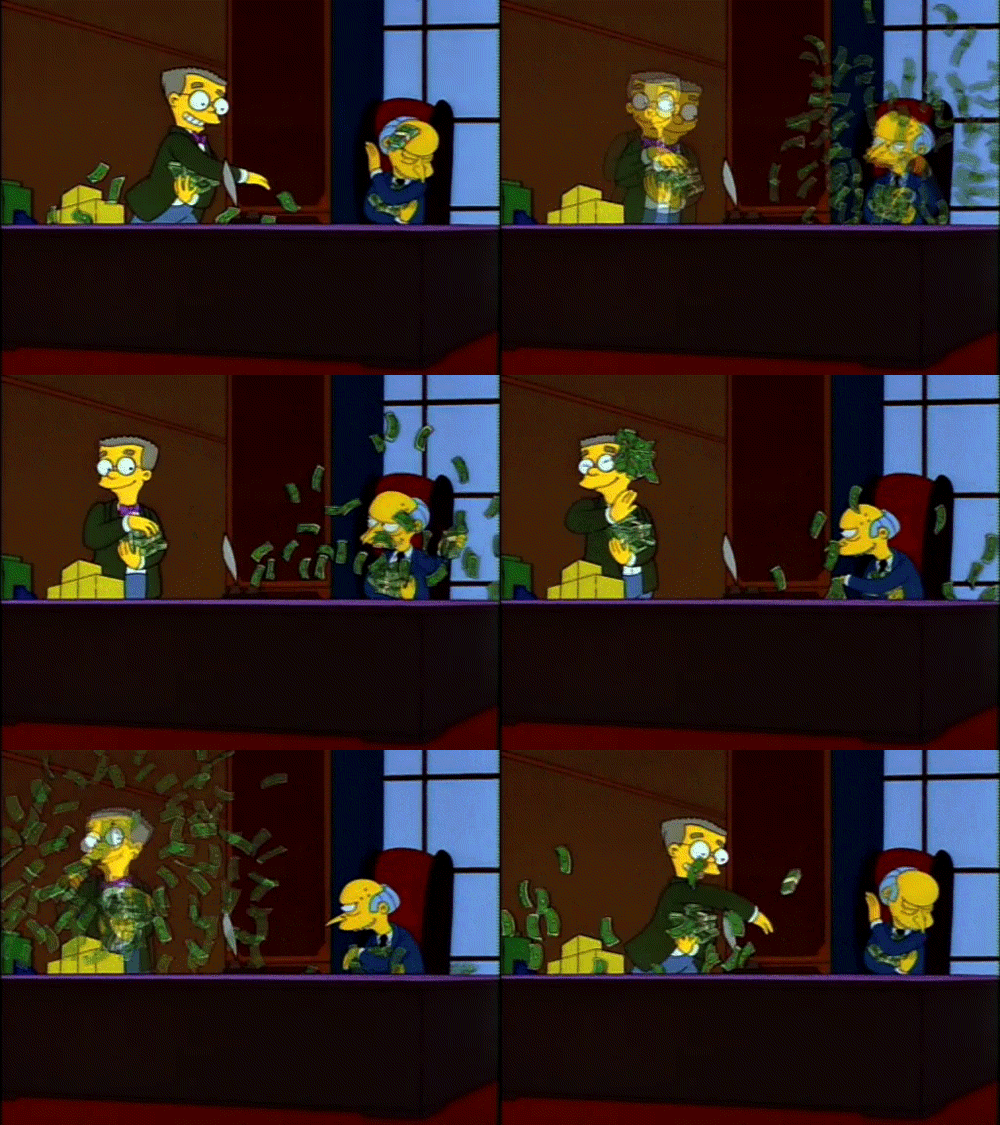
The Simpsons’ first seasons set an impossibly high standard.  They spawned a whole new world of animation for adults, begetting an array of entertainment that could often go further with offensive humour and push the boundaries of taste (South Park, American Dad!).  As such, The Simpsons in later years began to look safe and pedestrian.  Like Facebook, it risked acquiring a role as something embarrassing only your parents go on.  But, going back to its classics has been the perfect background comfort while pottering around my flat in lockdown 523, gaining a new and meaningful appreciation of its importance.  To imagine a world where it never existed is to imagine a duller, sadder way of thinking and being.  The inequalities it parodies are still with us so we can conclude that vintage Simpsons is as evergreen as the terrace where the eponymous family still live, all these decades later.

Tuesday, 16 February 2021

30 Rock

For the creators of amazing telly, it must be dispiriting to have their programme described as a background show.  Yet the concept is well worn, particularly when we are stuck at home all the time.  For me, the background show is ideally shorter than half an hour in length and, typically, a comedy.  It might seem like a fall from grace for something like Friends, going from must-see TV premiers in primetime to something we can put on for a bit of chatter to drown out our thoughts while our attention is half-taken by chopping up vegetables or watering the houseplants.  But, it’s either a new way of appreciating an old favourite, as my journey reacquainting myself with South Park proved in its unfolding, or a perfectly apt way of discovering a new show, as I did with Brooklyn Nine-Nine.  It’s even more impressive if a background show can make you laugh out loud, and this week’s subject, 30 Rock, certainly did that to me.

Interestingly, to nobody but me, 30 Rock straddled both of these categories.  I remember watching the first series in some former stage of my life, enjoying the fast pace of the gags on gags, the perpetual irrelevance and the abundance of very very silliness (hello to you, Miranda).  Nobody knows why, despite the best efforts of scholars, but I never got any further.  Cue 2020/1 and I’m working from home every day, trying to make lunch breaks a thing by popping on an episode of my current background show while treating myself to one of life’s few remaining comforts: food.  There, among all the Sky boxsets, was dear old 30 Rock.  Surely I could get through all seven seasons simply because I have nothing else to do, unless you count staring in the mirror and weeping.  I’m here to report that, yes, I really did achieve my goal of watching all of it.

Scant research, by me, has revealed that the concept of 30 Rock is loosely based around the writers’ room of famous American cultural thing Saturday Night Live.  We don’t get that in the UK.  Our live thing on Saturday night is Strictly Come Dancing and that doesn’t have a writers’ room because, like a lot of British telly, there aren’t actually enough writers to go round that every show can fill its own room with them.  I suppose it depends on the room, though, as we could just be talking about the downstairs cloak.  In short, SNL (for short) is a parody sketch show of that week’s events featuring a celebrity guest host and a retinue of regular cast.  Within 30 Rock, our version of this is The Girlie Show but, as each series unfolds, we see hardly any of it.  Half the joke is that it’s bad and unfunny, cobbled together at the last minute despite the ineptitude of its writers and producers, while the rest of the humour comes from the lives of the characters trying to make it happen in the first place.

Our hero is Liz Lemon, played by creator Tina Fey.  I’m doing things arse-backwards here as I’ve already banged on about my Tina love in a previous post on her later creation Unbreakable Kimmy Schmidt.  Both shows have a lot in common, but one key difference is that Fey hardly appears in the latter.  Lemon, however, is our window into the TV sketch show production world, the only (relatively) normal and capable NBC employee trying to wrestle everyone else along to something approaching acceptable behaviour.  You’ll come to love her as much as you’ll love seeing her abused by co-workers, friends and family, often via flashbacks to her dweeby childhood and teenage years.  She’s all of us in later decades when we can’t be bothered to go out at night anymore (something I regret terribly now we’re not allowed to go out at all).

The pilot sets up her main foil, network executive Jack Donaghy.  Alec Baldwin has the time of his life as this right-wing conservative, sending up a variety of attitudes with charming affection and building over the series with Liz Lemon an almost perfectly symbiotic relationship.  Lemon, too, is thwarted by her cast.  Donaghy forces upon her Tracy Jordan, played by Tracy Morgan.  She must effectively parent this manchild and his entourage while keeping happy her best friend, Jenna Maroney, TGS’s original star whose nose is well and truly put out of joint by the arrival of Jordan.  At all times, Jane Krakowski’s performance is my favourite thing, as Maroney’s fame-hungry desperation, delusional attitude to ageing and uncompromising need for attention mark her out as a true kindred spirit, although I can’t sing and she can’t stop blurting out tunes at the slightest provocation.  The wider cast sets up constant jokes at the expense of various strata of American society, and then this is fleshed out to great effect by a steady stream of guest stars, from Mad Men’s Jon Hamm to Bojack Horseman’s Will Arnett.  I’m reserving special mentions for Rachel Dratch in various scene-stealing roles and for the character of Leo Spaceman, the world’s worst and therefore funniest medical professional.

And that’s the main conclusion to leave you with – this stuff is funny.  Some elements haven’t aged too well from 30 Rock’s 2006 beginnings, but we’ve had many intervening years to improve our society and so any reaction to bad taste simply shows you how far we’ve come.  The characters are strong, ridiculous and don’t even come close to running out of mileage.  The action is relentless and there’s never more than ten seconds without some sort of gag.  With even just half an eye on it while you move your mouse around on your laptop so it looks like you’re actively working from home, it can still guarantee you laughs.  So this still remains amazing telly, no matter what attention you’re paying it.

Wednesday, 2 September 2020

What We Do In The Shadows

My regular readers and fact fans will notice that this is Just One More Episode’s fourth foray into the world of vampires.  Like any normal adult man, I’ve talked about my enjoyment of The Vampire Diaries, graduating to the more sexually explicit world of True Blood, while my writing on seeing things from the opposite perspective (Buffy The Vampire Slayer) remains one of my most read instalments (though it still trails Love Island and, er, Naked Attraction).  Following on from a pal’s successful recommendation to open myself up to the life-enhancing entertainment quality of Succession I’ve taken the lad up on his ongoing insistence I would really enjoy What We Do In The Shadows.  And I did.

It’s a mockumentary sitcom, but make it vampire.  Spun off from a film I’ll never get around to seeing, the show’s genesis can be credited to Flight Of The ConchordsJemaine Clement who, along with Taika Waititi, asked himself that age-old question: wouldn’t it be LOLs if a load of vampires had to live together as housemates?  Wouldn’t it be even funnier if they were centuries old and therefore constantly at odds with modern life?  What if they had been sent to conquer North America from the old country but had only got as far as Staten Island?  Well, I can tell you now: it would be a right old chuckle.  So, let’s meet our line-up of co-tenants:

Nandor The Relentless

Head of the household thanks to his seniority in age, Nandor has moved on from pillaging and marauding on behalf of the Ottoman Empire (you never hear much about them these days, do you?) and now cultivates a more sensitive soul, calling house meetings to recap on hygiene standards.  His accent is everything, with Kayvan Novak elasticating his vowels beyond all recognition.

Laszlo Cravensworth

Matt Berry serves up a hearty portion of delicious Matt Berry as this lascivious, yet limited, Laszlo.  Toast Of London intonation is channelled throughout, so I always raise an eyebrow whenever he shouts bat as he transforms into a bat.  For a brief spell, he is Jackie Daytona, and it is wonderful.

Nadja

Billed third because the world still hates women, Nadja is actually the funniest vampire in our coven.  Her eurotrash accent elevates her every outburst to a new level of farcical indignation, thanks to Natasia Demetriou’s vocal dexterity (which also makes her one of the top guests of all time on The Adam Buxton Podcast).  Every time she slags something off with English that is ever so fractionally non-idiomatic, the linguist in me thrills at her silliness.

Guillermo

The vampires’ human familiar, this poor lad acts as a household slave while waiting (ten years and counting) for his chance to fulfil a lifetime ambition (prompted by Antonio Banderas) of joining the clan of Nosferatu.  Contrasting with how little his masters appreciate him is a growing realisation that his calling may be complicated by his genetic heritage (and I don’t mean his Hispanic roots) which leads to some hilariously clever slapstick action.

Colin Robinson

A different strain of vampire that can walk in the daylight, Colin is a pure bore because he feeds on human energy rather than blood.  He’s the office creep stealing your time with tedious chatter, draining you of your life force in the process.  As a comic creation he is genius and his workplace scenes are my favourite, especially when he encounters a worthy adversary in the form of an emotional vampire.  I love how much he annoys the other housemates, even from his dreary basement bedroom.  When he learns to online troll as a form of remote energy drainage you start to question how fictional he really is.  In fact, I think we’ve all worked with a few Colins.

A platter of comedic big names crop up across the two series, but Beanie Feldstein deserves a special mention as an outrageously naĂŻve college student who gets caught up in Nadja’s manipulations.  Throughout, the classic tropes of the genre are mined for comedy, from staying out of the sun to wooden stakes, via garlic, silver and countless occasions of hissing like cats at each other.  Luckily, there seems to be US dosh behind the special effects, with no expense spared on CGI shenanigans.  That said, I’m always most transfixed by the backstories whenever these are expanded upon, as the supporting illustrations that scroll by look like genuine historical artefacts, reminding us all that medieval religious art is whack.  My only slight frown, as a vampire purist, is that I’m not sure how I feel about the genre’s lore being played for laughs when it normally takes itself very seriously.  But, as always, silliness wins out, making What We Do In The Shadows a rollicking gothic romp of a contribution to the fangs-on-fangs canon.

Saturday, 11 April 2020

It’s Always Sunny In Philadelphia


I’d never realised how uplifting a musical accompaniment of strings can be.  It has the power to elevate moods.  Whether it’s me reading young adult fiction on my balcony in the sunshine while on lockdown with Spotify shuffling through classical classics in my AirPods because, let’s face it, it’s only a matter of time before a neighbour decides that a rare warm day is best responded to by playing Ed Sheeran at full subwoofer-shattering volume with the windows open, or it’s the opening sequences of It’s Always Sunny In Philadelphia (pre-credits set up, reveal of episode title, credits, start of episode itself), it’s a good time I have too often overlooked.  Indeed, It’s Always Sunny itself is something else I hadn’t really registered.  My Netflix algorithm constantly served me this suggestion, but the 14 seasons seemed like an insurmountable challenge.  Going since 2005, it clearly had longevity though.  A work colleague urged me to get into it, and yet I continued to find something about it off-putting.


Cue lockdown and, having got through all of The Office US, I needed another show with short episodes to serve as my background viewing while I made food and performed other banal acts in my longed-for new-build flat-cum-isolation prison.  Banished from the office, all food is made and consumed within my apartment, meaning I could devour two episodes with each meal, with further instalments knocked down during more extensive sessions of cooking (my response to the pandemic has been to follow a lot of Mary Berry soup recipes).  Thus I completed It’s Always Sunny in just a few weeks.


But let me warn you, for those beginning at series one, you’ve got a harrowing experience ahead of you.  This fast-paced sitcom tells the tale of four friends running an Irish pub in Philadelphia.  They don’t have dialogue, so much as scream at each other in a high pitch (a bit like the pitch that is boxset-specific to Archer).  My first impression was that the characters were all losers.  Keen on drinking, they existed in that half-drunk, half-hungover frame of mind where anything you do is done badly and unwisely.  This propelled the plots but made me want to shower afterwards.  What’s more, at fifteen years old, the footage looks like it’s been filmed on a pair of glasses.  I don’t mind my comedy on the cheap, but this, combined with some humour that’s now outdated as our sensitivities evolve, I was slightly conflicted about being required to press on for 13 further seasons.


It’s funny when you realise that what was missing all along was Danny DeVito.  He shows up in the second season and everything clicks into place.  Four young adults failing to recognise their responsibilities suddenly takes on another dimension when complemented by a much older divorcĂ© who wants to relive his bacchanalian youth while funding it with the wealth he has had a lifetime to acquire.  As Frank Reynolds, DeVito is at the heart of the humour, whether just looking short, confused and ridiculous, or role-modelling lascivious behaviour while craving pork products.  He completes the gang and suddenly I love the gang, both individually and together.  I want to hang out with them.  I wonder where I will fit in.  And, unable to see anyone during lockdown, they become ersatz-friends who make me laugh out loud every day.


Sure, like any bunch of real friends, the gang has constant conflict (screamed at high pitches).  Frank ditches the others at one point and latches on to some other young bar owners.  But this new clique have no interest in schemes and plans; they’re not impressed when he’s dressed as a cheetah for no reason (even though this still makes me laugh just to think about it).  They cannot forgive him the wrongs he does them.  And that’s the beauty of our Paddy’s Pub gang – they’re terrible people yet they always come back together, no matter what they have done to each other.  Probably because they can’t be arsed to hold grudges.  You can’t help but like them.  With each episode and series, their charm shines through, and awfulness gets mixed up in likeability.


Each is awful in their own way.  Dennis, the occasional leader, has matinee idol looks with sexual predator sensibilities.  His warped view of consent is unacceptable, but it does attract him all the trouble he deserves.  His sister, Dee, is the scapegoat of the group, who like to bond over nothing more than calling her a bird.  A failing-to-failed actress, her delusions of stand-up talent lead her to experiment with racially insensitive character creations, often as part of one of the gang’s schemes.  Mac, played by Rob McElhenney (the show’s creator), displays some of the greatest development across the seasons’ arc – and not just from a character point of view.  While slim at first, he fluctuates between athletic and average before piling on pounds to become truly fat.  Then, by season 13, he is the very picture of 0% body fat ripped-to-shreds physique aesthetic achievement.  It’s like the reverse trajectory of my own body’s quarantine response, which is now limited to a daily burst of rolling on the carpet with resistance bands in an unsuccessful attempt to minimise the damage.  And, finally, there’s Charlie.  He’s the janitor and has the most questionable hygiene habits, mostly ingesting his janitorial equipment for personal pleasure.

Each episode, the five come together in an ambitious set up, often outlining a pastiche of a societal issue, though just as often they pursue slapstick silliness.  Sitcom structure fans will note the alternating pairings into teams for plot and subplot interplay, before it all comes together in the comedic climax.  Swirling around this, a cast of Philadelphia’s supporting characters reoccur like there’s no tomorrow, especially as the gang normally ruin their lives.  Poor old Cricket has me chuckle with every appearance, while Waitress never even gets named.  I think Artemis is my favourite as the amateur actor with an inflated sense of craft, but each one is a triumph.


While the characters’ life plans aren’t ambitious, though, It’s Always Sunny truly is.  I can’t say how accurate it is in its portrayal of the city, as I have only been through Philadelphia on a train once (and it looked a bit like The Wire), but, once it’s established the tropes of its own universe, there is nothing the gang won’t try.  Of particular interest to me is their musicality.  They rehearse Motownphilly for a Boyz II Men concert, they perform in their own production of The Nightman, they ruin a wedding with dancing to George Michael (which is epic nowhere but in their own imagination) and there is even a musical episode (yes!).  We watch Mac interpretative dance.  The experimentation goes beyond music, challenging philosophy, perspective, gender, sexuality, religion, science and morality, but all while making horrible comments to each other, abusing each other and calling Dee a bird.  I’ve gorged on 14 series and now I’ve got that sickening feeling that I want to do all it again in case I’ve missed anything.  Otherwise, I’m going to have to find five depraved, narcissistic friends somewhere else with whom I can see out the rest of lockdown laughing my head off.


Friday, 20 March 2020

The Office US


Not being funny, but this blog is kind of a big deal in America.  Well, sort of.  The US is actually the biggest audience for my self-indulgent, mistyped ramblings that loosely relate to a series of obscure (mostly) British boxsets.  It’s more or less neck and neck with the UK, but the nation with the blonde-haired mess as a leader has pipped the other to the post.  What?  Oh.  Meanwhile, in third place, we have the Ukraine, so maybe it’s click farms and chatbots driving my numbers after all.  Either way, it’s gratifying to us, the internationally insignificant Brits, when some of our culture is taken on across the Atlantic by a bigger boy.  The Office remains the standard by which we measure all subsequent UK sitcoms and I think about it most days.  Partly because I work in an office and, after a decade of doing such, am slowly turning into David Brent (I did no [sic] get an agenda), but also due to its artistic merit.  It captured everything about the banality of working life yet made it hilarious as a result of its everyday tedium.  It found its own global audience but could go after even broader appeal translating itself into versions for other markets: The Office US was born.


Thanks to our inferiority complex (get over the empire, guys) the Brits sneered at the dumbing down of our sophisticated humour for great unwashed audiences of Yanks.  It was with that same curiosity that I inspected the first season.  A near blow-by-blow replica of the UK programme, the show makes a few swaps (cue Scranton for Slough, Dunder Mifflin for Wernham Hogg) and therefore it plays out almost the same content with different accents.  Even the layout of the actual office looks like an exact replica.  For some reason, it didn’t work for me.  Years later, I noticed a dear friend in the office spending his lunchtimes watching episode after episode.  “It’s quite good actually,” he said in his Blackpool brogue.  Again, I scoffed.  Anyone who could spend their lunch hour at leisure clearly wasn’t busy enough, as the only acceptable behaviour is to shovel food into your unwitting mouth while trying to clear emails, inevitably losing substantial quantities of foodstuffs in the cracks of your keyboard.  But, earlier this year, I needed a new comedy show to play now that I had finished South Park.  There, deep in my Amazon Prime browser, stood The Office US.  No pressure, just there.  I decided to give it another go, just in case it was “quite good actually.”


And without further preamble, I can confirm that it is definitely quite good.  While the first season feels straightjacketed by its UK progenitor, and the second wobbles a bit in places as the stabilisers come fully off and it feels all billy-big-bollocks about striking out on its own, The Office US soon develops into some of the most delicious sitcomery anyone can hope to find in their TV on demand platform.  My first shock was that the whole US thing ran for nine seasons, many of which were at the full length of over 22 episodes.  When we British aren’t scoffing at others, we’re busy making hardly any instalments of our favourite TV shows.  I wondered how I would ever get through it all.  But my strategy was well honed: four episodes could be nailed during Sunday-night food prep, another each night over dinners at home, and at least two in my weekly bath (please note I shower in between, but the bath is with special salts as I am a highly tuned athlete).  The programme became a close companion and constant life partner.  And here’s what it offers:


Great lead characters

Along with David, it’s hard to imagine success without Tim, Dawn and Gareth.  But their US iterations, especially with longer to develop, easily become just as beloved.  While Michael Scott’s constant stream of attention-seeking irritates just as deeply, there’s an innocent charm to Steve Carell’s portrayal that makes you root for him more than you’d expect.  Pam and Jim embody a true love story but with the added subversion of their competitive pranking preventing things from ever being too saccharine.  And the target of their pranks, Dwight Schrute, is mined endlessly for the butts of jokes.  Rainn Wilson clearly revels in his awkward, human-hating lines, but also lives for shouting aloud the various German Schrutisms that delight the linguist in me.  These four form an awesome core…

Great supporting characters

…but it’s those we could dismiss as the peripheral characters that multiply The Office US’s charm beyond anyone’s expectations.  With each episode, my favourite changed, from Phyllis’s wonderful understatement, to Meredith’s hard-partying approach (and disastrous approach to casual Friday).  Creed often rose to the top with his abstract asides, looking more surprised than anyone still to be in a job, and I could never get enough of Toby whining nor of Darryl trolling his colleagues.  But it’s in the accountants’ corner that my heart truly lies.  Kevin, perhaps the first to become a caricature of himself as the seasons rolled on, is a joyful creation (enough for Holly to assume he has special needs) and his response to Baby Philip is pitched perfectly.  To his right, Oscar enjoys feeling superior to his colleagues while they blunder from faux pas about his sexuality to faux pas about his Latino heritage, while, opposite, Angela loudly disapproves of everything while worshipping her cats.  As Oscar and Angela’s storylines develop, they end up locked in embittered rivalries that alternate with moments of being there for each other: such apt office conflict.


Silliness

I’ve been clear on this blog many times before (see post on Miranda) but silliness in a boring office is crucial to survival.  Here, we have an absolute excess of silliness to feast upon.  Sometimes straying beyond realistic mockumentary into played-for-laughs buffoonery, The Office US is as comfortable with ridiculous dialogue as it is with pure slapstick.  I first realised this during the notorious fire drill episode (Stress Relief), containing a never-ending sequence of sillier and sillier moments of physical comedy (until a cat and then Oscar fall through the ceiling tiles).  I laughed for days.  There’s also an excellent parkour moment with Andy and a cardboard box whose genius is matched only by its fleetingness.


Lifelong friends

As the show draws to its end, it reiterates an emphasis on friendship.  Just as you can’t choose your family, you can’t choose your colleagues.  Well, in fact, you can, just leave and work somewhere else.  But what they mean is that you end up spending all day everyday (apart from weekends) with a bunch of strangers, and you end up sharing so much of your lives that they become dear friends.  It can’t be helped.  Even Stanley, who never finds his co-workers anything other than irritating or funny to laugh at (not with) finds a moment of poignancy.  The final seasons, coping well enough with a lack of Michael Scott, begin to investigate how the employees of Dunder Mifflin will cope when the documentary they’ve spent nine years making finally airs.  While the mockumentary trope is sometimes stretched pretty thin as the action plays out, it does help things turn meta as the cast consider themselves on camera and reflect on the time they have passed together.


Like Parks & Recreation (which is very similar and I have no way of checking which came first but instead I will just love both), finally finishing The Office US was a bittersweet moment.  These characters had become my real-life friends, and their absence would leave a space in my life.  I suppose I better talk to my real colleagues again, then.  They’re quite good actually.