Showing posts with label british. Show all posts

Wednesday, 11 November 2020

Mock The Week

I’ve just done a quick check, and I don’t think we’ve done a panel show before.  Unless you count University Challenge as a panel show, and you shouldn’t, because it’s not one.  It’s actually a quiz.  It differs from panel shows because people are actually trying to give the right answers to difficult questions.  Though panel shows are also quizzes of sorts, it’s more important to give a hilarious answer instead of a correct one.  And the questions are easier.

The reason I’ve not talked about one here before, though, is because I don’t really watch them.  Like chat shows, they seem to be a bit of a waste of time.  Chat shows are just people plugging their new book with rehearsed anecdotes while a former comedian swoons over them – I can get this sort of content from podcasts without having to use my eyeballs.  In my millennial office life (and by office, I mean working from home) nobody ever makes an appointment to view a panel show.  Lots of them are broadcast on Friday nights when we’re all at after-work drinks (not me), and now we’re not allowed to do that anymore, we’re too deep in season two of The Boys (no thanks) or the end of Schitt’s Creek (already completed it) to tune in.  In short, panel shows aren’t the kind of boxsets you can show off to your friends with.

When I still lived at home, Have I Got News For You was a firm family favourite.  Little did we know we were choosing our future PM based on who was the most discombobulated panellist (well, I didn’t vote for him, but it was f***ing one of yas – dezguztan!).  My parents still relish how the show’s humour makes a farce of British politics, but for me the subject matter is already too much of a farce to be funny anymore.  I once spent a whole train journey to Cornwall for work (shout out Eden Project) watching Never Mind The Buzzcocks on my phone and laughing so loudly that fellow passengers worried for my sanity.  But will we ever get Simon Amstell back?  I may save this for a future edition, as is my plan with Celebrity Juice, so we’ll try and focus on the show in hand.

The reason I’m picking Mock The Week is that I’ve come to admit begrudgingly it’s actually rather good.  Of an evening, around 10pm, as I disconnect the telly from Netflix or Amazon Prime or Sky Boxsets, I’m hit with a brief glimpse into live terrestrial telly.  The channel is never set to BBC1 or ITV, as my life is too worth living ever to sit through either station’s ten o’clock news – I am not going to bed angry.  Invariably, it’s BBC2, which means, on a certain night of the week I have thus far not ascertained, Mock The Week is in full swing.  Whether it’s a repeat, or a more recent edition with fun-ruining plastic dividers and social distancing, I will typically lose between ten and twenty minutes of delicious sleep because I’ve become distracted by the hilarity on screen.  But it’s worth it.

The idea is to laugh at things that have happened in the last seven days.  That’s where the name comes from.  Mocking the week.  Got it?  Good.  And we all know we could do with a laugh these days.  Given my fractional viewing, I’m not too sure of the rest of the format.  Dara Ó Briain ably chairs proceedings, a characterful man who combines erudition with, my personal favourite, plenty of silliness.  He once called me a c**t at a live show in response to my answer to his question regarding what job I do.  So I consider him a close personal friend.

The two teams of three that make up the rest of the panel are a revolving retinue of comedians, all taking part willingly in the weekly mockery.  More recent episodes have seen a great big shift upwards in the diversity of backgrounds here and if this doesn’t excite you then please stop reading now.  I’m up for banning white men from all TV and politics for the next five years (especially me) and seeing how we get on.  What’s the worst that can happen?  Sadly, this would cost me some of my favourites: Ed Gamble and his dry delivery, James Acaster and his perpetual face of confusion (let’s all agree to watch his Netflix specials please) and Tom Allen, taking a break from slagging off cakes but in a charming way on Bake Off: Extra Slice.

Sometimes our panellists sit around, sometimes there’s a microphone on a stand that they have to dash towards from little raised platforms and it’s fun wondering if they’ll bump into each other.  Sometimes you wonder how people can be so quick-witted, sometimes you wonder if they’ve had time to prepare their best lines.  Either way, there are plenty of chuckles to go round for everyone and, of course, nobody cares who actually wins.  I couldn’t even tell you if scores are kept – that’s just how little research I do for these posts.  And so, Mock The Week, let us salute you as a pandemic hero – you’re making me want to watch you in spite of myself.

Monday, 21 September 2020

W1A

This week, nobody has been asking me the following question: what other hidden gems in the world of comedy have you uncovered since you wrote so passionately about Crashing?  Nevertheless, I do need to tell you that I have gone and done it again.  I’ve come across a show whose existence I was completely oblivious to and now I’m going to harp on about it like I invented it myself.  It was probably huge at the time and is therefore already beloved by millions, but this is my blog and I can do whatever I like.  Something else people never ask me is how I decide which shows to feature in my self-indulging prose.  Well, there is no method to this madness.  I do have a longlist of shows I ought to get around to and this week’s programme was in fact on there – something I didn’t even realise until I had finished the third and (hopefully not) final season.  Anyway, preamble aside, we’re doing W1A this week.

Now, regular readers will be aware of my increasing despair when it comes to how awful we British our proving ourselves to be.  The dangerous yearning to return to a post-war peak from 75 years ago threatens everyone’s present-day opportunities.  Nevertheless, alongside the sinister jingoistic gymnastics, there are British traits that, conversely, feel as comforting and familiar as saying sorry to a stranger who’s bumped into you.  One of these is always suspecting we will make a mess of things.  Our trains can’t run in the snow, our trains can’t run in the heat, our breweries have hosted poorly organised piss-ups.  Back when we won the 2012 Olympics, everyone rolled their eyes in anticipation of ensuing shambles (when it was actually a recent national peak, inequality riots aside, and I’m not just talking about me dancing in the closing ceremony…).  So little faith did London’s wonderful liberal elite have in the organising committee than an irreverent sitcom was conceived: Twenty Twelve played on our suspicions surrounding how petty office bureaucrats would arrange and execute so much sport.  Sadly, I never saw this show and can’t find it anywhere, but W1A is its successor, following on with the adventures of Ian Fletcher (that lovely Hugh Bonneville off that lovely Downton Abbey) as he takes up a new post at the BBC.

Aha, you say, another institution we can deride for being a bunch of silly sausages.  How dare they make pensioners pay for their licenses when they of course deserve everything for free?  How dare there allow two women to dance together on Strictly?  How dare they pay female staff less than men?  (Guess which of these three is my actual opinion).  But, this is a BBC production, brilliantly sending up itself and our perceptions of the pencil-pushers who make it tick.  Fletcher serves as our guide in this institutionalised institution, stumbling through Old and New Broadcasting House trying to make sense of how things are done as the new Head of Values while slowly coming to accept that everyone is either incompetent at what they do, or they don’t do anything at all.  It’s at this point I must stress that the whole thing is laugh-out-loud funny.  I giggled my socks off in every single episode, so let’s count down which comedy creations scored the most LOLs on my chuckle-o-meter:

One: David Wilkes, played by Rufus Jones

As a development exec responsible for evolving potential show formats into ratings winners, Wilkes channels a new level of incompetency.  In any meeting, he expertly absolves himself of blame for every action and inaction of his.  He’s there, behind the fridge door, ready to steal your idea and take all the credit.  He interrupts discussions to tell everyone he can’t believe it and prefixes the name of anyone they are talking about with the adjective lovely: “Lovely Izzy, lovely Lucy.”  He’s frequently told to shut up and this generates in me the purest of joy.

Two: Siobhan Sharp, played by Jessica Hynes (seen in The Royle Family)

Another overspill from Twenty Twelve, Sharp is the PR guru who is incapable of listening to anyone but herself.  She is soundbites, mixed metaphors and statement jewellery, the very definition of having nothing original or useful to say.  Her response to every crisis is to blow things up on Twitter.  Her voice is supremely smug and she’ll announce that she’s “good with that” despite nobody requiring her approval.  I get the sense that whoever created her had some axe to grind after spending one too many meetings with members of the PR industry.  I can’t think why.

Three: Will Humphries, played by Hugh Skinner (seen in Fleabag)

“Yeah, no, hi, ok cool.”  Like everyone else, Will rarely says what he means, but he doesn’t know what he means anyway so it doesn’t matter.  He’s the awkward intern who’s overstayed his internship, but Skinner’s facial expressions show the perfect perplexity as Will screws up the simplest of tasks.

Four: Anna Rampton, played by Sarah Parish

As Head of Output, Rampton’s inability to move her top lip marks her out as a serious woman in business.  By repeating “yes, exactly, yes” she falsely portrays an air of decisive action while never doing anything.  Her catchphrase wears out slightly in later series, but she is at her funniest early on refusing every requested refreshment that is brought to her: “No, I don’t want that.”

Five: Simon Harwood, played by Jason Watkins

Harwood is that colleague we all sadly have.  The saboteur who wanted your role.  Non-committal, but always prepare to play his hand as a self-claimed confidante of the Director General (with whom he might enjoy the odd morning muffin), Harwood’s passive-aggression can be seen from space.  He’s constantly telling people he has no idea how things work (because they should) and that they will know how they want to play things (because he’s sure as hell not helping), before emitting one of his frequent exclamations of “brilliant” no matter what’s been decided.

I could go on.  There’s the for-once palatable David Tennant narrating, inserting the odd word to render all action ridiculous (particularly the Ministry for Culture, Media and, also, Sport).  You’ve got Tracy Pritchard beginning every criticism with “I’m not being funny but…”  Ben and/or Jerry bring a surreal element to the incredible pacing of every Damage Limitation meeting.  Layer upon layer of farce is dolloped out in rich scoops, crescendoing into ill-fated launches.  But it’s almost too close to home.  Some of the meetings feel like they were taken directly out of my life.  The curious inability of each and every character to communicate clearly makes wondrous use of two of the English language’s most abused words: yes and no.  Never seen alone or with certainty, W1A is strewn with oodles of “yes no” and lashings of “no yes” and then further fleshed out with generous portions of “yes no yes” and “no yes no.”  Playing out in a corner of London where I’ve worked for the last ten years, I look for myself in the background of scenes were Fletchers cycles into the office on his terrible Brompton (which bikes’ super-naffness is played for miles as laughs).  I’ve even been in the offices of Siobhan Sharp’s Fun Media on many occasions.

Get on the sofa and consume this immediately.  And then tell me if I was right or wrong about its brilliance.  Fair play to the Beeb for being such a good sport, lampooning itself for comedy (though never mentioning its news coverage’s right-wing leanings).  It’s not perfect – some exasperation at increasing wokeness has dated slightly.  Characters start to repeat their catchphrases too much and the freshness of the surprise wears off.  There’s an inevitable love triangle involving Ian Fletcher that doesn’t ring true, while the relationship between Izzy and Will remains effortlessly more charming.  We might not be able to organise a Brexit (so let’s stay) or a pandemic, but we sure can organise a silly sitcom about people who can’t organise things.

Wednesday, 1 January 2020

Hollyoaks


How the mighty have fallen.  This blog was going to be all about the high-brow boxsets I had uncovered.  Well, let’s be honest, that and a whole load of trash TV that I only watch ironically and as part of my job in media and just out of cultural curiosity and not because numbing my mind with garbage is the only way to cope with the traumatising experience of living in a country that’s repeatedly voting itself into oblivion.  Throughout, I’ve been scathing about the world of the soap opera.  Even though soaps give us a lot as a nation.  They provide the contestants for Strictly Come Dancing.  I think that’s it, actually.  I suppose they also reflect us as a nation and our slowly liberalising attitudes.  My nineties childhood teatimes featured witnessing a lesbian kiss in Brookside, swiftly followed by the discovery of a body under the patio (in Brookside, not at home in Surrey).  The British press railed at this travesty in a way not out of place in The Handmaid’s Tale, but, as we enter a new decade, nobody would bat an eyelid at this now.  People on TV (and in real life) are free to snog whomever they choose and, in this new apparently Tory4life Britain, we can hide whatever bodies we like under the patio.  So, with that in mind, let’s tear Hollyoaks apart.


While I don’t currently watch this soap, there was a period when I did.  Specifically, this was the early summer of 2007.  I was a finalist at Oxford, an institution that still asks me for money (I don’t have that much and they certainly aren’t top of the list for getting it), and every waking minute was spent preparing for our final exams, safe in the knowledge that roughly 100% of my final grade would be generated by the eight three-hour papers I would be sitting (in academic clothing known as subfusc).  Ever since I began the degree back in 2003, I’d noticed a guilt around our approach to studying: if you weren’t working, then you were aching with the bad conscience that you should be.  Pals at other academic institutions talk fondly now about memories of watching Neighbours twice a day and whiling away hours between a weekly lecture.  My average week involved 3,000 words of essay-writing (for which 40 hours of reading were expected – lol!) and translations in four different directions.  Therefore, as things inevitably ramped up under increasing pressure while finals approached, more and more time was spent studying and fewer and fewer moments remained for leisure.  However, this was and still is a recipe for burnout.


After a day buried in books, we would meet for dinner in hall, desperate for social contact and the support it brought.  Naturally, this was informal hall, rather than formal hall.  Informal hall involved a more canteen-like service, whereas for formal hall you had to don your gown over your normal clothes and be served a three-course meal that began with grace in Latin (which was sung by the choir on Sundays).  Just imagine Harry Potter and you’re pretty much there.  Both types of hall needed to be booked on a computer in the porters’ lodge (the main entrance to college) before lunchtime.  No, you couldn’t access this through the internet as that would be Oxonian heresy.  And yes, they really did need that many hours’ notice to broil an unidentifiable meat and mash some swede in time for that evening’s meal.  What a tangent!  The point is, after wolfing down this subsidised sustenance, we would still crave a further moment of unwinding.  Being 6.30, we would end up in front of someone’s TV.  And thus, Hollyoaks would end up in front of our eyes.


What began as ironic activity became something more important.  We began to look forward to our scheduled viewing, anticipating the storyline developments and speculating on the fallouts, anything to distract us from the 7pm drudge back to the library or our rooms for more fusty book-learning.  To this day, the first few notes of the Hollyoaks theme tune set my teeth on edge, but for that one summer, they were solace.  Our main problem, though, when it came to identifying with the characters in the production, was that they didn’t seem to be afflicted as we were with a constant need to be doing work.  They would walk about, talk to each other, do things, all without the omnipresent commentary of “Well, I really better be getting back to it.”  The reality didn’t match ours and their lack of work ethic didn’t compute.


But that didn’t stop us.  We were lost in the scripted tension that finally built up to John-Paul kissing his best friend Craig, all while Nancy and the other evergreen characters got smashed on half a sniff of Smirnoff Ice while “going out” at a venue that was, as with all local amenities, on the one street that they ever went along.  That was a terrible sentence, but it really brings to life the production quality of your average episode.  Let’s say my standards must have been lower, as, at no other time, have I been able to stomach multiple weeks of soap watching.  The plot developed at an agonisingly glacial pace, trapped within its own limited reality, chunked into daily cliff-hangers that got stretched so thinly you could see the next few weeks’ episodes through them.  It was still better than revising.


Exams completed, university a distant and overpriced recollection, I never returned to Hollyoaks.  To this day, it remains billed as the teen soap.  Yes, it’s still being made.  Occasionally I’ll catch a marketing trail on Channel 4 and be like: “Oh wow, this looks good,” but then I have to check myself and remember that this is one of those programmes whose marketing is better than the actual product.  Given the huge community of characters that make up the cast, unwieldy storytelling has to be avoided: only a handful of characters feature in any particular week.  It’s acting shift work.  And that’s always the complaint with soaps: the sheer quantity of entertainment they are required to produce harms its very quality.  Brookside may have long-since perished to cul-de-sac heaven, but Emmerdale seems to be on 43 times a week.  Either way, the 6.30pm broadcast was often well before home time once I became an office worker.  In fact, my favourite joke when on calls late in the day was to tell people planning to leave at 5.30 that it was good news they would be home in time for Hollyoaks.


So yeah, I’m not opposed to Hollyoaks being the 129th programme on Just One More Episode.  As this week’s post demonstrates, this is mostly about me anyway, and Hollyoaks was in my life for a brief period in a former decade, despite there being nearly 4,000 episodes to catch up on, not to mention late night specials with extra sex and a whole array of scantily clad calendars nobody asked for.  Its approach to issues, too, should be commended, serving a national purpose to the country’s youth (who still watch TV and not just inane YouTubers) when it comes to coming to terms with and coming of age in a political entity that hates them.  With cuts to public mental health funding, Hollyoaks will soon be the sole method through which our young people are cared for, so I better get used to the jangly guitar notes of its opening sequence.  It’s only a moment of discomfort when compared to a future lifetime of being locked out of Europe.

Sunday, 15 December 2019

The League Of Gentlemen


The dark humour of this cult classic sitcom-cum-sketchshow used to scare me slightly.  Its first TV series appeared back in 1999 when I was still a rather sheltered Surrey schoolboy.  I was known for things like having the most housepoints in the year and being good at drawing.  Subversive comedy seemed unnecessary: how could you laugh when something was horrible?  This is probably why I harboured such a soft spot for Keeping Up Appearances.  Nevertheless, I was drawn to The League Of Gentlemen.  The characters were inordinately quotable, and many a playground conversation consequently descended into recitations of the episodes’ scripts.  I could therefore seek solace in recognising the key players from the village of Royston Vasey.  For example, Tubbs and Edward were vile, but also ridiculous.  Once they started talking about local shops for local people, there was safety in the catchphrase, allowing me to overlook the brief references to burning bodies on the moor, to the fact that nobody ever left Royston Vasey… alive.


But as each would-be customer of their Local Shop slowly arrived at the realisation that they had set foot in a terrible place, chills would shiver down my spine.  And that’s why I have chosen The League Of Gentlemen this week.  I am that unsuspecting stranger, hoping for the best (or at least not fearing the worst).  And England is that Local Shop.  I’ve finally seen its grotesque nature for what it is, and all too late in the day.  Trapped and doomed, I await my grisly fate.  But hey, that’s enough election chat for this post – I don’t want to make things too political at the expense of being silly!
For those that don’t know this classic contribution to our horrendous nation’s comedy canon, The League Of Gentlemen is a series of interlinked sketches set in a fictional northern settlement.  Everything about it is sinister, and only those that live there can in any way tolerate its ways.  These ways can sometimes get pretty fantastical, but its thanks to the performances and the writing of the actual gentlemen in this league that they are as believable as they are sickening and entertaining.  My tastes in adult life have caught up with their subversion, so let’s take a Top Trumps moment to go through these not-so-gentle men (in no particular order):


Best character:  Credit has to be given for Edward (of Tubbs and Edward fame).  While his sister-wife channels a Skeksis-like degree of naïve mischief (see post on The Dark Crystal), Edward’s more plausible stance as your recognisable local bigot is almost therefore the straight man to her easier laughs (counting to twelvty and touching her precious things).  His distrust of outsiders makes him the perfect parochial Tory.

Close second:  Bitterly lampooning the class-sensitive wives of middle earners, Judee Levinson’s spot-on believability is a triumph in its own right.  But contrasted with working-class cleaner, Iris Krell, then this lady-on-help passive-aggression reaches new levels of acid tongue.


Best character:  Everyone has ended up a third party to some awful couple’s petty arguments.  Pemberton plays Charlie Hull, husband of Stella, and together they turn any location into a theatre of war for the years of resentment their marriage has given them.  While anyone would prescribe a divorce, the Hulls can turn any environment into a tense hotbed of angry grudges.

Close second:  Running the Royston Vasey Jobcentre with as much efficacy as Little Britain’s Marjorie Dawes runs her Fat Fighters branch, Pauline Campbell-Jones has a terrifying universality to her.  Patronising yet clueless herself, we’ve all worked with a Pauline.  The lipstick alone makes me want to wash my face.


Best character:  Clad in Val Denton’s lank long hair, Gatiss’s mumsy mannerisms and ability to make far-fetched lines sound totally humdrum result in a subtly gruesome creation.  Along with husband Harvey, and creepy twin daughters Chloe and Radclyffe, the Dentons’ household is every unusual family visit you’ve ever been forced to endure.  From the toad fascination to Harvey’s masturbation obsession, and not forgetting the first Monday of every month (nude day – something we all suspect our neighbours of doing), we share their nephew Benjamin’s terror that he may never be able to leave.

Close second:  Hilary Briss, the local butcher famed for his special stuff, was probably the hardest character for my young mind to stomach.  Even the name causes me shudders now.  Briss.  Urgh.


Best character:  He doesn’t play any of them – he just writes with the others.  Well done him.  I wouldn’t be able to resist dressing up and getting on camera, but that’s just me.

I could go on for ages, reminiscing of my favourites, but we’ve got lives to lead.  You’ll have to resurrect your own memories of Papa Lazarou, Herr Lipp or Legz Akimbo (put yourself in a child), or maybe seek out this classic if you’ve never seen it before, but there’s one final sketch I have to fuss over, simply as it remains one of my most quoted pieces of comedy and yet still makes me laugh.  Enter stage right, Pamela Doove.  Another Shearsmith performance, this budding actress just needs to nail some diction challenges to hit the big time, as exemplified in this orange juice advert audition.  While the joke is obvious, even Jed Hunter’s small-time director is just one of the many subtler creations that enhance Royston Vasey’s realism.  Strangely prescient, then, that this British settlement should seem so normal and acceptable on the surface.  Scratch beneath and it is truly grotesque by its very nature.  Unlike Europe, we can never leave.

Tuesday, 10 December 2019

Gogglebox


It’s time to acknowledge something that’s been painfully clear in all of these posts: I’m pretty sure I’m addicted to TV.  Things came to a head in these last few weeks of I’m A Celebrity.  Until the Sky man comes next weekend (so that I have ITV2 HD in time for Love Island – always set and achieve your life goals), I’m in a household without any decent way of recording off my massive OLED telly.  Unable to stomach a nightly hour-long show complete with adverts (especially at Christmas, the most odious time of the year) I decided to watch the show catching up a day behind on ITV Hub.  However, this VoD service has the picture quality of peering through a steamed shower panel, the ads are all still there but at higher frequency and it loses your programme coming out of each break with a cheeky Whoops! message that infuriates more than it sympathises.  Realising it would only be a matter of time before my remote was smashed through my LG 55” screen, I reluctantly switched back to live viewing.  Suddenly, we were back in HD, and I could tell which one was Ant and which one was Dec again.  The dreaded ad breaks became three-minute chunks during which I would find other things to do, banal things like wash up, clean the kitchen, Whatsapp pals or stare into space – each preferable to watching supermarkets argue about who can provide the most magical Christmas.  The bigger drawback, though, was that I became a slave to the appointment to view.


Every evening was a countdown to 9pm, lest I miss the opening link.  Before the I’m A Celeb final, the nightly show was running longer till 10.30, cutting thirty minutes into my sacred bedtime and making the 5.30am alarm the next morning for Crossfit all the more devastating.  It was hell.  I’m relieved it’s over, despite loving the show.  My point is, keeping up with my favourites and devouring new boxsets in order to keep this blog interesting is starting to dominate my evening life.  I’m ending up watching hours each night, normally too exhausted from the early morning and full day of work to do anything productive (first-world problem – it warrants no sympathy).  Once my bum hits the sofa, that’s it.  I’m supposed to be furnishing a new flat, but now that the TV den part of the living room is up and running, I’ve a bad feeling we’re going to be stalled here for some time before there’s any further progress.  I have become a couch potato.  I have become my father.


It’s only fitting, then, that this week I should take a look at another set of people who while away their time on this fascinating planet sedentary on DFS furniture staring at a telly screen (though my sofa is from Heal’s everybody).  So, let’s do Gogglebox.  But, before we go any further, I should confess that this is a programme I don’t watch.  Don’t worry, though, that’s never stopped me throwing in my two pennies’ worth before (see posts on The Apprentice and Keeping Up With The Kardashians).  I’ve channel-surfed on enough Friday evenings to catch sufficient chunks of it to have the measure of the format and its cast.  Please read on while I oscillate wildly between tearing it asunder and extolling its charm.


And I do have some bones to pick with Gogglebox.  For the unaware, it’s a TV programme about people watching TV programmes.  It’s a real-life The Royle Family.  Up and down Britain, we mutually view selected televisual highlights with a cast of actual non-famous normos.  That’s right – we watch people watch telly.  Despite all of the above making it clear I’m wasting my life away, this format is the very definition to me of wasted time, and it’s for this reason I never make any effort to watch it.  Additionally, it shows you all the must-see moments of the week just gone which I rightly suspect would have the effect of making me want to watch even more TV.  This would benefit no-one.  But what I didn’t realise about the filming process was that the cast of Gogglebox know what they’re going to watch – they have scheduled filming sessions.  The production team pick the shows, put them on and then sit down to shoot the reactions.  When I realised this, I was very disappointed.  I thought we had more of a Big Brother vibe: families sign up to a camera being in the living room, go about their viewing lives as normal, and then the best bits are picked up and edited together.  This, I always felt, would be a fairer reflection of what we really watch and how we really react.  It’s excessive and impractical, but that’s just where my imagination goes to first.


Linked to this first fallacy and the fact that the participants know they are being filmed we have the following consequence: their responses aren’t that natural.  It’s an artificial set up.  I therefore can’t escape the feeling they’re all showing off.  Don’t get me wrong, I love showing off.  I do it constantly and enjoy it in others if they are entertaining me.  But Gogglebox acts like it’s a sneak peek behind closed doors to a more humdrum evening, with interstitial shots of household façades leading to cosy living-room set-ups, allowing we privileged few to glimpse real truth from unaware subjects.  But no, it’s just regional accents trying to think of the funniest thing to say about that week’s news or the John Lewis advert.  And it’s at that point I stop caring.


Everyone talks about their favourite Goggleboxers, but I don’t really know who’s who beyond those that have appeared in other reality shows (looking at you, Celebrity Big Brother).  What I do love is the diversity.  We have all points of the UK compass covered here: a wide array of family structures, lifestyle choices, ethnic backgrounds, cultural values, political persuasions, incomes, faiths, genders, ages, sexualities etc – basically every flavour of Brit you can shove out of the way on a crowded train.  What unites them all is a need to redecorate their living rooms.  It’s a bit like Come Dine With Me when you see that someone’s kitchen is a bit natty in comparison to all the show kitchens you see on cookery shows.  That said, given how many of them have hundreds of dogs sprawled across their soft furnishings, rubbing their worms into the fabric and wafting their canine farts over the cushions, there’d be no point updating any of the interiors.  You can sometimes smell the dog breath through the screen.  But it doesn’t matter what I think: what’s touching is the genuine love and affection these family members and friends have for each other.  That, at least, is always reassuringly genuine, if sprinkled with dog hair.


So, who on earth do I think I am talking disparagingly about Gogglebox simply because the people on it watch TV and do showing off?  This whole blog is based around the exact same concept: I watch too much TV and then show off about it, desperately seeking attention for my musings, awaiting offers of global syndication and secretly beaming when friends compliment my writing in real life.  The difference, sadly for me, is that Gogglebox still has millions of viewers, whereas I’m only getting tens of thousands of reads here…

Sunday, 13 October 2019

The Apprentice


For the landmark 117th post of Just One More Episode, I’ll be returning not only to the recently talked-about topic of programmes I don’t watch (like Naked Attraction) but also to the rarely covered theme of programmes I actively hate (Altered Carbon).  While this blog has mostly remained a safe space of positivity about all the different boxsets out there (with a healthy dose of my own self-obsession), this week we are turning our smarmy observations and cutting critiques to the absolute pile of dross that is The Apprentice.  A fifteenth series has slipped onto air this month to a collective shrug of indifference and I’m happy to say I feel no need whatsoever to catch a single episode.  Part of this is now down to the fact I’ve reached the stage of flat ownership where I can have friends round for dinner (especially ones that invite themselves), so I’m too busy serving up Viennetta as a feasible dessert option to tune into this BBC flagship production.  So, eighties ice cream products aside, let’s go through the reasons why The Apprentice should be stricken from the TV guide.  And just to recap quickly the premise for anyone who’s never grasped it, this show is, in short, competitive job interviewing.  Yes, really.


It’s reality TV but pretends not to be

During the first few series from 2005 onwards, this programme’s biggest crime (against my personal view of what’s wrong and what’s right) was to provide a route to reality TV for viewing snobs that claimed not to be able to tolerate the genre.  Big Brother!” they would cry, “I can’t be watching that bunch of wannabes desperate to be famous.  But have you seen The Apprentice?”  I would sneer at them, pointing out they should just own the pleasure they take in consuming trash TV.  If you never miss an episode of Keeping Up With The Kardashians or Love Island then you might as well own that behaviour.  Anyone who judges you for it isn’t important.  Yet The Apprentice legitimised our natural interest in watching ordinary people humiliate themselves by dressing itself up in the pinstripes of actual business.  A tenuous link to product development, sales, marketing and boardroom practices suddenly meant that it was highbrow to watch 20-year-olds from Essex slag each other off while desperately trying to stay on the telly as long as possible.  Frankly, unforgiveable dishonesty.


The stupid tasks

Each week’s episode is themed around an industry, whether confectionary, fashion, events or some combination of all three to make cold hard cash.  A common trope of reality TV is to get people to showcase a skill but with the added pressure of an unfeasibly short period of time in which to do so (Great British Bake Off’s timed technical challenges, or the matter of days allowed to master a Quickstep in Strictly Come Dancing).  But somehow, The Apprentice stretches this too far by making ill-matched groups of applicants think up, refine, manufacture, distribute, market and sell a product within mere moments.  If this wasn’t enough of a recipe for failure, you need to factor in that the all team members are working against each other, with their interests vested in making everyone but themselves look as incompetent as possible.  What ensues are montages of the contestants, dressed in their best banker-wear, running around London streets doing everything wrong before a classic bollocking in the boardroom.


Stupid Lord Sugar

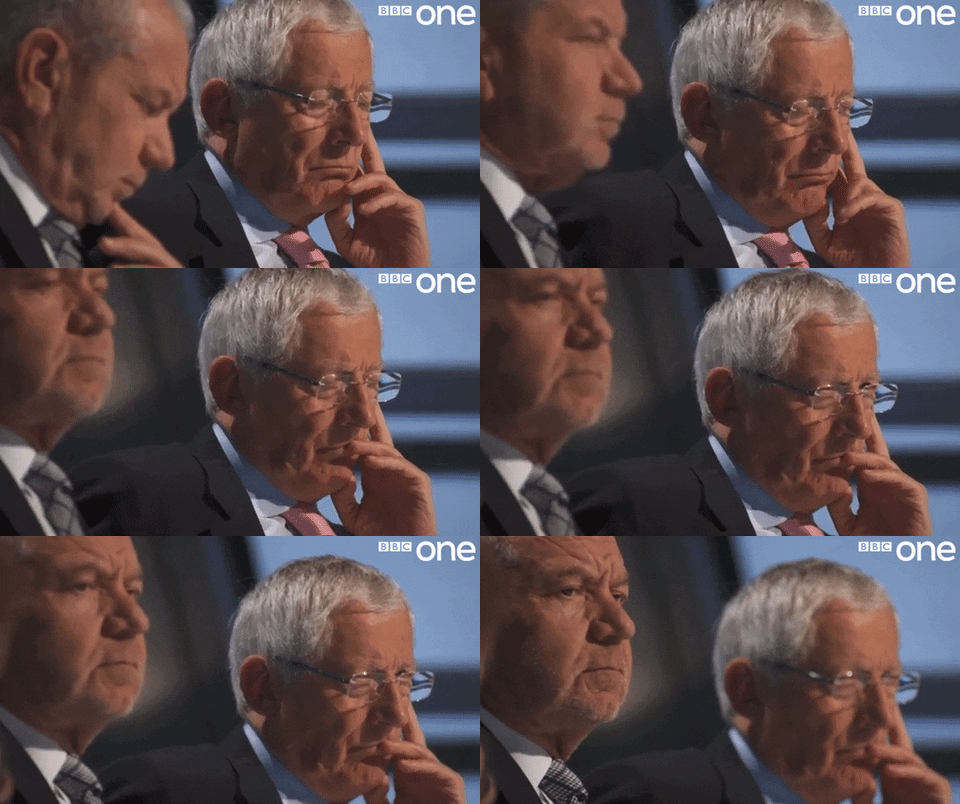
Enter (from a tiny door in the middle of the room, presumably coming from some sort of subterranean troll hole) Lord Sugar, the man whose apprentice these people are supposed to want to be.  Apparently he’s done well in big business, but he doesn’t strike me as someone dynamic enough to thrive in 2019’s brutal economy.  His furrowed brow thinly muffles the sounds of his mind whirring as he dodderily computes what’s said to him.  Fair enough, what’s being said is normally an accusatory argument between a handful of competitive business wannabes, but it all seems a bit much.  Relishing his own interruptions, our Alan then wheels out dad-gags that I swear have been written and fed to him by a team of eighties comedians.  Or sugar-jacked ten-year-olds.  If he announced “Well you’re a stupid poo poo head” to someone I don’t imagine a single eyebrow would rise in in surprise.  But that’s the thing about interviewing: best practice is to put the candidate at ease.  Instead, Sugar rules by fear and intimidation, pointing rudely and mistakenly firing people before he’s even employed them.  The apprentices might be inane, but I would feel more comfortable watching them judge him for his contributions to humanity.


The stupid contestants

This is a bit harsh as my only point of reference here has been the odd one that’s ended up on Celebrity Big Brother.  James Hill was actually a top lad, and I was even won over by Katie Hopkins in the house, watching her reason carefully with Katie Price in a way that betrayed a side to her which today’s unacceptable media persona has shat all over.  The rest come across as officewear-clad interns that talk a big game about their skills but end up set up for failure by each week’s task.  One thing I’ve learned in my working life is that nobody ever looks good blaming someone else, and yet these people sit in front of Sugar pointing fingers at poor old Jenny for not selling enough soap.  Maybe squabbling children is what’s missing from the world of professional behaviour, but it has me reaching for the remote.


Its crimes against humanity

Our UK version is based on an original US iteration that first gave a platform to Donald Trump.  This says it all.


Phone abuse

We’ll look back at The Apprentice UK’s most significant contribution to culture: holding the iPhone below your chin while talking on speaker.  This action became characteristic during the contestants’ various wild goose chases, coordinating errand teams sabotaging the overall effort on the sly.  Now it’s taken hold on the top deck of many of London’s buses, which is great if you want to be involved in other people’s banal chitter chatter.  Similarly, the tension of each episode’s climactic boardroom scene is supposedly elevated by a receptionist using the world’s oldest landline to tell the nervously waiting applicants as and when Sugar is summoning them to his shiny boardroom for some more showing off.  This all needs to stop.


In summary then, for those that might have missed the nuance, I really do take exception to this show.  It’s trash masquerading as premium, a theme that runs through the whole operation, from the contestants to Captain Sugar himself.  I don’t mind lots of showing off, but once someone’s screamed “look at me!” long enough to get your attention, they should have something interesting to tell you.  This is never the case in The Apprentice.  I don’t watch it, and I don’t like it.  Of course, loyal readers, you’re free to make your own decisions, just like Sugar is free of UK employment law in order to make his own hires.  But just be honest with yourself: you’re watching it because you like trash.

Saturday, 20 July 2019

Cardinal Burns


After going for broad appeal with last week’s homage to Made In Chelsea, I’ll be taking things in a much more niche direction this week.  Cardinal Burns was a sketch show that ran on e4 in 2012 and then Channel 4 for its second series in 2014.  Why on earth would I be talking about it now?  Well, it too had a sublime parody of scripted reality, which I almost included last week, but instead decided to branch out into its own post this week (see, I do plan).  Secondly, and this takes us back to the niche point around the show, the only other person who loved this show as much as I did is a dear former work colleague whose response to a number of years in the same office as me was to move as far away as possible to Australia.  I’ve got a guilty conscience as he messaged me this week just as I was running out the door to a wedding, so hopefully he reads this and forgives me.


I’ve talked about my love of the sketch show before when covering Little Britain and Come Fly With Me.  Even Bo’ Selecta! has been fondly remembered in this blog (and, after little to no interest from readers at the time, that post has been gathering clicks like nobody’s business and is now my second most popular piece of content – no idea why, or why now).  Every two minutes, you’ve got something new to look at.  It’s either a new set up where you’re wondering what humour will strike next, or we’re given returning characters that are nice and familiar.  If a scene doesn’t work, it’s over before you know it, and if it does, you can chuckle into your microwave meal or Ottolenghi sides, making a mental note to remember the best lines for work tomorrow, safe in the knowledge you’ll have forgotten everything by the time you reach your desk.


Below I’ll run through some of Cardinal Burns’ top characters, but the selection is merely incidental.  Seb Cardinal and Dustin Demri-Burns, the namesakes of the show in question (though it’s not actually called Cardinal Demri-Burns) have acute skills of observation which they couple with an ability to enact incredibly accurate mimicry.  Each character has a root in the banal and everyday, but the lads’ amplification of behaviours we might otherwise miss, exposing them with comedic acid for the silliness that they are, elevates their scenes and characters to the exact level of wit you need when you only know one other person who watches a show.  My highlights are as follows:

Camp Ghost Hunters

Phil and Jase channel their inner Yvette Fielding from Most Haunted and dive into dark spooky houses in search of the paranormal, accompanied by a film crew.  Their passive-aggressive bickering, “Someone’s a bit tetchy,” soon escalates until they fully miss each and every ghoulie they would otherwise come across among the shadows, which is bound to happen if you’re worried about texts from Steve asking to borrow your juicer, or if you fancy the priest at an exorcism.


Banksy

In real life, it’s universally agreed that Banksy is cool.  But in Cardinal Burns, he is a big old saddo.  He’s agreed to be filmed, but only if he can wear a really naff disguise.  We see him interviewed by local radio or struggling with his satnav, all with underlying currents of casual racism and a deep underestimation of the meaning of his own work.  Things ramp up as he tries to get his stepson on side, but nothing comes close to his announcement that he has taken the last nana from the fruit bowl.

The Office Flirts

Flirting is a huge part in the world of doing business.  People do deals with people they fancy.  I wear skin-tight shirts so nobody realises I have no idea what I’m doing.  In this series of sketches, the culture of flirting is given a Microsoft Outlook approach, with a dreary office temp scheduling quick flirts with various office females, telling them they look nice, which shows his distinct lack of game in this area.  Suddenly, the New Guy enters.  Seb Cardinal with bouffant hair and a leather jacket projects a give-a-shit attitude that has all the girls losing control and giggling coquettishly.  At one point, he parades about on a motorbike.  The original office flirt is impressed and signs up for a masterclass in this artform, but nothing beats New Guy’s departure from each scene, which typically involves punching a random square-on in the face.


Young Dreams

And so to the Made In Chelsea link, but this also has an air of The Hills about it.  Young Dreams is a spoof scripted reality vehicle following three girls, introduced with some saccharine pop music while we get the roll call of the girls.  Cardinal is Rachel, the alpha queen with immaculate hair and pronunciation so affected that you won’t recognise a single vowel.  There’s Olivia, a dogsbody for Rachel who mostly just hides her giant mole, and, lastly, we have Yumi, a Japanese transfer played by Demri-Burns.  All are convincing.  Each segment plays out around some scheme of Rachel’s to do whatever she pleases, typically prefaced with her declaring that “this little fishy is about to” before announcing her self-serving intentions.  Inadvertently, Yumi always manages to ruin everything with some sort of faux pas.  At this point, the emotional music scores in, Rachel storms off, and Yumi is left shouting out in a racially insensitive Japanese accent: “Raaaachel, pleeeeasse.”  I don’t know why this line has stuck with me, but I’m unable to address any Rachel I work with without replicating her emotional whine.


I won’t go on anymore – there’s no time for Vomit Cops and I daren’t describe the Fiery Hawk sketch (where an enthusiastic young actor obediently follows a casting director’s ever more sinister directions) – oh, I just did.  Either way, if you’ve not heard of Cardinal Burns, get to watching it.  It even comes with the epithet of award-winning.  I don’t what awards these are, and I can’t be bothered looking it up, but I can give it my own award: the award for the show that my friend and I really liked.  I hope the chaps turn up working together somewhere else soon (though I did spot Demri-Burns in an episode of Peaky Blinders), but until then, this little fishy is going to have to think of shows that more people have watched (help).