Showing posts with label industry. Show all posts

Tuesday, 1 December 2020

Industry

Thank goodness for this boxset.  I don’t know when the BBC and HBO got together for this co-funder, nor when they filmed it as there are plenty of scenes involving people coming within fewer than two metres of each other, and I don’t even really know when it was on or who told me about it (a manager said I might like it and, as if unregistered at the time, I suddenly obeyed this recommendation at an unconnected juncture a few weeks later).  There’s no way of knowing any of these things, least of all me checking for myself, but it doesn’t matter.  The important thing is that I came across a new show that gripped me and wouldn’t let me go until I had consumed every last drop.  And now I’m telling yous lot about it: Industry.  This is a big deal: I’m putting it up there with Succession and Watchmen, even though a number of friends I’ve insisted watch it aren’t quite convinced.

Firstly, it’s set in the world of work.  And not just any old job.  We’re talking finance.  This means we get to look inside offices that are full of people.  As we end a year spent mostly working alone in underpants, seeing desks and business attire and strained professional relationships has taken on an almost pornographic quality.  We’ll come back to the porn side later, as there’s plenty of stimulation in the swish City of London office of Pierpoint already.  Some of these people have six screens (including a Bloomberg one, known affectionately as a Bloomie) and I couldn’t even count the phones: there are headsets and then funny retro ones on coils hanging directly from the desk with little switches on the back.  It’s all a feast for the eyes and this is before we even get onto the drama.

Pierpoint is a swanky fictional (sure) investment bank, long the preserve of privileged white men and a hotbed of questionable financial ethics and even more questionable employee behaviour.  Our intro into this world is a new intake of grads, hungry to earn those big money dollars straight out the gates of university.  But first, they must survive the upcoming reduction in force (RIF) day to secure permanent contracts – pow, we have tension right from the start.  Our grads’ chances are subject to numerous unfair factors, from the desk they end up on, to their line manager’s temperament, their clients’ intentions, their own backgrounds and whether they fit in with the vision of itself Pierpoint is trying to create.  It’s not life or death (well…) but nobody is safe.

You might find yourself struggling with the lack of likeability all the characters display.  Our main focus, Harper Stern, has proven challenging for many.  She’s unpredictable, makes seemingly bad choices that result in self-sabotage and can be unnecessarily unpleasant to those around her.  But she’s blazing a trail, has ambition and won’t let her past overcome her.  There’s doubt about her college credentials from the off (as stuttered by a creepy HR man) and she’s a woman of colour in a world not known for embracing diversity beyond tokenism.  In fact, fellow grad Gus Sackey (not that she is fond of him) seems endlessly amused by how little Pierpoint knows what to do with him.  More than once, his eyebrow is askance at the drones around him.

Back to Harper, though, as we invariably always must go, and her story arc sees her caught in office tension between her desk lead, Eric Tao, and her line manager, Daria.  Should she align herself with the rogue trader who is a law unto himself or the conscientious rising star, carefully plotting an ascendance that will coincide with a redressing of Pierpoint’s gender balance and subsequent treatment of women?  Over on the FX desk, meanwhile, we’ve got Yasmin, whose approach to ingratiating herself with the menfolk is to go on constant coffee/salad/smoothie runs at the expense of proving her investment chops.  From an inordinately wealthy background herself, she instead flexes female strength via humiliating and escalating power play with Robert.  Despite his cocksure manner, he too suffers from the other Pierpointers’ snobbery when it comes to his more working-class background.  His dark suit is ridiculed, but he soon finds a way in with the oldest-school Clement Cowan.

In time, the dysfunctionality of the grads only serves to emphasise the more deeply ingrained dysfunctionality of their superiors, eventually sucking everyone into a vortex of sexy skulduggery.  Claims that the drama is far-fetched don’t wash with me – if it’s someone’s real job to spend their days trading money that’s so derivative it doesn’t exist via impenetrable jargon and their nights indulging in excessive alcohol and drug consumption to entertain evil clients, then surely it’s easy enough to buy the storylines of Industry.  Having spent my first working year in financial headhunting, it confirms the whole banking sector as a glorious near miss for me.

Now, we wanted to circle back to porn, didn’t we?  Hold tight, everyone, because Industry is incredibly graphic.  If sexual misconduct is going down, then we really do see it all.  We see more or less all of our young leads too.  This adds that Game Of Thrones jeopardy of being surprised by a boob or willy at any point, lending grittiness to a London that is already smeared with dirt as it is.  Sure, we often end up seeing about twelve more thrusts that we needed to in order to establish what’s afoot, and, if like me, you get distracted whenever a line is snorted by wondering if it’s CGI or if the actor really did woof some talcum powder, but it’s all part of the fun.  Who said work had to be boring?  You just have to work in the right industry.

Sunday, 13 October 2019

The Apprentice


For the landmark 117th post of Just One More Episode, I’ll be returning not only to the recently talked-about topic of programmes I don’t watch (like Naked Attraction) but also to the rarely covered theme of programmes I actively hate (Altered Carbon).  While this blog has mostly remained a safe space of positivity about all the different boxsets out there (with a healthy dose of my own self-obsession), this week we are turning our smarmy observations and cutting critiques to the absolute pile of dross that is The Apprentice.  A fifteenth series has slipped onto air this month to a collective shrug of indifference and I’m happy to say I feel no need whatsoever to catch a single episode.  Part of this is now down to the fact I’ve reached the stage of flat ownership where I can have friends round for dinner (especially ones that invite themselves), so I’m too busy serving up Viennetta as a feasible dessert option to tune into this BBC flagship production.  So, eighties ice cream products aside, let’s go through the reasons why The Apprentice should be stricken from the TV guide.  And just to recap quickly the premise for anyone who’s never grasped it, this show is, in short, competitive job interviewing.  Yes, really.


It’s reality TV but pretends not to be

During the first few series from 2005 onwards, this programme’s biggest crime (against my personal view of what’s wrong and what’s right) was to provide a route to reality TV for viewing snobs that claimed not to be able to tolerate the genre.  Big Brother!” they would cry, “I can’t be watching that bunch of wannabes desperate to be famous.  But have you seen The Apprentice?”  I would sneer at them, pointing out they should just own the pleasure they take in consuming trash TV.  If you never miss an episode of Keeping Up With The Kardashians or Love Island then you might as well own that behaviour.  Anyone who judges you for it isn’t important.  Yet The Apprentice legitimised our natural interest in watching ordinary people humiliate themselves by dressing itself up in the pinstripes of actual business.  A tenuous link to product development, sales, marketing and boardroom practices suddenly meant that it was highbrow to watch 20-year-olds from Essex slag each other off while desperately trying to stay on the telly as long as possible.  Frankly, unforgiveable dishonesty.


The stupid tasks

Each week’s episode is themed around an industry, whether confectionary, fashion, events or some combination of all three to make cold hard cash.  A common trope of reality TV is to get people to showcase a skill but with the added pressure of an unfeasibly short period of time in which to do so (Great British Bake Off’s timed technical challenges, or the matter of days allowed to master a Quickstep in Strictly Come Dancing).  But somehow, The Apprentice stretches this too far by making ill-matched groups of applicants think up, refine, manufacture, distribute, market and sell a product within mere moments.  If this wasn’t enough of a recipe for failure, you need to factor in that the all team members are working against each other, with their interests vested in making everyone but themselves look as incompetent as possible.  What ensues are montages of the contestants, dressed in their best banker-wear, running around London streets doing everything wrong before a classic bollocking in the boardroom.


Stupid Lord Sugar

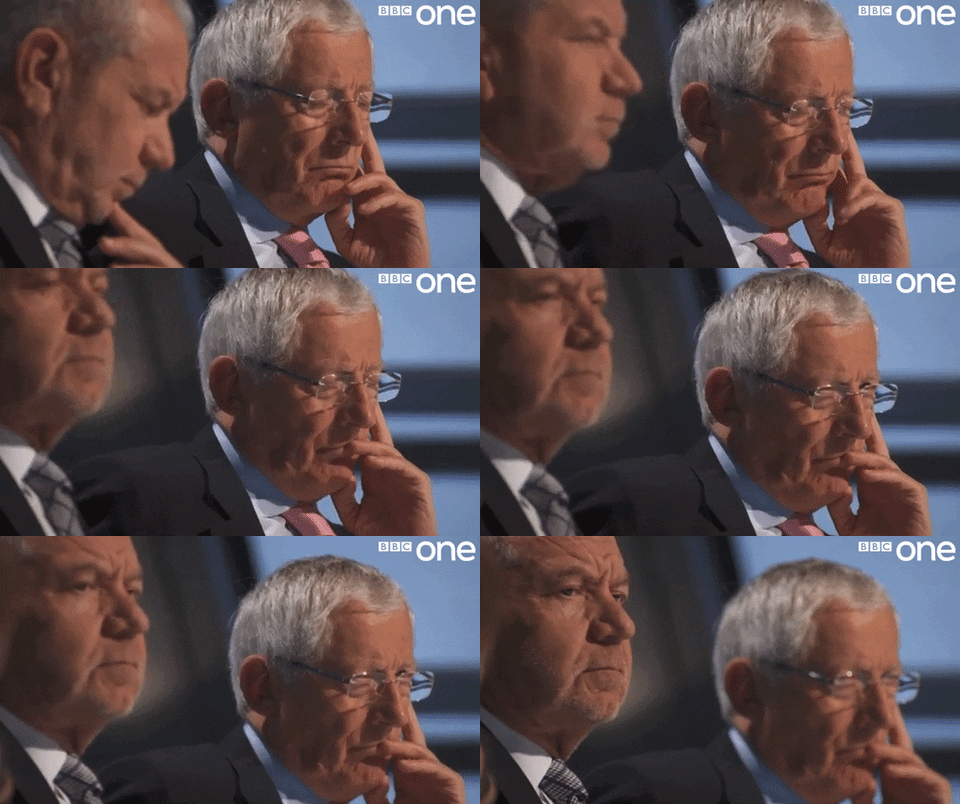
Enter (from a tiny door in the middle of the room, presumably coming from some sort of subterranean troll hole) Lord Sugar, the man whose apprentice these people are supposed to want to be.  Apparently he’s done well in big business, but he doesn’t strike me as someone dynamic enough to thrive in 2019’s brutal economy.  His furrowed brow thinly muffles the sounds of his mind whirring as he dodderily computes what’s said to him.  Fair enough, what’s being said is normally an accusatory argument between a handful of competitive business wannabes, but it all seems a bit much.  Relishing his own interruptions, our Alan then wheels out dad-gags that I swear have been written and fed to him by a team of eighties comedians.  Or sugar-jacked ten-year-olds.  If he announced “Well you’re a stupid poo poo head” to someone I don’t imagine a single eyebrow would rise in in surprise.  But that’s the thing about interviewing: best practice is to put the candidate at ease.  Instead, Sugar rules by fear and intimidation, pointing rudely and mistakenly firing people before he’s even employed them.  The apprentices might be inane, but I would feel more comfortable watching them judge him for his contributions to humanity.


The stupid contestants

This is a bit harsh as my only point of reference here has been the odd one that’s ended up on Celebrity Big Brother.  James Hill was actually a top lad, and I was even won over by Katie Hopkins in the house, watching her reason carefully with Katie Price in a way that betrayed a side to her which today’s unacceptable media persona has shat all over.  The rest come across as officewear-clad interns that talk a big game about their skills but end up set up for failure by each week’s task.  One thing I’ve learned in my working life is that nobody ever looks good blaming someone else, and yet these people sit in front of Sugar pointing fingers at poor old Jenny for not selling enough soap.  Maybe squabbling children is what’s missing from the world of professional behaviour, but it has me reaching for the remote.


Its crimes against humanity

Our UK version is based on an original US iteration that first gave a platform to Donald Trump.  This says it all.


Phone abuse

We’ll look back at The Apprentice UK’s most significant contribution to culture: holding the iPhone below your chin while talking on speaker.  This action became characteristic during the contestants’ various wild goose chases, coordinating errand teams sabotaging the overall effort on the sly.  Now it’s taken hold on the top deck of many of London’s buses, which is great if you want to be involved in other people’s banal chitter chatter.  Similarly, the tension of each episode’s climactic boardroom scene is supposedly elevated by a receptionist using the world’s oldest landline to tell the nervously waiting applicants as and when Sugar is summoning them to his shiny boardroom for some more showing off.  This all needs to stop.


In summary then, for those that might have missed the nuance, I really do take exception to this show.  It’s trash masquerading as premium, a theme that runs through the whole operation, from the contestants to Captain Sugar himself.  I don’t mind lots of showing off, but once someone’s screamed “look at me!” long enough to get your attention, they should have something interesting to tell you.  This is never the case in The Apprentice.  I don’t watch it, and I don’t like it.  Of course, loyal readers, you’re free to make your own decisions, just like Sugar is free of UK employment law in order to make his own hires.  But just be honest with yourself: you’re watching it because you like trash.