Showing posts with label bingewatch. Show all posts

Wednesday, 12 August 2020

Succession

People are always telling you what you should do.  You should stay two metres apart from each other.  You should work from home.  You should watch Succession.  Sometimes, it’s good to ignore people.  If you’re being selfish with space around the eggs in the supermarket, I’m only going to give you a matter of moments before I invade your two metres for my Burford Browns.  I don’t want to work from home anymore because the office has air conditioning and my flat is now the inside of a hair dryer only without any air movement whatsoever.  And I didn’t really want to watch Succession.  It looked like rich white people arguing while being unattractive and there was too much sexy and exciting TV to be getting on with.  Episode one only confirmed my apprehension.  There were so many characters, none of them likeable.  They talked quickly and oh-so-wittily, making references where I lacked context.  There were lots of suits, lots of greys, too many office interiors (even though this has become my dream destination).  Episode two was more of the same.  I itched with the desire to distract myself.  The crossing and double-crossing felt distant and irrelevant.  I still hadn’t picked a horse to back and, more specifically, I didn’t want to.  What should have been humorous just felt weird and in poor taste.

But everyone had been so insistent.  They had told me I really would like it.  And then, episode three happened.  I crossed a threshold.  I was hooked.  I don’t know what did it.  It was like a penny dropping.  Suddenly, Succession was the absolute treat of each evening.  I even felt like a grown up watching it.  My phone discarded out of sight, full focus on the screen, I got more and more into it, eventually unable to resist the urge to binge through the remaining episodes of the second season just because I had to know what was going to happen next.  And now I can’t bear the wait for more.  So maybe I should listen more to people telling me what I should do.  Either way, I’m now going to commend the living daylights out of Succession, but I’ve bucketed the commendations into handy themes for easier digestion, helping you, the reader, to manage your entrance into an exquisite, intelligent boxset that stretches the very limits of what you thought was possible on television.

The spot-on and terrifying exposition of a media landscape

You won’t have heard of Waystar Royco, nor the Roy family who own most of it, but both might strike you as uncannily familiar.  Succession deals with this media conglomerate (which also includes cruise lines, theme parks and a scattergun array of ill-advised ventures in other markets) and the unanswerable question about who is next in line to take on its captaincy once the paterfamilias (I’ve always wanted to use this word) steps down.  While this intrigue ensures endless tension, the interplay between the family’s right-wing news channel (ATN) and their political ambitions would be ludicrous if it didn’t mimic real life so closely.  Financing, acquisitions, cover-ups: there’s dirty trick after dirty trick, with Shakespearean levels of backstabbing and betrayals.  Yet the boardroom melodrama is so plausible you could buy this as a genuine documentary.  You just need to accept that there is nobody to root for.

The first ever portrayal of accurate adult sibling relationships

Lining up to inherit the vast fortune and power of the company, three brothers and a sister represent the future of the Roy family.  Eldest son, Connor, has dialled out of the race, but his abuse and misuse of his own (his dad’s) wealth reveals him to be a threat to the real world, if a non-contender in the Roy battles.  Kendall, our heir apparent, is having the worst go-to-work-with-dad day that anyone has ever experienced, only it’s his whole career.  Pouring all his energy into the company, at the expense of everything else, his fractious paternal relationship is the source of unending and delicious plot twists.  Jeremy Strong shifts effortlessly between conniving shark, office square as trend-missing douchebag and downtrodden underling.  Meanwhile, Kieran Culkin brings so much to what are already most of the best lines as Roman Roy, the rebellious one who can’t get taken seriously but who also doesn’t take anything seriously.  Then there’s Shiv (an outrageously good Sarah Snook), the daddy’s girl striking out on her own, trying to rise above the wheeling and dealing but always getting suckered back in.  I’ve spent too long enumerating the Roys, when the emphasis is on their relationships.  What I really buy is that these four grew up together.  Their childhood fisticuffs even persist into maturity (Shiv and Roman).  Their bickering is no longer about sharing toys, but manipulating dad, running companies (into the ground) and willing each other to look as bad as possible, all while forming occasional united fronts whenever it suits.  Needless to say, you can’t build a case to become CEO of a global megacompany when you’re blaming your brother or sister for your own mistakes.

The use of Brian Cox

Now we’ve done the kids, let’s look at the dad.  Logan Roy is our rags-to-riches self-made man.  We might be in a time when we acknowledge that plenty of screen time has already gone to white old men, but Brian Cox consistently delights in this role.  Even my pet hate of being able to tell how much he’s enjoying himself in his performance doesn’t get activated because his performance is so convincing.  It’s merely my assumption that he gets to have a great time as an actor, whether suffering the after-effects of his stroke, or reacting to his kids’ betrayals.  It would be worth working for Logan Roy just to get fired in a blaze of abuse.

The swearing

Which leads me to Logan’s potty mouth.  Never has the expression “f*ck off” sounded so satisfying.  This is how he concludes most dialogues, whether with his leadership team or his own children.  He hits the K with real back-of-throat disdain, his words literally causing the recipient to acknowledge they have no other choice but to f*ck right off.  Now that’s power.

The passive aggression

We don’t always resort to effing and jeffing though.  Plenty of the dialogue sparkles with outright cusses semi-shrouded in manners or corporate jargon.  When the wordplay moves from artful cleverness to explicitly rude insults, it’s somehow all the more delightful.

The money

Not only do the cast splash their cash, but so too does the production.  Choppers seem to be on standby, and no location seems too remote to receive a full shooting unit, whether Dundee or obscure stately homes elsewhere in Britain, or US ranches, or indeed a yacht in the Mediterranean.  I would like to work on the show just so I can try out the inflatable slide on the back of Logan’s mega vessel.

The supporting cast

The Roys have become everything to me, but every character in their orbit enriches Succession.  Hiam Abbass (Logan’s wife Marcia) revels in her scenes as the conniving stepmother, while my softest spot is reserved for the company’s general counsel, Gerri Kellman (J. Smith-Cameron) who seems to work every hour of the day, mostly while wearing ball gowns, but can be an absolute boss when required.  Special mention of course to Cousin Greg who is pure joy in his naivety, never more so than when being mistreated by Tom Wambsgans (an incredible Matthew McFadyen).  I even enjoy Willa.

But this is enough commending – there’s only so much I can say before we start running through plots and spoiling surprises.  From a sceptical viewing, pressing play under pressure from TV connoisseur friends, I’ve become obsessed with Succession.  You really should watch it.

Tuesday, 4 August 2020

Euphoria


Following on from I May Destroy You and Normal People (let’s forget about Final Space for now), we’re continuing this week our run of blogging ourselves silly about outstanding drama.  Fair enough, this show was on a while back, so I’m well behind the curve here (we can even call it a second wave unless people find that triggering), but, realising I wasn’t making the most of my Sky subscription, I decided to go for something available on Sky Atlantic here in the feudal state of the UK (where you can be a lord if you’re mates with the government).  I’ll admit that Chernobyl was top of my list when it came to getting more into the channel that became the British home of Game Of Thrones, but people had been telling me about Euphoria since it first broadcast.  However, what they said was kind of off-putting.  They talked about club kids.  Whatever these are, they’re not inherently interesting.  I myself am immune to FOMO and therefore haven’t been awake past midnight for many years.  However, TV shows about people who do go out at night can offer a useful vicarious route to the thrills, chills, spills and queuing up outside in the cold to pay real money for the privilege of going inside a place experienced by the kinds of people who do have social lives.  The Euphoria advocates also talked about drugs.  Again, not a part of my life, unless you count the crazy crazy highs of pre-dawn crossfit sessions, but I suppose I thoroughly enjoyed Narcos, even if I only used my post on that show to point out that, currently, buying illicit substances funds criminality.  As such, my expectations of Euphoria were that it would simply be sequences of drugged-up teenagers raving to house music under the glow of colourful lights.  Superficial, yes, but potentially just what I was after.  For some reason.


Euphoria is so much more, however, and I am now grieving for the fact I have finished all eight episodes.  Set in East Highland, presumably a generic American neighbourhood that feels a bit Californian but could be anywhere, this is a show about high school teens that elevates the trope to new (drug-fuelled) highs.  I’m sure I could research the actual location, but I’m bashing this out during a lunch break, and the one thing about working from home (slash living at work) that I’ve learnt during lockdown is that nobody is allowed a lunch break, so speed is of the essence – something by now we’ve hopefully grown used to in my weakening week-on-week prose.  At the heart of our stories, we have the main character of Rue.  She is our guide to this world and the point around which a lot of it revolves.  Rue is played by Zendaya, who is an actor who doesn’t need a second name.  I think there has been news about her, but I’ve never really seen it.  What I have seen, though, is her mesmerising and heart-wrenching performance as Rue.  Freshly back from rehab following an overdose, Rue is a victim of America’s addiction to prescription drugs.  A lot of our narrative tension comes from her palpable struggles with keeping clean.  Intersecting with these are the challenges of her budding friendship with Jules, a brightly dressed new student who forms a kindred spirithood with our Rue.


This would be compelling in itself, but I have to confess that Rue’s arcs are, to me at least, some of the least interesting in the whole of Euphoria.  They’re still more gripping than 99% of TV out there, but it’s the surrounding cast of other high school classmates that really hooked me in.  Rue, however, serves as our introduction point, often narrating the opening scenes of each episode, sparing no production expense in bringing to life scene after scene depicting various tableaux of childhood dysfunction.  Every family we look into is a hot mess and a product of visceral pain.  Whether we’re introduced to McKay’s (father’s) dreams of NFL stardom (a dramatised Last Chance U of sorts) or given a whistle-stop tour of the origins and undoings of Maddy’s incredible confidence, you can’t take your eyes off the screen until everything is divulged.  This renders the ensuing plot points all the more significant, serving as a grounding for our teens’ otherwise reckless actions.


This structure also permits Euphoria to tread tired old high school and growing up themes in a way that completely resists any definition as generic.  Instead, we are awash in originality as we consider the blossoming (ugly head rearing) of such onset-by-adulthood innocence losses, including but not limited to: gender, sexuality, body image, parental disappointment, mental health and many many more.  Seriously, all your favourites are here.


Somehow, this plays out with a high level of stylisation while retaining a contrasting grittiness.  Euphoria is at once dreamlike yet realistic.  And yes, I’ve just said the same thing twice, but with some of you I really feel a need to labour the point.  There’s nothing for me to criticise with my usual archness.  Sure, maybe I could do without so much importance being placed on eye make-up/furniture, but it’s an aesthetic that gets confidently owned.  Euphoria loves a tracking shot as much as I do; we’re either following a single character on the march, or watching a beautifully choreographed ensemble march play out in varying directions.  This adds a compelling and masterful intensity to the glorious unravelling that brings together all the characters’ narratives in the fairground episode.  No doubt the originality of the soundtrack helps glue the individual strands to each other.


Everybody, this is the show Skins wishes it had been.  I am desperate to find out more about the whole gang.  I want to be told more about the sadness behind Cassie’s eyes.  I want to know if Kat will persist in her delusion that she is using sex as a weapon on others rather than on herself.  Why do I feel such sympathy towards Fezco?  Can we get more of Lexi (whether dressed as Bob Ross or not)?  And dare I ask: how can things end between Nate and his father?  So let’s view my gushings here as a well-deserved round of applause for something that will guarantee you at least eight evenings of entertainment and thought-provoking diversion, all while looking pretty nice on your telly and leaving nobody uncertain that the televisual golden age rumbles on.

Wednesday, 29 July 2020

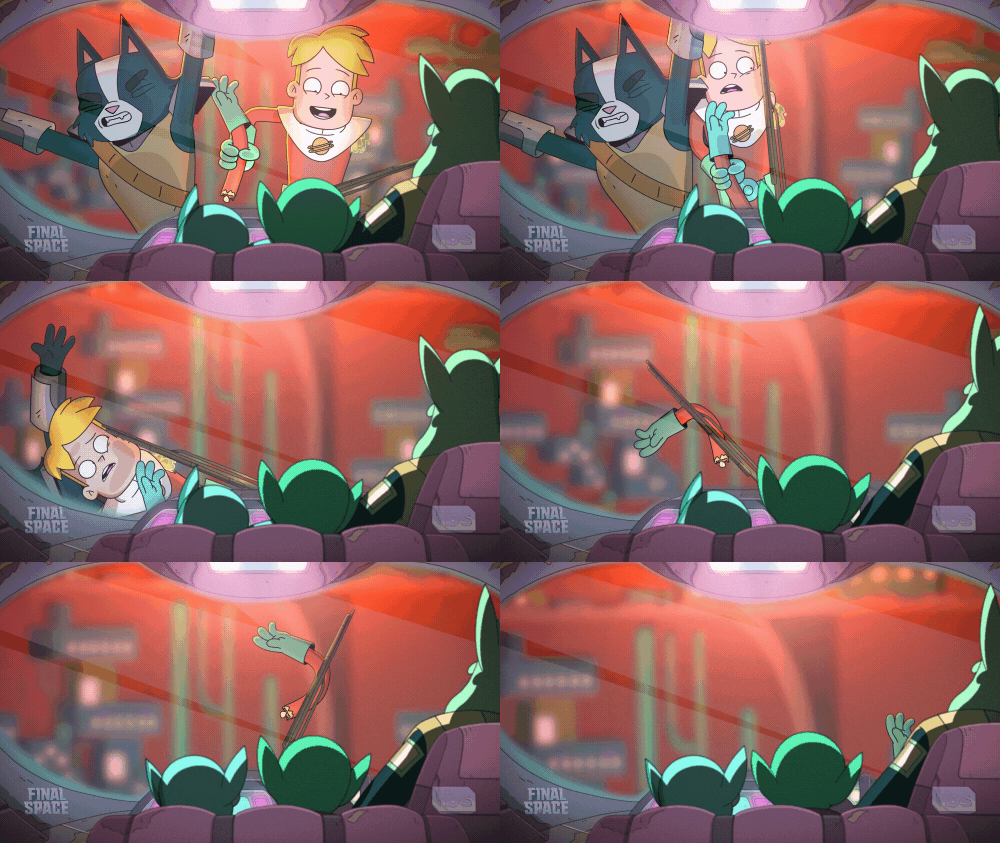
Final Space


While nobody will really recall 2020 as being a golden age for anything (unless this really does turn out to be the year everyone stops being racist), I would like to suggest that TV is, overall, doing a very good job at the minute.  We are spoiled for choice.  Luckily, this big old pandemic has come along and given us more time at home to keep up with boxsets.  If anything, let’s spread the rumour that telly started the corona-thon.  Thanks to my evenings in, I’ve torn through (and loved) Normal People and I May Destroy You from the BBC (great to see the institution taking time out from delivering news coverage biased to chinless Tories), I’ve been making the most of my Sky subscription for once (look out for upcoming posts), but I seem to have totally bricked it with my Netflix decisions.  There’s a third series of Dark and a fifth of Last Chance U, both absolute gems, that I am yet to start.  Instead, I’ve been trying to follow up on my impressive achievement of devouring the fourth series of Rick & Morty.  Suddenly, I’ve craved cartoons about space.


Enter Final Space, a Netflix animated series that my tired mind hoped might just be in a similar vein.  There’d be laughs, clever humour, but also philosophical provocation and richly imagined worlds.  I really do love a richly imagined world.  But let me get this out of the way upfront: the world in Final Space is so richly imagined that I couldn’t keep up and, before long, I had no idea what was going on.


This is totally my fault.  And, in my defence, it only happened in the second series.  Season one of Final Space introduces us to our hero, Gary Goodspeed.  An astronomical everyman, Gary is nearing the end of a space prison sentence, living in isolation in a 2001: A Space Odyssey-inspired ship with an Alexa-esque companion called HUE.  His concerns are obtaining cookies and staving off boredom.  Enter Mooncake, a squishy green floating being who makes Pokémon sounds and turns out to be a hugely significant, er, thing.  This is where my understanding runs out.  He’s a creature, but also, I think, an energy source, or a key, or you know, whatever you like really.  Either way, I was pretty gripped by the first series, slowly realising that each episode, rather than being a self-contained animated sitcom, is a sequential instalment in a hugely ambitious story about the very nature of space and time.  Throughout, irreverent humour is peppered.  We come across a lot of silly characters and ludicrous situations proliferate.


It’s well-crafted storytelling, but somehow, something didn’t connect with me.  That is my loss.  By the second series, as the universe, literally, of characters and backstories and mysteries expanded, my tiny mind lost its footing and Final Space, in all of its potential to entertain, ended up being a background show I had on while inexplicably baking gluten-free sponge cakes simply because it’s something to do in lockdown.  Ultimately, the show’s humour seems to detract from its serious storylines, while its serious storylines undo its humour.  Maybe it’s basic of me not to care about the end of the world when someone is whingeing about a cookie.


But there is a lot to love, and the animation is breath-taking.  If you like action happening in space, then feast your eyes on these cosmic bodies.  Futuristic vessels slip past, all slinky, while battles and asteroid clusters come to life in three dimensions.  It reminds me of a book I had as a child: some sort of graphic novel from the Ulysses 31 series.  I don’t know where it came from and I never actually read the words, just looking at the pictures in the early nineties and thinking: yeah, this is space and that.  If that specific reference doesn’t work for you, and why would it, then think anime.  And if you don’t know what that is, you’re probably better off watching Love Island Australia.


While I typically advocate for almost all Netflix animations (Bojack Horseman, F Is For Family, Big Mouth, Disenchantment) I will swerve any subsequent series of this.  If I have failed to do it justice, then so be it.  Let the talented voice cast, the incredible animators and imaginative writers all come after me.  Justice is already served in that I am persisting with a poorly read blog while their creative output is getting greenlit by the planet’s biggest streaming giant.  At least there can be no spoilers in this post, as I couldn’t even tell you what Final Space really is.  But yes, give it a go if your sci fi skills are better than mine, but otherwise there’s a host of animation out there that’s easier to connect with.

Tuesday, 19 May 2020

The Boys

Looking back, the last four weeks’ posts have all covered Netflix original productions, with the three weeks before that casting Just One More Episode side-eye on further programmes watched on that platform (including the pandemic’s breakout hit, Tiger King – another Netflix production).  So let’s balance things out with the revelation that I did actually watch something on Amazon Prime Video in recent times: The Boys.  Regular readers will know I am no real fan of superheroes: I’m yet to see a good explanation for the need to wear Lycra bodysuits, and by the inevitable climactic fisticuffs to save the world, I have totally lost interest.  But friends had raved about The Boys and it seemed only right I should give it a chance.  After all, it’s nice to be proven right.


I ended up particularly engaged with the launch marketing campaign way back whenever the show first got released, during a past age when we were allowed out of our houses to touch others at will.  My job in media meant I had been invited to watch an interview being recorded with Joel Dommett.  I’m convinced he’s my twin, even since seeing him on I’m A Celeb (though by listening to his podcast Teenage Mixtape I can see clearly that our music tastes are insurmountably divergent).  I had walked across a humid London with two grads from the office, slurped some complementary wine before enjoying Joel’s chat with Laura Whitmore (pre-Love Island, post-Survival Of The Fittest).  I was just stuffing my face afterwards with free ice cream when we were asked if we would stay for a second interview – turned out they were recording a sesh with Chace Crawford that night too.


Being young, carefree, spontaneous and loads of fun, I was happy to stay.  I jest: in reality I was itching to get back to my flat for some lean chicken, sweet potato and a bit of boxset.  But I had already fully sweated through my underpants on the walk over and self-destructed on my macro requirements with my scoops of triple chocolate.  So, there was Chace, him off Gossip Girl, metres away talking about his new show: The Boys.  Sounded decent.  Nevertheless, the evening ended in faux-pas as we made for the lifts during our exit.  One of the grads declared out loud that poor Chace “is much less good looking in real life” as our elevator arrived.  Little did he realise that Chace was standing right behind him but was too gracious to respond.  With that cringe in mind, I owed it to successful Hollywood actor Chace Crawford (who doesn’t care what media grads think about his face) to watch his new show.


Like Amazon’s other centrepiece, Mr Robot, The Boys has an epic pilot episode.  There is set up galore as we are shown a world where superheroes are a commodity as commercialised as any US sport, with merchandise and revenue streams beyond anyone’s wildest capitalist imagination.  What a fun slant to take on an overdone genre: looking at the business side of rescuing plebs from danger with x-ray vision and glowing yellow eyes.  I could gladly have just followed a fly-on-the-wall documentary on the inner workings of Vought International, the fictional corporation that has globally cornered the market in caped crusaders.  But because this is drama, we need to acknowledge that we are here to see the destruction of this proffered reality for which we have suspended our disbelief, so it’s no spoiler for me to tell you that the first season slowly edges us towards the demise of this morally corrupt business endeavour.


Sadly, so often, a great pilot can result in a huge drop off in following episodes.  Therefore, instalment two bored me and from then I was kind of done, sitting through the rest paying little attention and feeling even less.  Crawford himself is actually fairly marginal as The Deep, whose power rests in his abdominal gills.  He seemed to be there for comic relief, but without realising it.  And it wasn’t that funny, just weird.  Most of the character development had gone into his biceps.  Centre stage was, in fact, Karl Urban, as an anti-hero activist.  I don’t know what else he did as somewhere along the line the terrible decision was made for him to have a cockney accent.  Cue the worst apples-and-pears dialogue ever recorded.  Urban heads up a bunch of misfits taking on the big corp world – in fact, I think they are the titular boys, rather than the badly behaved celebrity heroes (who I kind of preferred).  If I could pinpoint the moment I turned off, it was sadly the arrival in episode two of Frenchie, a generic team member with the rebels who just left me cold with everything he did.  It’s derivative to call things derivative, but he was derivatively derivative (not the actor, the part).


Nevertheless, there’s plenty to enjoy: explosion-based action, wry wit, moral conundrums, romance, intrigue, a lens on our hero-worship of celebrity.  Just as the heroes care little for their fans and the great unwashed they rescue, I felt no real emotional investment in any of it.  I’m pretty sure it’s all based on some sort of book/comic source material.  There’s no way of knowing as I’m not prepared to google it – it’s better just to fire off an online rinsing, isn’t it really?  It’s reassuring to know I won’t need to watch a second season if there ever is one.  I’ll be too busy getting deep into Netflix’s much more user-friendly menu system, holding my breath for another season of Elite.

Wednesday, 13 May 2020

Unorthodox


Netflix has fast become my most cherished companion during these weeks of lockdown.  While discouraged from leaving the house (I think) by various unclear Tory waffles (not sure why I would take any form of instruction from people who have actively pursued something as stupid as Brexit), my TV has seen unprecedented (pandemic bingo!) levels of use.  It gets switched on while I make breakfast, a weekend brunch affair that has become a daily routine of slowly scrambling eggs and brewing coffee.  If I manage to grab a lunch break between video calls, I’ll treat myself to a quick episode then.  And finally, after work, rather than a rushed Tube commute with angry Londoners, I simply have to stumble from my laptop to the living room, leaving the never-ending avalanche of emails for another day, for a few hours of inert diversion (some of which time is spent wondering what I can do about my growing belly as it protrudes over the elasticated waistband of my tracksuit bottoms).  In all of the quotidian monotony, I’ve had a very good run of Netflix not only entertaining me, but gripping me to my seat: Tiger King, Last Chance U, Cheer and Elite awakened a compulsion in me not to stop until every episode had been devoured.


As the TV powers on, I can’t switch from linear broadcast to Netflix quickly enough.  The news that always seems to be on is, quite simply, the worst.  Blurry contributors garble on from their home studies while showing off their AirPods.  Some sort of Scottish minister holds forth about how corona is affecting Scotland (specifically and endlessly) while a nice deaf lady does sign language in the corner, her face betraying a preference to be doing any else but this.  Everybody speculates about what will happen next while invoking an unhelpful comparison with World War II.  That culminated in the Holocaust, so perhaps we can do a little better in 2020.  I’ve taken to re-watching Friends for comfort (even finding an episode of series one I had never seen – I know!) just to get away from the lazy journalism.  So, I clicked on Unorthodox.


I was immediately sucked in and raced through the four episodes while practically holding my breath.  I’ll be honest that my choice was partly informed by linguistic policy.  After so much Spanish, I was hopeful for something in German to help tune me back in for FaceTimes with friends in Hamburg.  Unorthodox came up in a search for German-language content, but it’s actually half in English and half in Yiddish, with a few other languages scattered across it.  Based on a 2012 book by Deborah Feldman about her real-life departure from an ultra-Orthodox Jewish community in New York, Unorthodox’s setting in a minority religious community was catnip to me as a compelling theme, so I shrugged that Yiddish was similar enough to German and cracked on.


Raised a heathen, the world of any sort of faith eludes me.  You can justify anything with faith.  I can punch you in the face and say it was faith and you can’t get mad.  I can make lifestyle choices based on spurious translations of millennia-old texts and then apply them to other people at will and they can’t get mad.  Unpacking what makes people cling to this sort of thing is fascinating.  I’ve always devoured documentaries about the Amish, while Wild Wild Country offered another view on how these things start and how communities respond.  I’d also seen the Netflix documentary One Of Us which had given me fair warning about how hard it is to leave not only your ultra-Orthodox community, but your friends, your family and your whole way of life.


Unorthodox is told in two concurrent narratives.  The first, sticking most faithfully to the book, follows our heroine, Esty Shapiro, as she prepares to leave her husband and flee the Williamsburg neighbourhood where she has lived her whole life.  The tension crackles as she secretively breaks free and you can’t help but will her to run away.  The second, which is more loosely only inspired by the book, follows her progress on arrival in Berlin – making new friends, wearing new clothes, eating ham.  Shira Haas blows my mind with her lead performance.  I’m still thinking about it now.  I am so convinced by her journey that I occasionally find myself wondering how Esty is getting on in Berlin.

As such, resisting just one more episode is impossible, as you’ll need to know if she makes it, how she makes it, why she escapes and what happens next, all at once.  This is multiplied by the privileged glimpse into a deeply religious world that is hidden from most of us; the wedding scene in particular is documentary-like in its setting out of customs for us to witness.  While voyeuristic, there isn’t a sense of condemning what we see.  We are simply able to view it, and the characters’ responses to it, in the frame of Unorthodox’s sociological storytelling.  Marriage is crucial in Esty’s community, as procreation is seen as its primary purpose, their drive to repopulate a historical hangover from the Holocaust (which I inadvertently foreshadowed in my self-pitying introduction).  Affection and sexual enjoyment are therefore fairly low down the marital agenda, far behind taking the bins out and weeing with the door open.


Meanwhile, in Berlin, Esty is confronted by the fact that the aftermath of genocide, rather than leading to a life-defining duty, is more practically incorporated into daily life as a part of history and geography.  The Berlin scenes rely slightly too much on happenstance to take Esty’s journey forward, her leeching on to a multinational group of idealistic young musicians being met with enthusiastic adoption when surely most people would ask a hanger on to get lost – maybe that’s just the London in me.

In conclusion, Unorthodox offers compelling drama and an eye-opening insight into a community and their practices that you might not know much about.  I now want all my dramas to be set in devout sects, for the hats alone.  But I warn you, set aside sufficient time to get through the whole thing, as you won’t be able to stop after just one episode.  This should be fine, though, as it’s not like we can go anywhere.  Maybe lockdown is our own orthodox lifestyle that we can’t escape from.

Wednesday, 5 February 2020

Game Of Thrones (Season Two)

WARNING: CONTAINS SPOILERS


Still reeling from the execution of beloved Ned Stark, nothing delayed me in adding the second sequence of Game Of Thrones to my old Lovefilm list.  As one of the show’s only fans in those distant days, I had little competition for the DVD discs which soon appeared in the post for immediate viewing.  That said, the picture quality of DVDs is now tantamount to watching content through a butter-smeared cataract, so I’m surprised I was able to make out anything.  Now no longer shameful of its fantasy origins, with no apologies necessary for things like zombies and dragons, the second series offers an emboldened portrayal of Westeros, enriched by all the layers of storytelling its previous instalments had laid down.  I would quantify the action as aplenty, yet the dialogue scenes still sparkle with political tussling, knowing wit and rich imagery.  Some battles are only alluded to, due to their production cost (such as a Robb Stark ambush on the Lannisters) but this clearly allowed them to save enough budget to enact a naval battle in the series’ penultimate instalment, Blackwater.  So it’s swings and roundabouts, slash, creative editing and wildfire.


But I’m not cussing the production for being efficient, not least because all our scenes north of the Wall seem to be filmed in real snow.  No film or TV show ever has nailed realistic-looking fake snow, so the Night’s Watch in their almost entirety are shipped off to some godforsaken winter wonderland, not for a skiing break but to traipse through snowdrifts in their big black cloaks whilst in pursuit of Mance Rayder.  It’s a visual joy worth every penny and for which I am happy to sacrifice any other battles in this series.  And like all our theatres of action in this season, things get dark.  While those who have taken the black come face to face with the awful Craster and an army of the undead (and nobody can decide which one is worse) grim and ghoulish characters dominate scenes throughout each storyline.  From the blue-stained mouth of Pyat Pree in Qarth to basically anyone in the Iron Islands (though Yara Greyjoy turns out to be a babe), the baddies outnumber the goodies.  Even solid Lannister-alternative Stannis is joyless and potentially a bit evil, while darling Joffrey plumbs new depths of depravity yet still channels American daytime soap-operatic expressions to great effect.  Hating him more than anything unites us on the side of Sansa in the coming battles.


And indeed, that is the main thrust of this second series – the worsening of the war.  The Tyrells switch sides, Dorne is brought to heal, massacres run in the Riverlands and wildlings prepare for invasion.  As a result, the violence multiplies and grows more extreme, and it’s made clear it’s the smallfolk who suffer at the hands of the powerful in their petty squabbles.  Nowhere is this easier to see than at the doomed holdfast of Harrenhal.  I remember finding the tension here unbearable on my first viewing.  When the daily selection of torture victims threatens to end Gendry’s journey through a hot rat to the stomach (really) I almost lost my mind.  Furthermore, Tywin Lannister’s selection of Arya Stark as his cupbearer leads to an oblivious truce so paper-thin that you’re screaming at the TV each time the youngest daughter of Ned nearly opens up Tywin’s neck with her mutton knife.


Nevertheless, there is also greater confidence with LOLs, as humour creeps through even against the bleakest backdrops.  Ygritte’s goading of Jon Snow (for knowing nothing) draws a wry smile in the Arctic tundra, while some of Samwell Tarly’s comedic potential is slowly revealed.  There’s even space for dark humour, with the slightly slapstick approach to Jaqen H’ghar’s assassinations on behalf of new bestie, Arya.  Indeed, offsetting this lighter touch is a heck tonne of foreshadowing as well.  Reviewing these earlier series with the benefit of having seen everything, certain lines make more sense, certain expressions are more significant and certain background observations feel strangely pivotal.  But the expansion of the Game Of Thrones universe satiates our yearning for more of what we love.  Everything is spiralling out of control and starting to go very wrong (especially for the Starks) so the only response is a desperate need to return for more series to find out what happens next and to answer the ever more unanswerable question about how this can ever be resolved.


Best newcomer

Podrick Payne is who I’m going to single out of the many new faces to grace Westeros.  While he at first simply makes up the numbers in his initial scenes, he later becomes a source of great humour.  But it is his prowess in the Battle of Blackwater that marks him a true hero, most particularly as he saves Tyrion Lannister from his sister’s sketchy third-party attempt on his life, ensuring one of our most beloved characters makes it through to the end.  We also learn in season three about his massive willy, so it’s important that this too is acknowledged.

Most valuable character

I would like to make a big fuss here of Osha, as her achievements are wrongfully unsung.  While she enters the fray as a sinister Wildling, her loyalty to House Stark soon grows strong.  Determined to save Bran and Rickon from Iron Islander clutches, she takes one for the team by seducing Theon Greyjoy and offing a number of his guards.  With Bran’s survival pivotal to so many of the subsequent series (with many a great character meeting a grisly end while he just daydreams sitting down) it’s thanks to Osha that he survives this moment and lives on to warg another day.


Best death

Picking up where the first season left off, this sophomore series doesn’t hold back with the dispatching, so there was a wealth of offing to choose from.  I’ve gone with the dual ends of Xaro Xhoan Daxos and Doreah in Daxos’s own vault deep in Qarth.  Sealed in while still alive by Daenerys as punishment for betraying her and stealing her dragons, this first glimpse into her vengeful spirit is not only terrifying in and of itself, but being locked in a dark room until you die feels like a dreadful way to go, and the whimpers of Doreah as her fate is sealed (geddit?) still haunt me to this day.


Jaw-dropper moment

Meeting Melisandre is traumatic for all of us, not least because she talks only in the mantras of her Lord of Light religion, constantly gets her boobs out and pulls some wonderfully patronising facial expressions.  She likes setting fire to things (and people).  But, as she ascends in the camp of Stannis Baratheon’s claim to the Iron Throne, she makes sure to do away with any doubters by using the dark magic for which we love her.  While I could mention the smoke baby that ends Renly’s campaign after emerging from twixt her legs, it’s the poison goblet switcharoo she does with Maester Cressen which is both believable and terrifying enough to make it clear that this is a woman who can’t be trifled with (and is dark and full of terrors).


Thursday, 30 January 2020

Game Of Thrones (Season One)

WARNING: CONTAINS SPOILERS


Right then, EVERYBODY, here come some big ones.  I haven’t put myself under this much pressure since I took on Love Island.  But don’t worry.  I’ve every confidence this will be another amazing post.  When I first started Just One More Episode, Game Of Thrones was at the heart of my plans for the kinds of boxsets I wanted to be talking about (but have ended up with posts on Naked Attraction and Keeping Up With The Kardashians instead…)  But why has it taken 131 posts to reach this momentous occasion?  Well, I had planned to cover this show in the run up to its eighth and final season, but a cruel twist of fate saw me in a household without access to Sky Atlantic, dashing my carefully lain plans to review all prior series in preparation for this final swansong (as I had done for the two previous instalments – this is already too much fanboying).  But the panic is over.  I am now the proprietor of my very own Sky contract.  I’ve alluded already (Chernobyl) to the fact that this pivotal saga didn’t figure among the available boxsets when I first sat down with my new Sky Q remote and box, but suddenly it’s back on there!  And how did I find this out?  An advert in a podcast (Teenage Mixtape) voiced by none other than Sean Bean himself (that has since been served to me 500 more times and that I now can’t skip fast enough).  So, no more putting up with ersatz-Thrones (I’m looking at you, The Witcher), I’ve been back to Westeros (again) and I’m bloody loving it.


Before we begin, though, let me explain two key rule breaks with my approach.  Firstly, we’re going to split things up by series.  Normally, once I’ve “done” a programme, I move on.  It’s over.  No returnsies.  The only way I’ll ever go back to it is if it adds a colon and some more words (like Narcos: Mexico) by which action it definitively becomes a new show.  But this programme is more than that.  For a while, it was a global cultural phenomenon, with episodes commanding feature film budgets.  It’s the ur-boxset, the originator from which our new norms of staying in and watching episodes eclipsed any desire to brave it out into the rain and sit among a variety of coughs and illuminated smartphone screens in the cinema or, heaven forbid, actually talk to people.  Secondly, I’m alerting you to spoilers.  Typically, I take pains not to reveal any twists or unexpected plot progressions that can’t be gleaned from a marketing trailer.  But, with this show, if you haven’t seen it yet then you simply need to get off my blog right now.  This post ruining a Game Of Thrones twist is the least of your worries.


So how did you discover Game Of Thrones?  This is the question nobody is asking me, but I’ll have you all know I was early to this party.  I remember some tube posters across the tracks of the Northern Line featuring an array of moodily-lit and characterful faces.  It didn’t say much about the show or emphasise its fantasy roots too heavily, but something piqued my interest and I remember adding the first series to my Lovefilm account, with the DVDs arriving soon after (I told you this was a long time ago – that sentence is definitively historical memoir).  Sure, the rest of the world caught up and jumped on the bandwagon, but my first moments in Westeros still feel as if they were only yesterday.  Like the books, which I later devoured, each series’ opening scene features only peripheral (short-lived) characters, setting up some dramatic tension before those famous credits roll.  Series one’s prelude foreshadows the coming threat of the White Walkers, but keeps the northern bogeyman obscured in enough mystery that their plausibility is easily bought.  And that’s the beauty of this first foray into Thrones, the fantastical elements are only gradually revealed to us in such a way that we accept them as reality.


The key example of this are the dragons that finally emerge from the Essos ashes around poor old Daenerys’s (almost constantly) naked body.  At first, they are just some calcified eggs, and characters only speak of them as legends that died out hundreds of years beforehand.  Seems legit, right?  Only carefully is their being escalated into the fire-breathing beasts of the later series, with no serious viewer dismissing them as excessive as the show has thoughtfully prepped us for their coming glory.  But no, it’s not just the dungeons and dragons that draw us in.  Game Of Thrones has one of the richest settings ever attempted in TV.  Again, the books provide plenty here as a source material, but I commend the first episode and its offspring in introducing us to a world that’s totally made up yet easily believable.  The Seven Kingdoms are rich in history and folklore, dogged by opposing religious rites and ineffective government, riddled by rivalries and grudges among the nobility and regions.  It’s the inspiration for Brexit Britain.  The only question mark I have is related to the fact that there doesn’t seem to have been a single technological or societal advance in thousands of years – it’s made clear that people have lived this way for a long time.  But I can forgive this as the complexity is still delicious enough to fuel eight series of epic drama.


So cast your minds back to how that first episode drew you into a world where there were so many truths to establish before we could even progress to storyline.  Quickly, the viewer progresses from “Who are these serious-looking people shrouded in fur?” to “Ah yes, it seems an uneasy truce has descended on the lands and brought peace yet is about to bust apart at the seams.”  It’s artfully done.  For me, I lost all doubt as the Stark children stumbled across their direwolf pups.  I was in.  Sure, some initial lines from certain cast members carry a slight hesitance due to their pomposity, but that all passes quickly, and things get going without delay.

On that note, I should probably allude to the main thrust of season one: what actually happens.  Well, I’ve been thinking that it could otherwise be known as Ned Stark Investigates: The King’s Landing Mysteries.  But it’s more than murder mystery.  Thrones’ beauty is in its layers.  We have the present actions where Ned is strong-armed into leaving most of his family to take up a position of Hand Of The King to King Robert.  However, before that, and before even episode one, we go back a layer in time to the circumstances of Jon Arryn’s murder as a result of uncovering the truth about the supposed Baratheon line of succession.  Beyond that, yet another layer exists that binds the myriad characters (numerous as they are): the teaming up of the Westerosi houses against the Mad King, resulting in the overthrowing and end of the Targaryen dynasty.  The interplay between these layers of time propel every scene from “Oh look there might be a dragon” to politicking, intrigue and an impending sense of doom.  And this is all without mentioning the critical layer of peril present at all times: the coming White Walker trouble beyond the wall.  Filter this all through several theatres of action, factor in the geographically distant yet essential narrative of Daenerys and Viserys in Essos, multiply by a thousand, and you can only conclude that Game Of Thrones owes its success to crediting the viewer with the ability to cope with a lot of information.


Language, too, plays a part.  Each character has a nickname which, rather than complicating things, somehow makes them easier to remember, from Jaime Lannister’s Kingslayer to Petyr Baelish’s Littlefinger.  Each house also has its own mantra that easily slips into common parlance.  As a result, we all know winter is coming.  But a further stickiness comes from two other areas: gratuitous sex and relentless gore.  All the highbrow political debate is one thing, but at any moment a tavern whore might flash her downstairs, or the pointy end of a sword might suddenly protrude from someone’s eyeball.  It’s another layer of jeopardy among an embarrassing excess.  But it leads to one of Thrones’ most credible points: nobody is safe.  Big name actors like Jason Momoa and Sean Bean fail to survive to the end of the series, setting into motion a trend that heightens further the already great stakes at play.  Thus, we start to see how this became the biggest show in the world, but let’s conclude on some gentle trolling below.

Best newcomer

Slightly redundant here as everyone is new, but let’s take a moment to acknowledge the rise and fall of Khal Drogo here.  Never one to miss chest day at the gym (or wear a top), Drogo has mastered the smoky eye off a YouTube tutorial but continues to struggle with basic Common Tongue (English).  He prefers to mount his women from behind, but it’s actually strangely touching when Daenerys finally tames him sexually.  Sadly, his immune system fails to protect him from a rusty axe blade, but not before he spectacularly kills Viserys by pouring molten gold on him just when he’s at his most annoying.  We’ve all dreamt of doing this to a colleague, which is why smelting is not allowed in offices.


Most valuable character

Playing beyond her status here, I’m going to go for Mirri Maz Duur.  Not one to let a bad hair day stop her in any endeavour, Mirri is a crucial catalyst who sets Daenerys off on her path to emergence as a great leader.  From her wonderful accent, to her cheery screams as she is burned alive, Mirri can take a bow for life-coaching the Mother Of Dragons to be the best that she can be.

Best death/jaw-dropper moment

Back in Westeros, it has to be Ned Stark’s head rolling around on the floor that counts as one of the most shocking moments in episode nine, nay, the whole series.  Every pointer leads us to believe he has done enough to save himself, despite our regret that he seems prepared to compromise his morals to survive, but Joffrey’s bloodlust wins out and the seeds are sown for shit to kick off for seven further seasons.