Wednesday, 12 August 2020

Succession

People are always telling you what you should do.  You should stay two metres apart from each other.  You should work from home.  You should watch Succession.  Sometimes, it’s good to ignore people.  If you’re being selfish with space around the eggs in the supermarket, I’m only going to give you a matter of moments before I invade your two metres for my Burford Browns.  I don’t want to work from home anymore because the office has air conditioning and my flat is now the inside of a hair dryer only without any air movement whatsoever.  And I didn’t really want to watch Succession.  It looked like rich white people arguing while being unattractive and there was too much sexy and exciting TV to be getting on with.  Episode one only confirmed my apprehension.  There were so many characters, none of them likeable.  They talked quickly and oh-so-wittily, making references where I lacked context.  There were lots of suits, lots of greys, too many office interiors (even though this has become my dream destination).  Episode two was more of the same.  I itched with the desire to distract myself.  The crossing and double-crossing felt distant and irrelevant.  I still hadn’t picked a horse to back and, more specifically, I didn’t want to.  What should have been humorous just felt weird and in poor taste.

But everyone had been so insistent.  They had told me I really would like it.  And then, episode three happened.  I crossed a threshold.  I was hooked.  I don’t know what did it.  It was like a penny dropping.  Suddenly, Succession was the absolute treat of each evening.  I even felt like a grown up watching it.  My phone discarded out of sight, full focus on the screen, I got more and more into it, eventually unable to resist the urge to binge through the remaining episodes of the second season just because I had to know what was going to happen next.  And now I can’t bear the wait for more.  So maybe I should listen more to people telling me what I should do.  Either way, I’m now going to commend the living daylights out of Succession, but I’ve bucketed the commendations into handy themes for easier digestion, helping you, the reader, to manage your entrance into an exquisite, intelligent boxset that stretches the very limits of what you thought was possible on television.

The spot-on and terrifying exposition of a media landscape

You won’t have heard of Waystar Royco, nor the Roy family who own most of it, but both might strike you as uncannily familiar.  Succession deals with this media conglomerate (which also includes cruise lines, theme parks and a scattergun array of ill-advised ventures in other markets) and the unanswerable question about who is next in line to take on its captaincy once the paterfamilias (I’ve always wanted to use this word) steps down.  While this intrigue ensures endless tension, the interplay between the family’s right-wing news channel (ATN) and their political ambitions would be ludicrous if it didn’t mimic real life so closely.  Financing, acquisitions, cover-ups: there’s dirty trick after dirty trick, with Shakespearean levels of backstabbing and betrayals.  Yet the boardroom melodrama is so plausible you could buy this as a genuine documentary.  You just need to accept that there is nobody to root for.

The first ever portrayal of accurate adult sibling relationships

Lining up to inherit the vast fortune and power of the company, three brothers and a sister represent the future of the Roy family.  Eldest son, Connor, has dialled out of the race, but his abuse and misuse of his own (his dad’s) wealth reveals him to be a threat to the real world, if a non-contender in the Roy battles.  Kendall, our heir apparent, is having the worst go-to-work-with-dad day that anyone has ever experienced, only it’s his whole career.  Pouring all his energy into the company, at the expense of everything else, his fractious paternal relationship is the source of unending and delicious plot twists.  Jeremy Strong shifts effortlessly between conniving shark, office square as trend-missing douchebag and downtrodden underling.  Meanwhile, Kieran Culkin brings so much to what are already most of the best lines as Roman Roy, the rebellious one who can’t get taken seriously but who also doesn’t take anything seriously.  Then there’s Shiv (an outrageously good Sarah Snook), the daddy’s girl striking out on her own, trying to rise above the wheeling and dealing but always getting suckered back in.  I’ve spent too long enumerating the Roys, when the emphasis is on their relationships.  What I really buy is that these four grew up together.  Their childhood fisticuffs even persist into maturity (Shiv and Roman).  Their bickering is no longer about sharing toys, but manipulating dad, running companies (into the ground) and willing each other to look as bad as possible, all while forming occasional united fronts whenever it suits.  Needless to say, you can’t build a case to become CEO of a global megacompany when you’re blaming your brother or sister for your own mistakes.

The use of Brian Cox

Now we’ve done the kids, let’s look at the dad.  Logan Roy is our rags-to-riches self-made man.  We might be in a time when we acknowledge that plenty of screen time has already gone to white old men, but Brian Cox consistently delights in this role.  Even my pet hate of being able to tell how much he’s enjoying himself in his performance doesn’t get activated because his performance is so convincing.  It’s merely my assumption that he gets to have a great time as an actor, whether suffering the after-effects of his stroke, or reacting to his kids’ betrayals.  It would be worth working for Logan Roy just to get fired in a blaze of abuse.

The swearing

Which leads me to Logan’s potty mouth.  Never has the expression “f*ck off” sounded so satisfying.  This is how he concludes most dialogues, whether with his leadership team or his own children.  He hits the K with real back-of-throat disdain, his words literally causing the recipient to acknowledge they have no other choice but to f*ck right off.  Now that’s power.

The passive aggression

We don’t always resort to effing and jeffing though.  Plenty of the dialogue sparkles with outright cusses semi-shrouded in manners or corporate jargon.  When the wordplay moves from artful cleverness to explicitly rude insults, it’s somehow all the more delightful.

The money

Not only do the cast splash their cash, but so too does the production.  Choppers seem to be on standby, and no location seems too remote to receive a full shooting unit, whether Dundee or obscure stately homes elsewhere in Britain, or US ranches, or indeed a yacht in the Mediterranean.  I would like to work on the show just so I can try out the inflatable slide on the back of Logan’s mega vessel.

The supporting cast

The Roys have become everything to me, but every character in their orbit enriches Succession.  Hiam Abbass (Logan’s wife Marcia) revels in her scenes as the conniving stepmother, while my softest spot is reserved for the company’s general counsel, Gerri Kellman (J. Smith-Cameron) who seems to work every hour of the day, mostly while wearing ball gowns, but can be an absolute boss when required.  Special mention of course to Cousin Greg who is pure joy in his naivety, never more so than when being mistreated by Tom Wambsgans (an incredible Matthew McFadyen).  I even enjoy Willa.

But this is enough commending – there’s only so much I can say before we start running through plots and spoiling surprises.  From a sceptical viewing, pressing play under pressure from TV connoisseur friends, I’ve become obsessed with Succession.  You really should watch it.

Tuesday, 4 August 2020

Euphoria


Following on from I May Destroy You and Normal People (let’s forget about Final Space for now), we’re continuing this week our run of blogging ourselves silly about outstanding drama.  Fair enough, this show was on a while back, so I’m well behind the curve here (we can even call it a second wave unless people find that triggering), but, realising I wasn’t making the most of my Sky subscription, I decided to go for something available on Sky Atlantic here in the feudal state of the UK (where you can be a lord if you’re mates with the government).  I’ll admit that Chernobyl was top of my list when it came to getting more into the channel that became the British home of Game Of Thrones, but people had been telling me about Euphoria since it first broadcast.  However, what they said was kind of off-putting.  They talked about club kids.  Whatever these are, they’re not inherently interesting.  I myself am immune to FOMO and therefore haven’t been awake past midnight for many years.  However, TV shows about people who do go out at night can offer a useful vicarious route to the thrills, chills, spills and queuing up outside in the cold to pay real money for the privilege of going inside a place experienced by the kinds of people who do have social lives.  The Euphoria advocates also talked about drugs.  Again, not a part of my life, unless you count the crazy crazy highs of pre-dawn crossfit sessions, but I suppose I thoroughly enjoyed Narcos, even if I only used my post on that show to point out that, currently, buying illicit substances funds criminality.  As such, my expectations of Euphoria were that it would simply be sequences of drugged-up teenagers raving to house music under the glow of colourful lights.  Superficial, yes, but potentially just what I was after.  For some reason.


Euphoria is so much more, however, and I am now grieving for the fact I have finished all eight episodes.  Set in East Highland, presumably a generic American neighbourhood that feels a bit Californian but could be anywhere, this is a show about high school teens that elevates the trope to new (drug-fuelled) highs.  I’m sure I could research the actual location, but I’m bashing this out during a lunch break, and the one thing about working from home (slash living at work) that I’ve learnt during lockdown is that nobody is allowed a lunch break, so speed is of the essence – something by now we’ve hopefully grown used to in my weakening week-on-week prose.  At the heart of our stories, we have the main character of Rue.  She is our guide to this world and the point around which a lot of it revolves.  Rue is played by Zendaya, who is an actor who doesn’t need a second name.  I think there has been news about her, but I’ve never really seen it.  What I have seen, though, is her mesmerising and heart-wrenching performance as Rue.  Freshly back from rehab following an overdose, Rue is a victim of America’s addiction to prescription drugs.  A lot of our narrative tension comes from her palpable struggles with keeping clean.  Intersecting with these are the challenges of her budding friendship with Jules, a brightly dressed new student who forms a kindred spirithood with our Rue.


This would be compelling in itself, but I have to confess that Rue’s arcs are, to me at least, some of the least interesting in the whole of Euphoria.  They’re still more gripping than 99% of TV out there, but it’s the surrounding cast of other high school classmates that really hooked me in.  Rue, however, serves as our introduction point, often narrating the opening scenes of each episode, sparing no production expense in bringing to life scene after scene depicting various tableaux of childhood dysfunction.  Every family we look into is a hot mess and a product of visceral pain.  Whether we’re introduced to McKay’s (father’s) dreams of NFL stardom (a dramatised Last Chance U of sorts) or given a whistle-stop tour of the origins and undoings of Maddy’s incredible confidence, you can’t take your eyes off the screen until everything is divulged.  This renders the ensuing plot points all the more significant, serving as a grounding for our teens’ otherwise reckless actions.


This structure also permits Euphoria to tread tired old high school and growing up themes in a way that completely resists any definition as generic.  Instead, we are awash in originality as we consider the blossoming (ugly head rearing) of such onset-by-adulthood innocence losses, including but not limited to: gender, sexuality, body image, parental disappointment, mental health and many many more.  Seriously, all your favourites are here.


Somehow, this plays out with a high level of stylisation while retaining a contrasting grittiness.  Euphoria is at once dreamlike yet realistic.  And yes, I’ve just said the same thing twice, but with some of you I really feel a need to labour the point.  There’s nothing for me to criticise with my usual archness.  Sure, maybe I could do without so much importance being placed on eye make-up/furniture, but it’s an aesthetic that gets confidently owned.  Euphoria loves a tracking shot as much as I do; we’re either following a single character on the march, or watching a beautifully choreographed ensemble march play out in varying directions.  This adds a compelling and masterful intensity to the glorious unravelling that brings together all the characters’ narratives in the fairground episode.  No doubt the originality of the soundtrack helps glue the individual strands to each other.


Everybody, this is the show Skins wishes it had been.  I am desperate to find out more about the whole gang.  I want to be told more about the sadness behind Cassie’s eyes.  I want to know if Kat will persist in her delusion that she is using sex as a weapon on others rather than on herself.  Why do I feel such sympathy towards Fezco?  Can we get more of Lexi (whether dressed as Bob Ross or not)?  And dare I ask: how can things end between Nate and his father?  So let’s view my gushings here as a well-deserved round of applause for something that will guarantee you at least eight evenings of entertainment and thought-provoking diversion, all while looking pretty nice on your telly and leaving nobody uncertain that the televisual golden age rumbles on.

Wednesday, 29 July 2020

Final Space


While nobody will really recall 2020 as being a golden age for anything (unless this really does turn out to be the year everyone stops being racist), I would like to suggest that TV is, overall, doing a very good job at the minute.  We are spoiled for choice.  Luckily, this big old pandemic has come along and given us more time at home to keep up with boxsets.  If anything, let’s spread the rumour that telly started the corona-thon.  Thanks to my evenings in, I’ve torn through (and loved) Normal People and I May Destroy You from the BBC (great to see the institution taking time out from delivering news coverage biased to chinless Tories), I’ve been making the most of my Sky subscription for once (look out for upcoming posts), but I seem to have totally bricked it with my Netflix decisions.  There’s a third series of Dark and a fifth of Last Chance U, both absolute gems, that I am yet to start.  Instead, I’ve been trying to follow up on my impressive achievement of devouring the fourth series of Rick & Morty.  Suddenly, I’ve craved cartoons about space.


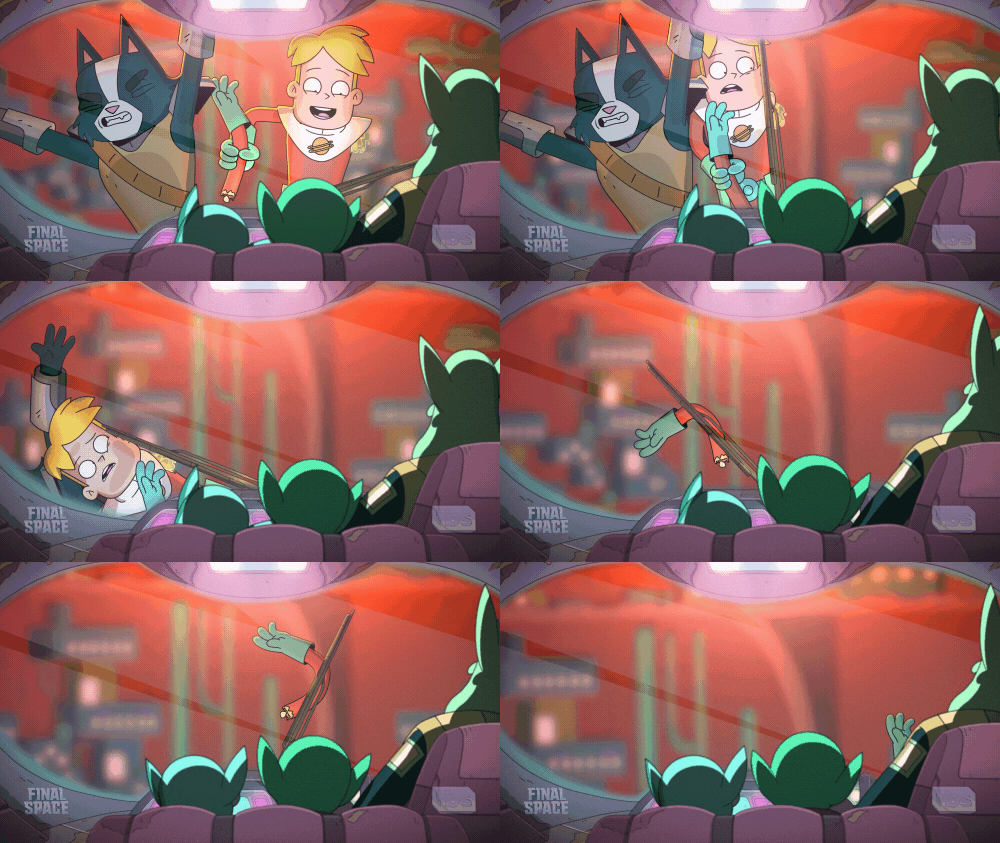
Enter Final Space, a Netflix animated series that my tired mind hoped might just be in a similar vein.  There’d be laughs, clever humour, but also philosophical provocation and richly imagined worlds.  I really do love a richly imagined world.  But let me get this out of the way upfront: the world in Final Space is so richly imagined that I couldn’t keep up and, before long, I had no idea what was going on.


This is totally my fault.  And, in my defence, it only happened in the second series.  Season one of Final Space introduces us to our hero, Gary Goodspeed.  An astronomical everyman, Gary is nearing the end of a space prison sentence, living in isolation in a 2001: A Space Odyssey-inspired ship with an Alexa-esque companion called HUE.  His concerns are obtaining cookies and staving off boredom.  Enter Mooncake, a squishy green floating being who makes Pokรฉmon sounds and turns out to be a hugely significant, er, thing.  This is where my understanding runs out.  He’s a creature, but also, I think, an energy source, or a key, or you know, whatever you like really.  Either way, I was pretty gripped by the first series, slowly realising that each episode, rather than being a self-contained animated sitcom, is a sequential instalment in a hugely ambitious story about the very nature of space and time.  Throughout, irreverent humour is peppered.  We come across a lot of silly characters and ludicrous situations proliferate.


It’s well-crafted storytelling, but somehow, something didn’t connect with me.  That is my loss.  By the second series, as the universe, literally, of characters and backstories and mysteries expanded, my tiny mind lost its footing and Final Space, in all of its potential to entertain, ended up being a background show I had on while inexplicably baking gluten-free sponge cakes simply because it’s something to do in lockdown.  Ultimately, the show’s humour seems to detract from its serious storylines, while its serious storylines undo its humour.  Maybe it’s basic of me not to care about the end of the world when someone is whingeing about a cookie.


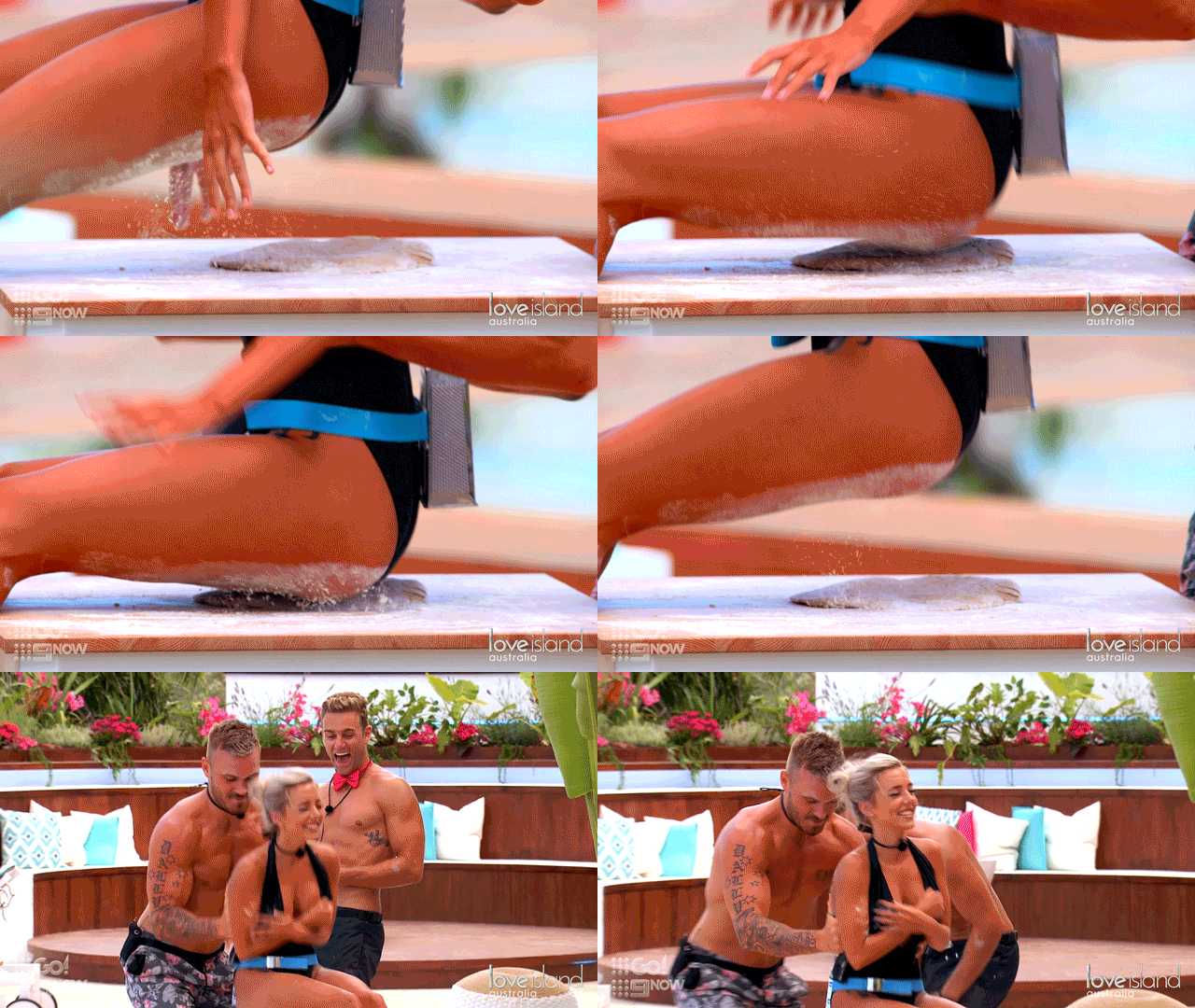
But there is a lot to love, and the animation is breath-taking.  If you like action happening in space, then feast your eyes on these cosmic bodies.  Futuristic vessels slip past, all slinky, while battles and asteroid clusters come to life in three dimensions.  It reminds me of a book I had as a child: some sort of graphic novel from the Ulysses 31 series.  I don’t know where it came from and I never actually read the words, just looking at the pictures in the early nineties and thinking: yeah, this is space and that.  If that specific reference doesn’t work for you, and why would it, then think anime.  And if you don’t know what that is, you’re probably better off watching Love Island Australia.


While I typically advocate for almost all Netflix animations (Bojack Horseman, F Is For Family, Big Mouth, Disenchantment) I will swerve any subsequent series of this.  If I have failed to do it justice, then so be it.  Let the talented voice cast, the incredible animators and imaginative writers all come after me.  Justice is already served in that I am persisting with a poorly read blog while their creative output is getting greenlit by the planet’s biggest streaming giant.  At least there can be no spoilers in this post, as I couldn’t even tell you what Final Space really is.  But yes, give it a go if your sci fi skills are better than mine, but otherwise there’s a host of animation out there that’s easier to connect with.

Tuesday, 21 July 2020

Normal People


It’s alright guys; I’ve read the book.  Now we can talk about Normal People.  Fair enough, most normal people finished talking about Normal People a few weeks ago.  At one point, a greeting as common as “Hello” or “I think your mute button is on” became “Have you seen Normal People?”  It was, if anything, completely normal to discuss your response to this show and, in particular, its gratuitous sexual content, before proceeding with whichever Zoom call you had dialled into that day.  But no, I seemed to have been taken by the notion that, while my curiosity was of course triggered by all and sundry’s compulsion to signal that they had been watching along, I would rise above all this popularity and universal experience by pulling my smuggest face, adjusting my voice to be more patronising than normal, and declaring: “No I’ve not been watching Normal People.  I’m going to read the book first.”  I’m all for gratuity.  I only got into Big Brother twenty years ago as my teenage self read an outraged newspaper article about nudity on the television.  The constant threat of an unneeded shag helped to suspend disbelief each time a dragon is mentioned in Game Of Thrones.  I came to Elite for some foreign language swearing and high school high jinks, and stayed for the constant erotica.  But the sensible me felt a need to impose a literary barrier before joining in with everyone else in gawping at the body parts onscreen.


Once I finally got hold of the book, though, it was a great read.  A dear friend promised to lend me the book, but subsequently either forgot to bring the book to our lockdown park walks, or I would forget to take the book with me on leaving, or we wouldn’t think about the book for a few weeks while I was lost in reading something else (such as the book Unorthodox is based on), or we’d just lose all hope that I would ever get my hands on the book in order to read the book.  But then I got the book and I went ahead and read it (the book).  That task out the way, I was able to catch up and dive into iPlayer to see how everything came to life televisually.


On reflection, consuming a drama straight after devouring the book from which it sources its material probably isn’t a flawless approach.  There isn’t sufficient distance to be surprised and delighted by elements of the novel you had forgotten.  You’re only really checking off the adaptation against the pages you’ve just torn through.  If this were A-Level English, we’d have just finished taking it turns to read the book out loud in the classroom together (worryingly highlighting that a significant number of 18-year olds are not fluent readers) before the teacher gave up hope and wheeled in the big VCR so we could sit through the BBC production over and over until the end of term.


My own stupidity aside, Normal People is a beautiful series of filmmaking.  Every shot is a luxury.  Set in and around Sligo and Dublin in Ireland (plus some Italy and Sweden, reminding me constantly that Ireland gets to stay in Europe), the mundane looks cinematic.  Even drizzle takes on a sexiness.  But part of the reason our settings all crackle before our very eyes is the truly gripping tension of our central story.  Normal People is the tale of a relationship between Marianne and Connell.  Almost banal in its secondary school origins, we follow our protagonists as they navigate university and beyond, at once incredibly compatible and somehow prone to the no banana part of an idiom that starts with the words close and but.  As I read the book, I hadn’t seen any stills from the show, so Marianne and Connell remained faceless to me.  But, on starting episode one, I was able to conclude immediately that this was perfect casting.  As Marianne, Daisy Edgar-Jones perfectly captures what it feels like not to fit in at school but to find your niche at college.  Walking round Trinity in her velvet jackets, she is almost everyone I went to university with.  She’s utterly believable when navigating banal and awkward social moments, particularly when coming across Connell’s friends one New Year’s Eve in a pub in their hometown.  I felt I was literally in that moment.  As a character, Marianne is damaged by her family.  I obsessed over the exact situation here.  Her mother’s coldness, her brother’s fixations – where do these come from?  The fact we never seem to get the full picture (unless I was looking at my phone when this got explained) makes the circumstances all the less generic and all the more credible.


Meanwhile, Paul Mescal must wrestle (and win) with Connell’s complexity, ensuring we buy him not just as the sporty lads’ lad at school, but the keen reader, the keen writer and the struggling student.  Some of their dialogue is drawn out to the point of snapping, but you don’t wish for them to hurry up (unlike the constant pausing for effect in Skins) because every swallow, hesitation, eyeball swivel, neck tendon tightening, hair adjustment, all of this washes over you in a way that brings you into the heart and the heat of the emotion.  And yes sure, just as the book is frank about their sexual interaction simply because it forms a significant part of any relationship of this kind, we have a lot of opportunities to see their whole bodies emote and perform with a full-on and unblinking focus.  It’s not all vanilla, so this is certainly the element that got tongues wagging, but given how certain I am that my neighbours’ children can see my TV screen through the window, I could probably have sacrificed about 50% of the slapping and tickling and lost nothing of the sentiment.
I’ll spoil none of the plot beyond its premise, but I will comment on my inability to understand the motives of either lead at various points in their relationship’s journey.  They do things that will make your soul wail in frustration.  You yearn for a glimpse of resolution, which means that even a slither of potential happiness for them brings on floods of tears (if you’re the kind of person who only experiences emotion in relation to TV shows).


I’m off to find the soundtrack on Spotify, looking forward to the next time I can drop into conversation that I’ve read the book and watched the TV programme when it comes to Normal People.  Basically, I’ll win.  I’ll leave you with some quick mentions of the supporting cast, simply because they’ve left a similarly deep impression on me.  Sally Rooney’s book enhances its own reality with such believable friends for Connell and Marianne.  Joanna (Eliot Salt) charms with every line and doesn’t seem to be acting at all (a similar comment was made about I May Destroy You), whereas lovely Karen from the school days deserves far more backstory.  I’m still creeped out by Fionn O’Shea’s horribly recognisable turn as the terrible boyfriend, even though his behaviour is sadly commonplace in some of the dreadful people I have come across in my life.  And that’s the strength in this drama – it’s at once normal yet abnormal in its familiarity.  The everyday elements set up a level of recognition, but the specific and unusual details enhance that reality.  This isn’t the movies, where films end with co-stars kissing, leaving us to envision them not parting till death.  This is much realer life.

Thursday, 16 July 2020

I May Destroy You


I wasn’t sure if I was going to write about this show.  In fact, I had already decided that I wouldn’t.  It was never up for debate whether I would watch it.  I was committed to viewing the whole thing the minute its PR machine swung into action and my daily trawling of the Guardian app for things to read that are relevant without being depressing (favouring articles about slavers’ statues being thrown into rivers at the expense of content relating to Tory gammonflakes personifying genuine incompetence and alarming inhumanity) saw me clicking on anything and everything to do with Michaela Coel.  Regular readers will have noted in my post on Chewing Gum that I have strong feelings about Michaela.  I’m not being funny (and, indeed, those same regular readers (both of them) will know I rarely am) but I am committed to her being recognised with national treasure status.  Friends are still only just uncovering Chewing Gum in lockdown, but if you’re expecting the same laughs generated by our Tracey, you’re in the wrong boxset.


I wasn’t going to write about it because I wasn’t sure I would have anything of value to say.  But now I am definitely writing about it.  I should have expected this, but I May Destroy You is a deeply affecting piece of television.  I have no choice but to throw my unwanted voice into the mix of unpopular online commentators looking to influence others’ behaviour.  As such, I urge everyone to watch this.  I’m not sure if the BBC felt the same, scheduling broadcasts of the twelve half-hour episodes in late-peak Monday-and-Tuesday pairs over the last few weeks, though the whole thing was available on iPlayer throughout.  We’ll get into why it’s a necessary watch, but I’ll first take it upon myself to tell you how to watch it as well.  Put your phone in a different room, settle down somewhere comfortable, give the screen your full attention and, most importantly of all, make sure nobody else is in the room who might make you feel awkward about some of the scenes that will ensue.


Like her previous hit, I May Destroy You has roots in Coel’s own real-life experiences.  However, if I were to say what it’s about, I would need to cop out with a list of things.  First and foremost, it deals with consent, particularly in the sexual sphere, and more specifically, the lack of it.  Whether this absence relates to hard-and-fast undeniable crimes, or shifts into a spectrum of permissibility that examines the interplay between deception and reticence, it’s a journey that is gruesomely fascinating.  The hooks that this series gets into you latch in deeply and quickly, and soon the onscreen action captures your attention to such an extent that you won’t even have twitching thumbs for your phone in the next room.  It’s a challenge on all levels.  Yet, it’s also entertaining, rewarding each provoked thought with a gem of universality, a raised eyebrow of humour or an eyeful of delicious delicious cinematography.


I promised myself I wouldn’t gush till the fourth paragraph, but it’s too late now.  You’ll get the point though: I rate this show.  Coel, whom I’d watch do anything, plays the central role of Arabella, a new writer approaching the twilight of her young adulthood.  She can follow her impulses to make bad choices, both enabled and thwarted by her two best friends: wannabe actress Terry (Weruche Opia) and Grindr addict Kwame (Paapa Essiedu).  These three things are brighter and younger than I’ll ever be, forming a sparkling trilogy of city-dwelling points of intrigue.  Through their lenses, we examine the discourses on consent that form our various plots.  But we look at so much more: race, gender, relationships, ambition, creativity, youth, family, heritage.


As if these three didn’t have mileage enough, they are surrounded by a seemingly endless swirl of supporting cast.  Coel creates the unique situation where you want to find out more about every incidental character and supporting role.  They are not just there as a foil or device to contrive along our next plot beat.  Why is Susy Henny so manipulative?  What has become of Theo (credit to Harriet Webb for genuinely making me forget I was watching acting)?  Why can’t I work Simon out at all?  In an honest reflection of London’s diversity, the glorious casting of such talent really lands the point that we’re all sick of seeing so many white people on TV.  In the neat packaging of the twelve episodes, you’ll find yourself wondering what happened to so and so from an earlier instalment, proving that Coel has created a universe of such credibility that it presents as truly real.  But, in throwing out the generic rulebook about how a drama should be constructed, that universe is also as enhanced as the colours of Arabella’s various wigs.  Suddenly we’re in Italy, then we’re back in the noughties, then we’ve moved on from those people to these people – keep up.  Coel doesn’t need your rules.


I only hope we continue to give Michaela Coel carte blanche to tell her stories.  The burden on one person to produce and replicate such quality TV must be enormous.  Even the soundtrack feels laced with sly nods to a greater understanding of her own message (great to hear Babycakes again).  She’s taken on sexual assault and revenge, creating in the process something that demands everyone’s attention, dancing between gravity and levity, but ultimately making you hold your breath through each episode.  This is intense viewing and I would like part two straightaway please.  And this is why I wasn’t going to write about it, because my only response would be to ask for more.


Wednesday, 8 July 2020

Love Island Australia


To what extent is showing a 2018 season of Love Island Australia an adequate replacement for a new series of summer Love Island in the UK?


While this is a question I could ask ITV, it’s actually the essay question I have set myself for this week’s blog entry.  No, sadly I’ve not completed an impressive foreign boxset that I’m going to tell you all about this week (though a third and final series of Dark has dropped).  So we’re turning to what is fast becoming my favourite lockdown viewing.  Let’s be honest, this pandemic has a lot to answer for.  We’re not allowed to have strangers invade our personal space on public transport.  We can’t spend all day in an office wondering what the dog is doing while we’re not home.  We can no longer speculate whether our elected (no, really) government could cope with a national crisis (they can’t).  These are all things we can live with (or without).  But when ITV pointed out that a socially-distanced version of our favourite reality dating show might not fulfil our expectations (you can’t watch a couple under a twitching duvet via night vision if they have to be two metres apart), all while having no clue whether foreign travel would be in any way possible, it felt like the final straw.  This pandemic might just be a bad thing.


However, in a stroke of genius, they decided to whack on another nation’s first series, probably reasoning it was close enough.  The good news about Australia is that we’re super familiar with it.  It doesn’t suffer from the gloss of the US’s TV output (the scripted dramas, I mean, not the dross of their political news).  Generations of Brits grew up on Ozzie soaps – every weekday dinner of mine after primary school in the early 90s was accompanied by Home & Away and Neighbours.  We swap our populations back and forth, nowhere more so than in the media industry (where I work (from home)).  Australiana is pretty easy to get used to.  In addition, the Australian version has all the familiarity of also being filmed in Majorca.  Not in the same villa, mind, but near enough.  I’m struck by the imagined statistic that 80% of this Balearic island’s GDP comes from various nations filming their versions of Love Island on it.  These two points made Love Island Australia a much more obvious choice than the US version, whose departures from key format points and inclusion of actual Americans means it loses all the charm of the original.


Alongside the classic setting, we also have the characteristically irreverent voiceover, though the Celt of choice here is an Irishman instead of a Scot.  The stray cats that visit the villa provide most of the ammo for his humour but I think we can all agree there is nothing funnier than a cat.  Just look at the reason for the internet’s invention: cat videos.  We also have a glamorous hostess entering the villa with bad news for the couples at random junctures.  Sadly, we lost the UK’s OG presenter earlier this year after our vile tabloids hounded Caroline Flack to her death yet faced no consequences, with Laura Whitmore taking over from her dear friend.  In the Australian version, former popstar Sophie Monk proves a feisty equivalent, and her antipodean vowels are so wonderful that I can’t help but suspect she may be a new character from Kath & Kim.  There are still texts with hashtags in them.  In summary, it’s similar enough then…


So, in order to answer the question (and if I learnt anything from GCSE it’s that’s you must make sure you answer the question) we need to look at the contestants.  This was perhaps my greatest stumbling block when it came to convincing myself that I had been provided with a worthy replacement.  They didn’t do much to grab me in the first episode, though the girls’ reluctance to step forth for anyone at all was amusing.  There was a major lack of diversity.  But then, with any season, it takes a few days to marinade and, before long, I began to look forward to catching up on the previous night’s shenanigans with all my new pals after a videocall-heavy day at the laptop.


Somehow, then, this can become an adequate replacement.  But there are certain rules that I must impart when it comes to being able to enjoy it as much as a brand new series of our own.  The first is that you mustn’t look ahead online to find out what the future held in store for these young Australians who are so full of hope in 2018.  To do so would deflate any of the tension that makes the show so compelling.  The second is that you need to attune to a different vibe on the behaviour.  So far, the Australian girls have proven much quicker to attack one another, never hiding their mutual dislike (split along hair colour lines) which, while a contrast to the British besties that emerge, is actually palatable as a more honest approach to the villa’s interpersonal relationships.  The boys seem to be predominantly from the socio-economic group that Australians describe as bogan, but on the whole are a slightly gruffer and less flamboyant equivalent of our own tattooed chaps.


I’ll conclude my essay with the answer to my own question.  Love Island Australia is quite an adequate replacement, offering charm and entertainment in its own way.  To illustrate, we’ll touch on my favourites of each gender.  From the boys, it’s Josh who, while one of the slenderer and under-tattoeed specimens, wins out consistently on personality simply because he speaks with the authority of someone who knows that confidence is the same as, if not better than, intelligence.  When the boys ask him for wisdom, he’s happy to fabricate his responses with the hilarious consequence that they almost always believe him.  From the girls, it’s Millie.  Shrugging off any nonsense from those of her own gender when it comes to disagreements, she’s practical and resilient, and would much rather be writhing around in the pool on an inflated flamingo than getting into arguments.  Wouldn’t we all.


Wednesday, 1 July 2020

Flight Of The Conchords


If you’re anything like me, you might have asked yourself on multiple occasions why can’t all TV be musical.  Following on from last week’s post on Netflix’s Soundtrack (still a masterpiece) and a previous unpopular rant from me about what Glee did wrong (it’s here and needs more reads), we’re going back in time to look at one of the few boxsets that managed to be musical and cool at the same time.  I had nearly forgotten all about Flight Of The Conchords.  But, back in January, I was lucky enough to fill a spot with friends in a French ski chalet and found myself bombing around Tignes with some very advanced practitioners of winter sports.  So adept were they at swooshing down black runs, treating their inordinate speed with nothing but nonchalance, they had earned the right to annoy less stable alpinists by carrying speakers in their rucksacks and playing music out loud.  Older gentlemen do this a lot in lockdown London, cycling through crowded parks with loud beats emanating from their bicycles.  I’m not proud to say that we were equally anti-social, especially when it came to forcing others to endure prolonged exposure to us on various ski lifts and in their various queues.  As six adults in their thirties (four doctors, one commercial airline pilot, and me, someone who tits about in media partnerships) you may find our music choices challenging.  After exhausting the soundtracks of various Disney films, from Moana to Frozen, and reliving our youths with Tenacious D, our next source of musical accompaniment was Flight Of The Conchords.


I defy anyone not to appreciate the wanky Brit-abroadness of zipping down a sheer ice face in a busy French ski resort while singing along to Foux Du Fafa.

So let’s unpack the enduring appeal of these minstrels.  Firstly, Flight Of The Conchords, as themselves, are a New Zealand comedy music duo who’ve been active since 1998.  This blogpost is about the two series of their HBO New York-based sitcom that ran from 2007 to 2009.  I’m not sure if it was ever broadcast properly in the UK and, like my friends when it comes to sorting out our first meal in a restaurant since the start of lockdown, I’m not prepared to log onto the internet to do the appropriate research that would benefit everyone.  It was one of my many Belsize Park flatmates who must have brought home the DVDs probably around 2008, drunk on the swagger of unearthing early-adopted content to show to his co-renters.  Let’s not take this accolade away from him, as he remains a dear friend, going on to have two daughters with the wife he met in that very apartment, giving my life some value by virtue of me being the one who chose his future spouse off Gumtree.  It turns out, we only had the first season, but we would watch it over and over, and then listen to the CD soundtrack, also over and over.  The second series was something I only came across in 2020 on my Sky Q box, as it seems Sky Comedy have the rights.  I therefore peppered this into my regular viewing: new Rick & Morty, a fourth season of F Is For Family, lockdown-induced reruns of old Big Brothers and, er, Cruising With Jane McDonald.


Everybody, there is so much to love about Flight Of The Conchords.  Let’s start with our heroes, Jemaine Clement and Bret McKenzie.  Unlucky in love, they’re a kind of kiwi Peep Show pair, their strong accents only adding to the silliness as almost all of their vowel sounds get swapped around for the wrong ones.  The cheap appearance of the first season brings to life perfectly the absolute shitness of the Chinatown neighbourhood they inhabit on their shoestring budget.  Gainful employment comes in the form of a posting as the in-house band of New Zealand’s consulate, an organisation occupying the most depressing-looking office block in all of the five boroughs.  This premise sets up the perfect contrivance: as a band, they of course burst into song.


Only, they don’t really burst.  They slip.  They shimmy.  They irreverently and knowingly look down the camera lens, in on the joke that codifies their song: we’ve met a woman of average attractiveness (The Most Beautiful Girl (In The Room)), we’re laughing about the banality of long-term relationship sex (Business Time), we think we’re better than we are in reality at social gatherings (Prince Of Parties).  Their lyrics are often juxtaposed with reality, the whole thing packaged up with a heavily themed video, whether taking inspiration from Bowie or 90s rap.  In short, nothing takes itself seriously.  Why then, indeed, wouldn’t you have a Gallic number composed entirely of stock GCSE French expressions?  Cue titters as we all laugh about asking “Oรน est la piscine?” or saying “splish splosh” in a Parisian accent.  These silly songs are silliest when it comes to their catchiness.  Forgive me for only focusing on our first series here – it’s a familiar place for me, whereas the cameo-heavy second season, which seems on first watch to match its predecessor on song quality, has yet to get its claws into my short-term earworm faculties.


Alongside their failures with the ladies, Bret and Jemaine also fail to get anywhere with their music career.  This is often down to their manager, Murray (Rhys Darby), whose focus is the attendance register and agenda of band meetings at the expense of having a clue about anything else.  Nevertheless, their one and only (super) fan is on hand throughout: we have wide-eyed Mel played by Bob’s Burgers’ wonderful Kristen Schaal sporting an anorak and being, frankly, a pervert.  Fans of the anglophone world will also enjoy the long-running rivalry with their counterparts from the Australian Embassy, made all the more insulting by most Americans assuming our lads in the band are actual Australians.


For me, the only thing that has aged is the portrayal of New Zealand.  The country and its consulate are positioned as a running joke, with the Prime Minster himself acting the fool throughout his official visit and the ill-fated establishment of Newzealandtown (squashed between Chinatown and Little Italy).  In reality, New Zealand is fast earning international respect as one of the best countries.  Instead of being run by round blonde racist toddlers like the US and the UK, NZ has gone for a goddess who pursues welfare over growth, all while keeping a pandemic at bay.  Please may Jacinda Ardern take over Britain?  You may ask where I got that preposterous hypothesis.  Did Steve tell me that, perchance?  Mmmph, Steve.

Seriously, though.