Showing posts with label science fiction. Show all posts

Wednesday, 29 July 2020

Final Space


While nobody will really recall 2020 as being a golden age for anything (unless this really does turn out to be the year everyone stops being racist), I would like to suggest that TV is, overall, doing a very good job at the minute.  We are spoiled for choice.  Luckily, this big old pandemic has come along and given us more time at home to keep up with boxsets.  If anything, let’s spread the rumour that telly started the corona-thon.  Thanks to my evenings in, I’ve torn through (and loved) Normal People and I May Destroy You from the BBC (great to see the institution taking time out from delivering news coverage biased to chinless Tories), I’ve been making the most of my Sky subscription for once (look out for upcoming posts), but I seem to have totally bricked it with my Netflix decisions.  There’s a third series of Dark and a fifth of Last Chance U, both absolute gems, that I am yet to start.  Instead, I’ve been trying to follow up on my impressive achievement of devouring the fourth series of Rick & Morty.  Suddenly, I’ve craved cartoons about space.


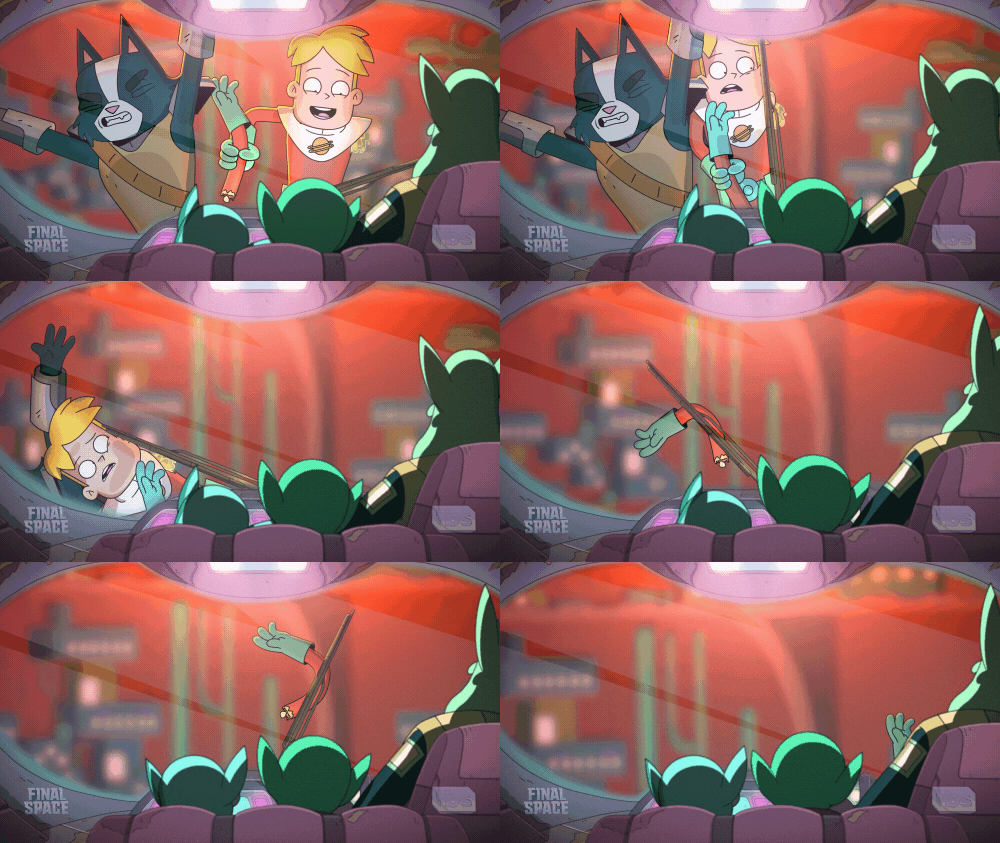
Enter Final Space, a Netflix animated series that my tired mind hoped might just be in a similar vein.  There’d be laughs, clever humour, but also philosophical provocation and richly imagined worlds.  I really do love a richly imagined world.  But let me get this out of the way upfront: the world in Final Space is so richly imagined that I couldn’t keep up and, before long, I had no idea what was going on.


This is totally my fault.  And, in my defence, it only happened in the second series.  Season one of Final Space introduces us to our hero, Gary Goodspeed.  An astronomical everyman, Gary is nearing the end of a space prison sentence, living in isolation in a 2001: A Space Odyssey-inspired ship with an Alexa-esque companion called HUE.  His concerns are obtaining cookies and staving off boredom.  Enter Mooncake, a squishy green floating being who makes Pokémon sounds and turns out to be a hugely significant, er, thing.  This is where my understanding runs out.  He’s a creature, but also, I think, an energy source, or a key, or you know, whatever you like really.  Either way, I was pretty gripped by the first series, slowly realising that each episode, rather than being a self-contained animated sitcom, is a sequential instalment in a hugely ambitious story about the very nature of space and time.  Throughout, irreverent humour is peppered.  We come across a lot of silly characters and ludicrous situations proliferate.


It’s well-crafted storytelling, but somehow, something didn’t connect with me.  That is my loss.  By the second series, as the universe, literally, of characters and backstories and mysteries expanded, my tiny mind lost its footing and Final Space, in all of its potential to entertain, ended up being a background show I had on while inexplicably baking gluten-free sponge cakes simply because it’s something to do in lockdown.  Ultimately, the show’s humour seems to detract from its serious storylines, while its serious storylines undo its humour.  Maybe it’s basic of me not to care about the end of the world when someone is whingeing about a cookie.


But there is a lot to love, and the animation is breath-taking.  If you like action happening in space, then feast your eyes on these cosmic bodies.  Futuristic vessels slip past, all slinky, while battles and asteroid clusters come to life in three dimensions.  It reminds me of a book I had as a child: some sort of graphic novel from the Ulysses 31 series.  I don’t know where it came from and I never actually read the words, just looking at the pictures in the early nineties and thinking: yeah, this is space and that.  If that specific reference doesn’t work for you, and why would it, then think anime.  And if you don’t know what that is, you’re probably better off watching Love Island Australia.


While I typically advocate for almost all Netflix animations (Bojack Horseman, F Is For Family, Big Mouth, Disenchantment) I will swerve any subsequent series of this.  If I have failed to do it justice, then so be it.  Let the talented voice cast, the incredible animators and imaginative writers all come after me.  Justice is already served in that I am persisting with a poorly read blog while their creative output is getting greenlit by the planet’s biggest streaming giant.  At least there can be no spoilers in this post, as I couldn’t even tell you what Final Space really is.  But yes, give it a go if your sci fi skills are better than mine, but otherwise there’s a host of animation out there that’s easier to connect with.
Sunday, 9 June 2019

Years And Years


Sometimes watching TV can be torture.  Granted, it often comes with the accompanying sentiment that you could be doing something better with your time: connecting with family members, perhaps, or making a difference in your community by volunteering to help those in need.  Once you’ve quashed those feelings by persuading yourself that you’ve worked hard enough all week and you’re perfectly entitled to exist inertly on the sofa while images are beamed into your head for the purpose of entertainment though, it’s the content on that hypnotising and paralysing screen that can cause untold pain.  Whether it’s the bodies on Love Island that you will never have, or the bright young things who are already better than you on University Challenge, the sought-after escapism can sometimes give way to unavoidable introspection, leading to an analysis of your reality that makes you feel worse than you did when you popped the telly on.  Enter, then, Years And Years.


An evening peak drama of course has the artistic license to fabricate a world where things happen that are more interesting than daily life.  Downton Abbey mixed ye olde moral compass with the foibles of servant management.  Line Of Duty poses the question: what if all those coppers are bent?  Either way, they offer distance from our humdrum existences, making the characters’ often terrible experience seem exciting and diverting.  Conversely, Years And Years can only fill its audience with dread.  Its narrative device?  It’s set a little bit in the future.  Not quite the virtual reality-dominated future of Black Mirror where attaching little metallic discs to your temple is all you need to enter wholly into an alternative reality.  No, we’re talking a few months’ away.  Things that might happen next year, and the year after, and then, as a result, a few years after that as well.


Why would this be so terrifying?  Two things: not actually knowing what will happen and fearing that the worst-case scenario will win out over the best.  And it’s so near that it’s not a single future that’s been imagined and will affect subsequent generations.  It’s what we ourselves might have to go through as our lives progress.  2019 headlines veer from climate crisis to Brexit farce via alt-right resurgence, neoliberal inequality and the rejection of truth in favour of malleable feeling.  Our future is not looking bright, it’s looking orange (if there’s more Trump and that).  Weathering this onslaught of one thing after the other, our everyman Lyons family boldly goes where a pessimistic media has long predicted we will all end up.


But the Lyons aren’t like most families.  This is because they talk on the phone in group chats all the time.  My own family mostly communicates by a Whatsapp group I set up a few years back.  In it, my sister and parents coordinate my niece’s schedule of educational and extra-curricular activities, my niece herself hijacks the group to use all the emojis at once or to leave voicenotes of her wailing comically, and my mum plumbs new depths of autocorrect mayhem that I am now expert at deciphering.  Conversely, the Lyons, who are split into the five constituent units of four adult siblings and their grandmother, chat through their latest news, pass comment on the world around them and pursue passive-aggressive banter.  In the first example of future technological advancement, they do all this through the voice-activated Signor service, a kind of Alexa-type gadget that actually seems to serve a purpose.

Now, if you thought I was going to make a comment on the family’s diversity, you can get off now.  The Lyons’ ticking of every box in this area might be a socially conscious casting director’s wet dream, but each Lyon is so much more than an exercise in representation, even though their very visibility on screen is significant to communities that don’t always see themselves reflected in their own entertainment.  If, along the way, even some viewers move beyond seeing people as categories and instead view them as individuals, then it can’t hurt for Years And Years to avail itself of the full spectrum of human potential.  So, who are these Lyons onto whom the near future is projected?

Our grand-matriarch comes in the form of Anne Reid (a favourite from dinnerladies), providing a lens on the encroaching of the future into family life that has both the confusion and the liberal attitude of old age.  Rory Kinnear is Stephen Lyons, the settled wealthier son, husband and dad of two, contrasting with his sister, Edith, who has been off around the world on moral missions (played by Jessica Hynes, whose amazing performance as Cheryl in The Royle Family I am currently reliving to great joy).  Feisty younger sister Rosie, meanwhile, succumbs to a more reflexive response to the events that engulf the family, while Danny Lyons, played by Russell Tovey (who should be in more, if not all, things) has a more idealistic approach to the ensuing calamity.


And calamity is what does ensue.  Each episode is interspersed with a number of montages that take us through the course of time, showcasing the family birthdays that mark each passing year as we journey into 2020 and the decade beyond.  Sound-tracked by a choir singing, this change of pace propels us into disaster each time – so much so, in fact, that you begin to dread its every appearance.  I now have a phobia of choirs singing, as they herald bad things.  Inhumane legislation creeps in, international tensions escalate, environments are plundered and, throughout, the British media and public make multiple catastrophic decisions.  Punctuating each of these current affairs round-ups is Emma Thompson (as if the cast weren’t already strong enough), having the time of her life as Vivienne Rook, some sort of Lady Farage (yet, here’s a lie) whose emergent and morally ambiguous political party gradually grows from a fringe movement to a mainstream force for wrong (ring any bells?).


Not only is there the human drama of the Lyons, then, with arguments, infidelity and deep-rooted resentment, but this is compounded by the consequences of the future’s news.  And the nature of compounding, is that it happens over and over (like in The Mandibles by Lionel Shriver).  Each montage screws them more than the one before, and in every area of their lives: employment, freedom, healthcare, housing, human rights etc.  Very occasionally, the relation of this back to the storyline is a touch wedged: some clunking lines swing in overhead to set out the wider political context.  Parts of the technological advancement also tip things unnecessarily from thought-provoking drama to science fiction fantasy, but there’s no reason a TV show can’t be both.  Whatever this is, it’s wildly entertaining, if you can stand the torture.  We’re not yet through all six episodes, but you always know something bad is going to happen, just like with the future in real life.  I’m pinned into my sofa at each viewing on BBC iPlayer and almost crumble under the tension of every time-accelerating montage – here we go again… to oblivion.  It really is potluck who will make it through each episode.  Just like it’s potluck who’ll make it through our real future.

Thursday, 12 July 2018

Rick & Morty


If you ever start watching this adult animation (and I’ll tell you why you should in a minute), you’ll instantly be struck by three very irritating things about it:

1.      The animation is so crude you’ll be forgiven for thinking the show’s creators couldn’t be bothered to spend any time on it
2.      Rick and Morty, despite being grandfather and grandson, refer to each other by their first names.  Not just on the odd occasion either, but constantly, till almost every sentence is punctuated with unending reciprocal name-dropping
3.      Rick, the grandfather, is a cranky old bastard, and while this is hard to adapt to at first, it’s the fact that he burps while he speaks that will have you reaching for the remote to try watching something else due to sheer disgust.  He doesn’t pause in a sentence to belch and then carry on.  His throat reverberates while it emits digestive gasses in the middle of words, so that he uses this emission to power his speech, rather than air from his lungs like the rest of us.  Let’s not generalise, but old men are mostly kind of gross.  Rick out-grosses them all.  In addition, when he’s a bit sloshed, he has this patch of drool on his chin that just makes you want to get out a hanky and start wiping your TV screen, even though he’s an animated character

Acknowledge these things.  Take a note of how they make you feel.  But believe me that they soon go away for the following reasons:

1.      As you work your way deeper into each of the three series, you’ll realise that the animation is actually breath-taking.  Sure, Morty still looks like a kid scribbled him into life, but as he and his grandfather travel to more and more planets and alternate realities, this whole universe of rich imagination comes to life before your very eyes.  There are aliens from the depths of the darkest trenches of human minds (sci-fi orientated, geeky writer minds), with limbs on limbs on sex organs.  There are landscapes that no live action or CGI could realise.  The brutal action demands total attention.  You’ll want to rewind and watch bits again just to bask in the spectacle
2.      The excessive name-using never really relents, but you simply stop noticing it, so don’t worry about that
3.      And, as for the burp-speaking, you will come to terms with it.  In fact, you might even go as far as starting to feel affectionate about it.  Don’t tell me you’ve never been surprised by a digestive interruption in the middle of a conversation and simply tried to pass it off as a change of tone, or blurted out “Oh, excuse me” while clasping a hand over your mouth and its offence.  The fact is, Rick doesn’t have time for this.  So let’s look at why

The basic premise of this programme is fairly generic.  American family in the suburbs.  Farcical things happen in a way that they only can in a cartoon.  The twist is that live-in grandpa, Rick, is a supremely intelligent scientist with his own portal gun and extensive experience in travelling between universes and dimensions.  Rather than bonding with his grandson by pretending to find football interesting, he drags him on adventures across the full spectrum of space, time and reality.  It’s pretty high-concept stuff, but it’s all brought down to earth (literally – lol) by the fact the family members just see these trips as adventures.


And what a great word.  Adventure.  Adult life simply does not contain enough adventures.  Though, as a child, an adventure meant going to the park when it was raining and pretending to be in Jurassic Park.  As an adult, it means getting your smartphone out on a busy street and seeing if a moped-mounted thief is going to come and grab it off you.


So, off go Rick and Morty, gallivanting around in their clapped-out spacecraft and leaving a trail of world-altering destruction.  Sometimes, cynical older sister Summer, is allowed to come along, brilliantly juxtaposing the drama of high-school crushes against the demise of a whole alien race.  Further banality comes in the form of Morty’s parents’ relationship, with Jerry and Beth teetering on the edge of divorce while the universe teeters on the edge of catastrophe.


Some episodes do seem to pair up family members into a formulaic plot and subplot structure, but their adventures still strike consistently entertaining chords, with the show’s overall subject matter elevating it above standard crude humour-based animation for adults.  Rick & Morty never shies away from intelligence.  Rick, as the owner of an unmeasurable IQ, must balance out his genius with the view of the world it forces upon him: he recognises the absurd farce that constitutes life.  This makes him seem cold and unhuman, something which the programme embraces in its plots.


In turn, this is why the show is so far up the IMDB list of the top 250 TV shows of all time, based on average ratings, with a score of 9.2 landing it in eighth place.  Not bad for what looks like a puerile cartoon.  A 22-minute of Rick & Morty packs a whole universe of challenging philosophy, eye-popping artistry and laser-sharp social commentary into your brain via your eyeballs and earholes, so jump on this bandwagon and get ready to impress fellow office drones with the news that, yeah, you’ve seen all of the eighth best TV show of all time.

Monday, 7 May 2018

Westworld

Sometimes you want a TV show to make you ponder the very essence of what it means to be a human.  And sometimes you just want something with plenty of sex and violence.  Maybe these two things aren’t that separate after all, as Westworld manages to deliver both, and all in a cheeky cowboy hat.  Let’s be honest, sex and violence are, after all, key parts of the human experience.  According to Westworld, they are definitely key parts of the cowboy experience too.


Billed, as with all big new shows, as something that would fill the Game Of Thrones hole in our lives, I let the first series of Westworld pass me by.  It was everywhere on my Sky EPG, posters followed me on my commute and trailers constantly rolled on every screen I went near.  It all made me lose interest, especially as nobody in the office seemed to be talking about it.  Could this big-budget western be a major dud?  But then, looking for a new show to start, and giving careful consideration to what should be covered on Just One More Episode, I consulted IMDB’s top rated TV shows: a list of 250 programmes that viewers have rewarded with up to ten stars.  Once I filtered out all the really old stuff and nature documentaries, Westworld (currently at #36) was the highest ranked entity I thought I could bear to watch.


My final barrier to overcome was that Westworld was also the name of a hip hop clothing shop at university and one particular friend used to dress in their attire from head to toe after watching You Got Served.  We all experiment with style when we’re young, but I should emphasise there is no age limit to enjoying a film produced as a streetdance vehicle for B2K.

From the cowboy chat so far, it should be clear that Westworld is a western, of sorts.  Not the kind of western made in the fifties that they repeat on TCM and your dad still watches during the daytime even though it’s sunny outside.  The western world of Westworld is actually a theme park.  Rather than queuing up at Thorpe Park to lose your lunch on a roller coaster though, the visitors to Westworld inhabit a near-future USA where technology has advanced enough to create artificial beings tasked with bringing history to life.  The wealthy book passage to this resurrected era, dressed for the period (a bit like those weird photo booths that actually are a part of normal theme parks), arriving by steam train at a frontier town.  Have they hired impoverished actors to flesh out the illusion?  No; these are, essentially, robots.


Right then, so it’s robots and cowboys – together at last.  Of all the historic periods you could create using animatronics, I’m still not sure I would go for cowboys.  What about all the courtly intrigue of Tudor England, or the licentious lifestyles of the Romans?  That might just be me.  Either way, the cowboy theme allows the paying visitors to shoot guns and whore about (literally) with little concern for the consequences.  Only the hosts can be killed, as they are programmed not to hurt humans.  Their purpose of existence is solely to fulfil their storylines in order to entertain.  But, such is their sophistication as pieces of tech, the ultimate tension comes from the slowly revealed truth that the hardware is starting to get emotional.  Cue a glacially paced and artfully crafted build up through series one to the inevitable pay off of the lunatics taking over the asylum.

With sinister grandpa Anthony Hopkins as the park’s founder and the hosts’ co-inventor, Dr Robert Ford, it’s all a bit Jurassic Park.  But that’s a huge part of the fun.  Let’s just say the future doesn’t look great for theme parks.  However, it does look good for A-list actors, as the cast is a roll call of household names, or at least names where you recognise the faces and can get distracted agonising over trying to remember where you saw them last.  They’re all enjoying themselves immensely, from James Marsden providing the cheekbones and jawline of the handsome cowboy hero, to Thandie Newton having the time of her life running the whorehouse as a tart with not just a heart, but a very complicated backstory.

And that’s the beauty of it.  The hosts play out storylines where they die, but then they are picked up by staff, tidied up, wiped and rebooted and sent out to play again in an endless cycle of suffering.  What if the memories start to come back?  Saying more isn’t possible without reeling off spoilers, so let’s instead focus on some questions that I always ask myself while watching.

Why do they have to be naked when they are getting serviced?

When a host is in for repair, they sit in glass rooms in the nude, while human technicians re-programme them using fancy tablets.  Not only is it unrealistic that the tech hooks up every time (the wifi never disconnects temperamentally) and nobody suggests turning it off and then turning it on again, but you’d think someone could afford the poor hosts something for their modesty.  Instead, their exposure further emphasises their abuse by the humans that run them.  Luckily, Newton’s character Maeve does finally get her own back in the second series, almost recognising the show’s surplus of wrinkly willies with one more wrinkly willy.

What’s up with the way the hosts die?

They’re robots, but they seem to have circulatory systems.  When shot with guns, blood spurts forth.  It’s not enough that they mimic humans in every way, they have this further facet of realism to provide.  Is the hardware designed so that injuries are categorised into fatal and non-fatal so the tech knows exactly when to shut down in order to maintain the storyline?  It’s kind of philosophical really.  Nevertheless, they’re back in the park the next day to do it all again.  They also never run out of battery, whereas my iPhone needs two charges a day just to keep up with Whatsapp.

Where is this place?

For the concept to be believed, we need to accept that somewhere there is a massive expanse of land that can be given over to leisure.  Our view of the outside world is, at first, limited, so we are as blinkered as the hosts to life beyond Westworld.  By the second season, characters suddenly start referring to an island, which curiously has never come up before, so I am wondering if they are now writing themselves out of a hole.


All of these niggles are just part and parcel of creating something so ambitious.  The scope of the show is as enormous as the park needs to be.  The first series takes it time letting you into Westworld and then works through twists that shatter your understanding.  Don’t get impatient, as repetition is used to show the farcical nature of the hosts’ lives.  I do admit that I have fallen asleep in almost every single episode, but don’t let that put you off.  It’s something that I have been watching late at night when I invariably start to reason that I can watch the last part with my eyes closed and then wake up to find it’s all over.  I’ve therefore had to re-watch some sequences a few times.  It’s better when you’re awake, or you won’t understand what’s going on.  The one time I didn’t fall asleep, I was ironing shirts at the same time as watching, so that kept me up luckily.


The complete first series is available on Sky Boxsets, while the second season is in the middle of premiering as I type.  This means I have gone from being able to hit up an episode each evening of series one to having to wait for my weekly instalment like some historical artefact.  Maybe this is how cowboys had to view boxsets before on-demand platforms existed.  I hope I remember what’s going on, but this enforced rationing should ensure more time to contemplate Westworld’s inner philosophical debate.  After all, what does define human consciousness?  I shall give it a good think while my eyes are glued mindlessly to the screen, trying to stay awake, watching naked people shoot each other on the telly.

Wednesday, 7 March 2018

Altered Carbon

I’m hip; I’m cool.  I can react to current trends with this blog, rather than just running through things I liked on the telly when I was 12 years old.   A few weeks ago, my Facebook feed was awash with people talking about Altered Carbon.  And by awash, I mean there were about two posts from friends I suspect to be fans of this sort of science fiction thing anyway.  Nevertheless, the show was unavoidable on Netflix for more or less a whole evening and I weakly succumbed to the power of suggestion and clicked play on the first episode.  I’d get through the ten-part series in no time at all and crack out the freshest post this blog has ever seen.


Weeks later, I’ve only just limped to the end of it.  I didn’t like it.  Critics of this blog (and most of you only say nice things (or point out my typos with a glee that can only be built up from years of me criticising every apostrophe misuse you have ever committed)) will note with rolling eyes that I seem to like most of the things I write about.  That’s why I write about them: to share them (and my opinions; oh, and to seek attention).  But I hated Altered Carbon.

I don’t say this lightly.  I wanted to love it.  On paper, it’s 100% my type.  I love zombies.  I love high schools.  I love a period drama.  But, I also love dystopian futures.  It looked slick and stylish and I had naively begun to think that Netflix only greenlights top-notch entertainment.  So gather round everyone, while I, with all my experience of working in an office, take you through my subjective ranting.

So why’s it called Altered Carbon?  I literally don’t know.  I’m also not going to Google it as I’m not really interested.  Next we must ask what it’s about.  Altered Carbon is a series of well-lit scenes where the unclothed body of actor, Joel Kinnaman, looks redunka-dunkulous.  I clutched my own belly paunch in despair that all my gym efforts so far have failed to get me in anything like that sort of shape (along with my own Netflix series).  Kinnaman is Takeshi Kovacs.  Well, kind of.  Kinnaman plays the body that the character of Takeshi Novacs has been put in.  Confused?  Panic now.

The key premise of Altered Carbon is that, in the future, humans will contain hardware that their whole being can be downloaded into.  If their body dies, they can then be put in another body, or sleeve.  You can even back yourself up to a Cloud like an iPhone.  This is at the centre of everything about the plot.  If you don’t buy this, then you can just give up.  Just think of all the human interaction complication that can arise from this.  If you’re wealthy, you can just buy new bodies (or clones of yourself) and live forever.  Race, gender, age, religion all become abstract constructs that you can alter at will.  For the casual viewer, it’s a lot to keep up with.

But then, we are talking 350 years into the future.  This is an embarrassment of future to handle.  Body-swapping is just the beginning, but it gets very disorientating when everything you think you know about human morality is called into question as a result of all this sleeving and re-sleeving and double-sleeving, not to mention keeping track of which character is in which body in this very complicated plot.  The temporal plains of action are wide and varied.  Let’s face it, I just wasn’t intelligent enough to follow this, so I lost interest.

With any vision of the future, the glimpses into how the rest of the world looks are always, for me, the most intriguing.  I might have fallen asleep in Guardians Of The Galaxy (as I do in all Marvel films – sorry, Black Panther) but I remember being most interested in all those people walking around in the background.  You know, on those walkways as if the future was simply an outdoor shopping centre.  In Altered Carbon, Bay City (which is San Francisco in hundreds of years’ time) is seen either in micro or macro detail, but the lack of in between prevents it ever seeming real.  It does rain a lot, though, if you enjoy Blade Runner getting ripped off.

In addition, every camera effect ever is used in a tick-box exercise to help the viewer navigate between the past, the distant past, the present, virtual reality and fantasy sequences.  This does little to give the show any edge, and in fact dilutes the impact of its excessive sex and violence.  Initial episodes are a bit like early Game Of Thrones when there could be a boob or willy at any moment.  The only edge seems to come from the fact that, despite all this technological advancement, the main character is still smoking.  What a rebel!

The characters all seem to be stock fodder, lifted from other pop culture works and dropped off without any depth.  Even Kovacs seems to be nothing more than a lot of witty quips, but his voice is so deep from all the smoking that I found it really hard to understand any of them.  They probably weren’t funny anyway.  Given the plot revolves around him waking up after 250 years of being in storage, he doesn’t seem at all arsed by the future in which he finds himself.  Again, too busy smoking, quipping and being in flattering lighting whilst scantily clad.


I’ve ranted so much I’ve forgotten the storyline.  Effectively, it’s a whodunit murder mystery, but with everything else thrown in too.


So there we have it.  Hopefully proof I don’t just love everything I watch.  I want to avoid being an internet troll, though.  Altered Carbon had so much potential, but something about it just didn’t work for me, and this led to each thing about it getting more and more annoying until it all snowballed into the vitriol I have thrown up here.  I probably therefore shouldn’t have continued to put myself through the whole ten hours of it, so that’s my mistake right there.  Maybe there’ll be another series and maybe everyone will love it.  I hope so on both counts.  I just won’t be watching (especially if it clashes with series two of Survival Of The Fittest).

Tuesday, 2 January 2018

Black Mirror

Times are bleak.  It’s wet.  It’s cold.  There’s nothing to look forward to.  We have to go back to work.  We have to leave Europe.  Trump.  Why, then, would Netflix choose this time of year to unleash a fourth season of Black Mirror on us?  I, for one, am feeling particularly vulnerable, following a family Christmas where my thirty-two-year-old self reverted to a moody teenager under my retired parents’ roof.  Have I gained no maturity in the fourteen years since I left home?!  No.  No, I haven’t.  But maybe rock bottom is a great place from which to stare into bleak oblivion.  And that is precisely what Charlie Brooker’s suite of near-future dystopias offers us: a reason to be hopeless.


Brooker himself is a terrifying character.  His rants on the wonderful Screenwipe and Newswipe carefully detail each side of various political and social arguments before proving that both sides are stupid (a bit like a South Park episode).  His Guardian features make sparkling reading.  I rode out a notice period at my first (awful) job simply reading through the entire back catalogue of his Screen Burn column, cleverly minimised to a tiny square on my screen so the fusty old partners had no idea what I was only pretending to work.  As a child that was probably too young, I even cherished his TVGoHome book (based on the popular website from before I had internet) which was a parody of a TV guide – the comedy literally wrote itself.  Then he did Dead Set, bringing together two of my favourite things: reality TV and zombies.  Before I descend into sycophancy, let’s just say I subscribe to Brookerology.

But it is indeed a dark, dark mind that brings us Black Mirror.  The first point to commend is that each episode stands alone.  It’s that uncomfortable experience that comes with starting a new boxset: who on earth is that?  What the fudge is going on?  Am I going to enjoy it?  Well, get used to it, because that is every episode of Black Mirror.  And while your brain is working this all out, there’s also a new interpretation of our soon-to-be future to get to grips with.  To generalise brutally, most episodes take a small life-changing technological invention and show how it revolutionises our behaviour.  This could be an implant that records all your memories for future reference, such as in The Entire History Of You, or the robot guard dogs of Metalhead.  A lot of this stuff tends to revolve around applying some sort of device to your temple.  So far, so sci-fi (but not geeky, everybody).  But yes, we were commending each episode standing alone, weren’t we?  Whereas your average boxset just needs to set everything up just the once, Black Mirror has to reel you in and hold you with something new over and over.  And it manages to do this very skilfully.  You can feel immersed in a brave new society within just a couple of minutes.

The downside is that this, combined with the stark imaginings of our future, makes for relentless viewing.  Therefore, this is not a series you can binge on like so many Quality Streets.  Try and ration them out, maybe one a week.  Don’t do it on Sunday nights, though, or you won’t want to return to your mind-numbing job on Monday.  Pick a time when you feel quite resilient.

This is because things go wrong.  Whatever the episode’s premise, whatever the technological tweak to reality, things will go wrong.  And then they will go wronger and wronger and you will wonder what possessed you to subject yourself to such entertainment.  You could have been watching old Friends, but no, you wanted to chime in with the office Netflix discussion.

If there were a gun to my head making me criticise the show, then it would be that this awry-going has become slightly formulaic.  You could almost break an instalment down into 10% set up new world, 20% things go a bit wrong, 60% things go very wrong and then 10% bloody hell.  But it’s a formula that works.  As with every advancement in our standard of living, there are always consequences we never dreamed of.  I swear my thumb bone is now as brittle as chalk due to iPhone overuse.  I don’t want to use an Alexa as I can’t imagine sitting there in front of housemates and asking it how to cure a runny tummy.

Finally, the show’s progression is curiously from a British thing, into an American thing.  From a Channel 4 property in series one and two, Netflix swiped the rights for what has become the third and fourth series.  As with our beloved The Office, we feel this is a marker of something being good: “Oooh they’ve made an American version; this must be quality.”  This isn’t always accurate, but it works here.  In addition, times may be bleak here, but they’re also bleak in America, so it makes perfect sense.


Thursday, 2 November 2017

Fortitude

On its launch in January 2015 you couldn’t move without seeing a billboard for Fortitude.  Huge out-of-home formats in train stations and by roadsides told everyone to stop what they were doing and to watch this massive show immediately.  There was a stellar cast.  Not just big names, but credible character actors who are in those shows and films that you like, and who did ever such a good performance in that thing where maybe they got some award nominations as well, probably.  Plus, there was snow in the background.  A show in the snow seemed like something a bit different, so what wasn’t to love?


Around the same time, I was lucky enough to meet the man at Sky who had commissioned Fortitude.  As part of my real job, I was at their HQ in Osterley (not worth the Tube journey in itself) for an immersion day and we were granted an audience with this very nice chap (which was worth the Tube journey).  Commissioners are often the most interesting people you can meet in media.  They have to predict and then cater to the desires of audiences, both telling us what we should want to watch and responding to what we actually want to watch.  For a drama like Fortitude, the gestation period can last years, but I remember being told that the script was like nothing he had seen before and like nothing on TV at the time, so he gave it the green light.

Now we are two series into Fortitude and, indeed, it is like nothing I have ever seen before.  In fact, after sitting through many hours of it, I still have no idea what it is like or, really, what it’s about either.  Is it science fiction or realistic?  Is it a murder mystery or is it a drama?  Is it a crime thriller or arthouse foreign nonsense?  Luckily, it’s all of these things, and most likely a few others as well.

I spent the first series imagining that Fortitude was an island near the Arctic, maybe like Svalbard.  With its governor and everyone speaking English, I thought it might be a British or US territory.  I think now it’s actually near Norway’s border with Russia, but it doesn’t really matter.  It’s snowy AF and the best thing about its place name is hearing all the cast pronouncing it in their wonderfully different accents.  Not the Americans or the Brits, but the various Scandinavians.  I’ve already talked of my love of a good Nordic accent in Vikings, but they don’t get to singsong For-ti-tude over and over again till it sounds ridiculously entertaining.

That aside, there are things about the show that don’t quite work.  Given the environment, action scenes do tend to end with people running in the snow.  But people can’t run very fast in snow.  Especially if they are wrapped up in big coats.  And the big coats make the characters hard to recognise.  Therefore, I find it hard to be excited by the snow chases, but it doesn’t matter, as I don’t know who the people are anyway.  The cast is pretty big – it’s a whole town.  If you don’t cotton on to names quickly, or remember everything you’ve seen, then abandon hope now.  Quite a few of them die, so series two regenerates with new people who you’ve never heard of and whose origins aren’t really explained.  The mysteries are also complex, mostly rooting back to a decomposing mammoth carcass in the permafrost.  And, you know, wasps.  If advanced biology, zoology and archaeology aren’t your idea of entertainment then you should probably be keeping up with a Kardashian instead.  However, if the gore of shows like Fear The Walking Dead isn’t enough, then Fortitude has many gruesome treats for you.  It’s the first show where I’ve had to mute the sound to spare myself the grotesque audio of some unnecessary surgery.

But yes, get drawn in by the stellar cast (until their characters die), enjoy the breath-taking snowscapes (even though they tone down any action chases as people are worried about slipping over) and stay for the twists and turns (because it doesn’t really matter if you have no idea what’s going on).  At no point will you be more entertained than when you hear a Scandinavian cry out the place name For-ti-tude…