Showing posts with label sci fi. Show all posts

Wednesday, 29 July 2020

Final Space


While nobody will really recall 2020 as being a golden age for anything (unless this really does turn out to be the year everyone stops being racist), I would like to suggest that TV is, overall, doing a very good job at the minute.  We are spoiled for choice.  Luckily, this big old pandemic has come along and given us more time at home to keep up with boxsets.  If anything, let’s spread the rumour that telly started the corona-thon.  Thanks to my evenings in, I’ve torn through (and loved) Normal People and I May Destroy You from the BBC (great to see the institution taking time out from delivering news coverage biased to chinless Tories), I’ve been making the most of my Sky subscription for once (look out for upcoming posts), but I seem to have totally bricked it with my Netflix decisions.  There’s a third series of Dark and a fifth of Last Chance U, both absolute gems, that I am yet to start.  Instead, I’ve been trying to follow up on my impressive achievement of devouring the fourth series of Rick & Morty.  Suddenly, I’ve craved cartoons about space.


Enter Final Space, a Netflix animated series that my tired mind hoped might just be in a similar vein.  There’d be laughs, clever humour, but also philosophical provocation and richly imagined worlds.  I really do love a richly imagined world.  But let me get this out of the way upfront: the world in Final Space is so richly imagined that I couldn’t keep up and, before long, I had no idea what was going on.


This is totally my fault.  And, in my defence, it only happened in the second series.  Season one of Final Space introduces us to our hero, Gary Goodspeed.  An astronomical everyman, Gary is nearing the end of a space prison sentence, living in isolation in a 2001: A Space Odyssey-inspired ship with an Alexa-esque companion called HUE.  His concerns are obtaining cookies and staving off boredom.  Enter Mooncake, a squishy green floating being who makes Pokémon sounds and turns out to be a hugely significant, er, thing.  This is where my understanding runs out.  He’s a creature, but also, I think, an energy source, or a key, or you know, whatever you like really.  Either way, I was pretty gripped by the first series, slowly realising that each episode, rather than being a self-contained animated sitcom, is a sequential instalment in a hugely ambitious story about the very nature of space and time.  Throughout, irreverent humour is peppered.  We come across a lot of silly characters and ludicrous situations proliferate.


It’s well-crafted storytelling, but somehow, something didn’t connect with me.  That is my loss.  By the second series, as the universe, literally, of characters and backstories and mysteries expanded, my tiny mind lost its footing and Final Space, in all of its potential to entertain, ended up being a background show I had on while inexplicably baking gluten-free sponge cakes simply because it’s something to do in lockdown.  Ultimately, the show’s humour seems to detract from its serious storylines, while its serious storylines undo its humour.  Maybe it’s basic of me not to care about the end of the world when someone is whingeing about a cookie.


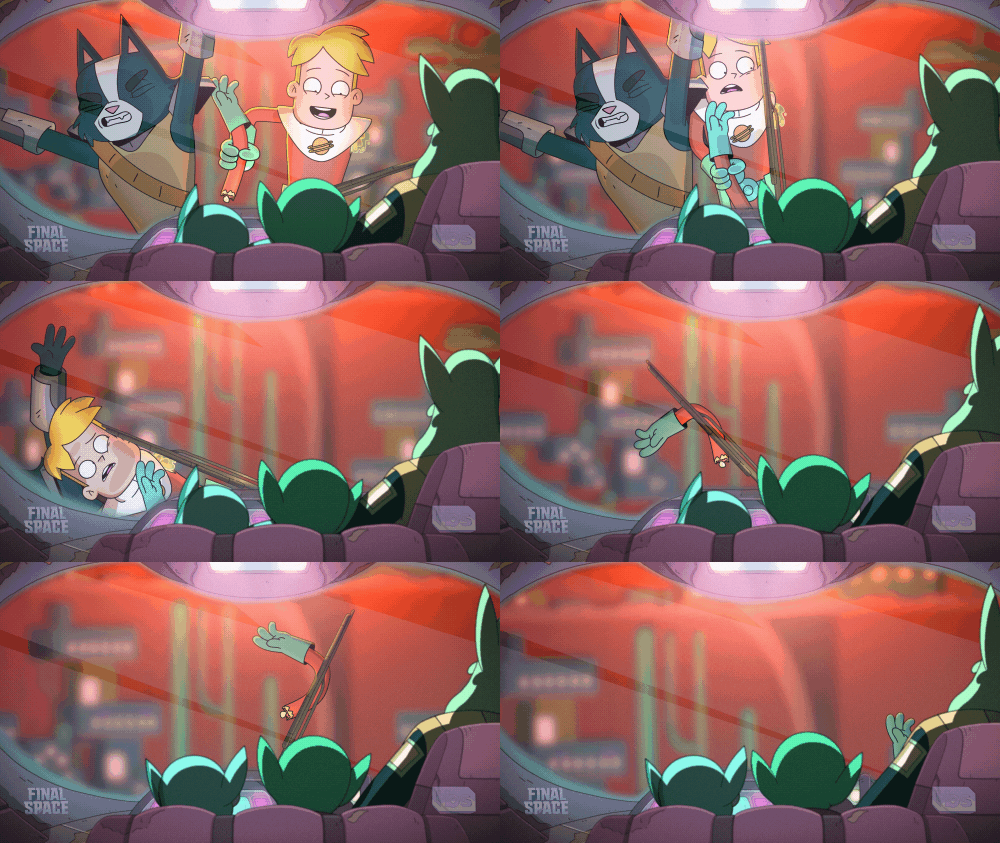
But there is a lot to love, and the animation is breath-taking.  If you like action happening in space, then feast your eyes on these cosmic bodies.  Futuristic vessels slip past, all slinky, while battles and asteroid clusters come to life in three dimensions.  It reminds me of a book I had as a child: some sort of graphic novel from the Ulysses 31 series.  I don’t know where it came from and I never actually read the words, just looking at the pictures in the early nineties and thinking: yeah, this is space and that.  If that specific reference doesn’t work for you, and why would it, then think anime.  And if you don’t know what that is, you’re probably better off watching Love Island Australia.


While I typically advocate for almost all Netflix animations (Bojack Horseman, F Is For Family, Big Mouth, Disenchantment) I will swerve any subsequent series of this.  If I have failed to do it justice, then so be it.  Let the talented voice cast, the incredible animators and imaginative writers all come after me.  Justice is already served in that I am persisting with a poorly read blog while their creative output is getting greenlit by the planet’s biggest streaming giant.  At least there can be no spoilers in this post, as I couldn’t even tell you what Final Space really is.  But yes, give it a go if your sci fi skills are better than mine, but otherwise there’s a host of animation out there that’s easier to connect with.
Thursday, 12 July 2018

Rick & Morty


If you ever start watching this adult animation (and I’ll tell you why you should in a minute), you’ll instantly be struck by three very irritating things about it:

1.      The animation is so crude you’ll be forgiven for thinking the show’s creators couldn’t be bothered to spend any time on it
2.      Rick and Morty, despite being grandfather and grandson, refer to each other by their first names.  Not just on the odd occasion either, but constantly, till almost every sentence is punctuated with unending reciprocal name-dropping
3.      Rick, the grandfather, is a cranky old bastard, and while this is hard to adapt to at first, it’s the fact that he burps while he speaks that will have you reaching for the remote to try watching something else due to sheer disgust.  He doesn’t pause in a sentence to belch and then carry on.  His throat reverberates while it emits digestive gasses in the middle of words, so that he uses this emission to power his speech, rather than air from his lungs like the rest of us.  Let’s not generalise, but old men are mostly kind of gross.  Rick out-grosses them all.  In addition, when he’s a bit sloshed, he has this patch of drool on his chin that just makes you want to get out a hanky and start wiping your TV screen, even though he’s an animated character

Acknowledge these things.  Take a note of how they make you feel.  But believe me that they soon go away for the following reasons:

1.      As you work your way deeper into each of the three series, you’ll realise that the animation is actually breath-taking.  Sure, Morty still looks like a kid scribbled him into life, but as he and his grandfather travel to more and more planets and alternate realities, this whole universe of rich imagination comes to life before your very eyes.  There are aliens from the depths of the darkest trenches of human minds (sci-fi orientated, geeky writer minds), with limbs on limbs on sex organs.  There are landscapes that no live action or CGI could realise.  The brutal action demands total attention.  You’ll want to rewind and watch bits again just to bask in the spectacle
2.      The excessive name-using never really relents, but you simply stop noticing it, so don’t worry about that
3.      And, as for the burp-speaking, you will come to terms with it.  In fact, you might even go as far as starting to feel affectionate about it.  Don’t tell me you’ve never been surprised by a digestive interruption in the middle of a conversation and simply tried to pass it off as a change of tone, or blurted out “Oh, excuse me” while clasping a hand over your mouth and its offence.  The fact is, Rick doesn’t have time for this.  So let’s look at why

The basic premise of this programme is fairly generic.  American family in the suburbs.  Farcical things happen in a way that they only can in a cartoon.  The twist is that live-in grandpa, Rick, is a supremely intelligent scientist with his own portal gun and extensive experience in travelling between universes and dimensions.  Rather than bonding with his grandson by pretending to find football interesting, he drags him on adventures across the full spectrum of space, time and reality.  It’s pretty high-concept stuff, but it’s all brought down to earth (literally – lol) by the fact the family members just see these trips as adventures.


And what a great word.  Adventure.  Adult life simply does not contain enough adventures.  Though, as a child, an adventure meant going to the park when it was raining and pretending to be in Jurassic Park.  As an adult, it means getting your smartphone out on a busy street and seeing if a moped-mounted thief is going to come and grab it off you.


So, off go Rick and Morty, gallivanting around in their clapped-out spacecraft and leaving a trail of world-altering destruction.  Sometimes, cynical older sister Summer, is allowed to come along, brilliantly juxtaposing the drama of high-school crushes against the demise of a whole alien race.  Further banality comes in the form of Morty’s parents’ relationship, with Jerry and Beth teetering on the edge of divorce while the universe teeters on the edge of catastrophe.


Some episodes do seem to pair up family members into a formulaic plot and subplot structure, but their adventures still strike consistently entertaining chords, with the show’s overall subject matter elevating it above standard crude humour-based animation for adults.  Rick & Morty never shies away from intelligence.  Rick, as the owner of an unmeasurable IQ, must balance out his genius with the view of the world it forces upon him: he recognises the absurd farce that constitutes life.  This makes him seem cold and unhuman, something which the programme embraces in its plots.


In turn, this is why the show is so far up the IMDB list of the top 250 TV shows of all time, based on average ratings, with a score of 9.2 landing it in eighth place.  Not bad for what looks like a puerile cartoon.  A 22-minute of Rick & Morty packs a whole universe of challenging philosophy, eye-popping artistry and laser-sharp social commentary into your brain via your eyeballs and earholes, so jump on this bandwagon and get ready to impress fellow office drones with the news that, yeah, you’ve seen all of the eighth best TV show of all time.

Tuesday, 2 January 2018

Black Mirror

Times are bleak.  It’s wet.  It’s cold.  There’s nothing to look forward to.  We have to go back to work.  We have to leave Europe.  Trump.  Why, then, would Netflix choose this time of year to unleash a fourth season of Black Mirror on us?  I, for one, am feeling particularly vulnerable, following a family Christmas where my thirty-two-year-old self reverted to a moody teenager under my retired parents’ roof.  Have I gained no maturity in the fourteen years since I left home?!  No.  No, I haven’t.  But maybe rock bottom is a great place from which to stare into bleak oblivion.  And that is precisely what Charlie Brooker’s suite of near-future dystopias offers us: a reason to be hopeless.


Brooker himself is a terrifying character.  His rants on the wonderful Screenwipe and Newswipe carefully detail each side of various political and social arguments before proving that both sides are stupid (a bit like a South Park episode).  His Guardian features make sparkling reading.  I rode out a notice period at my first (awful) job simply reading through the entire back catalogue of his Screen Burn column, cleverly minimised to a tiny square on my screen so the fusty old partners had no idea what I was only pretending to work.  As a child that was probably too young, I even cherished his TVGoHome book (based on the popular website from before I had internet) which was a parody of a TV guide – the comedy literally wrote itself.  Then he did Dead Set, bringing together two of my favourite things: reality TV and zombies.  Before I descend into sycophancy, let’s just say I subscribe to Brookerology.

But it is indeed a dark, dark mind that brings us Black Mirror.  The first point to commend is that each episode stands alone.  It’s that uncomfortable experience that comes with starting a new boxset: who on earth is that?  What the fudge is going on?  Am I going to enjoy it?  Well, get used to it, because that is every episode of Black Mirror.  And while your brain is working this all out, there’s also a new interpretation of our soon-to-be future to get to grips with.  To generalise brutally, most episodes take a small life-changing technological invention and show how it revolutionises our behaviour.  This could be an implant that records all your memories for future reference, such as in The Entire History Of You, or the robot guard dogs of Metalhead.  A lot of this stuff tends to revolve around applying some sort of device to your temple.  So far, so sci-fi (but not geeky, everybody).  But yes, we were commending each episode standing alone, weren’t we?  Whereas your average boxset just needs to set everything up just the once, Black Mirror has to reel you in and hold you with something new over and over.  And it manages to do this very skilfully.  You can feel immersed in a brave new society within just a couple of minutes.

The downside is that this, combined with the stark imaginings of our future, makes for relentless viewing.  Therefore, this is not a series you can binge on like so many Quality Streets.  Try and ration them out, maybe one a week.  Don’t do it on Sunday nights, though, or you won’t want to return to your mind-numbing job on Monday.  Pick a time when you feel quite resilient.

This is because things go wrong.  Whatever the episode’s premise, whatever the technological tweak to reality, things will go wrong.  And then they will go wronger and wronger and you will wonder what possessed you to subject yourself to such entertainment.  You could have been watching old Friends, but no, you wanted to chime in with the office Netflix discussion.

If there were a gun to my head making me criticise the show, then it would be that this awry-going has become slightly formulaic.  You could almost break an instalment down into 10% set up new world, 20% things go a bit wrong, 60% things go very wrong and then 10% bloody hell.  But it’s a formula that works.  As with every advancement in our standard of living, there are always consequences we never dreamed of.  I swear my thumb bone is now as brittle as chalk due to iPhone overuse.  I don’t want to use an Alexa as I can’t imagine sitting there in front of housemates and asking it how to cure a runny tummy.

Finally, the show’s progression is curiously from a British thing, into an American thing.  From a Channel 4 property in series one and two, Netflix swiped the rights for what has become the third and fourth series.  As with our beloved The Office, we feel this is a marker of something being good: “Oooh they’ve made an American version; this must be quality.”  This isn’t always accurate, but it works here.  In addition, times may be bleak here, but they’re also bleak in America, so it makes perfect sense.