Sunday, 24 November 2019

Green Wing


This week, I’m returning to work after two weeks on holiday.  While being on vacation is moderately preferable to sitting in an office, I’m counting my blessings that I’m not going down some terrible coal mine or making thousands of flat whites as a barista.  Sitting and typing emails isn’t really that taxing, so I’ve no need to dread my return to corporate life.  But I’m sparing a thought for my friends that have trained in medicine.  I’ve heard many of their tales of junior doctor shifts, seen them uprooted across the country with each rotation and laughed and cried while reading Adam Kay’s This Is Going To Hurt.  Now the NHS is being smashed and grabbed over as befits the run-up to any British election.  On holiday in the US, my hotel TVs (in between impeachment proceedings) were filled with vile ads for various niche drugs and their side effects.  Which has all got me thinking about hospitals.  But, as we can’t take anything seriously here, we’re hitting up a fantastic comedy whose two seasons (starting back in 2004) have always made me smile: Green Wing.


I had planned to go through each of the main characters, but Wikipedia lists 13 of these, plus some key recurring roles, and I’m running out of time before Seven Worlds, One Planet.  So, instead, I’m going to pick out my favourites from the madcap population that staffs East Hampton Hospital.

Harriet Schulenberg

Played by Olivia Colman (who’s now sporting the crown in The, er, Crown) Harriet is a bastion of the HR department whose every day of attendance is a miracle in spite of her four kids and unhappy marriage, to say nothing of her actual performance when finally seated at her desk.  Colman perfectly captures the chaos that can ensue when lots of small, dirty children are involved: cardigans constantly slipping off, school projects being crafted while ferrying offspring around extra-curriculars.  I never cease to be impressed by the parents in my office who, after each day, raise little people in their homes while I just lie on the sofa, only to be kept up by these same precious mites when they have the sniffles or start vomiting.  Yet they often manage to come in the next day fully composed.  Harriet is so cleverly observed and amplified that she has a universal quality in reflecting the edge of madness where working parents exist.  It’s not all bad though: you can leave the office at any time just by saying you have to pick your kids up.  I often pop off, claiming to be fetching children from somewhere, and nobody is allowed to question me.  But, secretly, I don’t have any offspring.


Sue White

East Hampton’s staff liaison officer demonstrates demonic behaviour in every scene, whether alone in her office up to no good, or torturing the staff whose concerns she is meant to soothe.  This was another occasion when I fell in love with Michelle Gomez (last seen in Chilling Adventures Of Sabrina) who clearly enjoys the madcap glint in her eye she is able to maintain throughout.  Of note is her ability to prevent all protest at her treatment of others, relying on British politeness and surprise at ill-behaviour in a way that’s similar to my hero, Jill Tyrell, in Nighty Night.


Guy Secretan

Stephen Mangan now performs 99% of all TV advert voiceover work, but his performance of the supercilious anaesthesiologist, always second fiddle to the much cooler Mac, made him a household favourite.  Every workplace needs a gaffman, and Dr Guy Secretan’s belief in his own half-Swiss importance can outgaff the gaffiest of them.


Caroline Todd

The newcomer through whom we navigate the sketch-show-esque world of East Hampton, Caroline is our everyman at an asylum full of medical professionals.  While she’s as neurotic as the rest of us, her foibles pale in comparison to those around her.  You can’t help but love Tamsin Greig throughout, even when she is having a strong adverse reaction to Angela Hunter.  There’s a GIF of Caroline typing wildly that I still use in work presentations most weeks, so she’s a gift (a GIF-t – get it?) that keeps on giving.

Angela Hunter

Sarah Alexander again nearly flies under the radar here (a perennially underappreciated national treasure of comedy acting), but this character is always one of the most enjoyable.  Excessively cheery and seemingly perfect, her colleagues’ response to her is always reassuring, including Caroline Todd’s irrational dislike.


Joanna Clore

I could go through the whole of the HR department here, but my final mention is for its head, played by Pippa Haywood.  A woman of a certain age, she doesn’t care what others might make of her brusque attitude and major mood swings.  You can’t beat an angry senior woman at work.  Senior men rightly cower from them leaving everyone else the chance to get on with stuff.


There are too many more to mention.  Even the deliciously named Martin Dear hasn’t made my list (despite his name encapsulating everything about his character perfectly).  I’ll stop once to mention Alan Statham though.  I have to confess that he was my least favourite and I never looked forward to his scenes coming around.  He is just so snivelling and conniving that my skin crawls every time I even think of him.  But one out of 13 ain’t bad, especially as there’s a great deal else to love about this sketch show-cum-sitcom-cum-comedy drama-cum-hospital show.  And that’s a lot of cums in this genre-splicing format.  Green Wing will forever remain welcome in our homes – we just need a political party to pledge in their manifesto that they are committed to bringing it back (and not shafting the actual NHS).


Tuesday, 19 November 2019

Seven Worlds, One Planet


Attenborough is back, and the BBC’s decision to schedule him in that Sunday evening slot makes drawing viewers as easy as shooting fish in a barrel.  However, shooting fish in a barrel is unethical and, probably, environmentally unsound, which means I am already making bad choices with metaphors and it’s only the second sentence of this week’s post.  If I’m A Celebrity Get Me Out Of Here can get with the times and acknowledge that insects shouldn’t be eaten alive for our entertainment, especially when the people eating them haven’t had proper telly careers for ages, then I can at least show our planet the respect that Seven Worlds, One Planet is very clear it deserves.  And by very clear, I mean smacking you in the face with it over and over throughout a single hour of television.  We’re at the height, here, of what TV can achieve.  Combining wildlife photography that easily stuns even the most soporific post-roast Sunday-evening eyeball into wholeheartedly acknowledging that everything ever on Earth is a miracle with undeniable demonstration of humans’ denigration of those miracles for our own gain, surely this programme will deliver the watershed moment where mankind stops it and tidies up?  (It being environmental naughtiness).


We all know something needs to happen, but our every subsequent action betrays a compromise of that truth.  I’m currently crawling through Connecticut on a train to Boston.  To reach the US, I generated a load of carbon emissions, but I’ll need to cross the Atlantic again by air to get back, so I already know I’ll be adding some more emissions.  I’m sorry.  Today’s been light on the old single-use plastics, yet I do have a bundle of garbage (American for rubbish) to throw in the trashcan (American for bin) when I reach my destination.  I’m sorry.  I stayed with a pal in New York whose building centrally regulates the heat for all apartments (American for flat).  The heating was therefore on too high and couldn’t be adjusted, but, no worries, the air conditioning kicked in to cool things down, burning energy at both ends in order to find the most energy-inefficient way to achieve room temp comfort.  We’re sorry.  So, can we rely on Sir David Attenborough to save the planet from climate change and plastic pollution?  The fact is, we shouldn’t have to.


Nevertheless, each episode of Seven Worlds, One Planet focuses on a different continent, detailing its unique and fragile ecological systems, so let’s review the story so far.

Antarctica

Penguins, seals and whales, with a backdrop of dramatically melting ice.  The guilt is woven in throughout, setting the tone for some uncomfortable viewing, but pulling no punches with the message that action is needed now.  We have facts and figures on population numbers that have dwindled or resurged at the hands of human activity, but there is retribution from Mother Nature when we see how seasick the production crew get as they sail to reach South Georgia.


Asia

Finally, a continent I have actually been to, though I am now of course racked with guilt at my carbon footprint following separate trips to China, Japan and South Korea.  This episode features the harrowing footage previously discussed on this blog from Netflix’s Our Planet: walruses falling to their deaths from Siberian cliffs.  Their plight is no less shocking this time around, though hopefully the BBC’s broader audience should draw greater attention to the living collateral damage my trips to the Far East have caused.  You’ll also weep for the orang-utan, both because this close cousin’s habitat is being destroyed so Iceland can make ads about it (I think) and because you’ll never pronounce the name of this animal correctly as it changes every few years.


South America

Never been here either, but we of course take time for the decades-old narrative about the disappearing rainforests.  This is chat that’s been in the media for such a long time that it’s become as easy to ignore as that rough-sleeper you walk past every morning on the way to work.  If, like me, the total number of hectares of virgin forest you have cleared personally in your lifetime is zero and you think that exculpates you, then you’re missing the point, you big silly.  But what do we do with the powerlessness we feel about the change we want to see?  This episode also delivers real novelty with animal behaviour never filmed before: pumas hunting guanacos.  I didn’t even know what guanacos were when the episode began, and now I am obsessed with them.


I’ll be catching up on Australasia once home, plus big player Africa is still to drop in the series.  I might confess early to expecting to be underwhelmed by Europe (the continent, not the political union we all want to stay in forever) as I’m not sure we can stretch foxes and squirrels out for an hour, but they might have found wilder cast members away from English suburbia.  Either way, this is the type of landmark content that makes me eager to pay my license fee (even if the BBC News app uses biased language to favour right-wing politics).  We can’t let down dear old David by carrying on as we have been doing.  I’m switching to Bulb, voting Green, shopping more at Co-op and haven’t put my heating on so far this year (mostly as I can’t work the new-fangled thermostat in my fancy newbuild) but these are drops in the plastic-filled ocean while New York is still giving out single-use plastic bags and I, ever the Millennial, jet about on fossil-fuelled aeroplanes.  Someone needs to stop me.  Someone needs to stop us.  Over to you, David.  We’ll do whatever you say.

Wednesday, 13 November 2019

Friday Night Lights


In life, it’s important to have goals.  I’ve only set very few over the years so I can focus on each in turn.  The first was to go to Oxford – something I decided at the age of about eight apparently.  Once that was achieved (it was expensive, and they still email me asking for money that I am never going to give them), the next was to become a published writer.  Still haven’t managed that, but I think one out of two in my 34 years is a pretty decent strike weight.  A completion rate of 50% is better than 0%.  So, while number two eludes me, other interim goals crop up.  One was to buy a flat, and that dominated the last ten years before this summer’s eventual Help To Buy transaction, and another was to watch all five series of Friday Night Lights.  And now, everybody, I have finally delivered that goal.  So let’s all read my blogpost about it.


First things first, I should declare my lifelong aversion to team ball sports.  I grew up in a household where football wasn’t a thing.  My dad’s only sporting interest involved filling our home with the bone-chilling screech of Formula 1 tires and Murray Walker’s whiny exclamations every Sunday, with many a roast dinner soundtracked by what became two of my least favourite sounds.  With nobody realising I was short-sighted till my teens and my appalling hypermobility-linked proprioception, taking part in any sort of PE involved me not only being unable to see any balls that were launched at me, but also an inability to position my limbs to intercept them successfully.  My adult life therefore is an extension of my childhood home: sport is not a thing.  I save hours every night by not having to watch soccer matches, and I replace the office chat I see pursued around me about whose team beat whose and which players will lift what cups by having an actual personality.  However, I love dramas about sport.  It’s a theme for good narrative tension, like zombies (see The Walking Dead) and prisons (see Prison Break).  Let’s be honest, I’ve written fondly about Footballers’ Wives, and probably repeated most of those points here, so Friday Night Lights falls into that category.


The show is based on a book that had already become a film.  I’d loved the film, so I remember adding the first series to my Lovefilm list back in the dark ages when DVDs were sent back and forth in the post.  I got through the first two series and then, pow, I couldn’t for the life of me get hold of the subsequent instalments up to and including the final fifth season.  This caused years of discontent, as everything about the show was brilliant and I was desperate to see what happened to the characters I so dearly loved.  The later series were available on a friend’s Amazon Prime account, but you had to pay for each one.  As a Millennial, paying for content is a cause of great internal conflict, so I kept my pennies and my anxieties about what becomes of the Dillon Panthers football team.  Finding out became a lifelong ambition.  But, with the new flat came the decision to get my own Amazon Prime and by this point all series were included in the monthly subscription.  I could finally complete my task and achieve my goal.  And the outcome?  This amazing piece of writing for all seven of my regular readers.


Let’s cover what the show’s all about.  We are talking American football here.  Set in the state of Texas, where this sport is a religion, the end-of-week evening illuminations in the show’s title refer to the significance of high school football matches in small-town America.  I’ve only been to Austin in Texas, so this is sadly not something I’ve experienced first-hand, but this can go on the list of lifelong goals now.  Our heroes are Coach Eric Taylor (the cracking Kyle Chandler) and his wife Tami Taylor (the equally cracking Connie Britton) – these wonderful characters are the heart of our show.  I might be in my mid-thirties, but I am available for adoption to these two.  With the whole town holding its breath for football wins each Friday, the sporting fixtures in their own right generate gripping drama.  But this is then compounded by the human stories around the sport, from the ever-evolving dynamic between Coach and Tami, to the players, their families and their friends.  The whole town of Dillon feels tangibly brought to life.


A word of warning: the whole thing is filmed in wobbly cam.  It’s as if the camera operator was trying to bat away flies throughout each shoot.  This gives an intimacy to the portrayals which is heightened by the quality of the performances throughout.  The show launched the careers of Taylor Kitsch and Michael B. Jordan, but you’ll recognise faces from an array of your favourite US dramas.  I’m going to focus on some of the peripheral characters whose actors’ names never make the emotive opening credits but whose work lifts the whole thing.  There’s Brad Leland as Buddy Garrity, a role that initially irritates before elevating itself to favourite position.  I also finished the show with a deep appreciation of Stacey Oristano as Mindy Collette.  There are too many more to mention, but the quality is consistent.  Sadly, one other element of consistency is the Taylors’ daughter, Julie.  She is annoying and stupid throughout.


On my part, I’ve also maintained the consistent approach of never understanding the rules of American football.  So much of the drama can hinge around things like who is the quarterback or how many yards are left, but not knowing what these really mean is no barrier to the show’s power.  Most remarkably of all, though, is each season’s ability to build on the previous while still finding a fresh direction.  Somehow, over the years, I ended up watching the third series twice, but it’s the perfect shift between the very different dynamics (which I won’t actually describe here as that would be giving spoilers) of the beginning and end of the programme’s lifespan.  I do remember thinking the finale to the third season was the whitest thing I had ever seen (and I grew up in semirural Surrey), but the subsequent series shift in focus to reflect and include a more holistic view of American culture.  And then, either way, your heart breaks as everything draws to a close and your life must continue without any news episodes.


So I’ll chalk up Friday Night Lights as another chapter in my love affair with America.  I’m even writing this from a Chinatown hotel room in New York, wondering why the US hasn’t got the memo about waste as plastic bags are given out freely here still and the entire hotel breakfast was an exercise in plastic landfill generation (disposable crockery and cutlery…).  But I’ll also chalk it up as an exemplary contribution to the canon of quality boxsets.  Intense drama, plausible characters, a subject matter that isn’t overdone and, even though I’m conflicted about this as I wanted more, it ends before it runs out of steam.  No matter the day of the week or the time of the day, I cannot recommend Friday Night Lights enough.

Thursday, 7 November 2019

Misfits


I’ve never really bought superheroes.  People wang on about the latest addition to the interminable Marvel Character Universe and I seem to zone out immediately.  What we can bear to watch comes down to what we can buy as a reality in which a story can play out.  My own mother can’t abide anything supernatural as it’s simply not realistic enough.  As a result, she cheerfully refuses to engage with the entire wizarding world of Harry Potter.  Sometimes I can’t work out why I’ll buy the things I’ll buy and reject the others.  Zombies?  Count me in no matter what (The Walking Dead and Kingdom).  Vampires?  Excuse me while I reminisce about loving True Blood.  I even sat through every season of Lost, long after I’d lost all hope of ever working out what I was actually buying.  But, typically, I’ll reject anything to do with costumed heroes.  So why, then, am I covering Misfits this week?


Well the truth is that I am behind with my boxset consumption and haven’t polished off anything new in a while.  But my viewing experience’s loss is your blog-reading pleasure’s gain, as I know we all love to trawl the archives.  I’ve cast my mind back to a show that did in fact deal with the real-life consequences of developing superpowers: Misfits.  The premise was not only a great excuse for orange jumpsuits, but also a sure-fire way to ponder the age-old question of just how much great power comes with which sort of great responsibility.  The premise was thus: some pesky youths on community service get caught up in a mysterious storm.  Superhuman new abilities ensue, with our drama served up by two sources: our characters coming to terms with their new faculties and the same characters coming across other individuals who enhanced their natural gifts in the storm’s rage.


Whenever I think what power I would have if I were a superhero, I always arrive at the conclusion that I can’t be improved.  I’ve occasionally thought it would be nice to be a bit taller, but I don’t think Slightly Taller Man would be a welcome addition to the Avengers when they’re next doing some of their assembling.  But don’t worry, the kids in Misfits got a good helping of powers each.  My favourite, regardless of power, was Kelly played by Lauren Socha.  At one point she was all over TV and I can’t fathom why this hasn’t continued.  Her voice had a quality to me that was pure entertainment and I just wanted her to say every line.  I’d have taken Misfits as a one-woman show if I’m honest.  Nathan Stewart-Jarrett (Curtis) appeared in a few things afterward, based on the strong vest-wearing he did in the show.  He once came to a party I was forced to attend as part of a work campaign (Primal Scream were playing but I just wanted to go home as I had no idea who they were) and I saw him in our VIP area.  “Yeah,” I thought, “there’s that man off the telly.”  Robert Sheehan provided impish charm with a hearty overegging of every scene as the very annoying Nathan.  He later appeared in Fortitude, which remains my least read blog (so click on it), and showed quite a different side to himself (and his private parts).  On the whole, though, everyone did a fantastic job in their parts.  Well done.  But some of those jobs got so over the top that I didn’t stick with things all the way to 2013’s fifth series.  It was the arrival of Rudy, played by Joseph Gilgun, in season three that started to wear me out.  I don’t like it when actors’ enjoyment of their own performances visibly outweighs the believability of their own performance.  You don’t see me at my office desk having a great time.


What made things really work was the gritty British urban setting of the whole thing.  Concrete wasteland is somehow a very plausible place for some inclement weather to dish out superhuman abilities.  But the greatest element of its own realism came from Misfits’ use of irreverent humour.  Sure coping with time-rewinding power and telepathy was deep stuff, but it also led to some LOLs.  This is why traditional hero fare always loses me.  At some point, our protagonist dons some sort of skin-tight outfit and begins posturing about the place as if we can take them seriously now they’ve got a uniform and a generic moniker that indicates their power.  I always think of Bananaman.  And I always hated him for being patronising.  The Misfits’ powers were buyable - probably just manifestations of the things we have about ourselves that make us think we are different to everyone.  I’ll confess here to my own hero creation: Bubble Boy.  Don’t worry; I didn’t think of the name.  My niece came up with that.  As an adult, imagination play is incredibly embarrassing.  I can spend hours building LEGO or playing board games with my sister’s daughter, but anything involving pretending goes beyond my comfort zone.  I was obliged to spend half the summer in the garden with her enacting superhero battles.  She was something to do with a ladybird.  Each battle starts with your pose.  It can be holding aloft a weapon or assuming some sort of proactive position.  Bubble Boy, whose name isn’t actually linked to any of my own digestive problems, draws a bubble with his hands.  Because, yes, he has the awesome power of bubbles.  Be afraid.  Don’t worry, I don’t proceed to assault a ten-year-old girl, as we are normally too busy laughing at our own posing to unleash any real violence.  Which just goes to show we British can’t take anything seriously.  I mean, just look at Brexit.


But if you want silly camp costumes, then Strictly Come Dancing is on every year.  Otherwise, dig out the old Misfits boxset for a masterclass in good British telly.  Nobody stands on a rooftop in Lycra with their hands on their hips.  They scowl while wearing dirty jumpsuits, before making some sort of quip about the whole situation.  The next time you see some disaffected youths, don’t forget that they might just have some superpowers you just don’t know about.


Monday, 28 October 2019

The X Factor


Picture the scene.  It’s autumn 2005 and rather than spending a third year at university, I’ve been shipped off to Germany to fulfil the position of human dictionary at a grammar school under the auspices of a year abroad.  All my shiny brand-new friends are carrying on to their finals without me.  But, thanks to low-cost airlines, I’m able to come back.  After about nine hours of travelling, which includes a bus transfer to a Swiss airport, a 45-minute flight, further trains and nonsense, I reach my hallowed college and burst into a friend’s room expecting a hero’s welcome.  But everyone ignores me.  On the screen of the television holding all their attention, a swarthy muscular chap is cavorting in what looks like an LA swimming pool.  “Guys, it’s me!” I try, convinced they must not have twigged to the significance of my presence.  “Sssh,” they all go, “we wanna see Chico.”  I drop my bags despondently and sink into a seat, well aware that only an advert break will allow attention to revert back to me.


This was my first real exposure to watching The X Factor.  It was the Judges’ Houses section of the second series, famous for Chico’s yearning to be taken through to the Live Shows manifesting in an electrocution-risking impromptu swim with microphone in Sharon Osbourne’s back garden.  I was derisorily regarding my pals’ viewing choice, but the pressures of final examinations had led them to seek solace in the most mindless of TV.  We had been out and about too much to bother with the first series, its super broad appeal as a shiny-floor Saturday night schedule-filler to replace Pop Idol, Popstars and Popstars: The Rivals sparking only contempt as we had the time of our lives spending our student loans on non-academic pursuits.  But the cultural steamrolling of this reality TV show soon proved unavoidable.  Leaving the oldies to watch Strictly Come Dancing, by its fourth series, The X Factor had struck gold and become essential viewing.  The revolution began with the addition of the fourth judge, Dannii Minogue, only for her to be joined in her second year by the then Cheryl Cole in a race to the bottom of constantly younger and tauter-skinned female judges while Louis Walsh and Simon Cowell aged in peace, subject to none of the same scrutiny despite looking much much worse.


Either way, we reached peak X Factor, with two of the X Factor-iest X Factor moments that stick in my mind being the following:

1.      Cheryl Cole stepping down from the judges’ table to perform The Promise with her bandmates from Girls Aloud, all clad in massive sparkling dresses and ITV’s Sunday night schedule being definitively the epicentre of British culture at that moment in time.  Sigh.

2.      Katy Perry debuting her single Firework on the Sunday results show, daring to sing live despite missing all of her notes and leading to some hilarious comments from various friends in their Facebook statuses decrying lyrics that went “Boom boom boom, even bigger than the moon moon moon.”  Everything about this sentence is now vintage and dated.


Now, after decades of manufacturing music acts, The X Factor has taken on a big refresh of itself, finally acknowledging that there probably aren’t any decent singers left in the UK and that everyone is watching Love Island instead.  Nevertheless, let’s celebrate the stages in any popstar’s life as they make their way from hideous unknown to hideous C-lister.


Auditions

Descending on various cities, the crew take over large venues and erect awnings and queuing infrastructure as Dermot O’Leary shouts at a moving crane camera that Sheffield/Manchester/Newcastle/Sutton Coldfield has the X Factor while crowds of wannabes and their dragged-along families make a cross shape with their pudgy arms.  Series have toyed around with closed-room auditions and demanding applicants sing in front of baying audiences.  Either way, we’ll get a background story about each hopeful singer.  The fun part is guessing whether they are going to be outstanding or appalling.  I’ve covered my disdain for sob stories in a previous post on the much less popular The Voice UK, but I’ll repeat the fact that so many people just “want it so bad” as if that’s reason enough to deserve a successful recording career.  There are two types of delicious moment we are aiming for here.  One is watching someone deluded get a reality check regarding their superstar aspirations: they can’t actually sing in tune.  The other is the genuine excitement when a great new act is discovered.  Nobody mentions the fact that everyone has been pre-vetted by production before being trotted out in front of the judges, as we’re here for the entertainment factor, relying on Cowell to interrupt singers mid-flow to demand different songs in the rudest way possible – leading to one of the best Bo’ Selecta! apings known to the modern world: “No offence, but I wish your mother was dead.”  But in fact, the most offensive part is always Louis Walsh likening any performer of colour to literally any other black celebrity: “You remind me of a young Moira Stuart.”


Bootcamp

This is my favourite part but it’s always rushed through.  By this stage, you’ve forgotten everyone from the Auditions, let alone the ones you really liked.  Clusters of hopefuls are cut willy nilly, sent packing to a big waiting coach for the long trip back to the regions.  There’s always a silly sausage who gets trolleyed the night before and then stinks up the stage as a result.  Cruelly, acts are made to sing together in an unnecessary test of their ability to collaborate with other artists before they’ve even established themselves.  The culmination is the judge reveal to each of the categories.  In separate conference rooms, the Overs, the Boys, the Girls and the Groups wait anxiously, hoping more than anything that their chances aren’t killed by being assigned Louis Walsh.

Six Chair Challenge

This was injected in recent years to overhaul the tiredness of the format in its later decades.  A final bunch in each category is whittled down to six.  One by one, they sing before an incensed mob, receiving a chair/wonky stool if they’ve done well enough.  Gripped by their own emotion and attention-seeking, the judges give away too many chairs too early, resulting in cruel swapsies where the privilege of sitting is snatched from young hopefuls.  However, the cruellest part is the fact that they only supply one wobbly stool for the groups, leaving the majority of the band hovering awkwardly on foot behind a frontman.


Judges’ Houses

If you end up with a chair, then you get to go on holiday with your judge.  You don’t get to take the chair with you, though.  This is the best product placement opportunity for airlines on UK television, as we’re guaranteed overexcited scenes in airports where the acts in each category find out their destination.  The unlucky bastards under Louis Walsh are guaranteed a trip to drizzly Dublin, so you can always manage a smile at their disappointed faces.  Meanwhile, Cowell and the others hit up glamorous US and European cities, though the contestants with criminal records conveniently drop out when they are denied visas.  Everything that takes place from this point on is pure over-emotional slush, but first each judge reveals their celebrity help-judge.  Usually it’s some famous pal who has nothing more interesting to say than “I’m glad I’m not the one deciding,” which is beyond unhelpful, though at least you can rely on Sinitta to be making suggestions about how to use foliage as a clothing option.  Each act performs, normally in an awkward spot by a swimming pool, probably with the sun in their eyes.  The judges stay up late agonising, before the most drawn-out sequence known to broadcasting.  Each act is told face-to-face if they’re being taken through to Live Shows.  A masterclass on how to respond was given by Rylan in 2012, but we end up oscillating wildly between happiness and devastation.  It’s at this point that all my favourites are normally culled, but Dermot is always there to show he doesn’t really care either way.


Live Shows

And then here we go: the countdown to Christmas.  All the acts sing every Saturday, usually according to some sort of theme.  Big Band Week seems sadly to be long gone, but sometimes it’s Guilty Pleasures and occasionally it’s the back catalogue of whoever they can get to sing on the Sunday, however spurious.  I like to imagine the least appropriate acts for this sort of week: the greatest hits of System of a Down or Marilyn Manson for example.  If you thought Judges’ Houses were drawn out, these shows can sometimes take several years to get through.  Each judge intros their act, typically looking down the wrong camera.  Cue jeopardy-emphasising VT where expressions like “Barry’s gotta nail it this week, or he’s going home” abound, and we forget these people literally get to return to warm homes and gainful employment, rather than the religious persecution and unbridled violence we’re all too willing to send Syrian refugees to.  The acts perform in front of cameramen who can’t keep still for five seconds, so you see many shots of everything and nothing, before the judges give unfounded criticism based on how much they want to be cheered by the studio audience.  Dermot then opens the phone lines and you vote to save your favourite act.  I’ve never missed an election (though nobody I’ve ever voted for as ever got into power) but I wouldn’t be caught dead actually ringing up to vote on this show.  I prefer the sense of disappointment when my favourites are ejected.  Voting stats are released once the series are over and the outright winner has normally already stretched ahead by week one.


Live Shows – The Results

In historical times, people would find out who had got the fewest votes on the same night, like barbarians.  Now, to stretch things out, the results are in a separate Sunday show.  This was to complement perfectly the winning Sunday line-up of The X Factor Results and Downton Abbey, trapping millions of Brits on their sofas for two whole hours.  The show used to open with the never well-rehearsed group number, a highlight for fans of awkwardness.  Guest acts perform, and things get meta when a previous season’s winner comes back, free to deliver their single without the judges being allowed to slag them off this time.  Finally, Dermot reveals the bottom two and then the judges decide who to save.  There are tears and tantrums, but nothing beats Deadlock.  This is when the judges are split and we have to go back to the vote result.  The nation comes to a standstill and everyone has carte blanche to rape and pillage freely until a disappointed minstrel is being shown their best bits.  Through attrition, we are finally left with the, er, finalists.


The Final

Hello Wembley!  These days, the Final has outgrown a TV studio and a whole arena needs hiring out to get through the inordinate pageantry of selecting who’s got the X Factor.  Established acts clamour to promote latest releases in and among the finalists’ own best songs, with a quick comedic break offered by the exploitative but necessary wheeling out of all the worst singers from that year’s series.  No expense is spared, as long as that expense is spent on confetti cannons.  Tradition dictates the finalists duet with the planet’s most successful popstars.  One peak year saw Beyoncé grace our stage, but these days it tends to be the awful Robbie Williams, who is guaranteed to forget his own lyrics.  Our winner is crowned and rather than crossing live to Andi Peters at the CD factory, the winner’s single is available for immediate download.  Our champion tries to perform it before being rushed by the other finalists and Dermot eventually gives up trying to keep control of the activities on stage.  Even winning the show doesn’t guarantee success – more than half of the victors have faded into obscurity.  But, sure as eggs is eggs, another generation of schoolchildren will expect overnight success in pop music, should their careers as YouTubers or pro footballers not work out.]


I jest!  I’ve slagged this show off throughout, but I really do bloody love it.  Working in media buying, I dreamed ITV would one day invite me.  But then my team did a licensing deal for a client directly with the production company.  Next thing I knew, I found myself at Fountain Studios for a results show.  I was meant to be looking after clients, but I was so excited that they were forced to take on a parental role to my hyperactive teenage behaviour.  Taylor Swift performed Shake It Off and I forgot to breathe throughout the whole performance.  Since then, I’ve been lucky enough to be invited back, both to the Live Shows and The Final itself.  The best part of the Live Shows is mingling backstage with the friends and family of the contestants, lording it over them with my free-drink wristband while they’re forced to pay.  The acts then emerge from their performances and I’m always surprised by how tiny some of them are.  Throughout filming, Cowell spends every commercial break outside smoking (assuming the fag packets are stored in his vile bootcut jeans, while the lighter nestles among his toilet brush barnet), while the female judges have their hair and make-up constantly touched up.  The Final is a massive undertaking, with a VIP ball in a nearby hotel before and after.


This blog has made it clear on repeated occasions that a lot of my viewing tastes align with those of teenage girls, so my fandom of The X Factor should come as no surprise.  This year, it’s taking a break while other formats are trialled, and while it may never ascend to its giddy heights, it still remains one of the biggest shows on commercial television, despite its overly commercial, sensationalised and desperate-for-drama tendencies.  Let’s be honest, nobody delays their Saturday evening out any more to catch The X Factor, plus you can always catch up the next day with the benefit of fast forward.  But I’ll never stop being charmed by the great unwashed’s unbridled desire for five minutes of fame.  So, in tribute, let’s make me famous by telling a friend how good this blog is.

Saturday, 19 October 2019

Toast Of London


Apropos of nothing, this week I shall be peeling back the skin of Toast Of London, taking a look at what lies beneath and maybe even sniffing it.  I say apropos of nothing, as I cannot link this week’s choice to anything happening in wider popular culture (plus the wankiness of the term suits the pretension of the programme in question).  Toast Of London’s three series came out between 2012 and 2015, yet my stumbling across them on Netflix in recent times and harnessing the gentle mirth and subversive lampooning of the luvvies that dominate British acting as my accompanying background viewing to Sunday evenings’ food prep marathon (step one: peel sweet potatoes, step two: accept the weekend is over) is particular only to me.  Yet that has never stopped me doing anything on this blog – in fact, regular readers will know it revolves more around me than it does around actually providing useful boxset recommendations.  That said, I have been craving more of Matt Berry since I made my way through The IT Crowd.  My need for his incredible voice was partly fulfilled by old episodes of The Adam Buxton Podcast (that’s right, I also voraciously consume content in podcast form – the eagle-eared among you may even have noticed a quotation from Russell Brand’s Under The Skin in this very introduction), but a vehicle of his own would surely hit the spot.


Fans of silliness will be well rewarded, though the brand of silliness is more conceptual than you might find in my other favourite silly sitcom, Miranda.  Toast is a London-based actor who isn’t that successful.  He gets enough degrading voiceover work to keep going, he has potentially been a household name during a previous decade’s heyday, but he still needs to badger his agent for work while she too badgers him to take up unsuitable jobs.  Like Andy Millman in Extras, he exhibits seething jealousy for any member of his acting cohort who is doing better than him.  The best thing about all of these minor actors is their surnames.  Toast in itself is enough to stop any top billing sounding too serious, conjuring up images of melting butter spread with crumb-covered knives.  Surpassing that English word for banal naffness is the name of Toast’s greatest rival, Ray “Bloody” Purchase.  Purchase is such a wet sock of a word and of a name.  Neither glamorous, nor familiar, it’s a simple monetary transaction for a good or service.  Starring Ray Purchase and Steven Toast isn’t what you want to hear about any blockbuster film.  Nor will you.  Purchase turns up on almost every job of Toast’s, outdoing him through chumminess with difficult prima donna directors or getting on better with smirkingly smug mugs of voiceover booth technicians.


Both take their craft seriously, but the comedy comes from showing how amateur and ham they really are.  Even Toast’s natural flair as a high winds actor (shouting in front of large fans) doesn’t bode well for future jobs, as whatever can go wrong does.  Helping to expose the evil of taking acting too seriously is a supporting cast with names as delicious as Toast’s and Purchase’s.  There’s Ken Suggestion, Duncan Clench, Cliff Bonanza, Jenny Spasm and Max Gland, not to mention a further raft of names who are only ever referred to such as Warren Organ and Sookie Houseboat.  Each belongs beneath a signed black-and-white headshot in a regional curry house.  Most beloved for me, though, is Toast’s agent, Jane Plough (pronounced Pluff).  Played by Doon Mackichan (whom I’ve always loved since Smack The Pony and I once smiled at on a train), Plough makes grandiose statements about never opening the attachments on emails (amen) and is often seen calling her client from completely unexplained sexual scenarios involving scantily clad young men and some dessert options.


Self-importance is easily made ridiculous, but we all end up on Team Toast, rooting for him to catch a break, despite him being a misogynist pig who only cares about himself.  He is aghast at current trends and longs for his younger years galivanting around Soho when he was a youthful upstart, rather than having to cope with the sniggers his voiceover recordings invariably draw.  Sending up how the British revere their stage and screen actors might seem like easy prey, but Toast Of London’s silliness has a caustic edge, an absurd narrative and a surrealist approach to almost every scene.  You’ll feel delicious every time you hear that immortal line: “Hello Steven, it’s Clem Fandango here.  Can you hear me?”  And so, apropos of nothing, let’s have another series please.

Sunday, 13 October 2019

The Apprentice


For the landmark 117th post of Just One More Episode, I’ll be returning not only to the recently talked-about topic of programmes I don’t watch (like Naked Attraction) but also to the rarely covered theme of programmes I actively hate (Altered Carbon).  While this blog has mostly remained a safe space of positivity about all the different boxsets out there (with a healthy dose of my own self-obsession), this week we are turning our smarmy observations and cutting critiques to the absolute pile of dross that is The Apprentice.  A fifteenth series has slipped onto air this month to a collective shrug of indifference and I’m happy to say I feel no need whatsoever to catch a single episode.  Part of this is now down to the fact I’ve reached the stage of flat ownership where I can have friends round for dinner (especially ones that invite themselves), so I’m too busy serving up Viennetta as a feasible dessert option to tune into this BBC flagship production.  So, eighties ice cream products aside, let’s go through the reasons why The Apprentice should be stricken from the TV guide.  And just to recap quickly the premise for anyone who’s never grasped it, this show is, in short, competitive job interviewing.  Yes, really.


It’s reality TV but pretends not to be

During the first few series from 2005 onwards, this programme’s biggest crime (against my personal view of what’s wrong and what’s right) was to provide a route to reality TV for viewing snobs that claimed not to be able to tolerate the genre.  Big Brother!” they would cry, “I can’t be watching that bunch of wannabes desperate to be famous.  But have you seen The Apprentice?”  I would sneer at them, pointing out they should just own the pleasure they take in consuming trash TV.  If you never miss an episode of Keeping Up With The Kardashians or Love Island then you might as well own that behaviour.  Anyone who judges you for it isn’t important.  Yet The Apprentice legitimised our natural interest in watching ordinary people humiliate themselves by dressing itself up in the pinstripes of actual business.  A tenuous link to product development, sales, marketing and boardroom practices suddenly meant that it was highbrow to watch 20-year-olds from Essex slag each other off while desperately trying to stay on the telly as long as possible.  Frankly, unforgiveable dishonesty.


The stupid tasks

Each week’s episode is themed around an industry, whether confectionary, fashion, events or some combination of all three to make cold hard cash.  A common trope of reality TV is to get people to showcase a skill but with the added pressure of an unfeasibly short period of time in which to do so (Great British Bake Off’s timed technical challenges, or the matter of days allowed to master a Quickstep in Strictly Come Dancing).  But somehow, The Apprentice stretches this too far by making ill-matched groups of applicants think up, refine, manufacture, distribute, market and sell a product within mere moments.  If this wasn’t enough of a recipe for failure, you need to factor in that the all team members are working against each other, with their interests vested in making everyone but themselves look as incompetent as possible.  What ensues are montages of the contestants, dressed in their best banker-wear, running around London streets doing everything wrong before a classic bollocking in the boardroom.


Stupid Lord Sugar

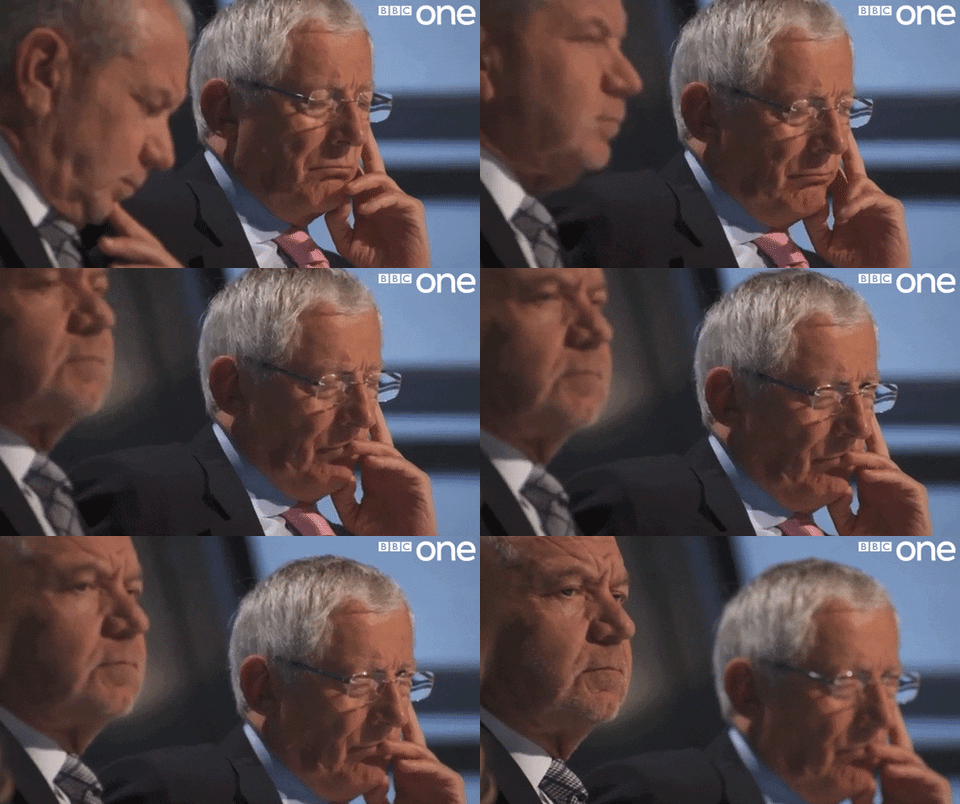
Enter (from a tiny door in the middle of the room, presumably coming from some sort of subterranean troll hole) Lord Sugar, the man whose apprentice these people are supposed to want to be.  Apparently he’s done well in big business, but he doesn’t strike me as someone dynamic enough to thrive in 2019’s brutal economy.  His furrowed brow thinly muffles the sounds of his mind whirring as he dodderily computes what’s said to him.  Fair enough, what’s being said is normally an accusatory argument between a handful of competitive business wannabes, but it all seems a bit much.  Relishing his own interruptions, our Alan then wheels out dad-gags that I swear have been written and fed to him by a team of eighties comedians.  Or sugar-jacked ten-year-olds.  If he announced “Well you’re a stupid poo poo head” to someone I don’t imagine a single eyebrow would rise in in surprise.  But that’s the thing about interviewing: best practice is to put the candidate at ease.  Instead, Sugar rules by fear and intimidation, pointing rudely and mistakenly firing people before he’s even employed them.  The apprentices might be inane, but I would feel more comfortable watching them judge him for his contributions to humanity.


The stupid contestants

This is a bit harsh as my only point of reference here has been the odd one that’s ended up on Celebrity Big Brother.  James Hill was actually a top lad, and I was even won over by Katie Hopkins in the house, watching her reason carefully with Katie Price in a way that betrayed a side to her which today’s unacceptable media persona has shat all over.  The rest come across as officewear-clad interns that talk a big game about their skills but end up set up for failure by each week’s task.  One thing I’ve learned in my working life is that nobody ever looks good blaming someone else, and yet these people sit in front of Sugar pointing fingers at poor old Jenny for not selling enough soap.  Maybe squabbling children is what’s missing from the world of professional behaviour, but it has me reaching for the remote.


Its crimes against humanity

Our UK version is based on an original US iteration that first gave a platform to Donald Trump.  This says it all.


Phone abuse

We’ll look back at The Apprentice UK’s most significant contribution to culture: holding the iPhone below your chin while talking on speaker.  This action became characteristic during the contestants’ various wild goose chases, coordinating errand teams sabotaging the overall effort on the sly.  Now it’s taken hold on the top deck of many of London’s buses, which is great if you want to be involved in other people’s banal chitter chatter.  Similarly, the tension of each episode’s climactic boardroom scene is supposedly elevated by a receptionist using the world’s oldest landline to tell the nervously waiting applicants as and when Sugar is summoning them to his shiny boardroom for some more showing off.  This all needs to stop.


In summary then, for those that might have missed the nuance, I really do take exception to this show.  It’s trash masquerading as premium, a theme that runs through the whole operation, from the contestants to Captain Sugar himself.  I don’t mind lots of showing off, but once someone’s screamed “look at me!” long enough to get your attention, they should have something interesting to tell you.  This is never the case in The Apprentice.  I don’t watch it, and I don’t like it.  Of course, loyal readers, you’re free to make your own decisions, just like Sugar is free of UK employment law in order to make his own hires.  But just be honest with yourself: you’re watching it because you like trash.