Tuesday, 16 February 2021

30 Rock

For the creators of amazing telly, it must be dispiriting to have their programme described as a background show.  Yet the concept is well worn, particularly when we are stuck at home all the time.  For me, the background show is ideally shorter than half an hour in length and, typically, a comedy.  It might seem like a fall from grace for something like Friends, going from must-see TV premiers in primetime to something we can put on for a bit of chatter to drown out our thoughts while our attention is half-taken by chopping up vegetables or watering the houseplants.  But, it’s either a new way of appreciating an old favourite, as my journey reacquainting myself with South Park proved in its unfolding, or a perfectly apt way of discovering a new show, as I did with Brooklyn Nine-Nine.  It’s even more impressive if a background show can make you laugh out loud, and this week’s subject, 30 Rock, certainly did that to me.

Interestingly, to nobody but me, 30 Rock straddled both of these categories.  I remember watching the first series in some former stage of my life, enjoying the fast pace of the gags on gags, the perpetual irrelevance and the abundance of very very silliness (hello to you, Miranda).  Nobody knows why, despite the best efforts of scholars, but I never got any further.  Cue 2020/1 and I’m working from home every day, trying to make lunch breaks a thing by popping on an episode of my current background show while treating myself to one of life’s few remaining comforts: food.  There, among all the Sky boxsets, was dear old 30 Rock.  Surely I could get through all seven seasons simply because I have nothing else to do, unless you count staring in the mirror and weeping.  I’m here to report that, yes, I really did achieve my goal of watching all of it.

Scant research, by me, has revealed that the concept of 30 Rock is loosely based around the writers’ room of famous American cultural thing Saturday Night Live.  We don’t get that in the UK.  Our live thing on Saturday night is Strictly Come Dancing and that doesn’t have a writers’ room because, like a lot of British telly, there aren’t actually enough writers to go round that every show can fill its own room with them.  I suppose it depends on the room, though, as we could just be talking about the downstairs cloak.  In short, SNL (for short) is a parody sketch show of that week’s events featuring a celebrity guest host and a retinue of regular cast.  Within 30 Rock, our version of this is The Girlie Show but, as each series unfolds, we see hardly any of it.  Half the joke is that it’s bad and unfunny, cobbled together at the last minute despite the ineptitude of its writers and producers, while the rest of the humour comes from the lives of the characters trying to make it happen in the first place.

Our hero is Liz Lemon, played by creator Tina Fey.  I’m doing things arse-backwards here as I’ve already banged on about my Tina love in a previous post on her later creation Unbreakable Kimmy Schmidt.  Both shows have a lot in common, but one key difference is that Fey hardly appears in the latter.  Lemon, however, is our window into the TV sketch show production world, the only (relatively) normal and capable NBC employee trying to wrestle everyone else along to something approaching acceptable behaviour.  You’ll come to love her as much as you’ll love seeing her abused by co-workers, friends and family, often via flashbacks to her dweeby childhood and teenage years.  She’s all of us in later decades when we can’t be bothered to go out at night anymore (something I regret terribly now we’re not allowed to go out at all).

The pilot sets up her main foil, network executive Jack Donaghy.  Alec Baldwin has the time of his life as this right-wing conservative, sending up a variety of attitudes with charming affection and building over the series with Liz Lemon an almost perfectly symbiotic relationship.  Lemon, too, is thwarted by her cast.  Donaghy forces upon her Tracy Jordan, played by Tracy Morgan.  She must effectively parent this manchild and his entourage while keeping happy her best friend, Jenna Maroney, TGS’s original star whose nose is well and truly put out of joint by the arrival of Jordan.  At all times, Jane Krakowski’s performance is my favourite thing, as Maroney’s fame-hungry desperation, delusional attitude to ageing and uncompromising need for attention mark her out as a true kindred spirit, although I can’t sing and she can’t stop blurting out tunes at the slightest provocation.  The wider cast sets up constant jokes at the expense of various strata of American society, and then this is fleshed out to great effect by a steady stream of guest stars, from Mad Men’s Jon Hamm to Bojack Horseman’s Will Arnett.  I’m reserving special mentions for Rachel Dratch in various scene-stealing roles and for the character of Leo Spaceman, the world’s worst and therefore funniest medical professional.

And that’s the main conclusion to leave you with – this stuff is funny.  Some elements haven’t aged too well from 30 Rock’s 2006 beginnings, but we’ve had many intervening years to improve our society and so any reaction to bad taste simply shows you how far we’ve come.  The characters are strong, ridiculous and don’t even come close to running out of mileage.  The action is relentless and there’s never more than ten seconds without some sort of gag.  With even just half an eye on it while you move your mouse around on your laptop so it looks like you’re actively working from home, it can still guarantee you laughs.  So this still remains amazing telly, no matter what attention you’re paying it.

Monday, 8 February 2021

The Mandalorian

Hats off to anyone who has been managing to thrive in lockdown, but with one exception.  It’s a massive boo hiss boo for Jeff Bezos of Amazon (the company, not the rainforest) as he’s grown far too wealthy and everyone is jealous they haven’t got the same amount of cash to spend on all that cardboard his deliveries are overpackaged in.  With this in mind, and having stopped buying anything on Amazon a while back (they’re not even on the Avios online shop), I finally cancelled my Amazon Prime membership.  I wasn’t bothered about next-day delivery, but I did want to make sure I had watched the final series of Vikings.  But where did I stick my spare monthly seven quid or so instead?  Well, I don’t think The Walt Disney Company are that hard up (I assume it’s run like Succession), but I became the proud owner of a shiny new Disney+ account (via a points-busting special offer on the Avios online shop).  I wanted to catch up with everyone else and, in particular, the sixty-seventh best TV show according to current IMDb ratings (an Amazon company – whoops); the time had come to watch The Mandalorian.

Let’s firstly digress into my history with the world of Star Wars.  In short, I was never that arsed with it.  I even spent five early years of my career running all of the TV sponsorships for LEGO Star Wars and mostly spent that time wondering what a Mace Windu was.  With nothing else to do, I decided to test-drive the Disney+ experience with a film a night in chronological order (by storyline, not production date).  Well, what a roller coaster of nine evenings that was (plus another two sessions for the standalone films).  Turned out, of the three trilogies, I had seen about three films once and two many times, and the rest never at all.  And there was no way of knowing which was which as the names are all a bit similar, aren’t they?  Nevertheless, I came to treasure 7pm, fresh from my commute home (from the seat in my poxy home office corner over to the sofa on the other side of the same room I have been in alone the whole day) settling down to the rousing orchestral swelling of the theme music (that’s what she said), accompanied by the PowerPoint of the scrolling plot prompts, keeping me abreast of the latest trade route taxation disputes.  Disbelief suspended, I willingly bought into the richly imagined universe of a galaxy far far away.  I can’t be doing with superheroes, but I am happy to tolerate clone armies, light sabres and the Force being with people.  It’s a bit like Game Of Thrones, only make it super PG and throw in some crazy vehicles.  My further observations are below:

1. Health and safety doesn’t seem to be a concern for the Dark Side.  Every Imperial construction might look all shiny and new, but there’s nary a handrail in sight.  No wonder people are always falling over the edge of very high walkways.  With my vertigo, I’d be straight off the side.  I don’t suppose it matters as these are normally the settings where people are getting an arm chopped off anyway.

2. Talking of the Imperial forces, why is everyone so bad at shooting?  I’m assuming the Stormtroopers go through some basic training, but about 100% of each plot hinges on the fact they’re never on target.  It’s their only job.

3.Inconceivable technological advancements have made rapid interplanetary transport a reality for what looks like quite a low entry cost.  Yet most of the populations we see are eking out their livings as subsistence farmers.  Let’s live in poverty, but have automatic doors.

4. Those not languishing in barren deserts can be found in one of many daytime drinking establishments.  Always full to the brim with plenty of extra-terrestrial ne’er-do-wells (and spoilt for choice with live music options) it’s clear the costume department has had a field day imagining an array of impractical lifeforms.

5. While galactic diversity is celebrated, huge chunks of dialogue are conducted inexplicably in two languages.  Whether it’s a droid doing some beeping or a Wookiee gurgling, an English-speaking cast member will always reply in their own tongue, with nobody querying how they’ve deciphered complex instructions from what sounds like a fax machine coming online.

6. Whole planets have single habitats and people give locations in terms of the planet itself.  Imagine asking where something was and being told “Earth” only Earth is just one desert that all looks the same.  Well, that’s Star Wars.

7. The Stormtrooper outfits.  We all know single-use plastic is a bad thing, but their armour offers literally no blaster protection at all.  Even punching their helmets knocks them out.

8. This works out well for the fact that most shootouts happen in corridors, often with nooks and crannies to hide behind while someone strides out, blaster aloft, making the classic command, “Cover me.”  I don’t even know what that means.

But this is all part of the charm.  A slightly camp, family-friendly imagining of a futuristic society with a late seventies/early eighties perspective on technology results in a world where swords and cloaks mix with spaceships and robots, creating a compelling terrain on which good can battle evil and we can be really clear who we’re rooting for.

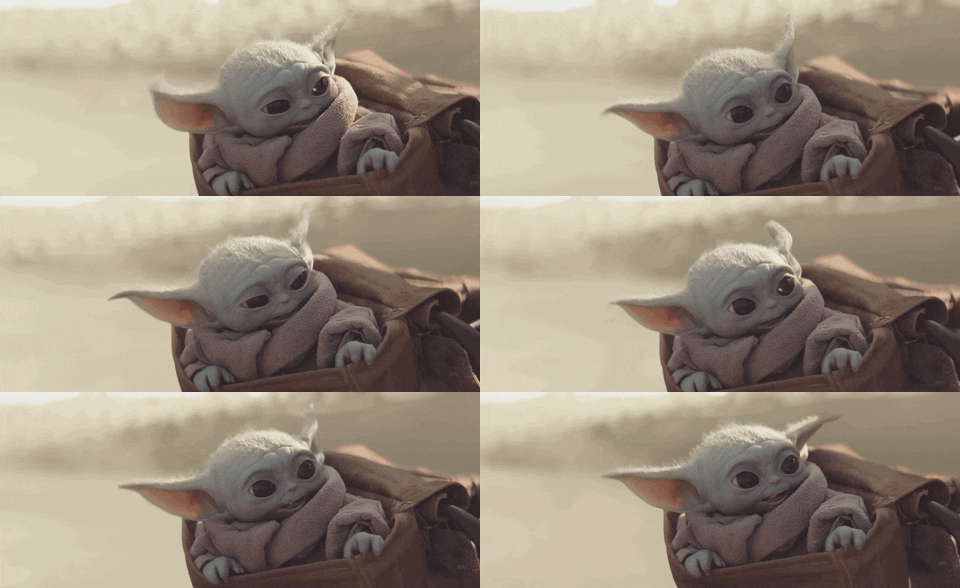
As a modern update, The Mandalorian gives us a bit more of a grey area.  I’m sure these Mandos have many beliefs, but their most central tenet is keeping their helmets on.  This means, throughout its two seasons, we see hardly any of our star, Pedro Pascal.  His ever-present voice lends some of his trademark charisma to proceedings (as seen in Narcos and Game Of Thrones (Season Four)) but he’s otherwise comfined to his armour, giving us more time to admire the Disney-est thing about the whole show: a little baby “Yoda”.  Perhaps the whole treatment started with a merchandising idea, but let’s just go for it.  Our Mando is a ruthless bounty hunter till he sets eyes on the cute one.  From then on, we’re basically viewing a multi-planet babysitters’ club, but it’s all great fun.

The fun is directly proportional to the budget, with everything looking very expensive.  Our hero’s ship, the Razor Crest, features heavily, even finally answering the question of whether these things have toilets on them.  Every time we set off, Mando must flick and click a great number of switches in his cockpit, perpetuating the legacy of Star Wars’ analogue origins.  If it were being imagined now, he’d just have an iPad in there.  Yet, sitting down each day at my home office desk, turning on all my various bits of gubbins, I too am able to imagine I am some sort of Star Wars pilot preparing my ship.  On goes the laptop, the big screen, the speakers, the lamp, the wireless mouse and keyboard.  I’m not taking on the Empire but some of my work emails are rather fiery.  Try it yourself.

But yes, back to the show.  It’s a big tick from me.  I had to come to terms with the fact that this is basically a western.  This Mandalorian is the most lonesome of rangers, with each episode featuring an almost self-contained micro-mission en route to the great big mission of the series finale.  I’m not normally a fan of moving from setting to setting, but each lush spectacle of a new planet is a further glimpse into the inner workings of the Star Wars world.  I wanted to stop and see what each person was doing.  I mean, where is everyone going in all those Empire corridors?  You can be certain of quality viewing, though.  All I could suggest to elevate things is some actual gore.  Let’s be clear, most of our adventures involve an absolute massacre of Stormtroopers, yet the violence can have a cartoonish quality.  At one point, I was reminded of Power Rangers, and nobody wants that.  I won’t suggest, however, that we investigate more intimate activities in pursuit of that adult rating, as I have already pointed out that fervent Mandalorians don’t take their helmets off, much less, I imagine, their breeches.  There’s plenty of other action to enjoy, and you’ve always got Bridgerton/Industry/Euphoria/Normal People if you need some rumpy pumpy.

Thursday, 4 February 2021

Bridgerton

I don’t know how they do it, but Netflix always seem to know just what we need.  It’s Christmas Day 2020.  Everyone is coming to terms with substantial compromises to their celebrations, potentially stranded far from home by following the whiplashing advice from the old boys’ club running our government.  The weather is crap, the year is being wished over, and little do we know, the next one is going to be getting off to the most underwhelming of starts.  And pow, Netflix drops the most optimised dollop of delicious escapism right in front of our eyeballs.  That’s right, this week we’re doing Bridgerton.

Regular readers won’t be surprised to know that I was very late to this party.  Spirited away to my parents’ just before London was turned into an inescapable fortress, their loyalty to live TV had driven me away into my Louis Theroux documentaries.  Returning to my home and work (which have now been the same place for nearly a year – I can’t confirm if I will ever wear underpants again), everyone was talking about one thing: Bridgerton.  I resisted its call.  I didn’t need to follow the herd.  I was deep in other series (wondering if The Sopranos would ever end).  Its mania would pass.  But then, instead, it snowballed.  Every other Guardian article (I ignore all other news – no surprises there) was about its music or its fashion.  It was revealed as the most watched Netflix production.  My interest was piqued.  Then everyone chuckled at the explicit sexual content and, lo and behold, I was sold.

The eight episodes are based on the first in a series of novels that follow the fictional Bridgerton family.  Named alphabetically, they’re an A to Z (well, an Anthony to Hyacinth) of upper-class London society in 1813.  We’re with them for a social season, from the young ladies’ debuts through weeks and weeks of balls balls balls until a final climax that sees all the lords and such retire back to their country piles.  Here’s the first reason Bridgerton’s timing are spot on: all these well-attended events are spectacles we can only dream of.  Right now, a good day out is a mask-clad whiz round the supermarket.  A lavish night of dancing and drinking, dressed up to the nines, is as alien to us as most of the social conventions of nineteenth-century Britain, but it is so richly and colourfully brought to life on screen that it has the power to fill that part of our lives that is so sorely lacking.  There’s even a nod to our present day, with the string quartets treating us to classical interpretations of modern pop songs.

While we’re at it, the costumes are a second well-tuned route for vicarious living.  Most of us are now set in our leisurewear (please see earlier comment about underpants), but the lords and ladies of Bridgerton are never out of excuses to push the sartorial boat out.  Even the discomfort of very tight breeches or having your cleavage shoved up beyond your clavicle offers a welcome break to shuffling about our homes in slippers and hoodies, with the exception of the Featheringtons’ sickly colour palette.

Thirdly, the show is on the pulse of our enthusiasm for diversity, putting black Georgians front and centre.  No need to explain, no indulgence of anyone feeling threatened; it’s just a great time.  Any protest with reference to historical accuracy is farcical, and probably from the same people who wanted The Crown accompanied by trigger warnings.  Some people simply don’t deserve content this entertaining.

But lastly, it is just the story for the moment.  In a foreign world of ladies’ reputations, archaic courtship and primogeniture, there is a welcome frivolity to the various love stories.  Bosoms heave, sideburns protrude, and eyes are made across the ballroom, and we’re unable to resist caring about girls making a good match and marrying for love.  Some jeopardy is clunkily contrived, with Anthony Bridgerton (Jonathan Bailey – a key player from W1A and Crashing) going from key barrier to his sister’s happiness to someone without quite enough to do, and the endless speculation regarding the real identity of Lady Whistledown (Gossip Girl gone Georgian) lacking compelling consequence.  But once the love making starts, we’re miles away from the grit and realism of something like Normal People and drinking in every romantic thrust of some good old-fashioned shagging.  You don’t get that in Downton Abbey.  Yet the shenanigans don’t feel gratuitous – they’re just another layer of fun in all the stories.  More remarkable is the sheer size of the cast, with every peripheral player committing wholeheartedly from the start, gradually coming forward as fully formed characters as the episodes progress.

Sure, the script could have done with one more proof-read to tighten the lines beyond the point of simply aping how people probably spoke in the olden days, and maybe some of the cast are guilty of doing theatre acting with their shouting and enunciating, but there’s little to fault with Bridgerton if you’re looking for a hearty romp.  I would even go as far to prescribe this as self-care at a time when reasons to be cheerful may appear to be lacking.  Switch off the 5pm briefing when we get put into surprise tier 22 and take yourself off to the world created by Julia Quinn and realised by Shonda Rhimes (How To Get Away With Murder, among many other things).  It’s a treat we all deserve, and it’s come at just the right time.

Thursday, 28 January 2021

American Dad!

Due to a human error in my home office, this week we are back raiding the archives.  Yes, I’ve failed to time the completion of any new boxset to coincide with my weekly post.  You’d think that during another lockdown, when there’s literally nothing else to do besides consume hours of TV entertainment throughout the day and into the night, I would be doing better than this.  Truth is, I’ve only gone and started a part-time MA in Creative Writing (don’t laugh, especially if you see no improvement in the quality of this blog) and so I am occasionally drawn away from the big telly screen in one corner of the room to the smaller laptop screen in a different corner of the same room.  You’ve gotta switch it up.  I shan’t apologise for this oversight, as I can do whatever I want (provided I stick to government guidelines about staying two metres away from all other humans, unless I am testing my eyesight), but it’s also allowing me to reminisce about a show that’s linked to significant memories in my life: American Dad!  The exclamation mark is in the show’s title; I am not overexcited.

Now seems like a good time to turn our attention to a cartoon that set out to lampoon American foreign policy and domestic culture wars.  The year was 2005.  I was an undergraduate.  The White House was covered in Bush.  We were told our biggest fear was terrorism, to distract us from climate change and a lack of equality.  Sixteen years later, the US is recovering from an individual who makes Bush look like a harmless uncle, I’m jaded by thirteen years of office work (but am back studying), we’ve made little progress on climate change, some on equality but not enough, and the culture wars are worse than ever.  But there’s hope in America (if not yet in the UK).

American Dad! follows the Smith family, headed up by CIA career man Stan, often serving as the boomer/conservative voice, his wife Francine (she comes and goes policy-wise), and their two entitled millennial kids: Steve and Hayley.  The humour comes from the characters and the farcical things they do, often originating in Stan’s unerring patriotism and crashing into the kids’ sensitivities and/or self-obsessions.  This, plus the Washington DC setting, probably all sounds a bit vanilla.  Firstly, let’s point out that one of its co-creators is Seth MacFarlane, the comic behind Family Guy (which needs a post here too).  Any earnestness is therefore dowsed in irreverence, invoking the truism of South Park: everyone on every side of every argument is stupid.

Adding, then, to our human silliness, I’d now like to tell you all about Roger, the alien.  Hiding out at the Smiths’ after being captured during secret CIA work, Roger comes armed with a third option of opinion that often lays waste to those of the Smith generations.  An incorrigible sass-mouth, whose penchant for showing off clashes with his need to remain hidden, Roger has all the best lines and has to be carefully rationed in each episode so we are left wanting more.  He’s a world champion of dressing up though, which develops in later seasons (there are seventeen and counting) to allow more and more walks of life to be laid bare and exposed as nonsense.  Contrasting with his sharp wit, there’s also a German goldfish who’s pervy for Francine but unfunny in every other way.  He also murders the German language with incorrect grammar, and this is unacceptable on all levels.

I’ll admit to being way behind on keeping up with American Dad!  It was 2007 when we first got our hands on DVDs (yes, ancient times) of the show.  Such was our excitement that we gathered round someone’s laptop to watch them the minute they arrived.  It happened to be the day I had finished my last final exam (I had to sit eight three-hour papers dressed in an academic outfit called subfusc: dark suit, white bow tie, commoner’s gown, a carnation of the right colour, carrying a mortarboard).  The university tradition was for friends to meet you from your final paper to throw streamers and silly string over you, give you drinks and congratulate you for surviving.  I was therefore still in my formal get-up, covered in crap, and full of cheap booze.  You’re supposed to have a wild night out to enjoy your new freedom.  But I was powerless to resist the promise of subversive new animated comedy from America.  Indeed this is proof that I have always been cool, especially as I fell asleep after only a couple of episodes, but not before I’d heard Roger utter his immortal lines: “By the way, Hayley, oh my god. These Chocodiles. These Chocodiles, Hayley. Oh my god. These Chocodiles. Oh my god.”


Thursday, 21 January 2021

I Hate Suzie

Something terrible happened towards the end of last year.  As a liberal hipster, my easily distracted thumb was pottering around on the Guardian app and I came across an article counting down the top 50 TV shows of 2020.  Like you, I did wonder for a moment why I hadn’t been asked to write it, but then realised I am not actually a professional journalist.  But, as an amateur connoisseur of boxsets, I quickly clicked it and read it, anxious to see whether I could nod in reassuring agreement or reel dramatically at their choices.  Naturally, in first place we had I May Destroy You.  Well done me; I had watched this.  But, at number two, was I Hate Suzie.  For shame, I had never found the promos of this show appealing.  I had in fact ignored a friend’s recommendation to try it, even though he was the same rascal that turned me on to my beloved Industry.  With lockdown going on forever, I made my way through its eight episodes on Sky Boxsets.

Billie Piper is as much a part of British culture as xenophobic newspaper headlines and voting in comedy prime ministers.  A massive popstar when I was in secondary school, she purveyed pop songs so cheesy and catchy that we laughed derisively about how uncool she was.  We were much cooler, being obscure, untalented children and all.  Until recently, though, my household did contain a CD single of Honey To The Bee, an underrated subsequent release of hers that almost references my surname.  It might still be around here somewhere.  But, thanks to my own perception of her as a singer, I never engaged with any of her acting up till now.  Secret Diary Of A Call Girl was a mainstay of pre-Love Island ITV2, but not of my viewing schedule.  Yet my friend, and the Guardian write-up, promised something worth investigating.  As a sufferer of FOMOIEOYCRL (fear of missing out in end-of-year cultural ranking lists), the completionist in me was prepared to embrace Billie and welcome a bit of Piper back into my life.  Because I wanted to.

Our premise is eerily similar to Piper’s own real-life trajectory.  She plays Suzie Pickles, a national sweetheart shot to fame on a reality TV singing show (hello X Factor) before transitioning into a TV actress.  She’s one of those people in the magazines and on the gossip websites and just doing this now.  Only the last thing she’s just done, putting at risk her entire career, is suffer a leak of private, explicit photos to the media.  Sadly, the shots are not a solo performance and her accompaniment comes in the form of an extramarital phallus, so there’s all that to deal with as well.  Each whirlwind instalment focuses on a single one of the eight stages in Pickles’ response to the trauma.

In the process, Piper and co-creator (and full writer) Lucy Prebble (as previously collaborated with on Secret Diary Of A Call Girl) use the unfolding disasters to provide deliciously inventive commentary on a huge number of our daily staples: the treatment of women, motherhood, fame, disability, loneliness, sexuality and so on.  From the audible diarrhoea-induing first discovery of the pics to a proliferation of meltdowns, via awkward family events (the wedding of Pickles’ sister is outrageous and universal at the same time), frustrated self-loving (for more or less a whole episode) and the ripest sending-up of celebrity culture, Piper’s performance is everything.  The camera often just gives us all that face and it becomes our anchor in the madness, trapping us with Pickles in her nightmare.

Yet more intriguing is her agent and best friend, Naomi (Leila Farzad).  The dynamics of their relationship creak under years of irreconcilable imbalance until we scream at Naomi to respect herself and prioritise her own needs.  Naomi gives one of the best ever shutdowns to casual, micro-aggressive racism I have ever seen, but her wronging by men knows no end (that train journey).  Pickles’ husband is himself human collateral in the fallout.  Daniel Ings (one of the joys from W1A) is exasperated as Cob, eagerly weaponizing their deaf son to his advantage yet less than keen to lose the perks of having a famous wife.  Even with her success, it is he, as the man, who expects to be more important in everything that happens.

I admit to lacking patience with some episodes, but I am learning to love this freewheeling style (as seen in I May Destroy You) where creativity and storytelling gang up not to care about what you’re expecting.  By the final scene of the final episode, my sympathy for Suzie Pickles was at its peak.  I had never hated her and I don’t know who did.  Having it all is simply another thing to feel lonely in spite of, only it emphasises the unjustifiability of that loneliness, so you feel even lonelier.  Does Suzie’s preoccupation with herself drive others away, or do they give up on her when she doesn’t give them what they think they need?  I still can’t work it out.


Tuesday, 12 January 2021

The Walking Dead: World Beyond

A lot of things surprised me in 2020.  The pandemic was one thing, chuckled about as some distant news story on a ski holiday with doctor pals in January and then ruining things throughout the rest of the year and beyond.  In August, I broke my hand on a barbell, which was in itself a nasty surprise, especially as I was in a cast during a number of weeks when gyms actually were open.  But also on that list of unexpected events is the appearance of a second spin-off programme from the universe of The Walking Dead.  There was me, one evening during some of lockdown, scrolling through my screening platforms and strategising to decide what to watch so I could join in with all the chatter and ensure a completed boxset each week so I can keep up with these nonsensical weekly posts.  Picking my way through Amazon Prime with low expectations, wondering if Jeff Bezos really needs any more money off me in this day and age, and there, nestled among subsequent series of Mr Robot and The Man In The High Castle that I will never sit through, was the recognisable font of The Walking Dead.  But, this wasn’t in the characteristic dark hues I normally associate with this horror series.  It was bright and neon, exciting and new.  I didn’t need to think twice before clicking play on The Walking Dead: World Beyond.

We’ve discussed the importance of the colon here before.  And no, I’m not talking about the large intestine (shout out, IBS sufferers).  I’m on about those two dots you sometimes see between words.  In TV shows, they separate an original title from its spin-off progeny.  You know, like Narcos and Narcos: Mexico.  Such a tiddly pair of punctuation points can carry a very large responsibility.  If you’re an impassioned fan of the original show, then this extra facet better be a welcome addition rather than an embarrassing dilution.  High hopes were had.  The Walking Dead, abandoned by many, remains my definitive zombie boxset.  Despite running for so many series, it always maintains its edge in finding new ways to bring to life the horrors of an ongoing undead apocalypse.  Its companion show, Fear The Walking Dead, was one of the first programmes I ever wrote about here and itself attained similar heights to its originator.  To recap, then, I had high hopes.  I have now written some paragraphs about my disappoint.

Just One More Episode was meant to be an exercise in boxset worship, but it’s developed a side hustle as the internet’s definitive home of zombie TV content blogging, so it’s only fair I speak frankly about World Beyond.  What made those hopes all the higher was the interesting angle of the concept.  With the initial outbreak of walkers now so far in the past of The Walking Dead’s universe, World Beyond would tell the stories of the first generation to come of age since the end of the world (a bit like the future youth of the UK now we’ve been dragged out the EU).  Our protagonists are enjoying their teenage years at the Campus Colony, a university-based satellite settlement of a grander network of civilisation that has sprung up.  For me, simply seeing how life is conducted there would be compelling enough, but this would clearly lack any real jeopardy.  Cue the Civic Republic, a more enigmatic political entity with whom our heroes’ community is forging a new relationship.  Hope and Iris are sisters whose father has gone to lend his academic skills to the Civic Republic but, suspecting him to be in danger, they sneak out of their safety bubble and embark on a journey across the devastated USA to rescue him.

So, we’re dealing with sheltered teens here.  Understandably, they’re not used to brain-injuring countless walkers while out and about.  In fact, they’re so pathetic, they tend to scream and lie down, allowing a zombie to get on top of them and try to bite them, only for an adult to have to come along and sort them out.  How they avoid getting bitten is beyond me, but this not only makes the walkers look like a non-threat, it makes it hard to respect our heroes.  By its very nature, the most kick-arse Walking Dead characters are the ones that can handle themselves around zombies with skill and flair.  Sure, the kids in our ragtag gang of rescuers all have the comic book-inspired looks we would expect, clutching weapons that give their character a signature or dressed individually to showcase that they’re hard as nails/troubled/a bit intellectual.  But it’s all mouth and no trousers.

Then there’s the fact they’re on a voyage.  Our setting is therefore a stream of southern scenes that don’t really ever establish a sense of place and theme.  Each season of The Walking Dead has a settlement at its heart, but in World Beyond we stumble from one tire fire to the next disaster, giving the episodes a cumulative effect of never really going anywhere.  We know Hope and Iris’s dad isn’t going to be rescued until things have been drawn right out.  This diminishes the tension and, ironically for Hope, drives in a feeling of hopelessness you can’t really escape.

The Civic Republic itself is squandered as a source of intrigue.  Too over the top to be that credible, yet too mysterious to be a true threat, they top and tail this first season of ten episodes in a way that makes you wonder if they’ve been forgotten.  There’s no real reason for them to be so sinister beyond the well-established concept that, even in a zombie apocalypse, humans will always be the biggest monsters.  We almost rush through any substantial grounding of the political and civil landscape to focus on the inner emotions of our teen stars, but watching them come to terms with smashing the head in of their first zombie of a multi-episode character arc just isn’t what bloodthirsty Walking Dead fans are looking for.  Naturally, the only way to script such psychological storytelling is with clichés, driving down the show’s originality score even further.

You have to be cruel to be kind, so let’s hope the second series finds some edge, otherwise this could be the beginning of the end for a character universe that has compelled so many viewers up till now to follow its adventures.  My hunger, quite literally, for zombies, means I will sit through this stuff, but treat yourself to something like Black Summer or Kingdom (킹덤) if you’re serious about living your life under the constant threat of the dead coming to life and eating you.  You never know what 2021 might bring.

Monday, 4 January 2021

The Sopranos

It’s 2021 and everyone’s glad that 2020 is over.  However, we still seem to be in lockdowns (and, worst of all, we’ve come out of the EU as if to exacerbate deliberately the economic effects of a pandemic).  If someone had said back in March that we’d be isolating and social distancing for a whole year, they’d have been told to do one.  The month-by-month slipping by of time under these circumstances is perhaps one of the worst things to look back on.  But that said, I’ve continued to embrace all things locked and down, and taken on a boxset that was definitively a big part of things way back at the start of all this.  Along with baking banana bread (didn’t do it), watching Tiger King (loved it) and clapping for carers (never did it as I would rather vote for parties that support essential workers instead of performatively applauding them in some hypocritical act of self-soothing), the government also mandated we should all re-watch The Sopranos.

Only I had never seen it.  I think, when it first emerged in 1999, I dismissed it as a programme for dads to watch.  I was a thirteen-year-old Surrey schoolboy, so I failed to see any real common ground or entertainment value in New Jersey mobsters and their mental health issues.  This means I got to spend the rest of my life telling people I had never seen it, holding out like a deluded antivaxxer.  But, in 2020, with more time forcibly on my hands and a lot of my favourite podcasters extolling the show’s virtues, I clicked download on my Sky Boxsets and settled in with high expectations.

Things, initially, appear to be quite dated.  At over twenty years old, the first season is indeed vintage.  The violence is fine, but the nineties décor of the Sopranos’ family home is quite hard to stomach.  I’m told this was the big splash that the programme made, the first in HBO’s run of revolutionising the boxset.  More blood, more boobs, more bad language.  I’m all for the constant risk of sudden nudity (see post on Industry), but the Sopranos’ contribution to this, throughout all six seasons, is a reliance on interstitial footage of the female staff of Bada Bing (still the best name ever for a mafia strip joint) jiggling their cleavage before we pan to a conversation among Tony and his brethren.  Yet, you can see the foundations for the expectations we now have of a seriously quality boxset.  And by the sixth series, it’s much easier to recognise these tropes.  In addition, with each season, the improvement in story-lining abounds.  At first, it seems to be a selection of things happening and we have none of the tight winding to a climactic final episode that the modern viewer expects.  A bit of this and a bit of that and, bada bing, the season ends.

In fact, some of the more action-based performances are slightly tentative.  Let’s be honest – this is just middle-aged men having a punch up, but I never fail to be impressed by the fisticuffs abilities of Silvio or Paulie when it comes to taking on any and all comers.  It’s often their sheer balls that outwit their opponents.  While the fight choreography doesn’t run rings around anything, the crime family do run rings around the cops.  It seems you can shoot your enemies willy nilly and the police won’t have a clue.  That said, there’s plenty of criminal-on-criminal abuse, making it clear that, as with Narcos and Top Boy, heading up an illegal organisation is a constant challenge, with a high churn rate of employees.

If anything, The Sopranos is a fairly affectionate lesson in how the mafia apparently works, with some Italian-American history thrown in.  I can’t remember if the show was accused in its day of glamorising organised crime (see earlier comments about middle-aged men fighting) but I can’t really see the appeal in how they run things.  There’s constant squabbling about who’s kicking up to whom on which dustmen routes, squeezing pals for higher percentages and then going for constant meals out at various Italian restaurants.  The death knell for me was when characters started to comment on how delicious certain gravy was.  In Britain, gravy does not go near pasta, so this was an abomination too far.

Away from the careers, it’s the adjacent families that always capture my interest more closely.  Tony Soprano himself, while an inexplicable lothario whose audible nose-breathing proves irresistible to almost any woman he comes across, is really your average put-upon breadwinner.  Outside of his day job and trials at work, dealing with his family is a source of even more compelling drama.  I love Carmela’s endless nagging, trying to hold moral high ground while constantly benefiting from dubious activities.  If not picking arguments with Tony, she’s passively aggressive or outright aggressive to daughter Summer and younger son AJ.  Both kids are brats whose impetuous parental arguments mirror their father’s own office politics back at the cosa nostra.  No wonder Tony resorts to therapy.

Indeed, it’s Tony’s time with Dr Melfi that helps to provide further exposition to his trials, but there’s a sense that nobody knows what to do with the therapist during some of the seasons.  I, for one, would have liked to see her branch out into overhauling Tony’s other health problems: smoking cigars, eating processed pork, never exercising outside of copulation, stressful occupation.  However, Dr Melfi gets to be badass in the final season, standing up for herself at long last.  In fact, the female characters add the greatest depth to proceedings overall.  From Tony’s mother, to his spoilt older sister Janice, via an array of mob wives of different shapes and sizes, the show makes it clear that they keep things ticking over.  Which brings me to Drea De Matteo’s stand-out turn as Adriana.  Having only ever seen her in Desperate Housewives, I was drawn in by her complexity as Christopher Moltisanti’s girlfriend.

If I were to analyse this, I would say Tony’s line of work is almost irrelevant, serving as just another lens on the American Dream.  Work hard enough and you can have it all, but what do you do with the all when you have it?  And how do you make sure you keep it?  What adds spice is The Sopranos’ position as an immigrants’ story.  While Tony’s associates are fiercely proud of their Italian heritage, they’re more conservative than the waspiest of Jersey’s residents, expressing outdated views about other minority groups, homosexuality, gender equality and all manner of social topics that continue to be hot buttons in 2021.  While I wasn’t always as gripped as I expected, I settled into a rhythm with my pals in the Soprano family, their whingeing accompanying many a WFH lunchbreak or the near-completion of a one thousand-piece Friends jigsaw I came back from Christmas at my folks’ with.  As the final scenes of the family meeting in the diner played out, I felt an additional tension around their prospects.  Despite it all, I wished them very well indeed.