Showing posts with label british sitcom. Show all posts

Sunday, 29 September 2019

The IT Crowd


People often ask me what do you do with yourself when you’re visiting Rome with pals but some of them have come over from China and therefore need afternoon naps to cope with the jetlag but you don’t sleep in the day because you wear contacts and are a machine?  The answer is simple: I watch The IT Crowd on the AirBnB’s Netflix account.  Part of my aversion to day-sleeping comes from a quality instilled in me by my mother that all time must be productive, otherwise I might have indulged in the slumber too.  In fact, given my penchant for early starts (5.30am on weekdays everybody) my body does shutdown if I am inactive for 45 minutes or more.  This makes afternoon meetings at work a huge no go, unless it’s me doing the talking, otherwise my plan just to shut one eye at a time so I’m only half giving into hibernation routinely results in nearly missed faceplants on company furniture.  Luckily I’m known for looking bored in all meetings, so this behaviour is part of a professional reputation I’ve spent over ten years building.  Secretly, I hear and remember all things (thank you, Asperger’s).


But yes, this well-loved sitcom (that ran 2006 to 2013) which I had never really seen before, despite getting halfway through the first season several times, proved to be one of the highlights of Rome.  Don’t worry – I had been before in 2005.  We did all the things, even spotting the then Pope (the former Nazi one, which reflects all my views on organised religion perfectly), not to mention me being stopped by elderly Austrian ladies while leaving a restaurant so they could tell me I looked like Hugh Grant’s younger brother.  Thanks.  This meant that my 2019 return was a chilled affair.  The non-Netflix highlights were my successful digestion of Roman gluten in several kilograms of pizza and pasta and a guided tour of the Forum by the talkative Giancarlo, whose palpable disappointment at his young charges actually being in their mid-thirties was exceeded only by his delight that one of my friends knew more than him about ancient Rome and ecclesiastical trivia.


Over a couple of afternoons, while it rained outside (mostly), I made my way through the four series and additional special of The IT Crowd, soothed under the apartment’s air conditioning, which made up for the major flaw which all AirBnBs subtly carry until you notice it on checking in: the third bedroom (mine) was actually a bed in a cupboard.  But let’s not dwell on the fact that I eventually commandeered the living room as my man pad and actually get into the telly bit of this week’s blog.  Back in 2006, every company’s IT department was endowed with majesty and mystery.  Nobody knew how their work computer functioned, yet a whole team existed to fix any bugs, viruses and digital runny noses that would occasion to happen (especially if you opened dodgy emails).  I’m pleased to report that, in 2019, things are exactly the same.  The Office perfectly captured the condescending IT geek whose one time to shine was while chastising the common worker for overheating their hard drive.  But the, er, crowd of The IT Crowd are a million times more lovable:

Roy

He of the ironic t-shirt and asking helpdesk callers if they’ve tried turning it off and then turning it on again (a joke that never gets unfunny, even in real life), Roy’s anger and impatience are a joy to behold.  This is because everything sounds delightful in Chris O’Dowd’s Irish accent.  Some of his best moments are in The Work Outing, when a toilet use misunderstanding is ensued by deeply offensive yet hilarious consequences, but I can’t get enough of him complaining about being kissed on the bottom by a male masseur in Something Happened.  Like me, O’Dowd is an actor who looks worse the younger he is.


Moss

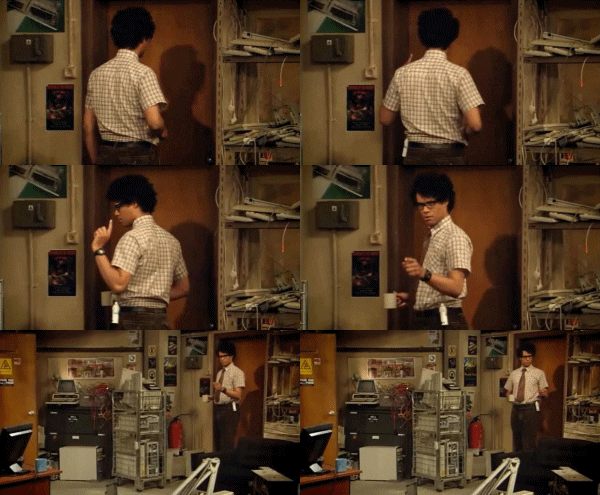
This character at first seems like a caricature, but ends up with inordinate mileage and depth.  I think I enjoy him most in The Final Countdown when the amazing Richard Ayoade gets to deliver the immortal line: “I came here to drink milk and kick ass. And I've just finished my milk.”  His every attempt to be normal only makes him more unusual, and that’s why he’s so special.

Jen

Played by Katherine Parkinson, who I would like on my screens more often please, Jen has one of my favourite voices in television, let alone comedy.  One of the key conceits is that Jen doesn’t know a thing about technology, despite being head of the IT Department.  But she can front anything, even without knowing what the I and the T stand for, or while thinking the internet is a black block given to her by Roy and Moss.  Her funniest moments are in Italian For Beginners when, in a delicious send-up of woman-on-woman workplace passive aggression (a situation that arises when women fight each other for dominance rather than taking on the chauvinist men-pigs holding them down) Jen pretends she can speak Italian and ends up translating for a visiting businessman by reeling off various Italian brands and sounding genuinely convincing.


Alongside our three heroes in the basement of Reynholm Industries, we are treated to occasional appearances from Richmond (Bake Off’s Noel Fielding) and almost constant appearances from series two onwards of Matt Berry as Douglas Reynholm himself.  I won’t extol the virtues of each here, as, if you don’t already recognise their genius, you can close this window and buy a tabloid newspaper (such is your level).


While some jokes have dated as attitudes have modernised and sensitivities adjusted, The IT Crowd, while guaranteeing an average of five LOLs in a decent episode, provides a lot of commentary on elements of our collective culture that are still relevant today: the impact of the internet, how we behave on social media, inequality, sexism, nepotism, unchecked privilege and turning computers off and turning them on again in order to make them work.  Let this be added to the guidebooks alongside the Trevi Fountain as one of the wonders of Rome, but please rest assured this can be watched in other places as well.


Wednesday, 28 August 2019

Keeping Up Appearances


This blog was going to be so cool and edgy.  I was going to uncover hidden gems on obscure platforms, curating them for readers’ viewing pleasure like some sort of Walter Presents, only with more hair and no glasses.  Highbrow people would come to me wondering what to watch.  This was clearly never going to happen for two reasons: firstly, I watch too much trash.  I’ve covered all the dross on here, from Geordie Shore to Ex On The Beach (broadly the same show) via Love Island and Bromans (which I still remember fondly yet it curiously doesn’t seem to be appearing for a second series).  Secondly, there aren’t enough hours in the day to get through all the TV.  I’m fairly vocal with anyone who’ll ask (nobody asks) that I have to be in bed by 10pm, which leaves a maximum of two telly-viewing hours of a weekday evening when I’ve dragged my heavily sweating body home from the office via a Tube, a bus and a quick walk.  With so many subsequent series of things like Peaky Blinders and Great British Bake Off taking up my schedule, my chances to uncover and share any gems, trashy or otherwise are limited.

So we’re back raiding the archives this week.  And what an old archive I’ve raided as I’ve gone all the way back to a sitcom that ran from 1990 to 1995.  I think I was searching for Cardinal Burns clips on YouTube for a previous unpopular post when I suddenly started getting served montages of this show, all in aid of promoting BritBox – seems to be some sort of platform for watching exactly the sort of old stuff I’m talking about this week.  Cunningly, though, another motivation to cover this is that aged British comedy that only just predates the internet gets the most reads.  Not straightaway, but I think eventually the searchbots crawl in and I end up being a leading authority on such classics as Bo’ Selecta! – now the most read post out of everything on Just One More Episode despite the clamouring apathy that greeted its initial publication.


And here we are, then, talking about Keeping Up Appearances.  Let’s begin with Patricia Routledge, a national treasure if ever there was one.  She had already proven she could hold her own, fully alone, in the outstanding Kitty monologues that featured in Victoria Wood’s As Seen On TV (something I immediately binged through when I spotted it on Netflix, but given my sycophantic piece on dinnerladies, I’ve saved posting about until another time).  As Hyacinth Bucket, she was given a wider world to expand into with her trademark impeccable character portrayal – not that any single line of Kitty’s lacked a complete visual rendering in the mind’s eye.


Hyacinth likes to keep up her appearances.  This is because her origins are distinctly lower class, so having scraped into the bottom rung of the middle class by acquiring a three-piece suite and (obsessively) cleaning her well-twitched net curtains, she exhibits the excruciatingly British trait of being agonisingly class-conscious.  Throughout the five series, she denies any association with her sisters: slovenly yet lovely Daisy and glorious maneater Rose, not to mention Daisy’s other half, Onslow, king of the slobs, played by the fondly remembered Geoffrey Hughes (also known as Twiggy in The Royle Family).  I’ll be honest though: as a Surrey schoolboy whose own parents’, shall we say, self-improvement naturally led to an element of snobbery, I was as appalled by Hyacinth’s family as she was.

In fact, as a child between the ages of five and ten when the show first broadcast, I couldn’t for a long time see what the joke was with our Hyacinth.  She had high standards, liked nice things and always wanted the best to happen – what wasn’t to like?  Her phone manner was clearly over the top, “The [bouquet] household; the lady of the house speaking,” but her candlelight suppers sounded like a hot invitation and she was always immaculately turned out (unless she had a tipple, in which case she became immediately dishevelled).  I could never understand why her neighbours, Elizabeth and Emmett, got so nervous about seeing her, though their anxiety rubbed off on me as I was always terrified of the impending moment one of them would be left with no choice but to smash their teacup on the floor in response to Hyacinth’s outbursts.  In conclusion, I really just thought this was a show about a nice lady, with lots of unexplained canned laughter.


Granted, despite the academic heights I later reached, some of the cleverer jokes were beyond me.  Whenever she quickly spelled her surname as B-U-C-K-E-T while insisting it be pronounced bouquet, I really had no idea what was going on, unable to match the spoken letters quickly enough to form the joke – all this despite the letters and spellings questions in University Challenge later being my top scorers.  Another regular recurring joke revolved around her phone number resembling that of a Chinese takeaway, which teed up many euphemisms about the availability of crispy prawn balls at the Bucket residence (low) due to misdials.  My own parents firmly believed that takeaways were for emergencies only and a clear sign of idleness on any other occasion.  To this day, I don’t use Deliveroo or Uber Eats, which does save me money and demonstrates a clear benefit to all the emotional scarring we’re unearthing here.  But this meant I had no idea that you used dish numbers when phoning a Chinese takeaway so I simply patiently waited for these scenes to end, safe in the knowledge something silly would happen eventually.  I remember we did once get a Domino’s as a family for some sort of treat, but this was of course served on our own crockery, with folded paper napkins, just in case anyone looked in through the window and thought we had a low household income.


Suffering through all of this we had Hyacinth’s husband Richard (a name she pronounced so wonderfully I can hear it ringing in my ears).  While driving, he would be told to mind the pedestrian, while gardening, he would be told to look like he was enjoying himself, lest people think a gardener beyond their budget, while rushing around at Hyacinth’s beck and call, she would hope he wouldn’t spoil things with lower middle-class humour.  Let’s face it, the man probably had clinical depression, which, added to her neighbours’ crippling anxiety, was just part of the show’s scathing social commentary around British snobbery.


Indeed, in real life, as a Daily Mail reader and probable Brexit voter, Hyacinth would be my natural enemy.  It’s hard to say how well the show has dated, but more valuable are my fond memories of crashing down the stairs to join my family in watching each episode in the early nineties.  This was all thanks to Routledge’s ability to create charm where there should be none.  Every line is a masterclass in delivery.  Every delivery is a masterclass in character.  Hyacinth Bucket remains as relevant as she ever was so we shall give her the last word, and the lifelong snob in me can’t help but agree with her sentiment: “If there's one thing I can't stand, it's snobbery and one-upmanship. People trying to pretend they're superior. Makes it so much harder for those of us who really are.”


Sunday, 2 June 2019

The Royle Family


After so many posts harping on about national treasures in the world of telly (Fleabag, Nighty Night, Chewing Gum), I’m prompted this week to consider the national treasures we have lost.  British summer seems at last to have remembered that it’s June and, judging by my back sweat as I sit on this Sunday morning train home to London from an idyllic seaside wedding in Kent, this better weather may indeed seem at odds with the somewhat hibernal nature of the show in the title of this week’s offering.  But indulge me the lack of seasonality; we’ve covered nearly a hundred shows here so perfect alignment to the cultural calendar isn’t always possible or interesting (to me).  In fact, continuing with the theme of writing more about myself than the shows in question, it’s the loss of a personal treasure that has influenced me here.  But don’t worry: it would be fairly uncharacteristic of me to display genuine emotion, so you’ll just need to bear with me as I segue clunkily from a death in the family to irreverent commentary on a sitcom from a few years back.  I mean, yes, even that sentence was clunky, wasn’t it?

We’ll start with the theme tune.  For us in our late twenties and early thirties, Oasis sound-tracked our coming of age.  In fact, last night’s wedding culminated in the bride and groom held aloft on the shoulders of pals, Don’t Look Back In Anger blaring out from the booth of a DJ only slightly disgruntled that a drunken pal had spilled drinks on one of his lights (which he then mopped up with a cushion) and with raucously caterwauled backing vocals provided by a choir of prosecco-fuelled Millennials playing at being adults, a moment as aspirationally instagrammable as it was beautiful in real life.  But beyond this band’s best-known hits, Half The World Away sticks out, not for being any less anthemic, but for its subtle pain teamed with muted comfort.  And thus, Noel Gallagher’s voice brings us each episode into the world of the Royles of Manchester.


I am bound to confess that my household missed out on The Royle Family during its initial broadcasts on BBC2 in 1998.  As northern as gravy on everything, the show failed to appeal to my southern clan’s Surrey ways.  These people were unemployed, so what interest could we have in their lives?  While their working classness was there to be celebrated, my parents had striven all their lives to project middle class temperaments at every encounter: for example, I wasn’t supposed to watch Grange Hill in case I picked up on their examples of poor speech.  It was only during my year abroad that a dear friend sourced and shared the DVDs.  I’ve previously talked of how, at the time, daily viewings of dinnerladies provided an essential link back to Blighty (before it was an embarrassing place to be from when in Europe), but once we had completed both series, it was The Royle Family that stepped up to offer us respite from all the Vollkornbrot posturing and Umsteigemöglichkeiten announcements.

Our premise is a family sitting on their sofas watching TV.  In many ways, then, an accurate reflection of my own family’s time spent together.  But while we literally ate crumpets for Sunday tea while watching (and bloody loving) Just William, the Royles seem to sit around watching any old thing.  But unlike the showing off of Gogglebox, these viewers’ charm came from their subtlety.  Instead of sweeping statements for shock value, or trying to look good with a pre-practised opinion, the Royles gave us a rawer realism, a more honest reflection of life on the British settee: flatulence, bickering about who makes the tea, gossiping about neighbours and selfish channel-hopping.  Yet, through that, the affection was irresistible, and its identifiability therefore transcended all factors of class and region.


The highs and lows, and the overall below averageness of the Royles made us fall in love with them, accepting them and all their unwashed clothing, nose-picking and toilet talk.  Patriarch Jim of course had the best seat in the house, selected for its unbeatable view of the small screen: a policy repeated in lounges the country over.  Meanwhile, at his side, Sue Johnston’s scrunchy-wearing Barbara perfectly captured that classic mum behaviour of getting very tired after doing what always seemed like not very much (at least to us as kids – I now know that all adult life is peerlessly exhausting), reclining deep in the sofa’s cushioning, her neck barely supporting the weight of her own head, while making sure every visitor had had their tea.  Coming and going was awkward teen our Antony, sent unfairly to the shop for any errand, before growing into a driven young man, much to the surprise of his own parents.


Propelling gentle plots forwards was eldest daughter Denise, played by the show’s creator and writer, national treasure Caroline Aherne.  Her relationship with, then engagement to long-term collaborator Craig Cash as Dave, who goes on to become her husband and the father of her children, generated the drama, if any.  From their spats to the eventual wedding, and in particular, the birth of their first child, crescendoing in a post-broken waters bathroom scene between father and daughter that I esteem to be one of the most accurate portrayals of British parental love ever committed to TV (much like Tim and Dawn’s romance in The Office is the most accurate portrayal of romantic love).  Fair enough, Denise does go on to display a lean-back approach to parenting and later claims that Christmas isn’t really for kids, but you wouldn’t expect much else from someone whose idea of dinner is Dairylea on toast.  And, more importantly, Baby David (or, rather, Dabry Babid) joins a family that love him no matter what.

Sadly, we lost Aherne in 2016.  From her first appearances in The Fast Show, declaring the weather to be scorchio or commenting on customers’ shopping as a garrulous checkout girl, her contribution to national comedy celebrated with laser-sharp observation the silliest things about us.  In addition, The Royle Family featured another lost national treasure.  Liz Smith inhabited the role of Nana Royle as comfortably as she sank into the cushions of her family’s well-used and well-worn sofa, a crafty foil to son-in-law Jim, but a source of grandmaternal comfort to all who sat beside her in that front room.  I could bawl now just thinking of the episode where Nana Royle passes away.  The loss was so touching in its normality that it felt all the more painful.  Understandably, the nation mourned again when Smith retired from the comedy of life at the age of 95, also in 2016.


And so, back to me, everybody.  A matter of days short of ninety, my mum’s last, yet much older, sister died peacefully in hospital.  She hadn’t been out of her nursing home bed in six years and never had any teeth in the whole 34 years during which I had the pleasure of knowing her, yet she was always cheerful and would never say no to a Jelly Baby (in fact, she would actively request them).  Steering clear of an excessive bout of sentiment, I won’t dwell on the grief of losing a personal treasure.  For the first time, I no longer have an elderly relative who needs visiting in an old people’s home, which means my sister and I will have to give up one of our favourite hobbies: speculating on the origins of brown stains on the ceilings (my sister: “that’s not coffee”).  This blog isn’t going to make a huge contribution to how we process grief, but whether it’s your Auntie Yvonne or Nana Royle, cherishing happy memories will always bring more than lamenting loss.  I don’t have a sitcom I can re-watch to reconnect with my aunt as I can with Aherne and Smith, but I can replay recollections of her telling me I had grown bigger, despite me being over 30.  And the smile that brings will have to be enough.