Showing posts with label pedro pascal. Show all posts

Monday, 8 February 2021

The Mandalorian

Hats off to anyone who has been managing to thrive in lockdown, but with one exception.  It’s a massive boo hiss boo for Jeff Bezos of Amazon (the company, not the rainforest) as he’s grown far too wealthy and everyone is jealous they haven’t got the same amount of cash to spend on all that cardboard his deliveries are overpackaged in.  With this in mind, and having stopped buying anything on Amazon a while back (they’re not even on the Avios online shop), I finally cancelled my Amazon Prime membership.  I wasn’t bothered about next-day delivery, but I did want to make sure I had watched the final series of Vikings.  But where did I stick my spare monthly seven quid or so instead?  Well, I don’t think The Walt Disney Company are that hard up (I assume it’s run like Succession), but I became the proud owner of a shiny new Disney+ account (via a points-busting special offer on the Avios online shop).  I wanted to catch up with everyone else and, in particular, the sixty-seventh best TV show according to current IMDb ratings (an Amazon company – whoops); the time had come to watch The Mandalorian.

Let’s firstly digress into my history with the world of Star Wars.  In short, I was never that arsed with it.  I even spent five early years of my career running all of the TV sponsorships for LEGO Star Wars and mostly spent that time wondering what a Mace Windu was.  With nothing else to do, I decided to test-drive the Disney+ experience with a film a night in chronological order (by storyline, not production date).  Well, what a roller coaster of nine evenings that was (plus another two sessions for the standalone films).  Turned out, of the three trilogies, I had seen about three films once and two many times, and the rest never at all.  And there was no way of knowing which was which as the names are all a bit similar, aren’t they?  Nevertheless, I came to treasure 7pm, fresh from my commute home (from the seat in my poxy home office corner over to the sofa on the other side of the same room I have been in alone the whole day) settling down to the rousing orchestral swelling of the theme music (that’s what she said), accompanied by the PowerPoint of the scrolling plot prompts, keeping me abreast of the latest trade route taxation disputes.  Disbelief suspended, I willingly bought into the richly imagined universe of a galaxy far far away.  I can’t be doing with superheroes, but I am happy to tolerate clone armies, light sabres and the Force being with people.  It’s a bit like Game Of Thrones, only make it super PG and throw in some crazy vehicles.  My further observations are below:

1. Health and safety doesn’t seem to be a concern for the Dark Side.  Every Imperial construction might look all shiny and new, but there’s nary a handrail in sight.  No wonder people are always falling over the edge of very high walkways.  With my vertigo, I’d be straight off the side.  I don’t suppose it matters as these are normally the settings where people are getting an arm chopped off anyway.

2. Talking of the Imperial forces, why is everyone so bad at shooting?  I’m assuming the Stormtroopers go through some basic training, but about 100% of each plot hinges on the fact they’re never on target.  It’s their only job.

3.Inconceivable technological advancements have made rapid interplanetary transport a reality for what looks like quite a low entry cost.  Yet most of the populations we see are eking out their livings as subsistence farmers.  Let’s live in poverty, but have automatic doors.

4. Those not languishing in barren deserts can be found in one of many daytime drinking establishments.  Always full to the brim with plenty of extra-terrestrial ne’er-do-wells (and spoilt for choice with live music options) it’s clear the costume department has had a field day imagining an array of impractical lifeforms.

5. While galactic diversity is celebrated, huge chunks of dialogue are conducted inexplicably in two languages.  Whether it’s a droid doing some beeping or a Wookiee gurgling, an English-speaking cast member will always reply in their own tongue, with nobody querying how they’ve deciphered complex instructions from what sounds like a fax machine coming online.
6. Whole planets have single habitats and people give locations in terms of the planet itself.  Imagine asking where something was and being told “Earth” only Earth is just one desert that all looks the same.  Well, that’s Star Wars.

7. The Stormtrooper outfits.  We all know single-use plastic is a bad thing, but their armour offers literally no blaster protection at all.  Even punching their helmets knocks them out.

8. This works out well for the fact that most shootouts happen in corridors, often with nooks and crannies to hide behind while someone strides out, blaster aloft, making the classic command, “Cover me.”  I don’t even know what that means.

But this is all part of the charm.  A slightly camp, family-friendly imagining of a futuristic society with a late seventies/early eighties perspective on technology results in a world where swords and cloaks mix with spaceships and robots, creating a compelling terrain on which good can battle evil and we can be really clear who we’re rooting for.

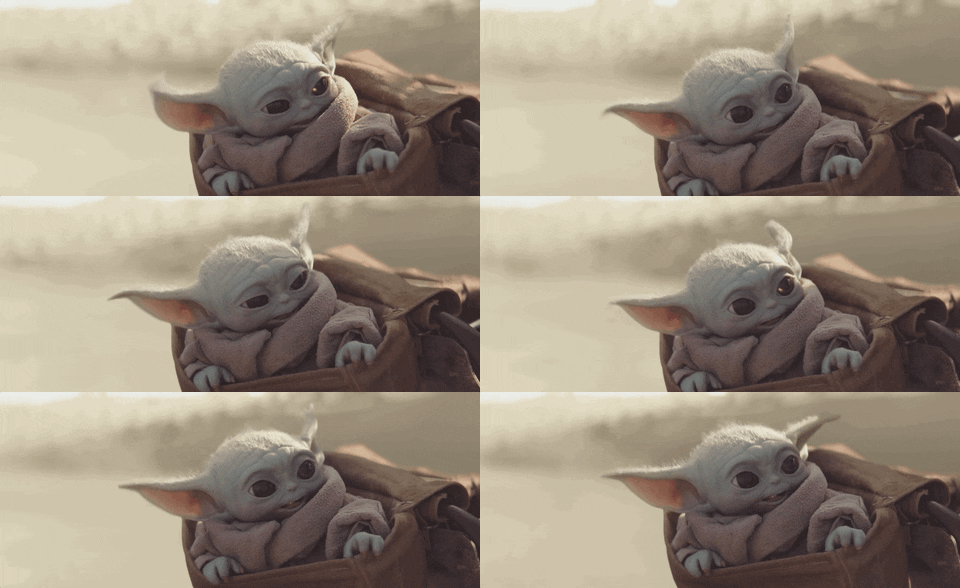
As a modern update, The Mandalorian gives us a bit more of a grey area.  I’m sure these Mandos have many beliefs, but their most central tenet is keeping their helmets on.  This means, throughout its two seasons, we see hardly any of our star, Pedro Pascal.  His ever-present voice lends some of his trademark charisma to proceedings (as seen in Narcos and Game Of Thrones (Season Four)) but he’s otherwise comfined to his armour, giving us more time to admire the Disney-est thing about the whole show: a little baby “Yoda”.  Perhaps the whole treatment started with a merchandising idea, but let’s just go for it.  Our Mando is a ruthless bounty hunter till he sets eyes on the cute one.  From then on, we’re basically viewing a multi-planet babysitters’ club, but it’s all great fun.

The fun is directly proportional to the budget, with everything looking very expensive.  Our hero’s ship, the Razor Crest, features heavily, even finally answering the question of whether these things have toilets on them.  Every time we set off, Mando must flick and click a great number of switches in his cockpit, perpetuating the legacy of Star Wars’ analogue origins.  If it were being imagined now, he’d just have an iPad in there.  Yet, sitting down each day at my home office desk, turning on all my various bits of gubbins, I too am able to imagine I am some sort of Star Wars pilot preparing my ship.  On goes the laptop, the big screen, the speakers, the lamp, the wireless mouse and keyboard.  I’m not taking on the Empire but some of my work emails are rather fiery.  Try it yourself.

But yes, back to the show.  It’s a big tick from me.  I had to come to terms with the fact that this is basically a western.  This Mandalorian is the most lonesome of rangers, with each episode featuring an almost self-contained micro-mission en route to the great big mission of the series finale.  I’m not normally a fan of moving from setting to setting, but each lush spectacle of a new planet is a further glimpse into the inner workings of the Star Wars world.  I wanted to stop and see what each person was doing.  I mean, where is everyone going in all those Empire corridors?  You can be certain of quality viewing, though.  All I could suggest to elevate things is some actual gore.  Let’s be clear, most of our adventures involve an absolute massacre of Stormtroopers, yet the violence can have a cartoonish quality.  At one point, I was reminded of Power Rangers, and nobody wants that.  I won’t suggest, however, that we investigate more intimate activities in pursuit of that adult rating, as I have already pointed out that fervent Mandalorians don’t take their helmets off, much less, I imagine, their breeches.  There’s plenty of other action to enjoy, and you’ve always got Bridgerton/Industry/Euphoria/Normal People if you need some rumpy pumpy.

Friday, 14 February 2020

Game Of Thrones (Season Four)


WARNING: CONTAINS SPOILERS

The fourth season is the first series of Game Of Thrones I remember being covered in the media.  This dragon-based fare was no longer the niche preserve of its traditional audience; it had broken out into the mainstream.  Coverage talked of the arrival of Pedro Pascal (from Narcos) and Indira Varma (from Luther) as key Dornishmen and women, bringing another of the Seven Kingdoms’ countrymen into our theatre of action.  With the Red Wedding a distant memory, and its celebratory murders extinguishing a whole dynasty of characters (Catelyn, Robb, Talisa), series four is marked by new pairings for key players as they embark on new journeys, while established groups take on further complications that, together, leave the impression of a universe expanding following a big bang and drifting further and further away from ever being resolved in the near future.  As a viewer, this was one of the most thrilling and compelling parts of Game Of Thrones’ appeal: we could see ourselves treated to endless high-quality, imagination-rich, boob-and-nudity-riddled ultraviolent content.


Everything pivots on the second episode’s notorious poisoning of King Joffrey.  As ever, a reminder, if ever we needed one, that nobody is safe, but it is gratifying to watch him asphyxiate in his mother’s arms after so cruelly tormenting every single guest at his nuptials.  This in turns fits the Thronesian wedding trend of every ceremony being marred by a death (the Dothraki will be impressed).  While this assassination robs us of Jack Gleeson’s delightfully camp yet sinisterly threatening performance, it sets into motion the intrigue and scheming required to replace the entire thrust of our storyline around the Young Wolf.  Tyrion ends up accused of killing his nephew and threatened with execution instead of being given the firm handshake we surely owe anyone who delivers the little bastard his comeuppance.  This allows Peter Dinklage to deliver more of his outstanding acting rage, moving on from irreverence and intoxication, building instead on his sensitive treatment of new (and unwilling) wife Sansa.  Persecuted by his entire family and, in fact, the entire realm, at his farcical trial, it’s his betrayal by Shae (whom I never liked) that leads him to deliver one of his most memorable soliloquys, admitting guilt to his only real crime in their eyes: being a dwarf.  The series’ rip-roaring finale sees us cheering our Tyrion along as he strangles Shae with Lannister gold (how ironic) and crossbows down his own dad and veteran actor Charles Dance while he passes his nightsoil.  Tyrion is then spirited from Westeros in a dual act of derring-do by dream team Varys and Jaime.


The devil, though, is in the detail.  The main culprits in the poisoning passed me by on my first viewing, but now I have enjoyed the episodes several times, I am able to pick out more foreshadowing, bigger clues and a great deal of stark obviousness that I had previously failed to detect.  Beating her husband to an escape from King’s Landing, Sansa’s flight takes place in the chaos that immediately follows.  Again, I defy anyone not to scream along at her progress as she dashes through the capital’s alleyways, placing blind trust in the ill-fated Ser Dontos Hollard, only to be delivered into the little hands of Littlefinger.  She manages to see out the series at the Eyrie, but we all know that the abuse coming for her in the fifth season will compound her vile treatment throughout seasons one, two and three.


Meanwhile, a lot more of the action unfolds beyond the borders of the Seven Kingdoms.  Daenerys is taking over Meereen and freeing slaves, building her retinue of core supporters but sadly ending the bristling tension between Ser Barristan Selmy and Ser Jorah Mormont after she discovers the previous duplicity of the latter (much to the former’s glee).  Bran, who helps us track the passing of time by monitoring his transformation at the onset of puberty, has made it beyond the wall, but comes a cropper at Craster’s Keep, bringing about another near miss as Jon Snow arrives on the scene to sort out the Night’s Watch mutineers filling their boots with Craster’s ale, food and wives.  I’ll admit to struggling to work out what Locke is doing on this mission, having seemingly taken the black.  I wondered if he was being punished for chopping off Jaime’s good hand, but no, he is on another Bolton baddie posting, tracking down Brandon Stark but meeting a well-deserved bloody end in the process.


But this series belongs to Jon Snow.  Mostly.  Sure, we have more of Ramsay torturing and mutilating Theon, to such an extent he refuses Yara’s rescue attempt, Brienne ends up in an odd couple with Podrick, and Arya and The Hound prove it’s not so easy to get along when you both want to kill each other.  But Jon just does everything right, no matter the cost.  Having betrayed his new Wildling pals, ending up both scratched in the face by an eagle and shot with arrows by crazy ex-girlfriend Ygritte, he must face discipline back at Castle Black.  Maester Aemon, ever the voice of reason, manages to mitigate his fate, but Snow’s enemies are clearly biding their time, despite him outperforming them in every element of night-watching.  This crescendos into our most ambitious episode to date: The Watchers On The Wall.  Yes, it’s another battle, but we’re allowed to see a lot more of the action, as there are a lot more actors in the budget.  Even giants.  Surrounded on both sides of the Wall, the Night’s Watch must survive the, er, night in what turns out later to be a giant waste of time (and a timely waste of giants).  The Wildlings aren’t the enemy; they turn out to be the refugees.  Sadly, we don’t realise this till Ygritte, Pyp and Grenn are killed.  Nevertheless, it presents a great chance to Stannis to do something right for once, but we’ll save that for next week…


Best newcomer

We finally meet the Three-Eyed Raven.  In this series, though, he is no great shakes, lounging inert in a musty room as you would expect any OAP to on a visit to the old folks’ home.  But it’s what he represents that’s so significant.  This is why Bran has journeyed so far.  Or should I say, why Bran has made Hodor carry him so far, while Meera sorts the food and protects them and Jojen trains him in clairvoyance before getting stabbed in the heart repeatedly by an animated skeleton.  Team Bran’s narrow survival of the dead army awaiting them at their final destination goes to show that season four’s epic drama does not run out at episode nine.  What is more, we are at last treated to seeing a Child Of The Forest…

Most valuable character

Olenna Tyrell takes all the best lines and steals every scene.  But she more than rises to the challenge of protecting granddaughter Margaery while fuelling and abetting her ambition.  Her lack of remorse for poisoning Joffrey before he ever gets the chance to be her grandson-in-law is truly delicious.


Best death

The Moon Door has always freaked me out, thanks to my terrible fear of heights.  I always worry I will go momentarily mad and jump off tall buildings, so I can never go near the edge of things.  In a climactic tussle, envious Lysa Arryn accuses Sansa of stealing away her new husband and we are on the edge of our seats at the fear of losing our ginger heroine over the edge of the Moon Door.  Demonstrating cold-hearted calculation, Baelish embraces his insecure lover to reassure her, before shoving her and sending her tumbling to her death screaming like a mad woman.  As if we didn’t already know: never trust Petyr!

Jaw-dropper moment

Tyrion’s trial by combat lives on in infamy.  The Mountain looks all but defeated, much to the displeasure of Tywin and Cersei, but he somehow manages to crush Prince Oberyn’s skull with his bare hands.  All our retinas end up with the image of the poor Dornishman’s squashed head burned into them, proving that nobody can take on the Lannisters and win.

Saturday, 23 February 2019

Narcos


In a recent survey of one person (me) I asked (myself) what’s the second most Netflixiest show after Orange Is The New Black?  One hundred percent of respondents were unanimous: Narcos.  So here we are, years after the third and final season was released on Netflix: you, reading all my silliness, and me, looking for attention while I find my (sarcastic) voice as a writer.  Thank you for humouring me.


The decision to click Play Episode on the first instalment of series one was a smug one.  It felt like a grown-up choice.  Rather than something cheesy about high schoolers (Riverdale) or, er, something else cheesy about high schoolers (The Vampire Diaries), this was adult fare: high-quality historical drama, dealing with dealers and distribution around a class A drug.  Not only would I learn more about a social issue, but it would be period-faithful.  It was even a bit foreign.  I couldn’t really get any more cultured unless I sat there reading poetry.  But nobody in the office has ever talked about poetry, so getting a good boxset under my belt was more important.  And I hate poetry (unless it rhymes and is funny).

But who are the Narcos?  There are two sides in our epic battle.  On one hand, we have los narcotraficantes.  The most famous of these is Pablo Escobar, who I only really knew about from various glamorising rap lyrics and a segment in Dark Tourist where the scenes of his crimes can be visited by those enamoured with his ruthless brutality, potentially a result of the glamorising rap lyrics.  Escobar and pals went from petty criminals to major global exporters of cocaine, netting billions of dollars in the process.  Trying to stop them, we have the other narcos: the agents of the DEA, a US agency that puts moustachioed men in hot countries to jog about in the heat with handguns, smoke cigarettes and sport an array of aviator sunglasses.


Thus ensues, over the first two series, an international high-stakes game of cocaine cat and cocaine mouse while our DEA agent heroes close in on Escobar.  But who to root for?  Escobar is cool, because we live in a culture where murder, bribery and corruption are cool.  Wagner Moura’s performance merits immediate viewing.  I especially enjoyed being able to tell how stressed Escobar is in a particular scene based on how heavily he breathes through his nose (and over his moustache).  But you may have been more focused on his attire than his nasal respiration.  Escobar’s outfits in the early nineties are exactly what my dad wore in the early nineties: loose-fitting light denim jeans, white trainers, size large short-sleeved shirts tucked in.  I’m fairly certain my dad wasn’t running a drug cartel, but I do have my suspicions now.


Surely we should prefer the goodies?  Steve Murphy and Javier Peña, however, are far from perfect.  Whether they’re bending the rules, smoking too many fags, womanising or neglecting their families, their drive to end Escobar never lets up.  I’ve seen people give up on a scheduling a meeting with me after just two rearrangements, but these guys happily chase Escobar through jungles, favelas and more jungles with little or no sign of an encouraging annual performance review from the powers that be.  And that’s what compels: the seediness, the corruption, the sweaty stake-outs.  Everyone is humanised, rather than glamorised.  The DEA agents gotta go bad to get Escobar.  Escobar loves his family more than anything (even though his son is super annoying) and who can hate a family man?  Oh, the internal conflict, everybody.


The third season’s focus shifts to a new cartel, and Boyd Holbrook’s absence is felt keenly, as he was our fish out of water by which we navigated the sweltering streets of Medellin.  But the new chase soon draws you in with the same excesses of tension.  The gore is gruesome and relentless, and the sheer wasting of life is distressing enough, but then you realise that this is all based on true stories.  In fact, the documentary elements threaded through to give historical context are all the more harrowing, as archive news footage of real fatalities reminds you that no dramatic gloss can cover up the true horrors of the cartels.


And that was my main question: what’s so good about cocaine?  As someone who routinely goes to bed at 10pm, the allure of this party drug is lost on me.  A former friend did once recommend the white powder, claiming I would want to talk to everybody in a room as a result of taking it, but I explained that that was an affliction I already had.  Anyway, I’m sure all the death and destruction in developing nations is worth it for those who like a little bump of a weekend at their trendy London parties.  No harm done, right?


But I got more from Narcos than just affirming the fact that I’m enough of a handful without any intoxicating substances.  I also seem to have learnt Spanish.  I did do a GCSE in a single year (A*, obviously) in this language back in my sixth form days, so the basics were there, reinforced over the years by pop songs like Despacito.  Narcos is half in Spanish, so get your subtitle eyeballs ready, as there’s plenty of reading.  Somehow, though, I seemed to attune to the Colombian accents after a few episodes, so if anyone does need me to arrange shipments of coca paste from a Latin American rainforest to a Miami nightspot, just give me a call on a massive nineties mobile phone.


Yet more great TV from Netflix?  Well, yes.  Am I embarrassingly late to the party with this one?  Also yes.  Have I answered all the questions I set out to?  I don’t know – I just kind of start bashing these out and see where they end up.  Is Narcos: Mexico a separate programme, or just the fourth series of the same show?  I’m still not sure.  I’m working my way through that as we speak, so let’s stay tuned for a future post.  I’m sure I can find plenty to be silly and sarcastic about.