Wednesday, 19 December 2018

The Vampire Diaries


Right, well it’s been 37 posts since we’ve had anything about vampires, so I thought I might as well chuck the old classic show Vampire Diaries into the mix.  I haven’t finished a boxset in a while, and it seems readers can’t get enough of teen fodder from our younger years (I’m looking at you, everyone who read about Gossip Girl), so why not?  Let me, as a 33-year-old man, write about a show aimed at teenage girls, that I mostly watched when I was a 20-something-year-old man.  And then you can read it and, together, we can all take a quick break from the monstrous season that is Christmas time.  If, like me, you’ve looked on in disgust while office co-workers shovel a month’s worth of advent chocolate into their gobs on a single day, or you’ve had to restrain someone physically from cracking out the festive playlist on Spotify before the end of November, then really ‘tis the season for the bloodsucking undead as an antidote to empty yuletide greetings at the end of every email.


On paper, Vampire Diaries is an exercise in ticking almost every box regarding my preferred televisual themes.  It’s set in an American high school, so all the characters get to hang out in front of lines of lockers on an impossibly glamorous campus, in stark contrast to my old school, the misleadingly posh-monikered Howard of Effingham, where lesson changeovers were characterised by bundles, high-up banister daredevilry and acne.  So far, so much escapism.  Secondly, we have the supernatural.  As if the pressures of growing up in this day and age weren’t enough, imagine having to cope in the midst of budding relationships with vampires.  Gripping plotlines ensue as we join the main characters in navigating such pitfalls as: being allergic to the sun, being thirsty for blood, and, of course, being evil.  Ah, them teenage years.


My cursory research reveals that we have eight series of this show to enjoy, but I really don’t think for a minute I got too far past season six.  Back in 2009, I probably made appointments to view the show at obscure hours on ITV2, but then I also recall various DVDs arriving on my Lovefilm subscription.  Sure, the initial premise of the opening series was gripping.  High-schooler Elena falls for handsome classmate Stefan Salvatore, only to find out he’s a vampire.  We’ve all done it, right?  Luckily, he has a conscience to balance out his murderous tendencies, but his cheeky brother, our Damon (played by a chap who was offed in the first series of Lost), is not burdened by such inconveniences.  His every crack is so wise that his dialogue eventually makes your skin crawl.  And wait, both brothers are so handsome that even after they’ve murdered you, you’ll still get lost in their eyes.  I assume the high school purged all of its students with below average looks in a public burning.  You can’t blame them.  Each episode seemed to culminate in an event in the beleaguered town of Mystic Falls (should have guessed, really) a bit like The OC, only the tension came not from social faux pas caused by the intermingling of the classes, but from the unleashing of bloody hell when some demon or rascal attacks the town and, mostly, the school.


Of course, to give the whole thing legs, the vampires were soon joined by other creatures.  Elena’s bestie gets into witchcraft.  You’ve got some werewolves in there, some hunters, some original vampires (cue spinoff) and many more.  Buffy The Vampire Slayer, anyone?  But then, a few series in, we flesh out plot contrivance to a whole new level with the arrival of the doppelgängers.  Suddenly, we don’t know if we’re dealing with lovely Elena, or Katherine, her naughty naughty twin.  Then we start swapping back and forth between which brother has a conscience and which brother is evil.  The plots wind themselves up more tightly until all the cast can do is frown in order to understand them.  As with Teen Wolf, complexity is mistaken for intrigue and the sheer volume of storyline becomes overwhelming.  And I don’t remember seeing a diary at any point beyond the first few episodes either, but Elena must have had her hands full diddling about with both brothers.  So I dialled out.


That’s not to say I don’t regret my decision.  This was a sexy show and, for a time, it filled an inexplicable need of mine to be consuming some sort of vampire content.  But ain’t nobody got time for plots that tie themselves in too many knots.  The Vampire Diaries only finished in early 2017 and who knows how it ended.  Maybe the doppelgängers got their own twins and inflicted triplegängers on a confused audience (this happened) or the leading lady was absent for whole series (this also happened).  Either way, I still have unrealistic expectations that vampires will enter my day-to-day life.  I’ll keep a beady eye out at the office for sure, but chances are it will be too busy casting withering glances at my Christmas-enjoying colleagues to spot the real bloodsuckers.

Saturday, 8 December 2018

Archer


“Have you seen Archer?” a friend asked.  I hadn’t.  I had no idea what they were talking about.  It was my worst fear come true: someone trying to engage in conversation about a piece of content pivotal to modern culture and there’s me, oblivious and unable to take part.  “You’d love Archer,” they went on.  Things had escalated.  Now this thing I had never heard of was actually being recommended to me!  I gave the only response possible at the time: nodding silently while my mouth slowly opened and closed.  But I don’t think I got away with it, as the same friend then insisted on showing me the programme while I was visiting him in Beijing.  (This was the same dear friend who first recommended the Unbreakable Kimmy Schmidt to me, so he has a strong track record).

Let’s relive my first thoughts during that initial viewing, as this will help to bring the show to life for readers.

“So, it’s some sort of spy agency?”

Yes, it is.


“Wow, this is a work of art.”

Firstly, it’s adult animation.  This doesn’t mean it’s a cartoon of explicit jiggery and pokery for lonely men to watch with boxes of tissues.  It means it’s something for grown-ups that just happens to be produced from moving illustrations, like BoJack Horseman or Rick & Morty.  But everything in Archer is drawn to look like artwork by Roy Lichtenstein.  The characters are pneumatic in their attractiveness (though this still isn’t aimed at the hand-over-fist crowd).  The backgrounds too add to the overall high quality, while sixties lines and styling give everything a slight Mad Men feel.  I feasted my eyes.

“Isn’t that Bob from Bob’s Burgers?”

Following the overload in the eyeballs, my ears attuned to the aural assault.  Lead character, Stirling Archer, is voiced by H. Jon Benjamin, who plays Bob in Bob’s Burgers.  While Archer isn’t exactly supposed to be a successful spy, it’s hard to forget the images of a bumbling family man who flips burgers when Archer is seducing beautiful ladies or rolling about on covert missions.

“Why is everyone shouting?”

The characters pursue all dialogue at a certain heightened pitch.  It’s the tone you use in a conversation where each exchange elevates the previous sentence’s sarcasm, irony or sardonic tone.  It has nowhere to go but shouting, which means that everything can feel a bit ranty, jokes (though funny) don’t stand out and we end up with one level to the whole thing.


“But yes, this is quite funny.”

Once you overcome the scream at which lines are delivered, you can appreciate the humour that laces everything.  Jokes reoccur and harken back to former statements, layering on themselves over and over till you can’t help but chuckle or groan.

“Oh, so it really is only these characters then.”

We more or less stick to the world of ISIS, the spy agency where Archer works.  Fun fact: it’s run by his mother, Malory (voiced, well, shouted by Jessica Walter from Arrested Development), so his relationship with her is the source of about 60% of the humour because it’s funny and silly to work for your mum as a spy.  Around eight characters feature in practically every episode, no matter what, which starts to feel close and closed off across the nine seasons.  Yes, nine.  Occasional relief comes from guest roles, for which some sort of Hollywood comedy actor is always found, like a bit of an inside joke, so you can have a great time trying to place the voice before giving in, checking IMDB and seeing that it was Janice off Friends.


In short, this is a good man-show.  I don’t want to be gendering things as we move into 2019, but the humour can be schoolboy, Archer lives consequence-free and I’m fairly certain the female characters only serve as garnish in order to bait or foil (all while shouting of course).  Nevertheless, nine series is good going, so let’s go through how things have been padded out and what my bodily responses were for each one:

Series one

Still getting to grips with the style, characters and tone, we have an episodic approach with each instalment more or less resolving itself.  There’s an airship, among other retro elements, with most conflict coming from a rival agency (and between Archer and Malory).


Series two

More office management japes creep in, but the episodes climax in Archer searching for the true identity of his father.  We get into our stride here a bit more.

Series three

Things get joyfully further and further fetched, with more action in the animation (versus perennial standing around posturing) and more diverse settings.  Robots appear, as does a mission to space.  Enjoyment peaks.

Series four

Just more classic Archer, with a hilarious Bob’s Burgers crossover.

Series five

This is Archer: Vice.  We depart from the old office and the whole staff end up in South America trying to offload cocaine.  Comedy comes from Pam doing most of the cocaine most of the time.


Series six

Back to nearly normal with more global travel.  Some of the characters’ backgrounds are fleshed out.

Series seven

Archers goes all Hollywood.  I didn’t really get what was going on.

Series eight

This whole series is a dream.  No, really, it’s called Archer: Dreamland and takes place in Archer’s mind during a coma.  It’s a shame he can’t dream up some new main characters.

Series nine

Completely clapped out, the whole thing moves to 1938.  I lost the plot.  I didn’t have a mental health episode, I simply was unable to find any narrative to follow.


After the quick intro in Beijing, I’ve limped my way through this show, possibly repeating series three, or, in fact, missing out whole chunks of episodes altogether.  Because of its constant tone, I find myself easily distracted, even though each instalment is short.  As such, in an effort to make it finally to the last episode (which wasn’t helped by series nine dropping when I was knee deep in series six) it has become a background show I put on whenever I am doing something else.  Many a work email has been bashed out on the old laptop while Archer and Lana scream at Figgis, or while Pam runs around naked eating snacks and taking drugs.  Maybe a close-knit colleague collective of inept spies can only go so far, yet Archer still feels unique in both the worlds of comedy and animation.  Within its overwhelming volume, there are hilarious gems.  So, if you live life terrified of being caught out by someone asking if you’ve seen Archer (and it’s only happened to me twice more and both times I could respond confidently with a big fat yes) try a couple of episodes.  If you hate it, then stop it and do something else.  And if you like it, then enjoy; you’re welcome.


Saturday, 1 December 2018

Dark Tourist


Continuing with the recent flurry of travel-based posts (Jack Whitehall: Travels With My Father and I’m A Celebrity Get Me Out Of Here), I’ve succumbed to the constant appearance of Dark Tourist in my Netflix menu.  It was sat there at the top every time I logged in, promising subversion, alternative lifestyles and the ability to brag about having been to really trendy tourist destinations for optimum office one-upmanship.  For instance, I was just showing off to a colleague about the fact I have been to Portland, Oregon, but I didn’t manage to shoehorn into the conversation I have also visited Austin, Texas, which, together, place me as a hipster traveller, despite the fact that I just made everyone sitting near me listen to Fleur East’s Sax (still a party banger, no matter what anyone says).  But, Dark Tourist is not about food trucks and cool urban scenes.  It’s about going to places you wouldn’t normally associate with Instagram fodder.


However, this seems to be even more hipster than the vegan plastic-free breastfeeding collectives of Portland.  Dark Tourist follows David Farrier, a New Zealand journalist who has always been attracted to death and destruction.  However, in his accent, this sounds more like “dith end distriction”.  He’s a hipster: too cool for a haircut, practical eyewear, non-ironed t-shirts.  Somehow, he’s convinced Netflix to fund his holidays to places that are sad, scary or both.  The people he comes across on these journeys, whether they’re touring the Fukushima radioactive area in Japan or cycling about Alexandra township in Johannesburg, ache with their own coolness about shunning package holidays to the beach in favour of seeing the more disturbing side of human life.


So, dark tourism and normal tourism have something in common: both cause inordinate smugness.  I’ve given some thought as to whether I have ever been a dark tourist.  There was the German exchange when I was fourteen; we made the obligatory visit to Dachau.  Going on to pursue this language all the way through university, I’ve read my fair share of World War II literature, but, at the time, the gravity of the place didn’t register as deeply as I now know it should have.  What I do remember, though, is a very enthusiastic guide taking us to the crematoria and then being slightly appalled by the rest of the class clamouring to take pictures of the ovens which thankfully were never completed in time to be used.  What exactly were they going to do with those images?  Enjoy them at a later date (remembering that this was many years before Facebook, let alone digital cameras)?  More recently, embracing the dark tourist mantra of being open to danger, I recall sitting on my cousin’s veranda in KwaZulu Natal while her son ran off into the bushes with a gun to investigate the sounds of potential intruders.  I just sipped my coffee because, as everyone knows, on holiday you’re immortal.  Especially if you’re a plucky Brit.  Right?


Chances are, we’ve all been dark tourists.  If you’ve ever been to a museum or a memorial or a battlefield, then the sights you’re seeing are rooted in some form of human suffering.  Farrier takes a muted approach to this: he’s not overly deferential or crudely exploitative.  He acknowledges his interest while also trying to understand it.  Nevertheless, it’s uncomfortable viewing, whether you’re witnessing voodoo animal slaughter in Benin, or, closer to home, coming to terms with the fact that England is very much on the list for dark tourism.  But our contribution is not necessarily the site of a transgression, but a museum that makes an exhibit of many: Littledean.  We can never quite make our mind up about the proprietor, but suspending judgment is part of the fascination.  Why else can’t we help watching Making A Murderer, if not for the constant challenges to our certainty about guilt and innocence?


Dark Tourist is at its best when breaking into a closed state or authoritarian regime.  The segments that cover Turkmenistan and Myanmar are particularly gripping.  For me, it’s handy that Farrier is investigating these places that I’ll probably never go to, taking risks and breaking into forbidden territory, whether this is due to free radicals or ethnic tensions.  But it all boils down to the ultimate means by which we justify anything we pursue in our leisure time: it’s entertaining.  We go on holiday to look, point and experience because it’s a diversion from daily life.  Watching a TV show that allows us to do this in shonkier locations but with no risk to ourselves is therefore highly entertaining, all pleasantly hosted by a southern hemisphere Louis-Theroux-alike.  It’s left me wanting to know more about all the subjects covered, precisely because Dark Tourist’s premise is to understand why people want to go there, rather than needing to go into the detail of what actually happened.  Booking details don’t follow each report and there’s no suntanned Judith Chalmers sipping a cocktail and having a jolly nice time, but there’s a curiously inspirational bent to the show: you’ll want to go and be a braver, darker tourist yourself.  I can’t explain why, buy you’ll wish you were there, all whilst being glad you’re not.

Wednesday, 28 November 2018

Chilling Adventures Of Sabrina


Well, Halloween has been and gone and people are now trying to play Christmas songs in the office (which I have swiftly put a stop to), but this blog is only just getting round to covering Netflix’s big content play for All Hallows’ Eve 2018: Chilling Adventures Of Sabrina.  I wasn’t going to watch this at first, even though posters were everywhere.  A quick trip to see friends in Hamburg revealed that most of their rail network’s out-of-home display sites had been booked by this show, which, in German, actually has the same name.  But then I felt the need for something dark and gothic in my viewing life, and, before I knew it or could regain control of my actions, I was eyeballs deep in episode one.


Part of my resistance came from the fact I saw no need for Sabrina, The Teenage Witch to be overhauled.  That show lives on in Millennials’ memory for all the right reasons, dominating our viewing from 1996 to 2003 (coinciding exactly with the seven years I spent at secondary school).  But this new version was billed as darker, more relevant, and as closer to the original source material: some old Archie Comic thing we didn’t really have in the UK.  More than that, these Chilling Adventures also acknowledge one of the fundamental truths about witch folklore: these women were believed to sell their souls to the devil to obtain powers.  Therefore, one of the main points of divergence between the two imaginings of this teenage witch is the amount of devil.  The 1996 version had almost none.  The 2018 version is really rather devilish with an overload of devil.

Sabrina has been aged down, with perfect casting seeing Kiernan Shipka in the lead role.  As a child star known by me (and maybe you) for playing Don Draper’s bratty daughter in Mad Men, I keep expecting her to stamp her feet and throw a tantrum at Betty Draper’s bitchy comments, but her tantrums are instead directed at her aunts.  Aunt Hilda is our own beloved Lucy Davis, qualified for British national treasure status since appearing in The Office, while Miranda Otto brings luvvie steeliness to Aunt Zelda.  While the actresses are British and Australian respectively, Zelda seems to be an American to Hilda’s Englishwoman.  But then, cousin Ambrose, a sort of housebound, open robe-wearing smart-mouth, is very very English, whereas Sabrina is as American as apple pie.  This isn’t that interesting, but it’s one of many things that just seem a bit strange about the adventures.


Other things follow here.  Everything seems to be filmed through an Instagram filter.  The edges of the screen are all blurred and this is distracting for the first few episodes.  In addition, it’s hard to know when this is set.  The hair, the costumes, some of the lifestyle choices all smack of a bygone decade, maybe even the seventies.  You never see a smartphone or hear tell of the internet.  But this niggle ends up adding to the overall charm – what’s a bit of styling if it doesn’t add to the spooky atmosphere?  And spooky is just what Greendale is.  Dry ice roams the streets, while the school is staffed by all manner of paranormality.  And because witches aren’t enough, Sabrina’s friends all inevitably take on supernatural tendencies of their own, a bit like werewolves needing magical friends in Teen Wolf.  In fact, the likenesses with high school-based teen dramas featuring mythical creatures calls to mind that other great oeuvre in the genre, Buffy The Vampire Slayer.  Sadly, though, it’s only really Lucy Davis’s Aunt Hilda who has the witty lines, and she delivers each in a performance that makes you want her on screen the whole time.


Vamping things up, we also have Scottish actor Michelle Gomez, in a very sinister role as Miss Wardwell, a teacher possessed by Mrs Satan, bringing a lot of the darkness into the show.  I swear I can still see a twinkle in her eyes that betrays her madcap antics in Green Wing and The Book Group, but she remains, as ever, a joy to behold.

The ten episodes take us through pivotal times in Sabrina’s life as a school girl who is half mortal, half a witch.  Turning sixteen, she must decide between two destinies, and the initial tension comes from which she will choose: signing her name over to Satan, or remaining at normal school because there are boys there (and this time Harvey Kinkle isn’t played by someone who looks 35).  The pressure to pick overwhelms both Sabrina and us the viewers for the first few episodes, but once her initial decision is made, we move into a more episodic format, with different demons showing up for neat containment within the one-hour running time, and things feel a lot more fun because of it.  But the series’ climax builds back up to the initial struggle between humans and witches, culminating in a great set up for more seasons, and further potential to get even darker.


So, should you watch this?  It’s a yes from me if you love a teen melodrama, think real life is better with added supernatural powers or you simply want an antidote to the saccharine Christmas nonsense that starts to get wheeled out at this time of year.  Some elements of the Sabrina universe’s mythology are all over the place, as is the tone struck by the action, characters and dialogue, but the atmosphere almost makes up for this.  You’ll jump if you’re jumpy, but this is safe to watch in the dark and home alone.  Most of all, it’s a lot of fun and a welcome addition of difference to the Netflix canon.  I sadly can’t promise you an animatronic Salem jerking about, but Sabrina can promise you a good time while she has her chilling adventures.


Wednesday, 21 November 2018

I’m A Celebrity Get Me Out Of Here


In the old days, they had seasons to tell them what time of the year it was.  In this golden age of television, we have the return of certain TV shows to indicate where we are in our annual cycle.  In fact, you could rely on ITV1 not only to provide shiny-floor entertainment, but also to fulfil this function: Britain’s Got Talent lets you know it’s nearly Easter, The X Factor heralds the end of summer and, finally, I’m A Celebrity Get Me Out Of Here makes it unmistakeable that here we go again it’s only already ruddy Christmas isn’t it.  Of course, you might be part of the camp that believes it’s not the festive season until you’ve wept at the John Lewis ad (reminding you of the true meaning of Christmas: promoting Elton John) or until you’ve seen a Coca Cola truck (reminding you of the other meaning of Christmas: using carbon-heavy distribution methods to ensure fat people can access fizzy, sugar-laden drinks).


But, whether you love this time of year, or, like me, you think we should only really do December 25th every few years, the return of I’m A Celeb is arguably more important than the alleged birth date of a man who claimed god was his dad and who still seems to yield unprecedented influence over two thousand years later.  This is because it reminds me, without fail, that the year is almost out, and all I’ve done with it is watch too much telly.  All those things I vowed I would achieve back in January… they’re still mere vows rather than actual actions.  Instead of prompting me to get a wriggle on and deliver something, I instead resign myself to rolling them over to the next year, slouching down on the sofa, and tuning in for another nightly hour of jungle fun.

But it wasn’t always this way.  When the first series broadcast in 2002, I had no interest at all.  My perspective of its genesis might be skewed, but I am totally writing it here without checking any of it.  TV had just been rocked by the arrival of proper reality TV: Big Brother.  Convinced it needed its own version to rival Channel 4’s ratings hit, ITV acquired Survivor (and BBC done Castaway but that was more to do with the Millennium, apparently).  Instead of a house, there was a jungle, but it was basically the same: some skulduggery, some exhibitionism, some normos competing for a cash prize.  The main difference was that nobody wanted to watch it, despite untold marketing hype.  Then, I assume, someone gave it a quick tweak and turned it into a celebrity version.  Thus, according to my hazy recollection and fabrication, I’m A Celeb was born.


To me, though, it remained an irrelevant format.  All these people that claimed they’d never stoop so low as to watch the desperate wannabes on Big Brother, but would later happily sit through The Apprentice, extended this double standard by watching I’m A Celeb.  Yet surely this was the most desperate form of reality TV: faded household names doing anything to get famous again, whether that be eating kangaroo penises or withstanding a shower of thousands of cockroaches and crickets.  All for our amusement.  And not just our collective enjoyment alongside them, but for our point-and-laugh-at-their-sorry-state derision, at their expense and humiliation.  Starved in a camp on basic rations, pooping in a dunny and sleeping in hammocks, participants then fight for food in Bushtucker Trials by enduring close physical contact with scary critters (think helmets filled with spiders) or down drinks that will churn any stomach (think blended beetles).  It was cruel, but it was also super broad.  As a teenager, I needed things to feel niche and subversive, only there for me to discover, rather than shared with millions of average viewers.  I could watch Buffy instead.

Even in 2007, the show brought me out in hives.  Flicking through the freeview channels in my Belsize Park five-man flatshare, in the days before I had any way to watch telly other than tuning in at the right time (a barbaric era), I came across series 7.  Jason “J” Brown (from Five) and Gemma Atkinson (from Hollyoaks) were suspended above a jungle creek in an old aeroplane.  I don’t know why.  Everything was so offputting.  They had on horrible beige shirts.  There were red fleece bodywarmers, with phone numbers on the back.  I still detected the air of delighting in the end of someone’s showbiz career.  I switched over.


Things changed, though, back in 2012.  I was staying temporarily with a friend while in between flatshares (I told her three weeks, but stayed for three months – soz).  As the homeowner, she was in charge of evening viewing.  It was also my first Sky household, and I didn’t know how to work the remote.  She wanted I’m A Celeb, I was in no position to say no, and into series twelve we dived.  Her rationale was that the links, presented by Ant and Dec, were funnier than most other things on TV.

How right she was.  I can guarantee anyone viewing this show more than their fair share of LOLs on their witty interactions alone.  They’re irreverent when talking about the contestants, teasing their foibles and emphasising their idiosyncrasies.  To my surprise, this wasn’t done aggressively.  It felt like the gentle ribbing you see among friends, rather than full character assassinations.  Either way, they were spot on.  Alongside these the lads share camaraderie with the offscreen, yet audible crew, laughing at themselves as much as they do at the celebs.  As such, they’ve even built up their own parlance – a set of known phrases that appear every year.  My highlights are below:

I’m No Doctor, Guys But…

The job role here is interchangeable, but this one was originally wheeled out for medical issues, pointing out that contestants probably shouldn’t be eating/drinking that (that often being pureed turkey testicles).

I’ll Smash Your Face In

A threat of violence from Dec to anyone that dares to slight him.  Of course, he is not a violent man, so its incongruity with everything else that’s going on plays perfectly at tickling the chuckle bones.

Evening, Prime Minister

Whenever anything political comes up, a knowing glance is given to camera, alongside a cheeky bow, lampooning any potential viewing from our premier.  I enjoy the image of DavCam or T Maz perched on the edge of the sofa, glued to the telly while international diplomatic nightmares play out around them.
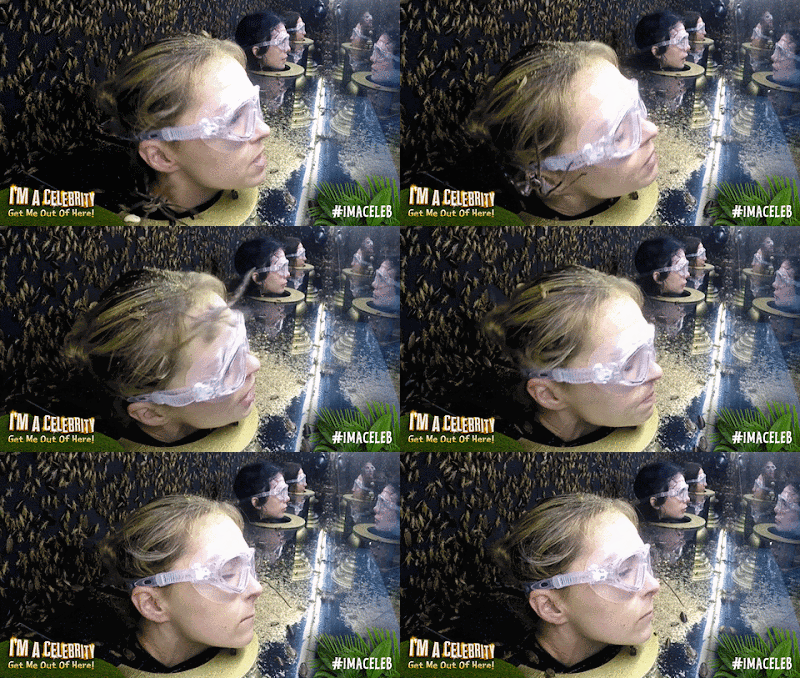
But now, our beloved Ant is having time off and Holly Willoughby is on Dec’s right on our jungle set.  I mean, yeah, she’s doing ok.  I don’t want to be horrible about people here, but she’s one of the least friendly presenters I’ve ever met through work, so it’s nice that she smiles her chops off in front of the camera.  I would too, if I were that smug.  So let’s focus on the set.  What is this place!?  There are camps, and rope bridges, and treetop walkways, not to mention unlimited Bushtucker Trial locations.  I’m imagining a full out-of-town complex off some motorway in Queensland.  But how can it be sustainable to run this whole place (breeding the cockroaches, stroking the snakes, cutting off the kangaroo penises etc) when it’s just in use for one month a year to torment past and future stars of British panto.  I’m sure once ITV have cleared out they ship in the Argentine version of Ant and Dec or the Swedish version of Christopher Biggins and all hell breaks loose once again.


So, let’s finish with a round-up of my favourite participants since I started watching the show in 2012, with apologies to anyone who did a good job on it before I could be persuaded to watch.

Helen Flanagan, series 12

Some child of the cobbles of Corrie was now all grown up.  Grown up enough not to want to do any Trials.  She completely abandoned one at the first hurdle, on seeing a room containing an emu.  Ant and Dec struggled to hide their frustration, but at least they got to finish early.

Ashley Roberts, series 12

A worthy runner up, kept from the spotlight in the Pussycat Dolls, but charming British audiences with her American enthusiasm.  I once walked past her outside the Wolseley.

Rebecca Adlington, series 13

An absolute champ, building on her Olympic medal collection with a down-to-earth and practical approach to jungle life, all while revealing that even a gold-medal swimmer can suffer from insecurities.

Gemma Collins, series 14

I find everything this lady does hilarious.  Including when she literally couldn’t be arsed past day 3.

Vicky Pattison, series 15

I loved her on Geordie Shore, and I loved her winning this series and transitioning to a mainstream national treasure.

Lady Colin Campbell, series 15

A posh old white lady with a Jamaican accent?  As if that wasn’t enough, she was also the most stubborn contestant ever known and gave Duncan Bannatyne a run for his money in the dour stakes.

Joel Dommett, series 16

I hadn’t heard of him, but, the minute he appeared, I got all these texts claiming he and I are the same person.  And we basically are.


Larry Lamb, series 16

It was just nice to spend time with Gavin’s dad from Gavin & Stacey.

Amir Khan, series 17

An extreme case of manchild.  He was the first celebrity to consume his Dingo Dollar Challenge treat himself before taking it back to the camp.  Fair play to him.

Special mention to Gillian McKeith, who appeared in 2010.  I must have been shown her performance (pretending to faint to avoid Bushtucker Trials) by someone else, but it enabled me to enjoy this song in its full intended glory (because, why is Gillian so reptilian?).


No matter how terrible some of the contestants, the field is soon whittled down to a loveable bunch whom we come to see as friends.  We share their private jokes, their jungle memories, and their journeys from pampered C-listers to primeval survivalists.  This is brought to life more than ever in the last days before the final.  I’m tingling now at the thought of Celebrity Cyclone, the best of all the Bushtucker Trials.  An enormous slip’n’slide with water cannons, colourful capes and an array of projectiles that illustrates just how much our new pals have bonded.  I’m almost sad when they finally announce the winner.  Where else can a diminutive rapper (Tinchy Stryder) and a former Tory battle-axe (Edwina Currie) go camping together in a rainforest? It’s no longer about a shameless plug for attention, but about how far they’ve been prepared to come to get the nation to take them back into their hearts. So yes, it really is the most wonderful time of the year, and it doesn’t need baby Jesus or Elton John’s stupid piano.


Monday, 12 November 2018

Jack Whitehall: Travels With My Father


We have some more firsts this week.  It’s the first travel show to feature on the blog (and Love Island doesn’t count, even though it’s the best holiday we’ll never get to go on) and it’s the first show to have a colon in its title.  The colon bit isn’t very interesting really, but the travelling part is what saw me select this from the overwhelming complexity of the Netflix menu.  I wanted something short, something vaguely British, and something with a few chuckles.  I also didn’t want there to be too many of them to get through.  And luckily, Jack Whitehall: Travels With My Father ticked all of those boxes.


I normally tend to avoid the genre of programme denoted by the term travelogue.  You know the thing.  It’s Joanna Lumley swanning around India looking at cats.  Or Michael Portillo sniffing the bedsheets at different hotels in hot countries while wearing a blazer the whole time as if he’s sold his soul to the devil in exchange for never sweating, despite the fact he stills come across as slimey, regardless of the dryness (or wetness) of his pits.  There’s even one where Chris Tarrant goes on trains.  I go on trains every day, but it doesn’t get put out on ITV1 in late peak and regularly pull in millions of baby boomer viewers looking for inspiration about where to thrust their money now they’ve used up all the wealth in the country.  But the rules that govern what I would never watch on normal telly go out the window when it comes to Netflix’s wily ways.  I’m powerless in the face of the endless choice.  Maybe the pressure will subside if I just watch one more show, bringing me that little bit closer to completing everything on there and becoming a hero of office conversation.  There’s not much else to live for.

The premise of the show is tenuous.  Whitehall never had a gap year (pronounced gap yah of course) what with his stand-up career taking off, thanks to the huge gap (minus the yah) in the entertainment market for a loveable posh boy who’s happiest when everyone is laughing at him.  Now is his time to hit up South East Asia for all the clichés imaginable, safeguarding a future where he can join the ranks of Thailand bores who discuss which islands they did and didn’t do while I slowly glaze over and die inside because I can’t join in.  But this isn’t enough comedy, so Whitehall Senior, Jack’s grumpy father, comes too.  Michael Whitehall likes to wear suits, live in luxury and doesn’t want to leave the comforts of South West London.  Cue ensuing hilarity as full moon parties collide with wine tasting and everything in between.


I’m lucky enough to have been a direct recipient of Jack Whitehall’s humour, so I can safely vouch for the fact that merely dropping him in confusing foreign situations should be entertainment enough.  At a work event, we were treated to a Comedy Central stand-up night.  I arrived just before the start and joined friends at the last remaining table just by the stage.  Someone warned me this would be a bad idea, but I was well tucked away and had no conspicuous features about me, so I felt certain that I wouldn’t be threatened by unwilling audience participation.  How wrong I was.  Within seconds of the compere appearing, I had been dragged on stage and subjected to a multitude of embarrassing situations.  By the time Jack came on, I had inadvertently become a focus for most of the acts.  “Where’s Rob?” was his first question.  He took a good look at me and then asked me what I did for a job.  My wanky media job is hard to explain, so I opted for the vague catch-all term of: creative solutions.  His response came in a beat: “More like pussy solutions.”  So, yes, we can all agree he is hilarious.

The addition of his dad is also a nice touch.  Well into his seventies, Michael hasn’t got time for any of Jack’s shit, including, but not limited to: being called Mike, being called mate, using any lavatory that deviates from the European norm, drinking anything alcoholic besides fine wine, all of Jack’s outfits.  There’s a deliciousness in the awkwardness whenever Jack brings up the ways in which his father has struggled to show affection or love in the past, such as sending him off to boarding school at a young age.  Michael is always quick to retort that Jack is a constant disappointment to him, so it really is like looking into a family mirror.


When being natural, I could watch these two explore anything, from the Killing Fields of Cambodia to Chernobyl (both of which get covered).  However, there seems to have been a terrible decision to include a number of constructed moments.  In these, obvious gags are set up and play out with such artificiality that it’s hard not to want to switch off.  A particular lowlight is Jack being pushed into a fountain by Steven Seagal.  Very strange.

The second series sees the lads conduct a grand tour of Europe (in the style of Victorian poets rather than in tribute to any consumer vehicle review show hosted by old white men in bad jeans).  Jack gets to live out one of his lifetime dreams, playing funky saxophone with SunStroke Project, a Moldovan boyband who don’t share his sense of irony.  Michael, meanwhile, is comforted by the continuing presence of Winston, a kind of creepy good-luck doll they picked up in Thailand and on whom he showers more love, praise and affection than it seems Jack has ever received.  This is oddly reassuring, as a fellow British person.


So, should you go on some travels with Jack Whitehall and his father?  Probably.  It’s easy viewing, mildly chucklesome, at points both touching and informative.  You can get a good cringe workout during each set piece, but they are soon over and you’re back to feeling inspired about booking that flight, exploring that foreign culture or cherishing time with your beloved parents.  You probably won’t get your own travelogue TV format commissioned, with its very own colon, such as Generic Person: Let Me Bore You With My Travelling Yarns, but that’s because you’re not Jack Whitehall and therefore nobody cares.  (Is anyone still picturing Michael Portillo sniffing bedsheets?)

Thursday, 8 November 2018

Bo’ Selecta!

The epitome of a good parody has to be something that takes on a greater significance than the original target.  This week’s show is one that achieved that several times over.  It’s lucky it did, as I still had no inspiration for what to cover in this week’s post, and then a meeting this morning brought Bo’ Selecta! back into my life, sixteen years after it first appeared on our screens.


Members of our Management team had gathered in a meeting room for important and confidential discussions (though these will only be interesting to you if you work in content partnerships for a media agency).  One key member needed to be dialled in from home, where they had been using the classic excuse of a poorly baby to get an extra-long lie-in.  A mobile was placed on the table and our dialler-inner was put on speaker.  “Are you there?” we asked.

“Yes,” came the response.

“Good,” said someone else. “You’re on speaker, so don’t say f*ck or bugger.”  Naturally, I was furious that the joke hadn’t come from me.  I was just about to launch into my usual spiel where I tell colleagues to be careful, as I’ll do the jokes round here (which must be about as charming as it sounds to type out here).

Instead, the phone crackled with our remote member dropping a particularly loud C bomb.  Oh, how we fell about laughing.  Saying naughty words without your parents telling you off is one of the best things about being an adult.  It might actually be the only thing.

By now, you’re either wondering what the devil I’m on about, or you’re recalling fondly the Davina McCall character from Bo’ Selecta!  Or you’ve stopped reading entirely, as you can source boring stories about someone’s life in an office from the person next to you on any train.  Either way, it’s fitting in this final week of Big Brother (whose final final I caught up with and said goodbye to as another part of my youth slipped into the ether), that we are talking about a sketch show that took the piss out of it.  I would wager that more people have quoted Bo’ Selecta!’s version of Big Brother this year than have actually watched the 2018 series.


When speaking live to the Big Brother house, our host Davina always had to remind the potty-mouthed housemates to mind their effing and jeffing: “Big Brother house, this is Davina; please do not swear.”  Not a funny line in itself, until Bo’ Selecta! turned it on its head with the absurd, “Big Brother house, this is Davina; please do not say f*ck or bugger.”  How ridiculous: here’s Davina saying the words that aren’t allowed on air, and, what’s more, they’re not even the worst words.  Fair enough, I think the F bomb is second only to the C bomb, but bugger is probably barely in the top twenty of offensive things you can say.


But the deviation from reality didn’t end there.  Bo’ Selecta!’s impressions of popular and unpopular people from popular culture never cared much for accuracy.  That’s because most parts were played by a white man.  Instead of prosthetics, he just donned some oversized NHS glasses and an even bigger rubber chin.  Our favourite celebrities, from Lorraine Kelly to Gareth Gates, would then be portrayed as grotesque creatures that often had little to do with their real-life namesakes.  The famous Americans often came in for worse treatment, getting transplanted from the glamorous US origins to some crap town in Britain.

Yet, these versions often threatened to eclipse their inspiration.  In 2002, Craig David was one of the UK’s biggest popstars.  He was so smooth he even declared in an album title that he was Slicker Than Your Average.  But, in the world of Bo’ Selecta!, he wasn’t from Southampton anymore, but from Yorkshire.  He wet the bed.  He had a pet kestrel called Kes.  He was deeply uncool and it soon became impossible to see Craig David without donning a northern accent and shrieking Craaaaig Daaaavid.  Having seen the real Craig David in recent years at a Summertime Ball (via free tickets from work, but let’s be honest: I loved it), it seems time has finally allowed him to reclaim his own identity, with his resurgence enthusiastically enabled by older millennials desperate to relive the heyday of UK garage.


Other characters didn’t necessarily have quite the same impact, but, for me, there are still certain words or phrases I can’t hear without thinking of them.  Any time something is described as mint condition, I can picture Destiny’s Child in a bus shelter, with Kelly only able to say “Question?” while Beyoncé explains in a Leeds accent that the best way to remain in “totally mint condition” is to rub lard on your shiny legs.  I can’t hear someone say “no offence” without the Simon Cowell character coming to mind, telling an unsuccessful X Factor hopeful, “No offence, but I wish your mum was dead.”  If I’m ever told to bring a friend, I immediately picture a scouse Christina Aguilera giving two simultaneous handjobs offscreen in a caravan, while explaining that she is dirrrty as you like, and telling punters to, “Bring a friend next time.”


In fact, every time I hear the name, Christina Aguilera, I can see the Bo’ Selecta! Kelly Osbourne (whose dad had terribly long arms and whose mum went around looking for dog poos to treasure) switching between a cutesy American accent to welcome viewers to The Kelly Osbourne Show (“Hey, you douchebags”) before aggressively ranting in a British accent about how much she effing hates Christina Aguilera, before switching back to American to declare, “But she has the most wonderful voice.”  Manatees make me think of a posh Marilyn Manson.  Shazam makes me think of a pervy David Blaine.  Earpieces make me think of Ant Man and Dec Pet, and so on and so forth…

I could live without the show’s interstitials, which saw neck-braced Avid Merrion conducting a personal creepathon with his celebrity obsessions.  In fact, a lot of the humour was deeply crass, puerile and generally offensive, with some of the racial and sexuality stereotyping feeling a bit wide of the mark for today’s tastes.  But it was often done while knowingly being so far from the reality that its ridiculousness was the very source of the laughs.  It didn’t feel the need to celebrate celebrities.  Instead, it really went for them (though I did miss some of the jokes due to the accents and rubber masks, which were hard to hear through).


Nevertheless, such a subversive late-night Channel 4 show didn’t quite make a household name of its creator, Leigh Francis, but he is now practically an ITV treasure in his more palatable (though equally as flap-orientated) character of Keith Lemon.  On the other hand, other elements of the show are fondly remembered in my household (by my sister and me, not by our parents), such as the ground-breaking feature: The Week In Bits, With Jodie Marsh’s Tits.  This really was a round-up of celeb gossip voiced by an actual nipple.  I suppose it depends on your household.

Posts you will also like:

Nighty Night
Rick & Morty
Little Britain
Come Fly With Me
Peep Show
Cardinal Burns