Showing posts with label fantasy. Show all posts

Saturday, 8 February 2020

Game Of Thrones (Season Three)


WARNING: CONTAINS SPOILERS

Well, I’m having a lovely time reliving Westeros’s greatest hits – not sure about the rest of you.  We’re onto series number three of this boxset to end all boxsets and, even though I think it’s my fourth time watching it all the way through, it’s still proving to be TV entertainment of the highest quality.  The toppest notch.  If you’ve not kept up, we’ve already done seasons one and two here and here (respectively), so I’ve covered everything that’s brought us to this point, as well as justifying two deviations from the usual mythology of Just One More Episode: openly discussing spoilers and splitting a programme into its constituent seasons.  But where was I?  That’s it: telling you all how happy I am with my choice to re-watch Game Of Thrones.  I can’t go wrong.  Each evening after work, there’s time for one or two instalments of this absolute favourite, before switching at 9.15 to that night’s episode of Love Island (ads fast forwarded, of course).  All going well, I’m in bed for 10pm and ready for the next day’s routine of gym, work, boxsets.  As an adult in London, it’s great to know I’m making the most of the culture the capital has to offer.


Let’s see what our pals in the Seven Kingdoms have been up to then.  Like the second series, these ten episodes continue the downward trajectory into darkness.  King (in the North) Robb’s war takes a number of ominous turns, culminating horribly in his appalling demise at his uncle’s wedding in The Rains Of Castamere.  Yes, let’s get the Red Wedding out of the way then.  This ninth episode (with a 9.9 rating on IMDB) provides a harsh reminder that every character’s days are numbered.  Losing Khal Drogo and Ned Stark in the first series wasn’t just billy-big-bollocksing from the show’s producers (and our source material writer, George R R Martin).  With a bit of knifey-knifey, a whole plotline is extinguished, along with the dynasty of the Young Wolf.  Surely Catelyn Stark, the dear old earnest mum of our favourite Northerners, is spared?  Sadly not, and not even offing Walder Frey’s newest wife in the process can spare her a slit throat at the hands of the new Frey-Bolton-Lannister coalition.  At least she won’t be making any more of those straw-based protection charms for her children, as these have been proven ineffective time and time again.


Nevertheless, this climax is as clever as it is shocking, as we share the pain of the Stark’s surprise.  So rich is the universe of Game Of Thrones that Cersei has already explained the origin of Lannister anthem, The Rains Of Castamere, to Margaery whilst threatening her at Tyrion’s unfortunate wedding to Sansa.  The tale of a family who took on Westeros’s wealthiest and perished is well known.  So when the wedding band (don’t book them for your do as they’ll end up shooting you with crossbows from the gallery) strike up the opening notes to this smash hit, Catelyn knows something is fishy.  And she should know, as she was born a Tully (with a fish sigil – lol).  The moment she peels back Roose Bolton’s sleeve to uncover his chainmail is a delicious reveal and we’re forced to come to terms with the fact we’ll never be able to predict where this show is going.  A foreshadowing of the shocks to come hits us earlier on when Jaime’s sword hand is sliced off.  I repeat: nobody is safe.


Season three is also a season of near misses.  Arya, escorted by the Hound, nearly reaches her mother and brother at the Twins before the wedding disco gets out of hand.  Jon Snow and Ygritte nearly fall off the Wall (though seem to get down the other side with no trouble at all).  Brienne is almost mauled by a bear till Jaime saves her (bringing to life another Seven Kingdoms classic).  Gendry is almost sacrificed by Melisandre until rescued by Davos, who himself almost dies of thirst while shipwrecked.  Theon nearly gets away from Ramsay.  We nearly make decisions about whether we can trust Lords Varys and Baelish.  It’s a lot of action to keep up with, but we’re in the thick of things now, too far to turn back but a long way from an end that, at this point, doesn’t even seem possible.


By this stage, though, there are some universal truths we can acknowledge about the world in which our drama is playing out.  Firstly, every room seems equipped with a jug or decanter of red wine.  The Arbor must have amazing distribution, as no character seems able to enter a chamber without pouring out and chinning some refreshment.  Secondly, someone needs to tell the Westerosi how to make mirrors.  Sansa looks unhappily at herself in what looks like a dirty tray, but this links back to my point about the lack of scientific advancement in the last few thousand years.  Thirdly, there’s always someone available and amenable to ride along carrying a banner aloft.  One-handed riding is an impressive skill, which is a good thing in a world so obsessed with allegiances, unless you’re from the Brotherhood Without Banners, who are too busy hiding in caves to worry about such extravagances.  And finally, without doubt, the Freys have the worst headwear of any family in the show.  No wonder they murder their guests.

We’re left desperate for the fourth season.  Daenerys is liberating slaves but has acquired armies, Joffrey is poised (or poisoned) to wed Margaery, Theon is becoming Reek, Samwell has learned how to kill White Walkers but the Wildlings are rounding on Castle Black.  Bring.  It.  On.


Best newcomer

Meera Reed clinches the title this season.  She might not be able to skin a rabbit as efficiently as Osha, but she looks after brother Jojen so he can tutor Bran while Hodor drags him to the Wall, and beyond.  She’s up for the danger they’ll face there.  And she has amazing diction.  I’m obsessed with the actress Ellie Kendrick, so every scene with her is a triumph.

Most valuable character

I hate to say it, but Tywin Lannister emerges as the main man in this third outing.  His scheming finally pays off in the war against the Starks, plus he out-manoeuvres the Tyrells to force Loras into betrothal with Cersei, as well as making Tyrion marry Sansa.  At the periphery, Shae seethes, but is this just because she can’t resist a powerful old man?  Fixated on his legacy, Tywin won’t even let royal decorum get in his way, relishing in the exquisite moment he gets to send King Joffrey to bed without any supper.

Best death

This is actually the worst death, but I want to call it out as significant due to how overlooked it so often is.  Ros has been with us from the start, bedded by Theon and Tyrion in the North before making her way to fortune in King’s Landing, become a sort of PA to Littlefinger while still dabbling in some light sex work.  Sadly, Joffrey’s idea of eroticism results in her skewered with crossbow arrows and an unsung hero disappears from our screen.  Played beautifully by Esmé Bianco, Ros shows us that decent people simply can’t flourish in Westeros.


Jaw-dropper moment

There are too many to count but stuck in mind is the revolt of the nasty-looking members of the Night’s Watch at Craster’s Keep.  The tension that simmers as he refuses his guests sufficient food and generally acts like a dick when it comes to his wives (who are also his daughters) palpates before our eyes, before patiences run out and he is dispatched along with dear old Jeor Mormont (while his son, Jorah, is lost in petty rivalry with Barristan Selmy in Essos).  It’s a bleak moment, but it sets us up for some much-deserved vengeance later on.  And with that, it’s time for another episode as we journey into the fourth season.

Wednesday, 5 February 2020

Game Of Thrones (Season Two)

WARNING: CONTAINS SPOILERS


Still reeling from the execution of beloved Ned Stark, nothing delayed me in adding the second sequence of Game Of Thrones to my old Lovefilm list.  As one of the show’s only fans in those distant days, I had little competition for the DVD discs which soon appeared in the post for immediate viewing.  That said, the picture quality of DVDs is now tantamount to watching content through a butter-smeared cataract, so I’m surprised I was able to make out anything.  Now no longer shameful of its fantasy origins, with no apologies necessary for things like zombies and dragons, the second series offers an emboldened portrayal of Westeros, enriched by all the layers of storytelling its previous instalments had laid down.  I would quantify the action as aplenty, yet the dialogue scenes still sparkle with political tussling, knowing wit and rich imagery.  Some battles are only alluded to, due to their production cost (such as a Robb Stark ambush on the Lannisters) but this clearly allowed them to save enough budget to enact a naval battle in the series’ penultimate instalment, Blackwater.  So it’s swings and roundabouts, slash, creative editing and wildfire.


But I’m not cussing the production for being efficient, not least because all our scenes north of the Wall seem to be filmed in real snow.  No film or TV show ever has nailed realistic-looking fake snow, so the Night’s Watch in their almost entirety are shipped off to some godforsaken winter wonderland, not for a skiing break but to traipse through snowdrifts in their big black cloaks whilst in pursuit of Mance Rayder.  It’s a visual joy worth every penny and for which I am happy to sacrifice any other battles in this series.  And like all our theatres of action in this season, things get dark.  While those who have taken the black come face to face with the awful Craster and an army of the undead (and nobody can decide which one is worse) grim and ghoulish characters dominate scenes throughout each storyline.  From the blue-stained mouth of Pyat Pree in Qarth to basically anyone in the Iron Islands (though Yara Greyjoy turns out to be a babe), the baddies outnumber the goodies.  Even solid Lannister-alternative Stannis is joyless and potentially a bit evil, while darling Joffrey plumbs new depths of depravity yet still channels American daytime soap-operatic expressions to great effect.  Hating him more than anything unites us on the side of Sansa in the coming battles.


And indeed, that is the main thrust of this second series – the worsening of the war.  The Tyrells switch sides, Dorne is brought to heal, massacres run in the Riverlands and wildlings prepare for invasion.  As a result, the violence multiplies and grows more extreme, and it’s made clear it’s the smallfolk who suffer at the hands of the powerful in their petty squabbles.  Nowhere is this easier to see than at the doomed holdfast of Harrenhal.  I remember finding the tension here unbearable on my first viewing.  When the daily selection of torture victims threatens to end Gendry’s journey through a hot rat to the stomach (really) I almost lost my mind.  Furthermore, Tywin Lannister’s selection of Arya Stark as his cupbearer leads to an oblivious truce so paper-thin that you’re screaming at the TV each time the youngest daughter of Ned nearly opens up Tywin’s neck with her mutton knife.


Nevertheless, there is also greater confidence with LOLs, as humour creeps through even against the bleakest backdrops.  Ygritte’s goading of Jon Snow (for knowing nothing) draws a wry smile in the Arctic tundra, while some of Samwell Tarly’s comedic potential is slowly revealed.  There’s even space for dark humour, with the slightly slapstick approach to Jaqen H’ghar’s assassinations on behalf of new bestie, Arya.  Indeed, offsetting this lighter touch is a heck tonne of foreshadowing as well.  Reviewing these earlier series with the benefit of having seen everything, certain lines make more sense, certain expressions are more significant and certain background observations feel strangely pivotal.  But the expansion of the Game Of Thrones universe satiates our yearning for more of what we love.  Everything is spiralling out of control and starting to go very wrong (especially for the Starks) so the only response is a desperate need to return for more series to find out what happens next and to answer the ever more unanswerable question about how this can ever be resolved.


Best newcomer

Podrick Payne is who I’m going to single out of the many new faces to grace Westeros.  While he at first simply makes up the numbers in his initial scenes, he later becomes a source of great humour.  But it is his prowess in the Battle of Blackwater that marks him a true hero, most particularly as he saves Tyrion Lannister from his sister’s sketchy third-party attempt on his life, ensuring one of our most beloved characters makes it through to the end.  We also learn in season three about his massive willy, so it’s important that this too is acknowledged.

Most valuable character

I would like to make a big fuss here of Osha, as her achievements are wrongfully unsung.  While she enters the fray as a sinister Wildling, her loyalty to House Stark soon grows strong.  Determined to save Bran and Rickon from Iron Islander clutches, she takes one for the team by seducing Theon Greyjoy and offing a number of his guards.  With Bran’s survival pivotal to so many of the subsequent series (with many a great character meeting a grisly end while he just daydreams sitting down) it’s thanks to Osha that he survives this moment and lives on to warg another day.


Best death

Picking up where the first season left off, this sophomore series doesn’t hold back with the dispatching, so there was a wealth of offing to choose from.  I’ve gone with the dual ends of Xaro Xhoan Daxos and Doreah in Daxos’s own vault deep in Qarth.  Sealed in while still alive by Daenerys as punishment for betraying her and stealing her dragons, this first glimpse into her vengeful spirit is not only terrifying in and of itself, but being locked in a dark room until you die feels like a dreadful way to go, and the whimpers of Doreah as her fate is sealed (geddit?) still haunt me to this day.


Jaw-dropper moment

Meeting Melisandre is traumatic for all of us, not least because she talks only in the mantras of her Lord of Light religion, constantly gets her boobs out and pulls some wonderfully patronising facial expressions.  She likes setting fire to things (and people).  But, as she ascends in the camp of Stannis Baratheon’s claim to the Iron Throne, she makes sure to do away with any doubters by using the dark magic for which we love her.  While I could mention the smoke baby that ends Renly’s campaign after emerging from twixt her legs, it’s the poison goblet switcharoo she does with Maester Cressen which is both believable and terrifying enough to make it clear that this is a woman who can’t be trifled with (and is dark and full of terrors).


Thursday, 30 January 2020

Game Of Thrones (Season One)

WARNING: CONTAINS SPOILERS


Right then, EVERYBODY, here come some big ones.  I haven’t put myself under this much pressure since I took on Love Island.  But don’t worry.  I’ve every confidence this will be another amazing post.  When I first started Just One More Episode, Game Of Thrones was at the heart of my plans for the kinds of boxsets I wanted to be talking about (but have ended up with posts on Naked Attraction and Keeping Up With The Kardashians instead…)  But why has it taken 131 posts to reach this momentous occasion?  Well, I had planned to cover this show in the run up to its eighth and final season, but a cruel twist of fate saw me in a household without access to Sky Atlantic, dashing my carefully lain plans to review all prior series in preparation for this final swansong (as I had done for the two previous instalments – this is already too much fanboying).  But the panic is over.  I am now the proprietor of my very own Sky contract.  I’ve alluded already (Chernobyl) to the fact that this pivotal saga didn’t figure among the available boxsets when I first sat down with my new Sky Q remote and box, but suddenly it’s back on there!  And how did I find this out?  An advert in a podcast (Teenage Mixtape) voiced by none other than Sean Bean himself (that has since been served to me 500 more times and that I now can’t skip fast enough).  So, no more putting up with ersatz-Thrones (I’m looking at you, The Witcher), I’ve been back to Westeros (again) and I’m bloody loving it.


Before we begin, though, let me explain two key rule breaks with my approach.  Firstly, we’re going to split things up by series.  Normally, once I’ve “done” a programme, I move on.  It’s over.  No returnsies.  The only way I’ll ever go back to it is if it adds a colon and some more words (like Narcos: Mexico) by which action it definitively becomes a new show.  But this programme is more than that.  For a while, it was a global cultural phenomenon, with episodes commanding feature film budgets.  It’s the ur-boxset, the originator from which our new norms of staying in and watching episodes eclipsed any desire to brave it out into the rain and sit among a variety of coughs and illuminated smartphone screens in the cinema or, heaven forbid, actually talk to people.  Secondly, I’m alerting you to spoilers.  Typically, I take pains not to reveal any twists or unexpected plot progressions that can’t be gleaned from a marketing trailer.  But, with this show, if you haven’t seen it yet then you simply need to get off my blog right now.  This post ruining a Game Of Thrones twist is the least of your worries.


So how did you discover Game Of Thrones?  This is the question nobody is asking me, but I’ll have you all know I was early to this party.  I remember some tube posters across the tracks of the Northern Line featuring an array of moodily-lit and characterful faces.  It didn’t say much about the show or emphasise its fantasy roots too heavily, but something piqued my interest and I remember adding the first series to my Lovefilm account, with the DVDs arriving soon after (I told you this was a long time ago – that sentence is definitively historical memoir).  Sure, the rest of the world caught up and jumped on the bandwagon, but my first moments in Westeros still feel as if they were only yesterday.  Like the books, which I later devoured, each series’ opening scene features only peripheral (short-lived) characters, setting up some dramatic tension before those famous credits roll.  Series one’s prelude foreshadows the coming threat of the White Walkers, but keeps the northern bogeyman obscured in enough mystery that their plausibility is easily bought.  And that’s the beauty of this first foray into Thrones, the fantastical elements are only gradually revealed to us in such a way that we accept them as reality.


The key example of this are the dragons that finally emerge from the Essos ashes around poor old Daenerys’s (almost constantly) naked body.  At first, they are just some calcified eggs, and characters only speak of them as legends that died out hundreds of years beforehand.  Seems legit, right?  Only carefully is their being escalated into the fire-breathing beasts of the later series, with no serious viewer dismissing them as excessive as the show has thoughtfully prepped us for their coming glory.  But no, it’s not just the dungeons and dragons that draw us in.  Game Of Thrones has one of the richest settings ever attempted in TV.  Again, the books provide plenty here as a source material, but I commend the first episode and its offspring in introducing us to a world that’s totally made up yet easily believable.  The Seven Kingdoms are rich in history and folklore, dogged by opposing religious rites and ineffective government, riddled by rivalries and grudges among the nobility and regions.  It’s the inspiration for Brexit Britain.  The only question mark I have is related to the fact that there doesn’t seem to have been a single technological or societal advance in thousands of years – it’s made clear that people have lived this way for a long time.  But I can forgive this as the complexity is still delicious enough to fuel eight series of epic drama.


So cast your minds back to how that first episode drew you into a world where there were so many truths to establish before we could even progress to storyline.  Quickly, the viewer progresses from “Who are these serious-looking people shrouded in fur?” to “Ah yes, it seems an uneasy truce has descended on the lands and brought peace yet is about to bust apart at the seams.”  It’s artfully done.  For me, I lost all doubt as the Stark children stumbled across their direwolf pups.  I was in.  Sure, some initial lines from certain cast members carry a slight hesitance due to their pomposity, but that all passes quickly, and things get going without delay.

On that note, I should probably allude to the main thrust of season one: what actually happens.  Well, I’ve been thinking that it could otherwise be known as Ned Stark Investigates: The King’s Landing Mysteries.  But it’s more than murder mystery.  Thrones’ beauty is in its layers.  We have the present actions where Ned is strong-armed into leaving most of his family to take up a position of Hand Of The King to King Robert.  However, before that, and before even episode one, we go back a layer in time to the circumstances of Jon Arryn’s murder as a result of uncovering the truth about the supposed Baratheon line of succession.  Beyond that, yet another layer exists that binds the myriad characters (numerous as they are): the teaming up of the Westerosi houses against the Mad King, resulting in the overthrowing and end of the Targaryen dynasty.  The interplay between these layers of time propel every scene from “Oh look there might be a dragon” to politicking, intrigue and an impending sense of doom.  And this is all without mentioning the critical layer of peril present at all times: the coming White Walker trouble beyond the wall.  Filter this all through several theatres of action, factor in the geographically distant yet essential narrative of Daenerys and Viserys in Essos, multiply by a thousand, and you can only conclude that Game Of Thrones owes its success to crediting the viewer with the ability to cope with a lot of information.


Language, too, plays a part.  Each character has a nickname which, rather than complicating things, somehow makes them easier to remember, from Jaime Lannister’s Kingslayer to Petyr Baelish’s Littlefinger.  Each house also has its own mantra that easily slips into common parlance.  As a result, we all know winter is coming.  But a further stickiness comes from two other areas: gratuitous sex and relentless gore.  All the highbrow political debate is one thing, but at any moment a tavern whore might flash her downstairs, or the pointy end of a sword might suddenly protrude from someone’s eyeball.  It’s another layer of jeopardy among an embarrassing excess.  But it leads to one of Thrones’ most credible points: nobody is safe.  Big name actors like Jason Momoa and Sean Bean fail to survive to the end of the series, setting into motion a trend that heightens further the already great stakes at play.  Thus, we start to see how this became the biggest show in the world, but let’s conclude on some gentle trolling below.

Best newcomer

Slightly redundant here as everyone is new, but let’s take a moment to acknowledge the rise and fall of Khal Drogo here.  Never one to miss chest day at the gym (or wear a top), Drogo has mastered the smoky eye off a YouTube tutorial but continues to struggle with basic Common Tongue (English).  He prefers to mount his women from behind, but it’s actually strangely touching when Daenerys finally tames him sexually.  Sadly, his immune system fails to protect him from a rusty axe blade, but not before he spectacularly kills Viserys by pouring molten gold on him just when he’s at his most annoying.  We’ve all dreamt of doing this to a colleague, which is why smelting is not allowed in offices.


Most valuable character

Playing beyond her status here, I’m going to go for Mirri Maz Duur.  Not one to let a bad hair day stop her in any endeavour, Mirri is a crucial catalyst who sets Daenerys off on her path to emergence as a great leader.  From her wonderful accent, to her cheery screams as she is burned alive, Mirri can take a bow for life-coaching the Mother Of Dragons to be the best that she can be.

Best death/jaw-dropper moment

Back in Westeros, it has to be Ned Stark’s head rolling around on the floor that counts as one of the most shocking moments in episode nine, nay, the whole series.  Every pointer leads us to believe he has done enough to save himself, despite our regret that he seems prepared to compromise his morals to survive, but Joffrey’s bloodlust wins out and the seeds are sown for shit to kick off for seven further seasons.


Wednesday, 22 January 2020

The Witcher


It’s not easy keeping up with Netflix.  In fact, I can’t do it.  Here I am, finally posting about The Witcher, weeks after pictures of Henry Cavill in his Lucius Malfoy hairpiece appeared all over the Netflix user menu.  Oh well, at least the passing of time has allowed an array of discussion of this show to take place in my real life, both in the office and on the ski slopes/lifts of France, as it appears I wasn’t the only one unable to resist Cavill’s face.  When I grow up, I’m definitely going to have a jawline like that.  So let’s proceed to work out what this programme was all about, safe in the knowledge I wont be completing any new boxsets for the next few weeks while my evenings are occupied with more Love Island and another series of the wonderful Sex Education.


The first question you’ll ask yourself is this: what is a Witcher?  I can safely say, even after all the episodes I’ve watched, that I don’t really know.  I’ve been a Witcher watcher, sure, but I’m assuming it’s just a sultry man with bright white hair, unusual coloured eyes and a penchant of slaying monsters and such.  Turns out, though, that The Witcher is actually based on a series of video games.  Now, this never really bodes that well for a piece of content in the TV or film world, but it’s a fact I’m just going to ignore completely.  It’s my blog and I can do whatever I want.  Besides, I’ve never really played video games, unless you count a Gameboy I got free with my Halifax Young Person’s Account many many years ago or a misspent summer spent addicted to PC classic Rollercoaster Tycoon.


It’s the world of the Witcher that’s more interesting than its joystick-inspired origins.  Our action plays out in a mythical land called the Continent.  There are various kingdoms, a bit like Westeros, and a league of wise mages appointed to each, a bit like Westeros, as well as an array of fantastic creatures that don’t hold back in lettting you know where to find them, a bit like Westeros.  It follows, then, that The Witcher is good watching for anyone needing a Game Of Thrones fix.  (I will eventually cover this show, as soon as series one reappears on Sky).  And like that show, there is a fair amount of bonkbusting, though the nudity is mostly reserved to the female cast members.  Some might say the display of boobs is gratuitous, particularly the episode where Yennefer seems to be without a top for the majority of the time, but if you’re looking to titillate (quite literally) video games fans, then lady nipple counting is sadly par for the course.  Fans of man-mountain Cavill won’t be disappointed either, though, as he does have a few baths you can watch him doing.


It’s all good, sexy fun.  But, primary among the conversations I’ve found myself in is the slight gripe that the narrative unfolds across the eight episodes with little regard to chronology.  It’s not a spoiler to say this, but it is fun to compare among other viewers at what stage the realisation dawned that we weren’t watching our Witcher in sequence.  As such, the best viewing technique is a meditative state.  Don’t worry about what’s happening when, and just focus on it happening.  Afterwards, your brain will rearrange everything.  Similarly, the confusion can be compounded by the enormous cast of creatively named characters, not to mention the various allusions to kingdoms, geographical features, monsters, other races, spells and histories, all of which enrich the programme if you manage to resist worrying that you can’t remember what any of it is about.


The truth is, it is about stuff, and it comes closer and closer together before leaving the ending open for more Witcher watching.  Alongside our narrative around Cavill’s character (Geralt of Rivia) which gradually unpacks the questions of: who is he, why is he so grumpy, and how come he’s growling all of his lines (nobody knows), we also have Yennefer (she of sometimes no top) who suffers in all sorts of unnecessary ways while performing a crucial role in the destiny of the Continent.  And then third in are trinity of leads is Ciri, a young princess who basically runs about causing trouble (while seeming inconsistently affected by cold temperatures) and is, therefore, kind of annoying.  All are linked (surprise!) but they’re about to find out it’s not so easy doing the right thing in the Continent (this is an obscure South Park reference by the way).


Despite this rinsing, it’s a double-thumbs-up, watch-this-right-now recommendation for The Witcher.  You’ve got great production values, an imagination-rich world and mythology, a novel approach to storytelling and a decent narrative that you want to find out more about.  The world has shown a huge appetite for this kind of fantasy fare, so this is a welcome contribution to the canon.  Just like Cavill’s Witcher won’t ever be able to slay all the monsters, you won’t ever be able to watch all of Netflix.  But get this boxset completed and you’ll be in good stead for the standard office question: “Watching anything good at the moment?”

Saturday, 21 September 2019

The Dark Crystal: Age Of Resistance


For most of this year, my entire personality could be aptly described by the phrase “buying a flat.”  I lost any sense of self and became a wreck of completion dates, solicitor’s enquiries and a desperate need to exchange contracts.  Throughout my life, friends have become homeowners, home renovators and home sellers, but I never showed an interest.  They’ve also married and procreated, and still my interest has been at best dutiful, bopping along absent-mindedly at their wedding disco or holding their child aloft after they’ve thrust their firstborn into my arms, commenting that, yes, well done, you seem to have added a human to our overpopulated planet.  Over the years, my self-obsession should have repelled all of these people, yet they still politely ask how the new flat is going, seeming to permit me to launch into various monologues about the John Lewis website or how to find the most expensive kitchen bin.  Two months in, though, and I’ve really got a tale to regale them with.  Sure, little Johnny might have learnt to walk at a precocious age, or the wedding video might be undergoing final edits (in an effort to remove me and my inappropriate attire from all the main shots) but this all pales in comparison to the fact that I now have a 55” TV.


I feel a bit whack using inches.  As a top-end Millennial, I’ve come of age with a blend of measurement systems – gym weights in kilos, bodyweights in stone, furniture sizes in metric, but my penis in inches.  But yes, TVs are always measured in inches diagonally across the screen; this isn’t me being some sort of Brexiteer (I’m not an idiot) but simply following an archaic norm.  The point is: I have promised myself a 55” TV since 2010.  Ten years later and there’s my LG OLED wall-mounted on my pristine newbuild living room in absolute pride of place.  When I was still fun enough to attend every media industry event, I ended up at a Bauer Media event by Bloomsbury Square.  Truth be told, I was supposed to be at the Company Fashion Awards across time, but student rioting at the Tory Party HQ had seen that cancelled, so I had tailgated along.  Each room brought to life a different Bauer brand.  I remember telling the Deputy Editor of Empire that I hated Lord Of The Rings, but my recollections end there.  Until a point when we were all ushered into a room.  Making media people do anything is nigh-on impossible, yet some firm security staff must have forced the assembly.  Nobody wanted to go as we knew we would have to entertain an audience with Duffy to promote Bauer’s Magic brand.  Nothing against Duffy, mind, she had some ok songs (Warwick Avenue) until she committed career suicide in that Diet Coke ad, but I would rather have stood about chatting and drinking than having to watch Dr Fox ask her questions about singing and that.  Nevertheless, a brief encounter on the way in saw me hand over some personal details for a competition whose prize I didn’t even enquire after.


Next day in the office and it turned out I’d won a 55” telly!  This was monumental to a poverty-wage grad saddled with uni debts.  Of course, there was no point getting the huge appliance delivered to the flat I shared with four other broke young people, so off it went to my parents’.  But then they were moving house and wanted this huge box shifted.  I finally found a buyer and, by netting £1,500, paid off my overdraft.  Yet my heart broke.  Surely one day I could afford to get a massive screen back in my life.  Well, let me tell you, as an amateur TV blogger, nearly ten years of solid office work, climbing the ladder of the media world, have all proven worth it in order to enjoy fully 55” of my very own.


But what show did I select to test out my new tech?  Well, I was hanging on for the third series of Stranger Things, but it’s not really gripping me.  Then I thought the third season of Dear White People would look great up there, but the storylines only seem to have become apparent in the final episodes and the show has really suffered from a lack of the urgency that propelled its first two instalments.  No, instead I have allowed pure joy to abound into my eyes through the awe-inspiring The Dark Crystal: Age Of Resistance.  And yes, this is the longest the blog has rambled on for before announcing the week’s subject.


The Dark Crystal was a Jim Henson film from 1982.  We had it on VHS in my sister’s room and dared ourselves to watch the slightly terrifying tale of the dying world of Thra on more than one occasion.  Henson was known for his puppets, but this was less Sesame Street and more Game Of Thrones.  Either way, it was an instant cult classic at a time when fantasy was far from cool.  Thirty-seven years later and Netflix have returned to the rich subject matter for a ten-part prequel series.
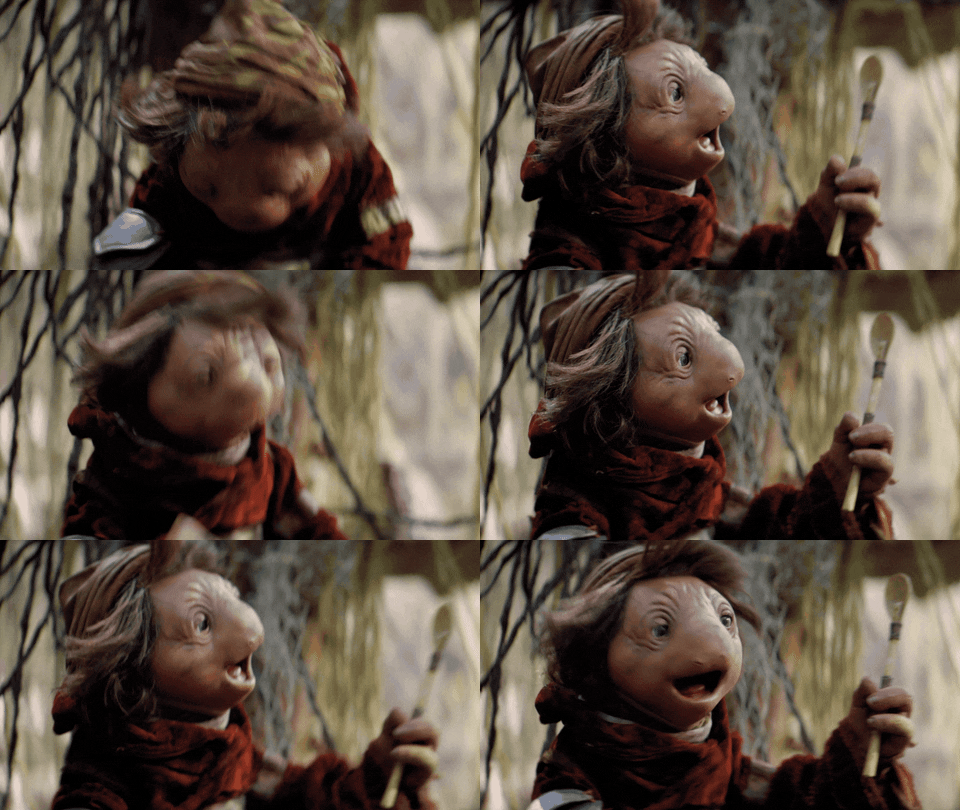
The first thing I have to say is: puppets.  The primary characters in our story are the Gelfling – partly elfin, partly equine-looking humanoids divided into seven clans across Thra.  Over the series, we meet a great number of individual personalities.  At first, you might wonder why we rarely see their legs or why dialogue seems to get acted out behind rocky outcrops that obscure their lower halves, but before long, you completely forget these things have been knocked up in a workshop (apart from, maybe, the synthetic-looking hair) and fall for their charm.  You need to believe in them for the story to work and I openly admit to being willingly convinced.


Our baddies are the Skeksis: bird-like extra-terrestrials from the man-in-a-suit school of puppetry.  They, too, blow minds with the creative lengths to which the production teams have gone to make them seem real.  Hours after watching, you’ll still hear the creepy and constant “mmmmm” of Simon Pegg’s Chamberlain as the dastardly Lords of the Crystal cross and double-cross each other.  And, on that note, the voice cast is stellar – it’s as much a who’s who of British luvvies as Harry Potter, with Helena Bonham-Carter, Lena Heady and Taron Egerton all lending credibility to the project.


The rest of Thra is populated by a menagerie of other races and creatures, from the Podlings’ comic relief to the land striders’ feasibility as a transport solution.  In fact, every frame of every scene is a feast upon which human eyes can seek months of sustenance.  And there’s me, on my new sofa, in my new flat, drinking it all in on a 55” OLED.  Telly never looked so good.  And by telly, I mean puppets.  This is fantasy beyond any normal imagination.  It helps to know the plot of the originating film, as this adds a dimension of narrative tension that certainly propelled me through each instalment desperate to find out the action.  But even without, this Netflix programme promises and delivers nearly an hour of pure, eyeball-awakening escapism with each instalment.  I’m aghast at the labour that must have gone into every single shot.  I can’t even be bothered to watch the behind-the-scenes documentary, yet these people must have laboured for years to craft everything that has gone into this show.  By way of showing gratitude, we all need to watch this.  Right now.  I promise it contains no references to me buying a flat.

Monday, 6 May 2019

Disenchantment


It’s happened again: I’ve succumbed to a cartoon on Netflix.  Though this wasn’t that recent.  A few months back, I found myself clicking play on episode after episode of Disenchantment.  But I can hear my dear reader(s) asking: why am I talking about it now?  Well, it’s vaguely linked to fantasy-based medieval kingdoms with dragons and that.  For a blog about TV shows, the fact that I’ve not really mentioned the highlight of our televisual lives so far can’t have gone unnoticed (unless you’re just dipping in for the shows you actually watch and not indulging my ramblings about things you haven’t seen – the requirement is that you read everything).  I had mighty plans for Game Of Thrones, let me tell you.  Breaking with precedent (93 posts and counting) I was going to cover each series individually, giving me the perfect excuse to re-watch all seven existing seasons (which would be my third time doing this – cool).  Alas, I am no longer in a Sky household however, so each Monday while series eight premiers is characterised by me rushing around London trying to get invited round to friends’ houses to avail myself of their Now TV or (ideally HD) Sky packages.  Today I took four different buses to Fulham and back.


I was supposed to be in my own flat by this point.  I had dreams of returning to Westeros on a massive sofa in front of a 55” telly, but I’ve not moved into My First Newbuild yet, as lawyers are not only doing nothing, they are doing it at their contractually glacial pace.  So, while I’m still in my final rental, with nothing but somebody else’s Netflix account for company while I save my final pennies for furniture, cutlery and a washing machine, I might as well cash in on Thrones fever by talking this week about something that is a bit to do with it.


Disenchantment is to fantasy what The Simpsons were to real life and what Futurama was to science fiction: animated irreverence.  Uniting all three is my hero and the owner of a surname I’m still not really sure how to pronounce: Matt Groening.  Whether he’d have wanted to or not, this man had a hand in my upbringing, such was the influence of his humour on me at an impressionable age (0 to 34).  Luckily, he didn’t have an effect on my appearance, as so many of his characters have horrendous overbites.  That said, I did require orthodontics to fix my own overbite, but this was never horrendous.  It was initially grotesque and now it is nearly moderate.


Instead of Westeros, then, we have Dreamland, a ye olde fantastical kingdom, ruled by a king in a castle.  Through the eyes of our heroine, we join a complex network of political structures.  But while treaties with neighbouring kingdoms or giants might be inconsistent and rocky at best, Princess Bean’s sure-fire ability to make a hash of most things is a very reliable way to create the perfect plot device, ensuring hilarity ensues in each episode.  Voiced by my beloved Abbi Jacobson of Broad City, Bean prefers drinking to all other princess-ly duties.  Goading her in this misdemeanour is a black cat-like demon whose possession of her spirit signifies a sort of adolescent willingness to do the wrong thing.  Funnier than him, though, is Elfo, a little green elf who is picked up into the trinity of pals along the way, and voiced by Nat Faxon of Friends From College.  As the elfin punching bag for all punchlines and physical comedy alike, Elfo’s interminable cheeriness proves a worthy foil to the constant fantasy peril in which our three leads find themselves.


Each instalment is a standalone adventure, though there does seem to be progression towards various landmarks in Bean’s life and Dreamland’s existence.  The realisation of a fantasy world varies, seeming at points incredibly rich such as when they voyage to the damp realms of Dankmire, and at other junctures shallow and only serving a purpose of pay-off for some joke or other.  Similarly, there are moments of animation touched by true artfulness, such as every establishing shot of King Zøg’s castle, and others which look like the creative direction was running out of time.


The misadventure, however, plods along from mildly amusing to oh-so-clever.  Untapped reserves for future mining spring up everywhere, from the various elves of Elfo’s home village, such as Kissy (who kisses), and the fact that Bonnie Prince Derek, Bean’s half-brother, is completely emo.  This is because the territory is fecund and therefore ripe for parody, mostly through shooting fish in a barrel rather than needing to do anything truly original.  Either way, it adds up to a pretty smart watch, leading me to the conclusion that you probably can’t go wrong with a cartoon on Netflix.  There are so many more stages in animation when compared to filming live action; I imagine that this means there are more opportunities for someone to decide the whole thing is bollocks and stop or improve the production.  A second, longer series is greenlit and the security of that acceptance should provoke bolder humour and bring the seminal achievements of Groening’s other canon within closer grasp.  It won’t fill any Game Of Thrones holes in your life, but you may well enjoy a couple of funnies while your beloved characters are brutally killed off.